



Three hours after losing to Oklahoma at the 1988 Final Four, junior Sean Elliott knocked on the hotel room door of Arizona assistant coach Kevin O’Neill.
It was midnight.
“I’m entering the NBA draft,” Elliott said.
KO asked Elliott to sit down while he phoned Lute Olson.
“When I went in to see KO, I was never more sure that I was going into the draft,” Elliott said a few days later.
And why not? Elliott was a first-team All-American who had scored 31 points against the Sooners that night. He was the Pac-10 Player of the Year, already a legend in his hometown. What else did he have to prove at Arizona?
Elliott, Olson and O’Neill talked until 3 a.m. It’s one of the best stories in the history of Arizona sports.
“I was changing my mind three or four times a week,” Elliott said.
When the broken-hearted Wildcats flew from Kansas City back to Tucson, Elliott went to Olson’s office so he could use (for free) the coach’s office phone, from which he called a half-dozen NBA front office people.
He later accompanied Olson to Los Angeles, where they watched the Lakers and talked to more NBA people. (This was before the so-called “test-the-draft-process days.”)
Finally, on April 11, 1988, nine days after the stinging loss in Kansas City, Elliott walked into a press conference at McKale Center wearing a white UA basketball T-shirt and a pair of sunglasses.
“I’m staying,” he said.
His smile lit up the room, as if someone had turned the lights to extra-bright.
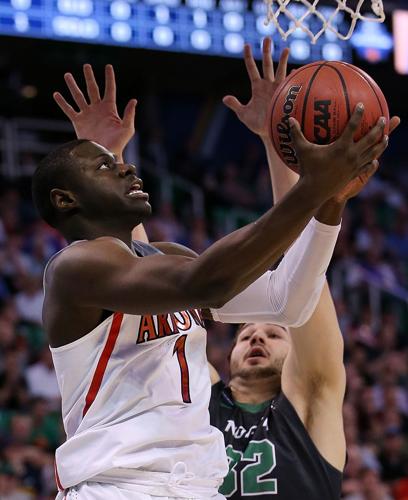
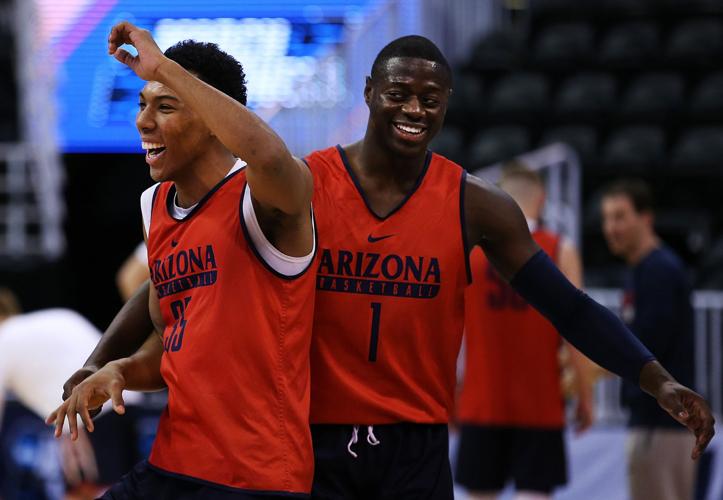
Monday afternoon, Rawle Alkins walked into a press conference at McKale Center wearing the kind of clothes you’d wear to a job interview. He, too, lit up the room with the kind of smile that suggests he is at peace with his decision to stay and play.
“It’s crazy to think that just a year ago, before my first college game, I was nervous as ever,” Alkins said. “I was scared.”
By late May, even though he has scored 2,151 fewer points than Sean Elliott, Alkins sent a scare through Tucsonans when he examined the NBA draft process.
Alkins hasn’t yet been a Pac-12 all-star — he’s wasn’t the leading scorer on his team, or even second — but college basketball has changed so extensively since 1988 that when Alkins announced he will return it had the same theatrical elements and the same it’s-a-great-day-to-live-in-Tucson reception as that April afternoon 29 years ago.
“Today, it’s easy to feel good about sitting here,” said UA coach Sean Miller. “But if Rawle had chosen to leave, I’d feel equally good for him.”
Alkins is the type of guy who can win a popularity contest after he beats you with a deep 3-pointer.
Given the surplus of talent on Miller’s 2017-18 roster, it’s possible that Alkins won’t average more than the 10 points and 28 minutes he played as a freshman. But Alkins isn’t a boxscore guy. He’s blessed with intangibles that aren’t manifest on the Kenpom.com reports.
“He’s as likeable of a teammate as we’ve ever had here,” said Miller. “His personality shines through as being genuine and honest.”
It’s just what a squad brimming with as much talent as any in UA history needs: An unselfish, prototypical glue guy.
The comparisons between Alkins and Elliott don’t go very far; Elliott was 6 inches taller and a national Player of the Year as a senior. But their reasons for returning to school have a connection.
“If I went to the Lakers now, I’d sit on the bench,” Elliott said at his 1988 press conference. “And, really, what would I do to help the Lakers? When I go to the NBA, I want to be completely ready and be an All-Star.”
Elliott made the NBA All-Star teams of 1993 and 1996.
On Monday, Alkins said NBA people told him that “once I get a reliable jump shot I’ll be virtually unstoppable.” But first he must develop that reliable jumper. Alkins pledged to be a gym rat until the Wildcats open the season in November.
There might be another part to this: Alkins’ investigation of the draft process surely included some sobering moments. Oregon’s two-time Pac-12 Player of the Year, Dillon Brooks, who averaged 22 points and shot 60 percent against Arizona in those two seasons, is not a likely first-round draft pick.
And if Brooks isn’t a first-rounder, how can the Rawle Alkins of 2017 hope to be?
Draft Express, which is as thorough as any college basketball evaluation outlet, suggests that Brooks lacks length, burst and strength, is an average ball-handler, isn’t a shot-creator, a quick jumper nor does he has the ability to defend NBA wings.
Its final assessment: “Brooks lacks elite strength and lateral quickness; he’ll have to carve out a (part-time) role in the NBA.”
Whoa. This isn’t kid’s play.
We’ll probably never know what truly spurred Alkins’ decision to return to Arizona, but it seems to be in his best interests.
Beyond Elliott, the four most notable draft-worthy Wildcats who chose to stay at McKale Center an extra year — Sean Rooks, Chris Mills, Damon Stoudamire and Michael Dickerson — combined to play 41 NBA seasons, retiring an the average age of 32, earning a combined $198 million, according to basketball-reference.com.
Rawle Alkins is 19 years old. You can find him in the gym.

