

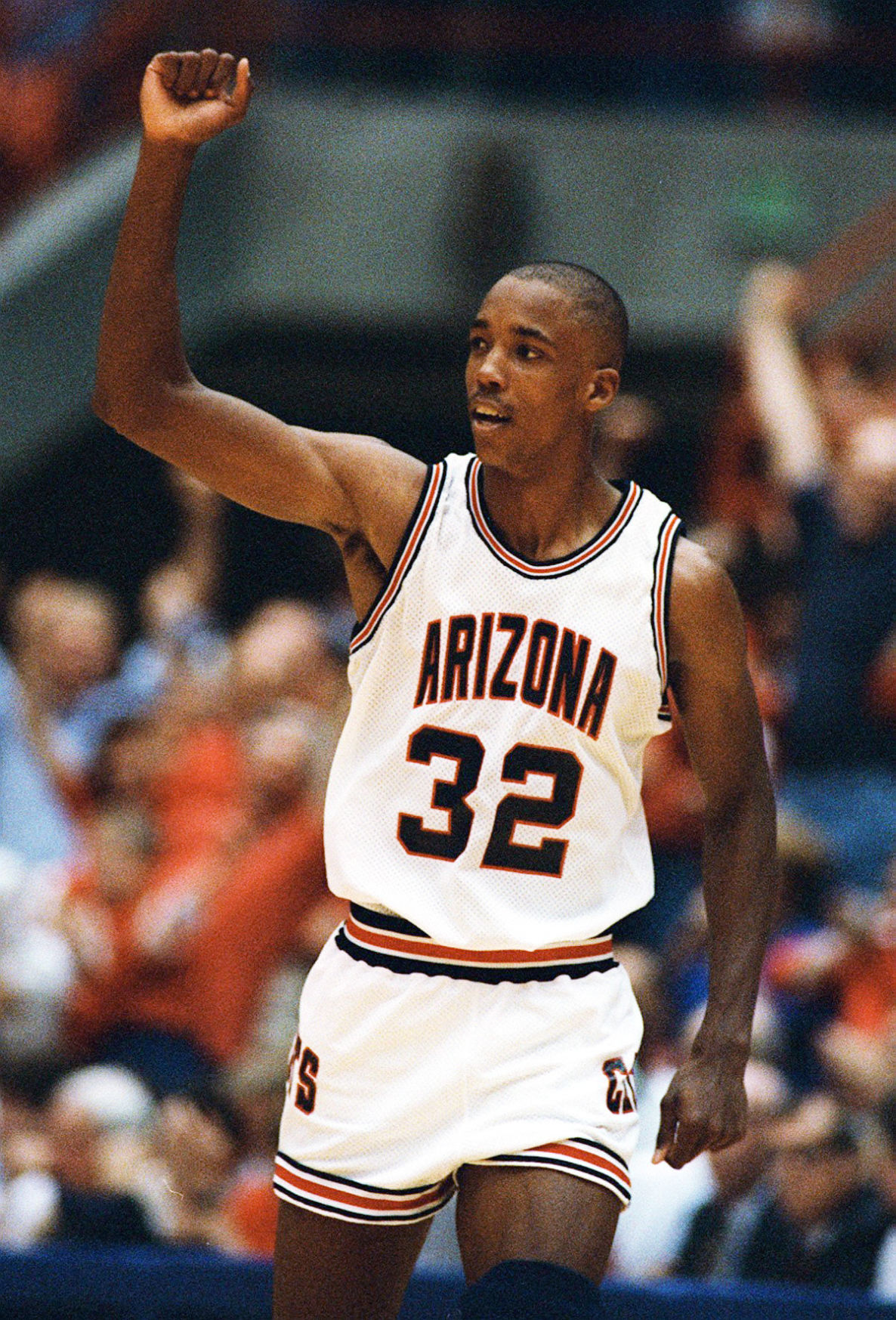

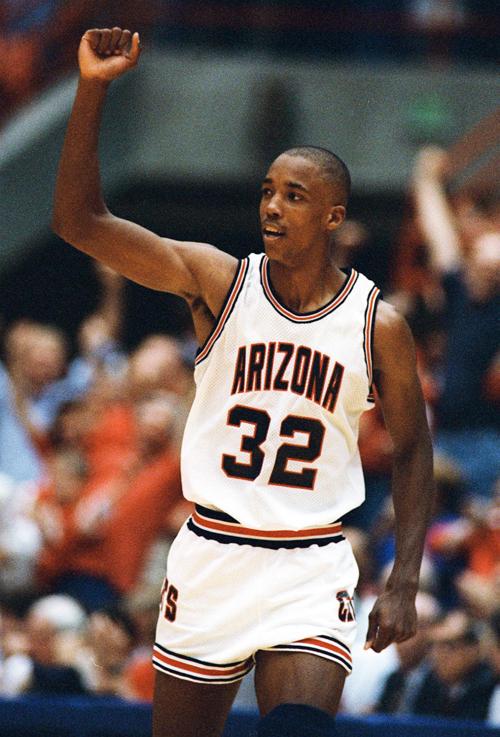
Feb. 18, 1989: Sean Elliott breaks Lew Alcindor’s Pac-10 career scoring record
Lute Olson asked his secretary for directions to Cholla High School on a Tuesday afternoon, January 31, 1984. His first Arizona basketball team was 3-12 and he was looking for players.
About all he knew of Cholla junior Sean Elliott is that he had grown from 6-feet 2 inches as a sophomore to 6-6 as a junior and that almost nobody was recruiting him, except New Mexico State and UTEP.
In those days, the Aggies and Miners had basketball programs superior to those at Arizona.
Elliott scored 22 points that night against Sunnyside and Olson knew in an instant Elliott was a worthy prospect. But how worthy? What he didn’t know was that Elliott would grow another three inches that year.
What he didn’t know was that Elliott was one of the best young athletes in Tucson history, and that he was late to make basketball his sport of choice.
Five years earlier, Elliott was the MVP of his youth soccer and football teams while at Tolson Elementary School. He was a baseball all-star and finished third in his weight class in a wrestling tournament.
Elliott was such a skilled young athlete that at 11 he flew to West Virginia to compete in an age-group competition and finished third nationally in the softball throw. His top accomplishment, however, was that he broke a state age-group record in the long jump.
A few years later, Elliott walked into the gym at Cholla and met Chargers basketball coach Mel Karrle.
“What’s your best sport?” Karrle asked the 13-year-old Elliott.
“Soccer,” he said.
When Karrle told me that story 30 years ago, he remembered that he suggested Elliott strongly consider playing basketball.
“His arms were THIS long,” Karrle said, with emphasis. “He had a basketball body. I thought, ‘let’s get this kid on the court.’ “
Once Elliott chose basketball, he played on the Chargers’ freshman team. It wasn’t promising. Cholla lost to Amphi 101-18.
But by the middle of Elliott’s junior year, word spread about the former saxophone player who had a quick first step, shooting range to 20 feet, and could beat any guard in Tucson off the dribble.
In the summer of 1984, Elliott was discovered on a national stage at the BIC All-Star Camp in Rensselaer, Indiana. Coaches from Maryland, Washington State, UTEP and ASU made contact with Elliott.
Before the camp ended, Elliott was flattened when a stray elbow smacked him in the face. UA assistant coach Ken Burmeister got to a pay phone and called Elliott’s mother, Odiemae.
“I think he’s going to be OK, but he was knocked out briefly,” Burmeister said. “We’ll check with the doctors and keep you updated.”
Odiemae Elliott was a single mother, a nurse who worked the graveyard shift at the VA Hospital, devoted to Sean’s upbringing; she spent countless hours driving Sean to all of his basketball, baseball, soccer and track practices before her shift at the VA.
Olson and his assistant coaches established a bond with Odiemae and ultimately that’s why Elliott declined a chance to take a recruiting visit to any other school. He committed to Arizona on September 4, 1984.
Four basketball seasons later, Elliott became a consensus All-American, leading Arizona to a 35-3 record, the nation’s No. 1 ranking and the Final Four. His best was yet to come.
On a Saturday morning, February 18, 1989, Elliott awoke early for a 4 p.m., McKale Center showdown against UCLA. He wanted to do something special for the nationally-televised game against the Bruins, so he shaved his head.
When the new-look Elliott walked onto the court for pre-game introductions, the crowd was unusually loud. It seemed to sense something special was at hand; everyone knew Elliott needed 35 points to break Lew Alcindor’s Pac-10 career record of 2,326 points.
Elliott was superb. He made six 3-pointers. He grabbed 11 rebounds. He had 20 points at half. And with 7:10 remaining, fouled while going to the basketball, all 13,621 in the crowd knew the score. Elliott had 33 points.
He swished both free throws to break Alcindor’s record. Arizona won 102-64, and the Wildcats rushed the court to embrace the former saxophone player from Cholla High School.
“I couldn’t keep from smiling,” Elliott said.
UCLA coach Jim Harrick put the day in perspective. “How many guys have you seen better than he is?” Harrick told me in the Bruins locker room. “Really? How many?”
At Arizona? None.
Where is he now? At 48, the 1989 NCAA Player of the Year is the radio/TV analyst for the San Antonio Spurs, and frequently works Pac-12 games for Fox Sports 1.
How he did it: “All during the game (against UCLA), coach kept yelling ‘clear, clear’ every time down court,” former UA forward Jud Buechler said. “It meant we should get out of Sean’s way and let him work; you could see the smile on Sean’s face. It was like heaven for him.
“I got a little teary-eyed. It’s something I’ll never forget.”

