



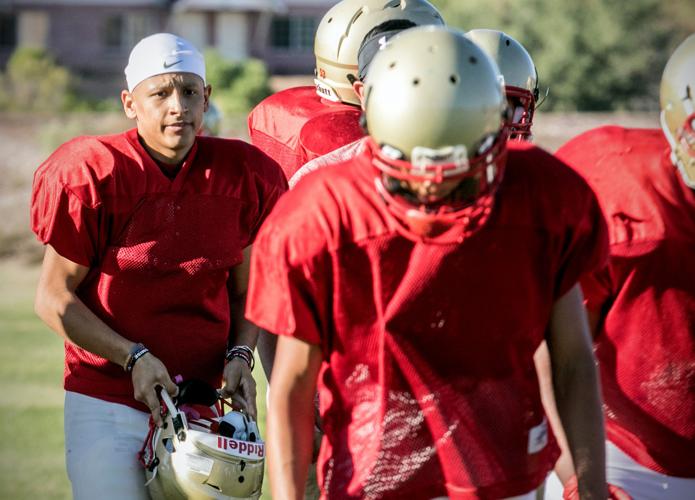
RIO RICO — Ricky Perez stood on the sideline, anxious, adrenaline pumping, biting his nails.
Rio Rico coach Zach Davila called his number and sent him into the game at running back. The Hawks were at the 1-yard line. The play call was simple — Rio 6, a rush straight up the middle. Perez caught the snap and dove across the goal line.
Touchdown.
Perez began to cry before the crowd roared. His teammates and coaches hugged him.
The game was already out of hand, and Rio Rico eventually lost to Rincon/University 49-14. But for Perez, it may have been the biggest win of his life. The Rio Rico standout was diagnosed with testicular cancer over the summer. A week before crossing the goal line, he finished his final round of chemotherapy.
“In that moment,” he said, “it was like: I finally beat cancer.”
•••
Perez began to feel discomfort in his groin during Rio Rico’s offseason workouts in May. At first, Perez thought it was a hernia; his parents believed improper weight room technique was to blame. That couldn’t be, Perez said: He always did things properly in the gym.
When the pain became too much to bear, Perez saw a doctor.
That doctor immediately spotted the tumor, and directed Perez and his family to a Tucson hospital for blood work.
Upon hearing the diagnosis, Perez cried. Then he spoke.
“Can I play football still?” Perez wondered.
His mother, Blanca, called it a “heart-breaking moment” when the doctors told him about surgery, the chemotherapy and how it would keep him from practicing and playing football.
Throughout the process, even on the darkest days when he was bedridden and couldn’t move, when he had a fever or threw up or cried through the night, football and the Rio Rico team was constantly on his mind. It kept him going after he underwent surgery to remove his testicle, and when tests revealed the tumors in his lymph nodes and lungs that necessitated four sessions of chemotherapy.
The first session had him bedridden for three weeks. He lost 20 pounds.
On his worst nights, Perez and his mother slept in the same room.
“Seeing him going through all those treatments and sometimes him breaking down and saying I don’t want to do this anymore and trying to find the words to give him strength to keep him going … it’s real tough,” she said. “I told him, ‘Look, if I could be in your place and I could take the treatment but the good part of it will go to your body, trust me I would.’ God picks his warriors, and he picked a tough one.”
•••
Perez’s mother was nervous when he returned Friday for his first game, but she’s always nervous when he plays football.
She doesn’t particularly understand football, the constant hitting, tackling and falling under a pile of other players.
But she knows what football means to her son.
Since May, when this whole process started, Perez didn’t smile much.
At chemotherapy sessions, he asked for a private room because he couldn’t stand watching all the kids, some as young as 2 years old, undergoing cancer treatment.
He was mostly silent.
“When I would go to chemo, I would be dull,” Perez said. “I wouldn’t talk to anybody because I just didn’t want to be there.”
Two weeks ago, Perez received his final treatment. A couple days later, he was fully cleared for contact, to practice with his team and to play under the lights.
“Going through the treatments, he had the saddest face, this hurting face,” his mother said, then paused to catch her breath. “When he got that smile back and those sparkly eyes, it meant the world to me. Once they told him he could play, that was the best smile.”
•••
Not long after his diagnosis and subsequent surgery, Perez and a group of his closest teammates went out for a fishing trip at Patagonia Lake in Santa Cruz. After a day of fishing, Perez still hadn’t said anything about the cancer, or the surgery.
They sat down after getting back, hanging out, cracking jokes, when Perez dropped the bombshell.
“He was just like: guys, I have to tell you something but I don’t want you to tell anybody because I don’t want anyone to feel bad for me,’” said offensive lineman Ruben Fuentes, a friend and teammate since middle school. “Then he said: ‘I have cancer.’”
They were taken aback. So was his coach, only in his second year at Rio Rico.
“The first thing I wanted to do was reassure him that we were going to help him through this,” Davila said.
Perez’s teammates visited him at least once a week, and he returned the favor often. Perez continued to practice with the team, at least during noncontact days. He rarely, if ever, missed a workout.
“When he couldn’t because he was weak from the chemo, he was coaching up the linemen, the running backs, receivers, quarterbacks, still having that imprint of being a leader,” Davila said.
Weak?
At a cookout with his teammates, this is a kid that played pick-up basketball following a chemotherapy session with a port still in his chest.
“Whenever he would jump, he’d hold it,” Fuentes said. “Nothing stops him.”
•••
Before the cancer diagnosis, Perez was viewed as one of Southern Arizona’s top running backs. He ran for 1,235 yards and 13 touchdowns in nine games, and went for 100 yards or more eight times.
The University of San Diego and Northern Arizona showed interest. His coaches couldn’t say enough nice things about him. Perez was a workhorse on the field,. never afraid to get hit. In the classroom, he carried a 3.8 grade point average.
“He was the type of kid I wanted to see how many times I could give him the ball because I knew his level of play raises everybody else’s,” Davila said.
Added Fuentes: “It was like we had an All-Star on our team.”
Rio Rico (1-4) has missed Perez on the field. He was limited to eight plays last week, and will see as many as 15 in Friday night’s rivalry game with Nogales. Perez could also see some time at quarterback. Davila hopes to have him on a full workload before the end of the season.
Regardless of how much (or how well) he plays, Perez’s mere presence is making an impact.
Last week, he had three receptions for 70 yards, with two carries for 7 yards and the touchdown. When he was in the game, the offense was at its best.
“On those eight snaps, we were a totally different team,” Davila said. “The line blocked better, the receivers ran better routes. The plays he was in there, it brought everybody’s level up.”
Added Fuentes: “It felt like we had a bonus: a legendary player coming back on the field.”
•••
Perez still misses the little things. He wishes he had more game-tape to send to coaches. He wants to play more than eight snaps and more than 15.
Perez is being home-schooled as he continues to recover. He misses setting his alarm, waking up in the morning, and rushing to get ready and make it to school on time. He misses class, and lunch with his friends.
“It just made me more grateful,” Perez said. “The little things in life are the things you miss the most.”
Perez will undergo a CT scan next week to see if the chemotherapy worked. Doctors will draw his blood every month or two indefinitely.
Perez is not 100 percent healthy yet, and his mother constantly worries about a relapse. She still cries a lot, though she says they’re are happy tears.
“They’ll be happier when they give us the results,” Perez said.
For now, the memories of a late-game touchdown against Rincon are enough.
“I’m not going to remember the loss 20 years from now,” Davila said. “I’m going to remember him scoring and the moment that he came back and gave a hug and just his smiling face after the game.”
Perez wants to smile — and score — some more.
“I was in shape, I was just ready. I was so hyped for this season,” Perez said. “My expectations for myself and for my teammates were high, but I guess things happen for a reason. Now they’ve seen what I’m going through, and I’m still here.”

