

Craig Cunningham does not want to be your mascot.
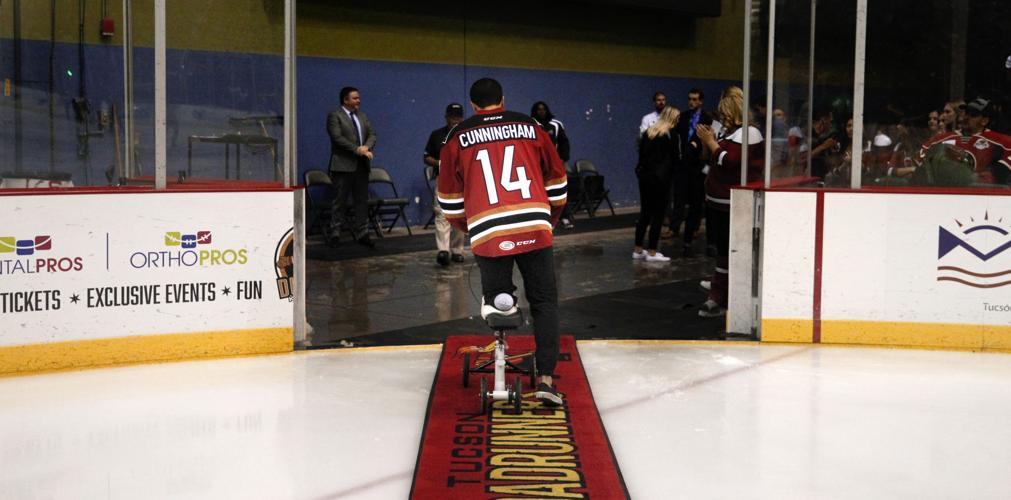
On the night that the Tucson Roadrunners retire his jersey, an honor for a player whose career was ended far too soon, Cunningham looks uncomfortable in the spotlight.
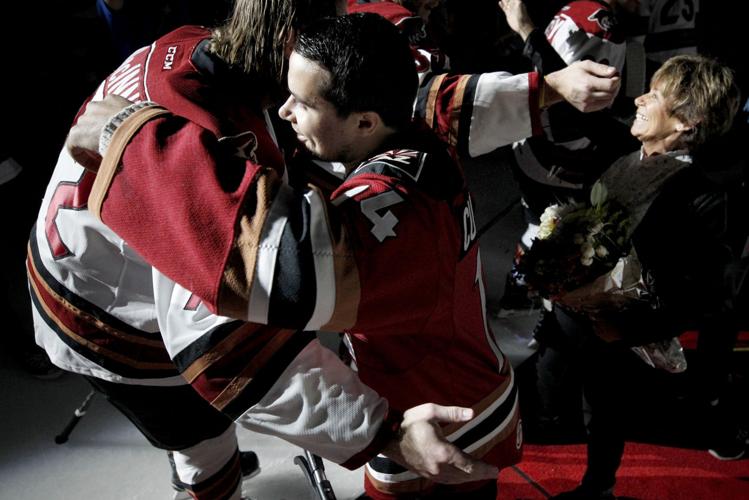
A reel of his highlights shows from the video board. Cunningham bites his cheek as he watches. His mother, Heather, is handed a bouquet of flowers. The No. 14 jersey is unveiled. Cunningham waves once.
The club presents to him a seven-day vacation to Hawaii, an engraved watch and a framed display of his jersey, a photo and the puck that he used to score the first goal in franchise history. The announcer says, “You will forever be a part of our team and community.”
A humbled Cunningham looks down.
One year ago Sunday, Cunningham collapsed to the ice of Tucson Arena, felled by sudden cardiac arrest and shocking the crowd and his teammates.
Heroic measures by a renowned team of doctors saved his life, and his recovery touched millions.
In the process, he’s been pulled in all directions, poked and prodded.
But he’s not about to throw on a giant left ventricle costume and become the face of sudden cardiac arrest. That’s not in his nature. That’s not who he is.
He wants to be so much more.
• • •
Dr. Zain Khalpey remembers the phone call, which came last Christmas Eve. By then, the cardiac surgeon knew Cunningham’s voice, and he knew Cunningham’s soul. Khalpey quite literally had held Cunningham’s heart in his hands. He knew serious when he heard it.
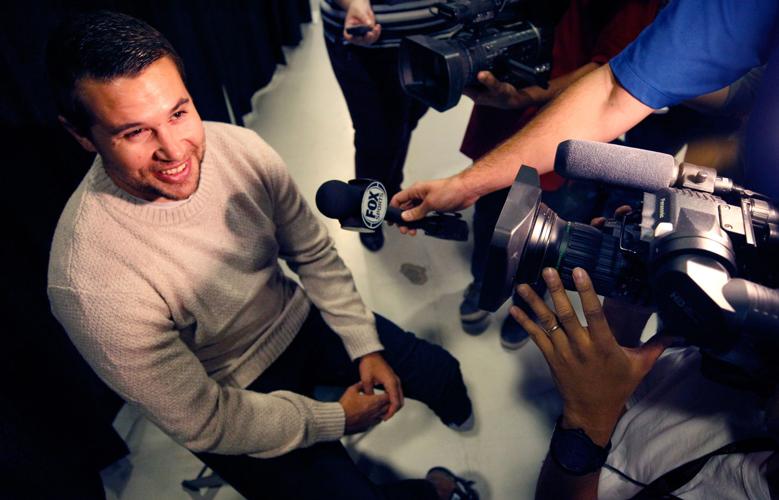
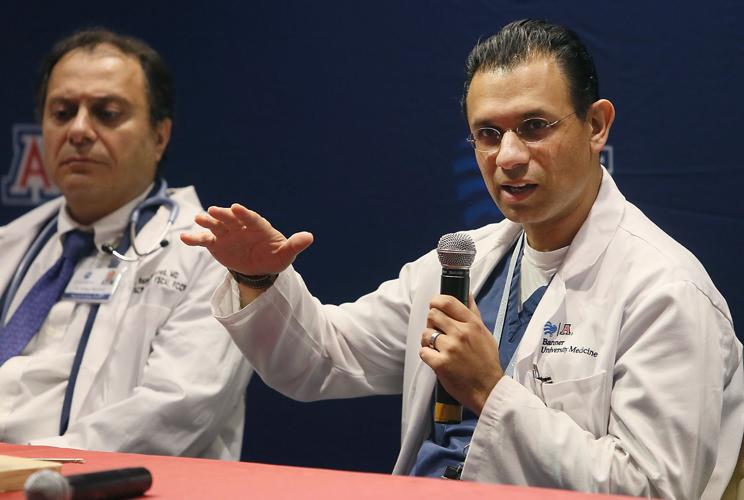
Just a few days after a well-attended press conference at Banner-University Medical Center Tucson, when he was paraded in front of a horde of media and pronounced a success story, Cunningham’s was in rough shape.
He had been looking forward to going home for Christmas, but Khalpey was hesitant. Cunningham was in a lot of pain, and the bottom of his leg was becoming, as Khalpey describes it, “very woody and heavy.”
The two talked Dec. 23.
“I spent an hour in his room, and he had said he didn’t want to do it on Christmas Eve, he was very matter-of-fact about that,” Khalpey said. “But it was like clarity had descended upon him.”
Khalpey told him to sleep on it, and they’d talk the next day.
The call came in at 7 a.m.
“(Bleep) it,” Cunningham told Khalpey, “Just cut the damn thing off. I have a lot more to do here.”
At 11 a.m., an orthopedic surgeon amputated the bottom half of Cunningham’s left leg using local anesthesia because Khalpey did not want to risk Cunningham’s heart. Khalpey was with him in the room.
“Once you have a patient like this, you’re connected for life,” Khalpey said. “It’s never just a pat on the back.”
The doctor and patient stayed in contact over the coming days and weeks, even as Khalpey left for a trip to Dubai.
“I remember I woke up, 3 a.m. I’m in Dubai, and I had just got a text from a nurse who was looking after Craig,” Khalpey said.
“They sent me a video of him on his crutches, walking. There was just a smile of resilience that colored the whole video for me. I can’t tell you how many times I’ve watched that video. Man, this guy is inspiring to so many people, including me.”
• • •
Cunningham checked in Saturday from San Antonio, where he is searching for the next him.
In May, the Coyotes brought him aboard as a pro scout. He covers the Southeast, parts of the Midwest, Colorado and Texas. Now he’s on the tail end of a 10-day road trip.
Cunningham knows what he’s looking for in his new job.
“For me, to vouch for a guy, I need to see character and work ethic and love for the game,” he said. “You can’t teach those things. You can help someone skate better, shoot better — but you can’t change those three things. You can’t get a 25-year old to change that way. What comes from the inside, you can’t change.”
He means heart.
And if Khalpey saved his life, the Coyotes saved his spirit.
“This is giving me a life I never would’ve had,” Cunningham said. “I missed hockey a lot, not really feeling like I had a purpose or an impact in the sport anymore. To get involved with a young group in the front office who is hungry, to feel like I can make an impact on the sport again, is awesome.”
But this is not a Hallmark Movie of the Week. Let’s be clear about that. Life since the — accident? incident? tragedy? disaster? — has not been simple.
Cunningham has undergone four surgeries on his leg. He’s been fitted and refitted for prostheses multiple times. Walking, as a result, has been a struggle.
“I can’t even describe how frustrating it’s been; just to get up to go to the bathroom in the middle of the night has become a challenge,” he said. “I’ve passed the frustration phase. Now I’m adjusting to it, seeing different ways to get around. When you can’t just get up like you’re used to … that’s hard.”
Cunningham has been living on his own for about five months now. He’s had to learn, as he calls them, some tricks of the trade. Before, that used to mean sliding a puck around a defender’s back.
Now?
“Getting groceries into the house, that’s a challenge,” he said.
In the store, he’s lucky. He can just hang bags off the handle bars of his scooter, though, he warns, “if it gets too heavy, it’s off balance.”
Getting the groceries from the car to the house is difficult. He’s makes two trips now, sometimes three. These are the little things nobody warns you about. He must take ramps everywhere he goes now. No steps.
And then there is the panic that sets in when he’s alone and it’s dark.
“There are some things deep down,” he said. “Anxiety here or there. I feel my heart start to race and I lay in bed, and I can literally feel every beat my heart makes. I’m addicted to checking my heart rate.”
The fear lingers.
Cunningham has undergone more than four dozen heart tests, and they have revealed no structural abnormalities.
“My heart,” he says, “looks like everyone else’s.
He is on what he calls “tons of medication” to prevent a recurrence, and he’s had an internal defibrillator implanted should it happen. That provides little reassurance.
“Deep down, you think there’s something wrong,” Cunningham said. “You don’t just go into cardiac arrest for no reason. There’s definitely something going on in there.”
Asked if he’s turned to a higher power because of this life-altering happenstance, Cunningham balks. He is not super-religious, he says. He is, however, increasingly contemplative.
“I thought my whole life was to be a hockey player. That’s what I could do, that’s what I loved. It’s who I am. Who I was,” he said.
“This has made me appreciate my family, everyone who has surrounded me, made me appreciate hockey, all the people I’ve come across. …
“This pushed me back into reality. We’re not superhuman people. I was lucky enough to make it through, and I’ve been put under the microscope, and I think it’s my duty to push this subject going forward.”
Khalpey wonders.
“Is it kismet? Or is it divine intervention?,” he said.
“I believe in a human purpose, how beautiful life is, and how things can happen to you. My wife tries to tell me that if you crush a flower, you can get perfume. If you press an olive, you get olive oil. Out of these extremes of human interaction, the darkness of things, there is a higher purpose.
“All I know is what happened to Craig has changed me, so that we can change a field.”
Cunningham has just formed the All Heart Foundation, and is in the process of applying for 501(c)(3) status. He and Khalpey want to revolutionize heart screening in athletics and, they hope, the world.
They also want to give automated external defibrillators (AEDs) to those in need.
Sudden cardiac arrest is the third-highest cause of death in the United States, with approximately 350,000 victims every year. Nine out of 10 die, according to the Sudden Cardiac Arrest Foundation.
Cunningham, who required 83 minutes of life-saving extreme CPR, beats even longer odds.
Cunningham isn’t the first hockey player affected.
Detroit Red Wings defenseman Jiri Fischer was saved by the team physician after collapsing on the ice in 2005. Almost 50 years ago, Viktor Blinov of the Soviet Hockey League’s HC Spartak Moscow died at 22 after suffering a SCA on the ice during practice. In 1998, former Vancouver Canucks and Quebec Nordiques center Stephane Morin died while playing in a game for the Berlin Capitals, collapsing on the bench in the second period.
“There are 1,000 people dying every day,” Khalpey said. “This didn’t happen all of a sudden. There must be a buildup, which means there must be some biomarkers. I know that I’m going to be shot down by the giants in the field. Somebody has to push forward.
“We’re going to do that.”
Khalpey and Cunningham are hoping to convince the sports world of the need for dynamic EKG screening — essentially, EKG screening while under stress.
The doctor believes the heart can fool you when at rest, but get an athlete going — say, after pregame warmups — and the stress may reveal specific weaknesses or susceptibilities.
“When Craig had a normal EKG, his heart was beating with the same digital fingerprint it normally does,” Khalpey said. “Adrenaline must have acted as a trigger. If you stress the heart, you’re able to unmask those abnormal rhythms, and by dynamic screening, we’re only using a better magnifying glass.
“If we can’t uncover this at molecular level, we will not be any smarter for it. More people would die. And that would just piss me off.”
Khalpey and Cunningham convinced the Arizona Coyotes, the Roadrunners’ parent club, to deploy the dynamic EKGs. Meetings with the NHL’s head doctors were less fruitful: the league asked for more science, more data.
Khalpey brings up the movie, “Concussion,” starring Will Smith as Dr. Bennet Omalu, who discovered chronic traumatic encephalopathy (CTE) in football players and faced overwhelming resistance from the NFL when attempting to present his studies.
“It feels like were talking about concussions, except with the heart,” he said.
Khalpey understands the political and legal ramifications that may be at play, and, he says, sometimes “We’re trying to push against this brick wall, and we’re really moving it millimeter by millimeter.”
Khalpey will screen as many as 36,000 marines after speaking to an officer whose son died “on a 4-mile run at the 3-mile mark.” He has also had preliminary discussions with Arizona athletic director Dave Heeke, who appeared interested in exploring advanced screening for the Wildcats.
Khalpey is also optimistic about a new heart-monitoring smartphone app developed by his wife, Amina Hamzaoui.
“We’re just simmering,” Khalpey said. “We haven’t reached a boiling point because we haven’t got the infrastructure.”
The funny thing is, this isn’t even what Khalpey does. He is a heart surgeon by trade. He’s used to fixing hearts. This will reduce his patient load.
“It’s the antithesis of why I became a physician,” he said. “I do surgery. But I’m resolutely focused in this new dimension. We’re extracting goodness from each other. We’re like a key and a lock, we can’t open the door if it’s not the two of us.
His partner in all this is champing at the bit. He knows what can come of this, with his heart and the doctor’s brain.
“I never was going to be Mario Lemieux or Sidney Crosby, guys with significant impacts on the game, with millions and millions of fans,” said Cunningham, who played 63 games in the NHL and likely would have played more for the Coyotes last season.
“Maybe now that I’m in this role here, working with an incredible doctor — deep down, I know that if we get this going, I’ll be able to make a bigger difference.
“That’s the thing. You want to have a purpose.”
• • •
Cunningham stands in the bowels of Tucson Arena.
He is, for a moment, wistful. A procession of fans eagerly approaches, careful not to bother Cunningham on his big night but equally excited to share their stories.
A year ago, it was his story that touched them.
Cunningham, then 26, collapsed onto the ice just prior to the opening faceoff against the Manitoba Moose.
In a stroke of fortune that may just be the reason he’s here today, a group of local firefighters who performed the national anthem began to administer CPR.
Cunningham was rushed to Carondelet St. Mary’s hospital, where he was kept alive by doctors George Haloftis and Reza Movahed. The doctors phoned Khalpey, who rushed over from Banner-University Medical Center with an ECMO machine. The artificial heart-and-lung device was used to save Cunningham’s life.
It was, for all involved, a harrowing situation.
“Watching that happen was mind-blowing, devastating, frightening,” Roadrunners fan Amy Hornfeck said on the night of Cunningham’s jersey retirement.
“We were up as a family the whole night. My girls slept in bed with me that night. We followed along all night, for me, as a mom, I knew his mom was here, and I felt terrible for her. And I worked in medicine, and I knew it wasn’t a seizure. I knew it was some sort of cardiac event, and I was terrified for him.”
Since that night, the Hornfecks — Amy and her husband Mike and their two girls, Samantha, 12, and Maggie, 10 — have become intimately connected to the Roadrunners.
Amy and the girls baked bread and pies for the team. Mike, a videographer, helped film Cunningham’s rehabilitation, including when Cunningham tried on his prosthetic leg for the first time. The video was used in an ESPN presentation called “Life or Limb.”
The Hornfecks approached Cunningham cautiously, hoping not to bother him. He beamed when he saw them.
“I do think he’s going to make a huge impact,” Amy Hornfeck said.
“I know he’s trying to do the heart-screening, and I know he’s an inspiration to everybody. He’s so strong. What he’s done for himself is unreal. His gracious, humble, charismatic way, that’s who is to his core. Before any of this, he was solid, full of character, full of grit. My god, what a guy, right?”
Mike Hornfeck marveled at how Cunningham has embraced his new lift.
“In his heart, in our eyes, he’ll always be a hockey player,” Hornfeck said. “He’s a champion, he really is.”
Look, Cunningham is not your mascot.
He is already so much more.

