


National Baseball Card Day is here! Now, that might not mean much for most people. But for my 16-year-old son and me, it is our own Christmas in August.
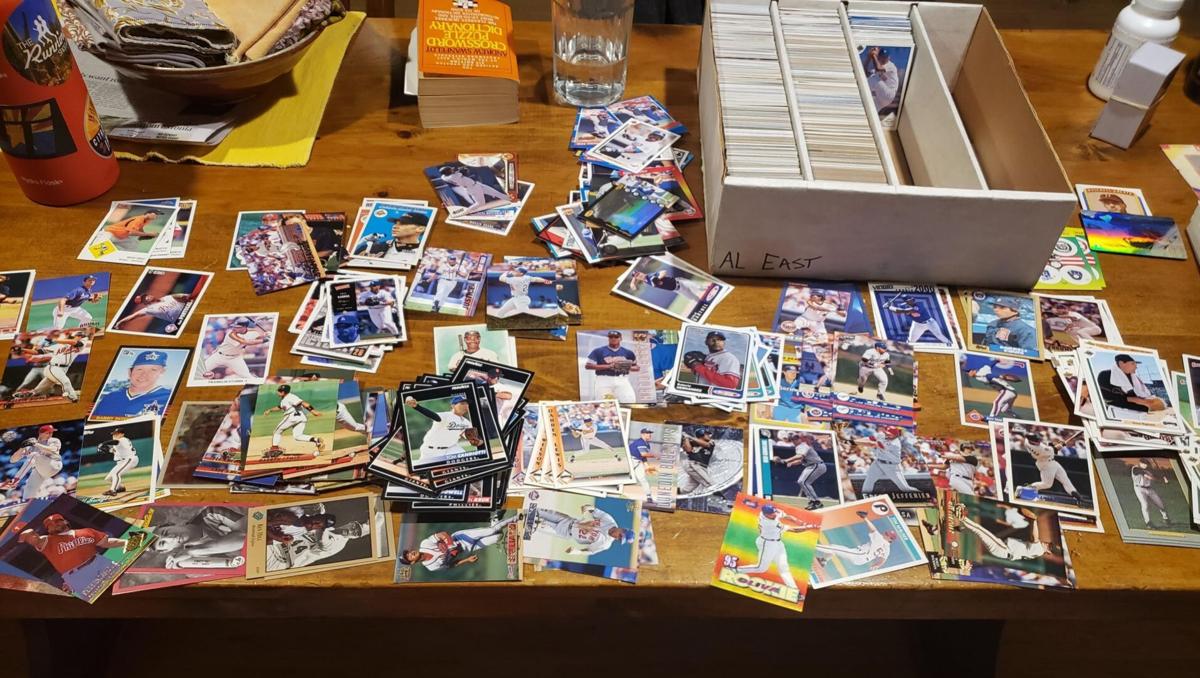
Cardboard boxes, plastic bins and frames are scattered throughout our living room. Binders render one end of the couch unusable. Stacks of baseball cards cover the dining room table. Amidst this chaos is supreme order. Each stack has been meticulously organized by brand, year and the player’s Hall of Fame status.
These cards, while always present in our home, have taken on a new significance.
Instead of spending our spring and summer going to ballgames and absorbing player stats, Mac and I have turned to baseball cards for our fix. Through the kindness of friends — and the power of eBay — cards have been steadily filling our house since the COVID-19 shutdown began.
As a kid, baseball cards were much more than tiny cardboard likenesses of my favorite players for me. I grew up on an Army base in West Germany during the height of the Cold War. Our one television station was filled with game shows, soap operas and “Starsky and Hutch” reruns.
Live sports were not common. The only time I might see actual film of games was when short NFL highlights were shown before weekly movies at the base theater. In fact, I didn’t see a live baseball game on television until after my eighth birthday. All of my sports news came from outdated library books and the daily edition of the Stars and Stripes newspaper.
As I read the paper, names and numbers filled my head. Like any good fan, I needed to pick a team to follow. Having been born in a Navy hospital on Lake Michigan, I chose to become a fan of the team closest to my birthplace. The Chicago Cubs, in hindsight, might not have been the best team to follow. Still, I didn’t know much about my “hometown” team until one day my dad brought home a couple of packs of baseball cards. As I ripped open each package, the players from the newspaper jumped out at me. My 5-year-old prayers were answered. That first pack contained not only a Chicago Cub (Pete LaCock) but the Cubs’ team card as well. That’s all it took. I was hooked.
Those same cards now reside in Mac’s collection.
Just like I was in Germany, my son is presently feeling separated from the sport he loves. Desperate for some connection when baseball games started being canceled, Mac turned to his baseball card collection. He spent hours sorting and resorting his cards into well-organized binders.
One day, we went online to buy a collection of random cards that promised players from at least five different decades. Before long, hundreds of cards covered the dining room table as Mac began sifting through them. He found a card for a player who lives in Tucson. Turns out it was Eddie Leon, a former Tucson High and UA player. I had heard about him, but didn’t know much. (Turns out he was drafted out of college in the first-ever MLB draft in 1965.)
After pulling the Eddie Leon card, we did some digging to find out how many UA baseball players have actually made it to the big leagues. According to a list we found from the UA, there have been 83 Wildcats to make it to The Show.
When I was younger and Arizona basketball began its rise, I would collect a card — usually autographed — for each Cat who was taken in the NBA draft.
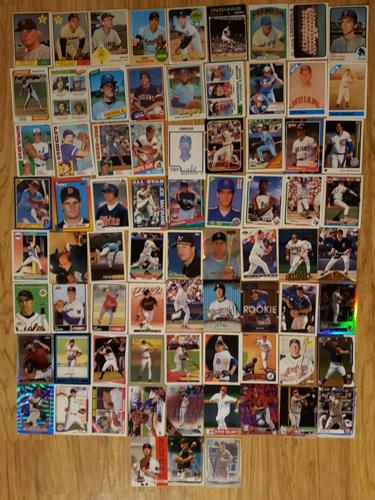
This got us thinking: How many cards could we find of the 83 former Wildcats to have appeared in the major leagues? Looking at the list, it appeared a bit daunting. Sure, getting a Trevor Hoffman or Terry Francona card would be easy. But we also had players dating back to the 1930s or guys who had just a quick cup of Sanka in the majors in 1966.
We found our mission. Mac and I fired up the computer and went through the list alphabetically, from Brian Anderson to Alan Zinter. We discovered that the baseball cards we know today really didn’t come into existence until 1951. This would make finding some earlier players more difficult. Luckily we found an autographed 3x5 card with Hal Warnock’s signature from 1938. We weren’t so lucky with Arizona’s first major-leaguer, Hank Leiber.
Player by player, we went through the list, searching preferably for each player’s rookie card. Dave Baldwin of the Washington Senators? Check. Joe Magrane of the St. Louis Cardinals? Check. Scott Kingery of the Philadelphia Phillies? Check.

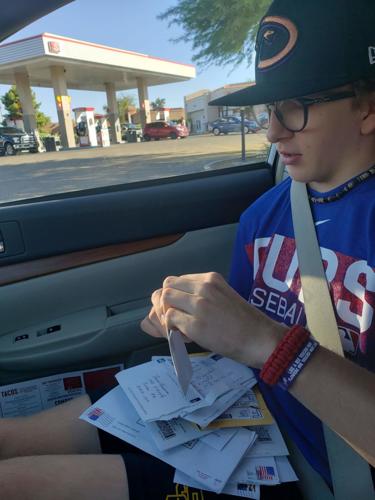
Mac Tronsdal, 16, opens up the latest tiny package of baseball cards purchased via email.
Every card brings us a new insight. Mac found a JT Snow where he is wearing the number 60, a jersey Snow wore for only seven games as a Yankee call-up in 1992. Then he discovered a 1980 Montreal Expos prospect card featuring both Terry Francona and his UA teammate, friend and future bench coach, Brad Mills.
And, of course, Kenny Lofton’s rookie card for the Houston Astros mentioned his UA Basketball career.
The cards were ordered from various card stores across the country. About a week later, the cards started coming … and coming. Our mailbox filled with small envelopes holding each of our finds. It was like Christmas morning as we opened 70 envelopes not knowing who we would find inside.
We located 77 of the 83 Wildcats to play in the big leagues. We were still missing six. One of the missing players, Kevin Ginkel, was sure to be included in a Topps set later in the summer since he was now an Arizona Diamondbacks reliever. (His card was just recently found in a new Topps package.)
That left us five players to locate: Hank Leiber (1930), Walt Kellner (1949), Bart Zeller (1961), Steve Barber (1967) and Jim Scranton (1979).

Tom and Mac Tronsdal are collecting baseball cards of Arizona Wildcats who made it to the big leagues. They need five more.
Our quest to complete the collection led us to the UA to see if we could find the missing players or their family. Despite the UA’s assistance, we weren’t able to reach anyone. (If anyone knows these men or their families, please let me know. Mac and I would love to reach out to these former UA greats.)
As the summer rolled on, more cards stacked up throughout the house. There were cards donated by friends cleaning out their closets. Some bought on trips to our local card store, Showtime Cards. And new projects started by Mac. My ever-patient wife, Amanda, has learned how to move through these stacks without disrupting their order.
The cards have kept us immersed in baseball with the absence of box scores or highlight shows.
And even though baseball has started again, it honestly doesn’t feel quite the same. Sure, our family watches every night, but the games haven’t connected with us the way they usually do. Whether it’s the empty ballparks or the specter of a virus hanging over us, the joy has been missing so far. Even if that joy is diminished right now, all we need to do is turn to the binders littering Mac’s bedroom floor to regain that missing connection. Decades of players and statistics jump out to remind us of the game we love.
Right now, we don’t have much time to dwell on what we’re missing. It’s National Baseball Card Day. And it might just be the day we find our missing cards.
The Cleveland Indians visited Tucson for spring training each year from 1947 to 1993.
The highest paid player on every MLB team
Arizona Diamondbacks: Mike Leake, $15,000,000
Updated
Seattle Mariners starting pitcher Mike Leake throws against the San Francisco Giants at Safeco Field in Seattle on Wednesday, July 25, 2018. The Mariners won, 3-2. (Bettina Hansen/Seattle Times/TNS)
Atlanta Braves: Freddie Freeman, $22,359,375
Updated
Atlanta Braves first baseman Freddie Freeman takes his first swings of spring training after arriving for camp on Sunday, Feb. 16, 2020, in North Port, Fla. (Curtis Compton/Atlanta Journal-Constitution/TNS)
Baltimore Orioles: Chris Davis, $21,065,362
Updated
Baltimore Orioles' Chris Davis fields ground balls at first base during practice on Feb. 17, 2020 at the Ed Smith Stadium complex in Sarasota, Fla. (Lloyd Fox/The Baltimore Sun/TNS)
Boston Red Sox: Chris Sale, $24,173,150
Updated
Boston Red Sox starting pitcher Chris Sale works against the Tampa Bay Rays at Tropicana Field in St. Petersburg, Fla., on July 23, 2019. (Dirk Shadd/Tampa Bay Times/TNS)
Chicago Cubs: Yu Darvish, $22,000,000
Updated
Cubs starting pitcher Yu Darvish delivers to the\u00a0plate against the Pirates on April 10, 2019,\u00a0at Wrigley Field.
Chicago White Sox: Yasmani Grandal, $18,250,000
Updated
New catcher Yasmani Grandal in action at practice on Feb. 20, 2020.
Cincinnati Reds: Joey Votto, $25,000,000
Updated
Cincinnati Reds first baseman Joey Votto tosses the ball to the pitcher covering first to retire the St. Louis Cardinals' Randal Grichuk in the eighth inning on Friday, April 7, 2017, at Busch Stadium in St. Louis. The Reds won, 2-0. (Chris Lee/St. Louis Post-Dispatch/TNS)
Cleveland Indians: Carlos Santana, $20,833,333
Updated
Cleveland Indians first baseman Carlos Santana hits a solo home run against the Boston Red Sox in the fourth inning. \rJoshua Gunter, cleveland.com Cleveland Indians first baseman Carlos Santana hits a solo home run against the Boston Red Sox in the fourth inning. \rJoshua Gunter, cleveland.com
Colorado Rockies: Nolan Arenado, $35,000,000
Updated
Colorado Rockies third baseman Nolan Arenado (28) slides safety into third base during the fourth inning of an Opening Day baseball game against the Miami Marlins at Marlins Park in Miami, Thursday, March 28, 2019. (David Santiago/Miami Herald/TNS)
Detroit Tigers: Miguel Cabrera, $30,000,000
Updated
Detroit Tigers first baseman Miguel Cabrera (24) looks to the Pittsburgh Pirates dugout after striking out during their MLB game at Comerica Park in Detroit, on Tuesday, April 16, 2019.
Houston Astros: Justin Verlander, $33,000,000
Updated
Justin Verlander says a past beef with a reporter while he played for the Tigers led to the Astros delaying that reporter's access to the postgame locker room this week.
Kansas City Royals: Ian Kennedy, $16,500,000
Updated
Closer Ian Kennedy of the Kansas City Royals pitches in the ninth inning against the Oakland Athletics at Kauffman Stadium in Kansas City, Mo., on Wednesday, Aug. 28, 2019. The Royals won, 6-4. (Ed Zurga/Getty Images/TNS) **FOR USE WITH THIS STORY ONLY**
Los Angeles Angels: Mike Trout, $38,500,000
Updated
Angels' Mike Trout rounds second base after hitting a solo HR in the first inning during Friday night's game, August 2, 2019, against the Los Angeles Angels at Progressive Field. David Petkiewicz, cleveland.com Angels' Mike Trout rounds second base after hitting a solo HR in the first inning during Friday night's game, August 2, 2019, against the Los Angeles Angels at Progressive Field. David Petkiewicz, cleveland.com
Los Angeles Dodgers: David Price, $32,000,00
Updated
David Price (left wrist) has been scratched from his Friday start.
Miami Marlins: Jonathan Villar, $8,200,000
Updated
Miami Marlins center fielder Jonathan Villar (2) swings at a pitch during the fourth inning of a Spring Training game against the Washington Nationals at FITTEAM Ballpark of the Palm Beaches Monday, March 2, 2020 in West Palm Beach, Fla. (Daniel A. Varela/Miami Herald/TNS)
Milwaukee Brewers: Ryan Braun, $16,094,855
Updated
Minnesota Twins: Josh Donaldson, $18,750,000
Updated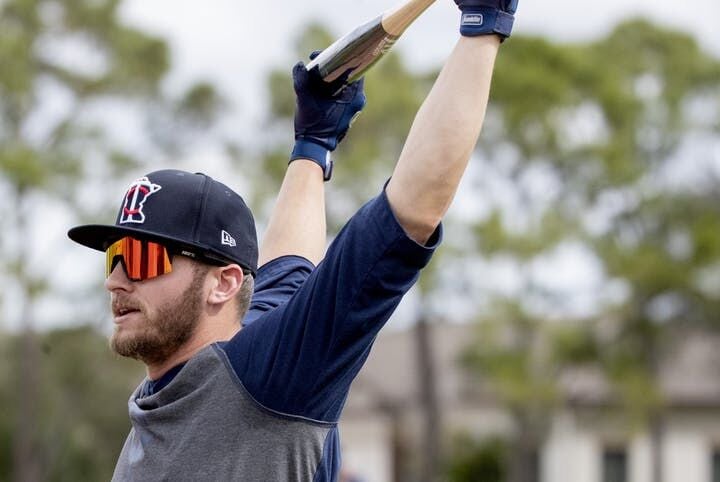
Josh Donaldson, at 34, said he thinks he has plenty of good offensive years left.
New York Mets: Robinson Cano, $24,000,000
Updated
The Seattle Mariners' Robinson Cano during his at-bat in the fourth inning against the Texas Rangers at Safeco Field in Seattle on Thursday, Sept. 27, 2018. (Dean Rutz/Seattle Times/TNS)
New York Yankees: Gerrit Cole, $36,000,000
Updated
New York Yankees' Gerrit Cole delivers a pitch during the third inning of a spring training baseball game against the Detroit Tigers Saturday, Feb. 29, 2020, in Tampa, Fla. New York Yankees' Gerrit Cole delivers a pitch during the third inning of a spring training baseball game against the Detroit Tigers Saturday, Feb. 29, 2020, in Tampa, Fla.
Oakland Athletics: Khris Davis, $16,750,000
Updated
Oakland Athletics left fielder Khris Davis (2) blows bubbles in the third inning as they play the Minnesota Twins at Target Field Friday, July 19, 2019 in Minneapolis, Minn. (Nicole Neri/Minneapolis Star Tribune/TNS)
Philadelphia Phillies: Bryce Harper, $27,538,462
Updated
The Philadelphia Phillies' Bryce Harper during a spring training game. (Yong Kim/The Philadelphia Inquirer/TNS)
Pittsburgh Pirates: Chris Archer, $9,000,000
Updated
Pittsburgh Pirates pitcher Chris Archer (24) throws a 93 mph four-seam fastball against the Miami Marlins on Sunday, June 16, 2019 at Marlins Park in Miami, Fla. (Charlie Ortega Guifarro/Miami Herald/TNS)
San Diego Padres: Manny Machado, $34,000,000
Updated
San Diego Padres third baseman Manny Machado, left, is all smiles after he signed an autograph for Jesus Roman, 8, right, of Hemet, during Padres FanFest 2020, January 11, 2020 at Petco Park in San Diego, California.
San Francisco Giants: Buster Posey, $22,177,778
Updated
The Los Angeles Dodgers' Alex Verdugo is safe at home as San Francisco Giants catcher Buster Posey fails to make a tag in the first inning at Dodger Stadium in Los Angeles on Tuesday, June 18, 2019. (Luis Sinco/Los Angeles Times/TNS)
Seattle Mariners: Kyle Seager, $19,500,000
Updated
Seattle Mariners third baseman Kyle Seager strikes out in the second inning against the Boston Red Sox on Sunday, June 17, 2018 at Safeco Field in Seattle, Wash. (Ken Lambert/Seattle Times/TNS)
St. Louis Cardinals: Paul Goldschmidt, $25,333,333
Updated
Tampa Bay Rays: Charlie Morton, $15,000,000
Updated
Tampa Bay Rays pitcher Charlie Morton throws in the first inning against the Houston Astros during Game 3 of the American League Division Series on October 7, 2019, in St. Petersburg, Fla. (Douglas R. Clifford/Tampa Bay Times/TNS)
Texas Rangers: Shin-Soo Choo, $21,000,000
Updated
CHICAGO, ILLINOIS - AUGUST 24: Shin-Soo Choo #17 of the Texas Rangers slides to catch a fly ball in the third inning against the Chicago White Sox at Guaranteed Rate Field on August 24, 2019 in Chicago, Illinois. Teams are wearing special color schemed uniforms with players choosing nicknames to display for Players' Weekend. (Quinn Harris/Getty Images/TNS)
Toronto Blue Jays: Hyu-Jin Ryu, $20,000,000
Updated
Los Angeles Dodgers starting pitcher Hyu-Jin Ryu works against the Arizona Diamondbacks on August 11, 2019, at Dodger Stadium in Los Angeles. (Kent Nishimura/Los Angeles Times/TNS)
Washington Nationals: Max Scherzer, $35,920,616
Updated
Washington Nationals pitcher Max Scherzer throws against the Tampa Bay Rays on June 26, 2018, in St. Petersburg, Fla. (Chris Urso/Tampa Bay Times/TNS)



