



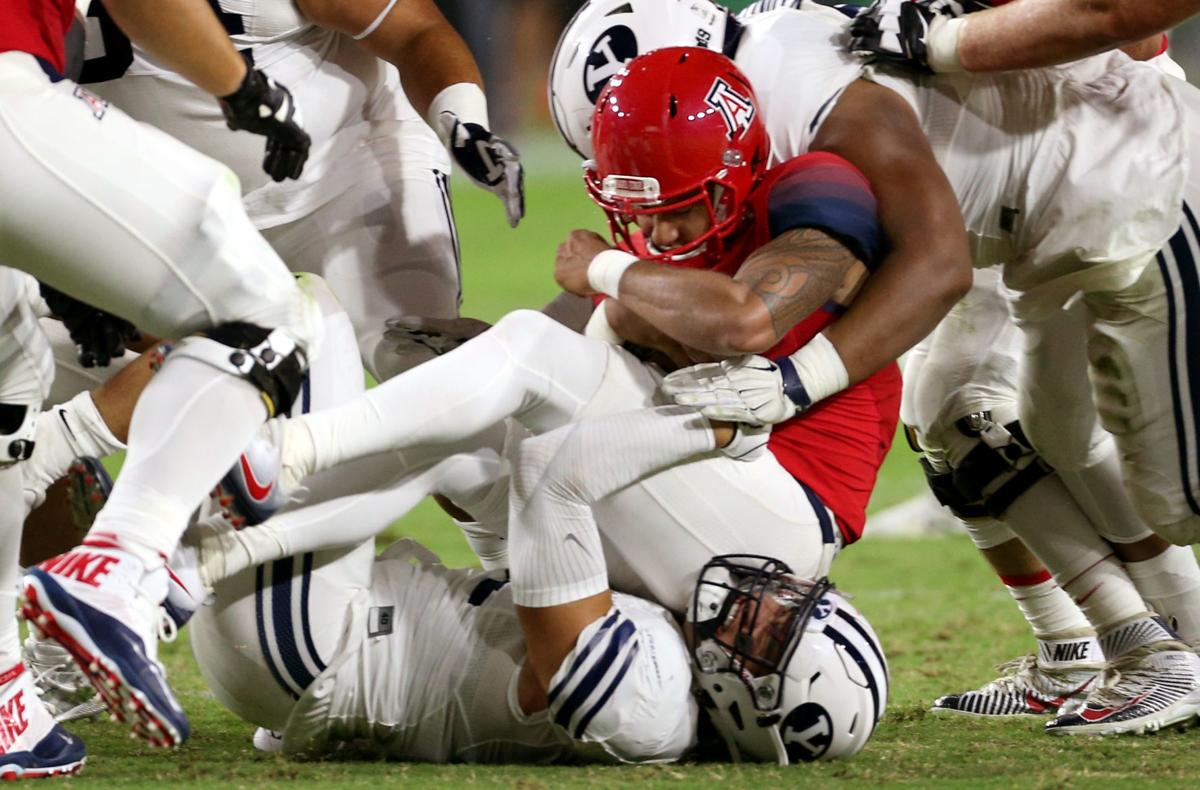
Last October, former Arizona Wildcats quarterback Anu Solomon medically withdrew from Baylor after experiencing several weeks worth of concussion-like symptoms.
The career-ending concussion Solomon suffered during his second game as a graduate transfer wasn’t his first: During the second game of the Wildcats’ 2015 season, Solomon was sidelined with a concussion and missed the next week’s game.
But nearly six weeks after the Sept. 9, 2017, game against UTSA, Solomon still hadn’t returned to the field. He had missed too many classes and had a hard time keeping up after the injury.
It only took two documented concussions during Solomon’s four years of college football to end his career. The residual damage from the injuries remains to be seen.
While brain injuries can be devastating to players in their 20s, 30s and beyond, research has shown that hits to the head can have even more catastrophic results in children and teens. More than 800,000 children visit emergency rooms annually for concussions, according to the CDC.
Youth tackle football leagues continue to thrive, even as participation in high school football steadily declines.
A study published last month could change the game for youth football leagues, however. A national think tank recommends a ban on tackle football until high school. Lawmakers from California, Illinois, New York and Maryland proposed legislation earlier this year that would ban tackle football for children under 12 years old. Around the same time, the Concussion Legacy Foundation — a well-known brain-trauma research and advocacy nonprofit — urged parents to keep their children out of tackle football until age 14.
“Advocates for delaying the starting age of tackle football argue that flag is a safer, age-appropriate alternative,” according to the Aspen Institute. “In homes and on fields across the U.S., this argument appears to be winning.”
Last year, flag surpassed tackle football as the most commonly played version of the game for kids ages 6 to 12, the analysis says, citing data from the Sports and Fitness Industry Association.
The issue has become so big that, for the first time ever, the CDC has released clinical guidelines for doctors treating children with mild traumatic brain injuries or concussions. Among the CDC’s recommendations: Waiting three days to return to non-sports activities and even longer to return to the field or court.
The recent push in legislative efforts, medical treatment and public education come on the heels of research that shows children are particularly vulnerable to brain injuries in high-collision sports like football and soccer. Children have relatively large heads and relatively weak necks, according to an analysis by the Aspen Institute Sports and Society Program. Their brains are still developing.
Concussions affect children differently than adults, the CDC says, and can cause changes in health, thinking and behavior that affect learning, social skills and self-regulation. Brain injuries in children can also negatively affect a child’s school performance and ability to learn, according to the CDC.
The Aspen Institute recommends that all youth tackle organizations shift to flag football for players younger than 14, but begin teaching blocking, tackling and hitting skills in practice starting at age 12. This will better prepare athletes for high school football in a controlled, “safe-as-possible manner” that doesn’t involve helmet-to-helmet or player-to-player contact, the study says.
In addition, the institute recommends that high school and college football programs adopt the “Dartmouth-style” practice standard. In 2016, Dartmouth moved to a tackle-free practice system under the leadership of former Stanford coach Buddy Teevens. The Ivy League, where Dartmouth plays, moved kickoffs to the 40-yard line. The 5-yard change makes a huge difference, research shows. There are more touchbacks, eliminating high-impact collisions on returns.
Critics of the movement to standardize flag football have suggested that the health benefits — notably, physical activity — of tackle football outweigh the risks. They also say the move to flag football could turn off families who feel blocking and tackling are the point of the game.
However, the Aspen Institute says it believes most families would adapt to flag and the game would prosper, citing the proliferation of hockey after it introduced its ban on body-checking in children.
Prioritizing flag football would also allow children who would otherwise avoid the game due to injury risk to participate in the sport, the analysis said.
The Aspen Institute contends that players who get a later start on tackle football still go on to succeed in the NFL. Tom Brady, Jerry Rice, Walter Payton, Warren Sapp and Lawrence Taylor are among a group of elite players who didn’t participate in tackle football before entering high school.
At least one University of Arizona professor and researcher agrees with the recommendations.
“I don’t think more kids are getting injured, but I think there’s more awareness of long-term effects of concussions and more awareness of what the injury is and how it presents,” Dr. Ian Crain, an associate professor at the UA College of Medicine-Phoenix and director of Banner’s Brain Injury Center told the Star. “Parents are noticing and players and friends are notifying adults when they suspect concussions in teammates.”
Children under 12 who receive concussions face a longer recovery.
“Even with sub-concussive blows, there’s a question of ‘are we changing a developing brain?’” Crain said. “There’s a good correlation between sub-concussive and concussive blows and more behavioral problems later in life.”
When deciding whether young children should engage in high-contact sports like football and soccer, parents need to weigh the risks and benefits of letting their children play, Crain said.
“What’s the risk of not doing it? Not much,” he said. “There’s not enough evidence to make medical guidelines and ban it, but I do think ... you have to weigh the risks and benefits.”
Kids who play flag football would likely arrive in high school and college with a less-extensive concussion history, Crain said, adding that he expects colleges to support the recommendations since they would — in theory — get healthier players.
“The more concussions you get, the easier it is to become concussed. The recovery time gets longer and a person can develop permanent symptoms,” Crain said. “It’s important that parents get their child cleared by someone with experience and who stays up to date on the recommendations for concussion treatment.”
For the time being, kids’ tackle football is still alive — and thriving — in Tucson.
The Tucson Youth Football and Spirit Federation offers both flag and tackle football to thousands of Tucson kids each year. Its flag program— which league commissioner Julius Holt said is one of the largest in Southern Arizona — is available for kids ages 5 to 7 and is considered an instructional league. Coaches don’t keep score during the games and players don’t compete for a championship at the end of the season, unlike in the league’s tackle program, which is available for players ages 8 and older.
While he’s frequently asked about starting a “Mighty Mite” tackle program for the organization’s 5 to 7-year-olds, Holt said Sunday, “We’re not doing that.”
With tackle football available to players ages 8 and older, the group has a number of safeguards to ensure the safety of its players and those who participate in the league’s cheer program.
It requires all coaches to undergo training and certification by USA Football, including in concussion management. It also uses the CDC’s HEADS UP program to educate coaches and players, ascribing to the CDC’s guidelines when it comes to concussion management and return to play. HEADS UP is a series of initiatives designed to protect kids by raising awareness about prevention, recognition and response to concussions and other brain injuries.
The helmet of each player is inspected and certified by the National Operating Committee on Standards for Athletic Equipment and fitted to ensure a safe fit.
Only time will tell if the Tucson league, and other leagues like it, will go further.
“To their credit,” the analysis said, “football leaders aren’t waiting for all answers to come in to begin reforming youth tackle.”

