

WASHINGTON — Undeterred by a panicked stock market, President Donald Trump threatened additional tariffs on China on Monday, raising fresh concerns that his drive to rebalance the global economy could intensify a financially destructive trade war.
Trump's threat came after China said it would retaliate against U.S. tariffs he announced last week.
"If China does not withdraw its 34% increase above their already long term trading abuses by tomorrow, April 8th, 2025, the United States will impose ADDITIONAL Tariffs on China of 50%, effective April 9th," Trump wrote on social media. "Additionally, all talks with China concerning their requested meetings with us will be terminated!"
The U.S. president shows few signs of backing down on tariffs despite the mounting pressure in the financial markets. His commitment to tariffs could have devastating effects for the global economy, even though Trump is banking that it will ultimately pay off with manufacturing jobs.
Asked Monday if he would consider a pause on his widespread tariffs, Trump said, "We're not looking at that." The U.S. president said he was open to negotiations "if we can make a really fair deal and a good deal for the United States."
Trump said it's possible to have both negotiated settlements with other countries and permanent tariffs.
Even as Israeli Prime Minister Benjamin Netanyahu said his country would take its tariffs against U.S. goods to zero, Trump was noncommittal about removing the new import taxes placed on an ally.
The White House also said Monday that Trump would veto a Senate bill that would mandate congressional approval for new tariffs, a bet that the critical mass of Republican lawmakers will loyally back him despite the economic and political risks.
If Trump implements his new taxes on imports from China, U.S. tariffs on Chinese goods would reach a combined 104%. The new taxes would be on top of the 20% tariffs announced as punishment for fentanyl trafficking and his separate 34% tariffs announced last week. Not only could that increase prices for American consumers, it could also give China an incentive to flood other countries with cheaper goods and seek deeper relationships with other trading partners.
The Chinese Embassy in the U.S. on Monday responded to Trump's latest tariff threat by saying his bluster would not help him resolve any trade disputes.
"We have stressed more than once that pressuring or threatening China is not a right way to engage with us," said Liu Pengyu, the embassy spokesman. "China will firmly safeguard its legitimate rights and interests."
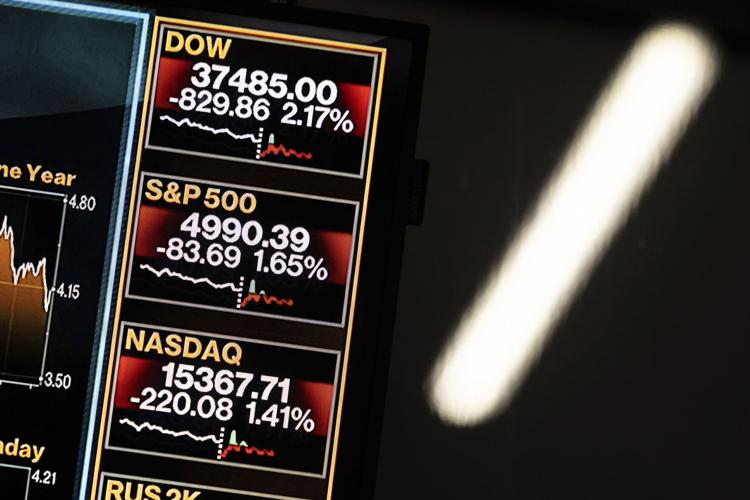
After sell-offs on the prior two days of trading, the Dow Jones Industrial Average on Monday fell 0.9%. The S&P 500 slumped 0.2%, and the Nasdaq composite was up 0.1%.
Trump frequently bragged about stock market gains during his first term, and the threat of losses on Wall Street was viewed as a potential guardrail on risky economic policies in his second term. But that hasn't been the case, and Trump has described days of financial pain as necessary.
"I don't mind going through it because I see a beautiful picture at the end," he said.
Trump officials frequently appeared on television to make the case for his policies, but none of their explanations calmed the markets.
The Republican president remained defiant despite fears that he could push the U.S. toward a recession, insisting that his tariffs are necessary for rebuilding domestic manufacturing and resetting trade relationships with other countries.
But his aggressive push scrambled U.S. economic policy. Even though inflation remains elevated, Trump called on the Federal Reserve to lower its benchmark interest rates that were increased to constrain price increases.
Federal Reserve Chair Jerome Powell warned Friday that the tariffs could increase inflation, and he said, "There's a lot of waiting and seeing going on, including by us," before any decisions would be made.
European Commission President Ursula von der Leyen said the European Union would focus on trade with other countries besides the United States, saying there are "vast opportunities" elsewhere.
White House trade adviser Peter Navarro suggested countries would need to do much more than simply lower their own tariff rates to reach deals, an indication that talks could be a drawn-out process.
"Let's take Vietnam," he said on CNBC. "When they come to us and say, 'We'll go to zero tariffs,' that means nothing to us because it's the non-tariff cheating that matters."
Billionaire Elon Musk, a top adviser to Trump on overhauling the federal government, expressed skepticism about tariffs over the weekend. Musk has said that tariffs would drive up costs for Tesla, his electric automaker.
"I hope it is agreed that both Europe and the United States should move ideally in my view to a zero tariff situation, effectively creating a free trade zone between Europe and North America," Musk said in a video conference with Italian politicians.
Navarro later told Fox News' "Sunday Morning Futures" that Musk "doesn't understand" the situation.
"He sells cars," Navarro said. "That's what he does." He added, "He's simply protecting his own interests as any businessperson would do."

