

In the first press conference of what could be his final week as the Arizona Cardinals head coach, Jonathan Gannon spoke about the importance of change. This has become a common refrain for Gannon over the past month, as the Cardinals' season has careened out of control. He knows that this year has been a disaster and that the status quo is unacceptable.
“Through adversity,” Gannon said, “you've gotta change.”
Later, he added, “This business, it's adapt or die.”
The reality, though, is that the Cardinals have not adapted. And if Gannon is fired next week, his tenure may ultimately have been doomed by the exact opposite tendency: An unwillingness to change.
This season often feels defined by one inflection point. In Week 5, the Cardinals were still a competitive team with playoff aspirations when they blew a 21-3 lead in a horrendous loss to the then-winless Titans. In the locker room, players have pointed to that loss as the moment when the season began to spiral.

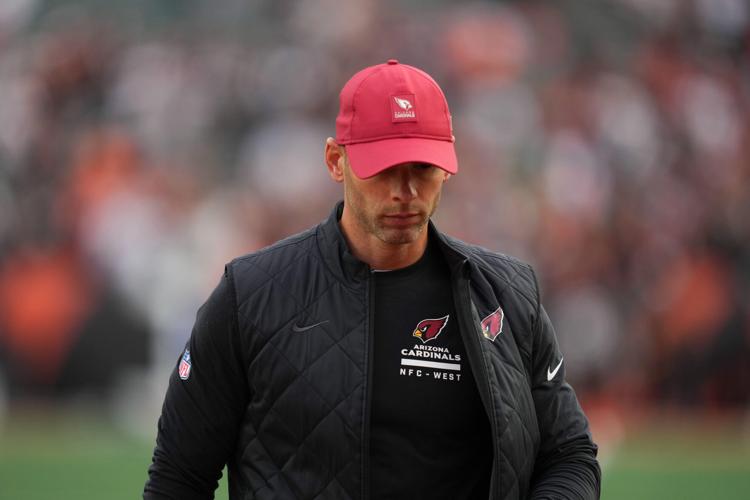
Arizona Cardinals head coach Jonathan Gannon leaves the field after an NFL football game against the Cincinnati Bengals, Sunday, Dec. 28, 2025, in Cincinnati.
The Cardinals failed to score on their final eight drives in that game. The stretch was punctuated by an inexplicable decision to run on third-and-8 late in the fourth quarter. The next day, Gannon was asked how short the “leash” was on offensive coordinator Drew Petzing.
“I believe in everyone we got in that locker room and the team,” Gannon said. “So we just gotta continue to do a better job.”
Since that moment, the Cardinals are 1-10.
And yet, when Gannon was asked whether he regrets not making bigger changes earlier in the season — back when the Cardinals were still in contention — he replied with one word.
“No,” Gannon said.
Why not?
“'Cause I thought that was the best thing to do for the team.”
Over the past few days in Tempe, that has been the common sentiment. No one has openly admitted any regrets about their role in this failed season.
For Petzing, defensive coordinator Nick Rallis and special teams coordinator Jeff Rodgers, this week was potentially the final chance to address the media — to offer a dose of introspection before an offseason staff overhaul. But when pressed for their reflections on the season, all three coordinators offered up some version of being focused on their Week 18 opponent, the Los Angeles Rams.
“I don't want to dwell on that on a Tuesday going into a game,” Petzing said. “We gotta focus on the Rams.”
Petzing’s most interesting response came when asked about Kyler Murray. Since the Cardinals inserted Jacoby Brissett as the starter in Week 6, he has looked like a better fit for Petzing’s offense, even if his actual production has been inconsistent.
Brissett has thrown 18.1% of his passes from under center, compared to 7.5% for Murray. The Cardinals are also using more play action with Brissett, even though they’re often playing from behind, with minimal threat of running.
This is the system Petzing came from in Cleveland, and it’s the system that the Cardinals have worked to construct. They’ve replaced undersized, speedy receivers with big-bodied, physical weapons. They’ve invested in blocking tight ends and power running backs. All of it has been an inversion of how their offense was constructed under Kliff Kingsbury, when Murray had his most successful seasons.
This was the subtext when Petzing was asked whether he did enough to build his offense around Murray’s skill set.
“I'd like to think I did,” Petzing said. “I always am gonna build the offense around whoever our best players are to give us a chance to win football games.”
The Cardinals’ offense, though, has not always been defined by their best players getting the most opportunities. Take Michael Wilson, for example.
Before Marvin Harrison Jr. went down, Wilson was often the third read in the Cardinals’ passing game, averaging 4.2 targets per game. Since Harrison began dealing with a variety of injuries in Week 10, Wilson has been far more productive than Harrison ever was in the top wide receiver role. In that span, he’s averaging 96.6 yards per game.
But when asked what he’s learned in his three seasons as offensive coordinator, Petzing did not point to on-field lessons.
“You learn so much about yourself from just a leadership standpoint,” Petzing said. “In terms of how you interact with different people, how you manage different personalities, how you deploy an offense, how you interact with people in the building. I think so much of that is valuable and extremely important to my process of always trying to improve and be better at my job.”
Rallis, like Petzing, declined to assess his unit, which has been a key contributor to the Cardinals’ shortcomings. A year ago, the Cardinals outperformed their talent level to finish 15th in points allowed per game. This year, after significant offseason investments, they rank 29th.
Rallis did offer a list of areas that he plans to investigate this offseason.
“You've gotta look at schematics in terms of what you do, what people are giving you,” Rallis said. “Situational stuff, playcalling, technique, technique development, players, player execution. … Those are the layered questions that you have to figure out every offseason and we'll eventually get to that point.”

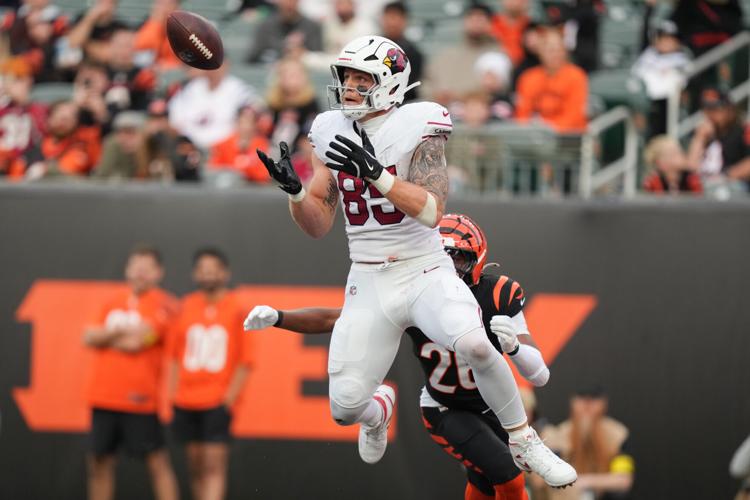
Arizona Cardinals tight end Trey McBride (85) catches a touchdown pass in the endzone during the second half of an NFL football game against the Cincinnati Bengals, Sunday, Dec. 28, 2025, in Cincinnati.
The Cardinals’ coaches, though, might be doing that analysis in new jobs, scattered around the league. If that’s the case, it will be in part because their changes were too little, too late.

