


The Arizona Wildcats rodeo team isn’t celebrating its 100th anniversary like the Tucson Rodeo, but the UA has been in lockstep with the Old Pueblo’s annual tradition for nearly nine decades.
The Arizona rodeo team, a club sport with UA Campus Recreation, is entering its 86th year at the UA. The Wildcats hosted the first-ever intercollegiate rodeo in the United States in 1939.
Tucson is home of the renowned Tucson Rodeo, or “Fiesta de los Vaqueros,” and the first collegiate rodeo team ever assembled.
Members of the UA rodeo team will be color guards during the Tucson Rodeo Parade on Feb. 20. In addition to some of the UA athletes competing at the Tucson Rodeo, members help the Tucson Rodeo staff set up the grounds and prepare water for the livestock, “giving them a little bit more manpower,” said Arizona rodeo president and senior Kiara Begay.
“We’re a small team, but any help to them is appreciative on both ends because they help us during academic and rodeo seasons,” Begay said.
Arizona’s rodeo team has 12 members — nine women and three men — and the Wildcats compete in the National Intercollegiate Rodeo Association (NIRA). The College National Finals Rodeo is held in Casper, Wyoming, in June. Rodeo events include steer wrestling, tie-down roping, team roping, bronc riding, bareback riding, bull riding, goat tying, barrel racing and breakaway roping.

The Arizona Wildcats club rodeo teams begins its 2025 season on March 1.
The Wildcats are hosting their home event at Tucson Rodeo Grounds on March 1 and will face other teams from the Grand Canyon Region: New Mexico State, Central Arizona College, Cochise College, Dine College, Navajo Technical College and Mesalands Community College, among others.
Arizona also has events at Central Arizona College, Cochise College and New Mexico State. Two Grand Canyon Region rodeos will be held in Payson and Prescott in late April and early May.
Arizona’s rodeo team doesn’t have a head coach or a designated practice area. UA rodeo members store their horses at stables around Tucson and Marana and travel to events independently.
“Some of them don’t have a vehicle, so they rely on others,” Begay said. “’If you’re going to this rodeo, can I jump in with you? If you have an open spot, can I throw my horse in there and I’ll find a ride?’ In that sense, we’re more of a community and we understand where each of us are coming from because we’re more independent and on our own. We try and help each other during rodeo season.”
Begay, who hails from a Tohono O’odham Nation background, grew up around rodeo and her parents competed in the Indian Rodeo Cowboys Association. She’s in her sixth season with the UA rodeo team and is earning a masters degree in applied biosciences, with aspirations to become a physician assistant.
Begay “was hesitant to become president (of UA rodeo) because I don’t like that spotlight on me at all and, personally, I don’t think I’m a good leader,” she said.
“I’m more of a ‘Tell me what to do and I’ll do it’ type of person,” Begay said. “Looking at it from the other side, I wanted to be that person because at times I was the only one on the rodeo team for about one or two years, especially after COVID. I had no guidance whatsoever. I wanted to be that guidance for others, especially the newcomers, and get them motivated and say, ‘Hey, I know we’re small and you might not think it’s going to work out, but it will.’ ... They’re doing a lot and I applaud every single one of them and it’s not easy.”
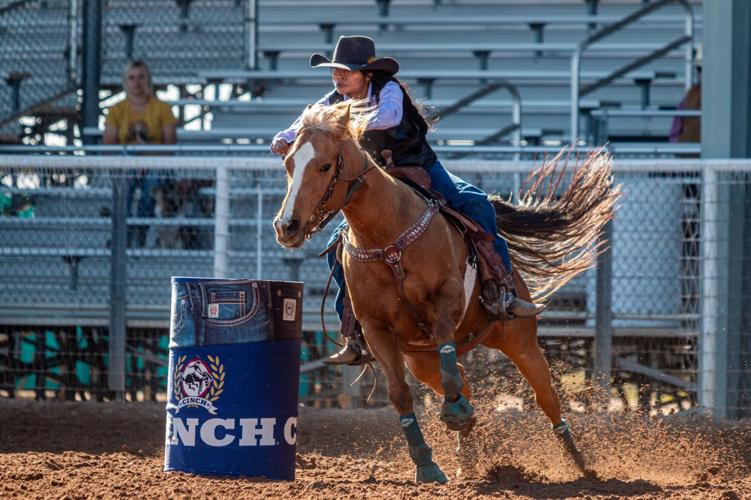
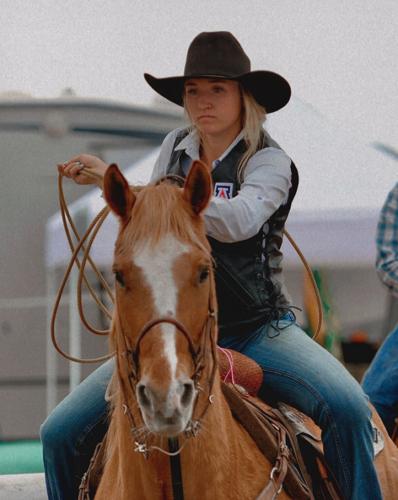
Begay is a barrel racer and the palomino horse, Cici Butters, she uses for competitions “got her name during my first rodeo season because she was new to me and I told the girls I was traveling with, ‘Hey, I’m debating on these two names,’ and they just kept calling her Cici Butters,” Begay said.

Arizona rodeo president Kiara Begay and her horse, Cici Butters, compete in the barrel racing event.
Like Begay, most of the UA rodeo athletes don’t have aspirations to turn professional and compete in the PRCA, “but some of them do and I applaud every single one of them because it’s a hard route.”
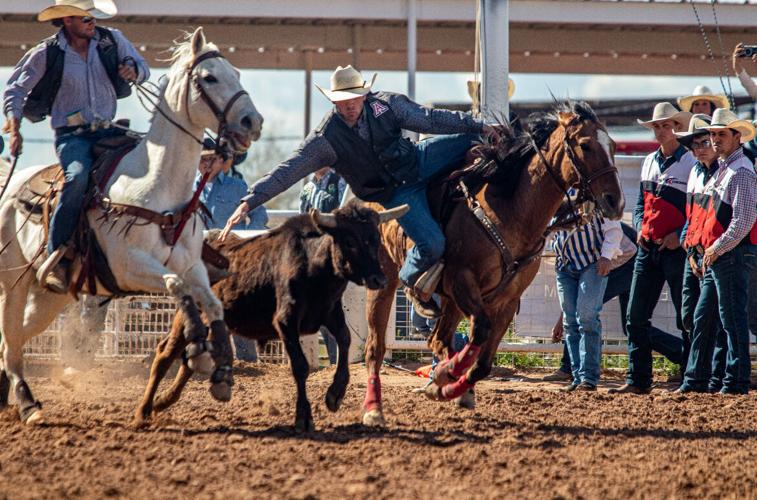
One of the potential pros on the Arizona rodeo team is senior steer wrestler Bridger Sanborn, who is studying aerospace engineering. After his rodeo career, Sanborn plans to go into the space industry and hopes to work at NASA’s White Sands Test Facility in New Mexico.
The Willcox native’s parents were rodeo athletes “long before I was born.” Sanborn’s mother, Amy, competed in barrel racing, goat tying and breakaway roping at the UA in 1991 and ‘92. Growing up in Willcox, “we’ve always been around cattle and horses and we’ve been on horses since the day I was born,” the younger Sanborn said.
Sanborn began his steer-wrestling journey in middle school with his older brother, Sherrick, and started with “chute dogging,” which has the contestant holding the steer in a roping chute and the objective is to bring the steer to the ground once the chute opens. Sherrick Sanborn went to New Mexico State and competed against Bridger Sanborn for three years. One of their family horses is coincidentally named Wilma, but not after the UA mascot.
“It just matched up perfectly,” he said.
Sanborn graduated to steer wrestling, which involves jumping off a horse to take down a running steer, and “after my first year in high school, I fell in love with it,” he said.
“Just doing it a bunch of times, hitting the ground and realizing it doesn’t hurt that much if you do it right and work on it,” Sanborn said. “It’s not as bad as it seems.”
The steer can weigh anywhere from 300-400 pounds. Taking them down is an art — more about technique than physical strength.
“There’s a lot that goes into steer wrestling,” Sanborn said. “You have to get off at the right time, especially when you have steer that will stop on you. You don’t want to get off too late because you’ll take a horn to the face. You have to focus on getting off early, grab on to the horns and put them away. Put their left horn in your left pocket and place your feet nice. ... You gotta slide your feet perfectly and with their momentum, you gotta bring their head around. You’re not strong enough to flip them around yourself, so you have to use every little bit of momentum you can get from them.”

The Arizona Wildcats club rodeo teams begins its 2025 season on March 1.
It’s one of the most physical events in a rodeo but “I’ve been pretty lucky in not hurting myself too bad,” Sanborn said; just a few rolled ankles and sore knees.
“A lot of people in steer wrestling, when they get older, they’ll get bad knees and bad ankles,” he said. “I’ve seen some people break their hips.”
The quarter horse Sanborn uses for competition is a grey mare named Berry, which was bought from an Ocean Spray stakeholder.
“She had this long, extravagant name that had something to do with berries, so we just shortened it to Berry,” Sanborn said.
Following the fall schedule, Sanborn is the top steer wrestler in the Grand Canyon Region with a score of 330 points; he’s 18th nationally. The last four years “have been fun and I enjoy all of the members,” Sanborn said.
“They’re all fun and we all joke around,” said Sanborn. “We’re all here to help each other out no matter what. It’s been fun to go through this journey with them and travel to different rodeos. Now that it’s my last year, I’m just trying to enjoy it, make the best of it and have the most fun I can have.”
Begay, who endured the pandemic as an underclassman and shouldered the responsibilities of team president in her final year, is “excited to hopefully end on a good note.”
Said Begay: “I’m excited to see where the team goes and where they take it.”

