


Dear Mr. Football: Could USC beat Arizona using just its second string?
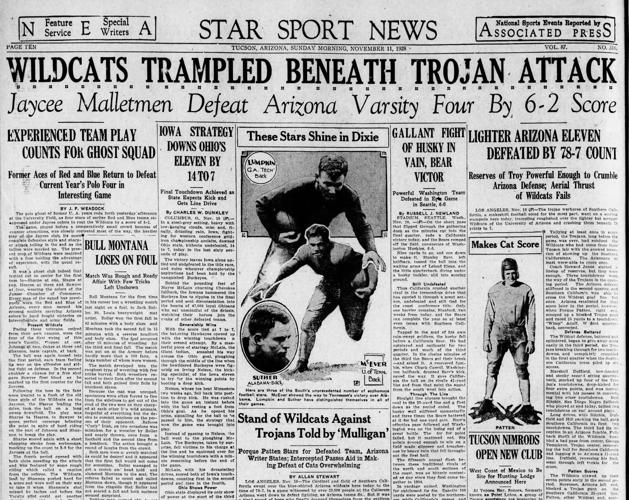
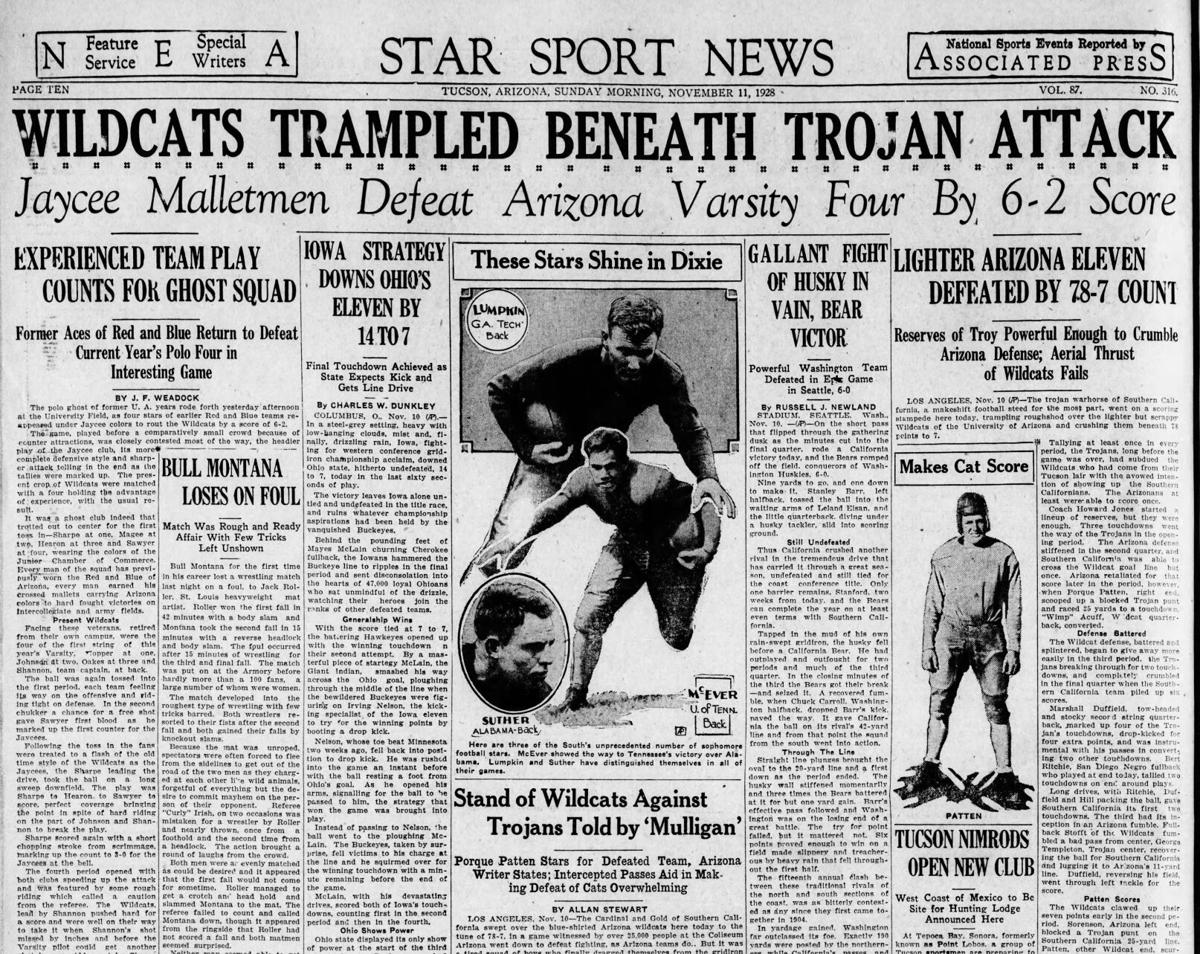
A: There is precedent for such strategy: In 1928 at the Los Angeles Coliseum, the Trojans benched their starters and played the second team from start to finish. What happened? USC won 78-7, the most lopsided defeat in Arizona history.
A day later, the Los Angeles Times reported the 78-7 rout was “something fearful and terrible to behold. It was a run riot with an orgy of scoring.”
Not that it was a surprise to USC coach Howard Jones, who in 1928 wrote a day-of-the-game predictions column for the Times. On the USC-Arizona game, Jones wrote: “Southern California should get by without too much trouble.” An Arizona opponent didn’t score 70 points again for 92 years, when ASU beat Arizona 70-7 in the 2020 Territorial Cup. (The Sun Devils used their starters).
Dear Mr. Football: Could Saturday’s USC-Arizona game (and next year’s regularly-scheduled Pac-12 game) be the last between the two schools for a half-century?
A: With USC joining the Big Ten in 2024, it’s entirely possible — and there is precedent — that the Wildcats and Trojans won’t meet again until, let’s say, 2075.
After that 78-7 mugging in 1928, Arizona and USC did not schedule one another until 1979. That’s 51 years. It made sense: Arizona and USC played seven times from 1916-28 and the Trojans outscored Arizona 298-26. Why keep banging your head against a stone wall?
Dear Mr. Football: What did the UA do to replace USC on its football schedule?
A: It started a Homecoming parade a year later, in 1929. Sadly, without any transparency and little public notice, the UA eliminated the parade this year.
The Homecoming parade — here and in most Pac-12 precincts — lost significant appeal the last decade. Times change. Students are no longer as involved and hyped up as they were in the 1950s and 1980s. Only two Pac-12 schools continue with a full-on Homecoming parade: ASU and Colorado.
ASU stages a traditional “Lantern Walk” up Tempe Butte behind Sun Devil Stadium followed by a short Homecoming parade down University Boulevard. Colorado maintains its Homecoming parade down bustling Pearl Street, followed by a pep rally on the courthouse lawn.
To replace a Homecoming parade, UCLA holds an alumni blood drive and alumni trivia night. The Oregon Ducks hold a 5K run/walk on campus and a pep rally. Utah holds a Beehive cheese tasting and social afternoon. Not exactly the good, old days, right?
Dear Mr. Football: Is there any modern link to Arizona’s historic 38-7 blowout of USC at Arizona Stadium in 1993?
A: One of the UA’s starting cornerbacks that night was Claudius Wright, a key part of the Desert Swarm defenses of 1993 and 1994. Wright started 17 games as a Wildcat.
Wright, who grew up in Los Angeles and came to Arizona after playing at Fullerton Junior College, is the father of USC starting cornerback Ceyair Wright, a sophomore with NFL-type speed and athleticism.
Ceyair is surely the leading celebrity in Pac-12 football. An accomplished young actor, Ceyair was part of the “Space Jam 2,” in which he played the part of LeBron James’ son. He has also appeared in “2 Broke Girls” and a dozen other TV shows, and has a regular part in the ongoing series “Grown-ish.”
Dear Mr. Football: Is this a vintage USC team?
A: The Trojans are generally favored by 14.5 points and that’s not close to their largest betting spreads over Arizona through the years.
During the Pete Carroll days, USC was favored over Arizona by, in order, 28, 35 and 38 points in 2003, 2004 and 2005, according to the Phil Steele football preview magazines. The 38-point betting margin in 2005 is believed to be a record for an Arizona opponent.
Those Trojans teams were ranked Nos. 2, 1 and 1 on game day against the Wildcats and won 45-0, 49-9 and 42-21.
When Arizona beat No. 1 USC 13-10 at the L.A. Coliseum in 1981, the line set by betting guru Jimmy The Greek was 21 points.
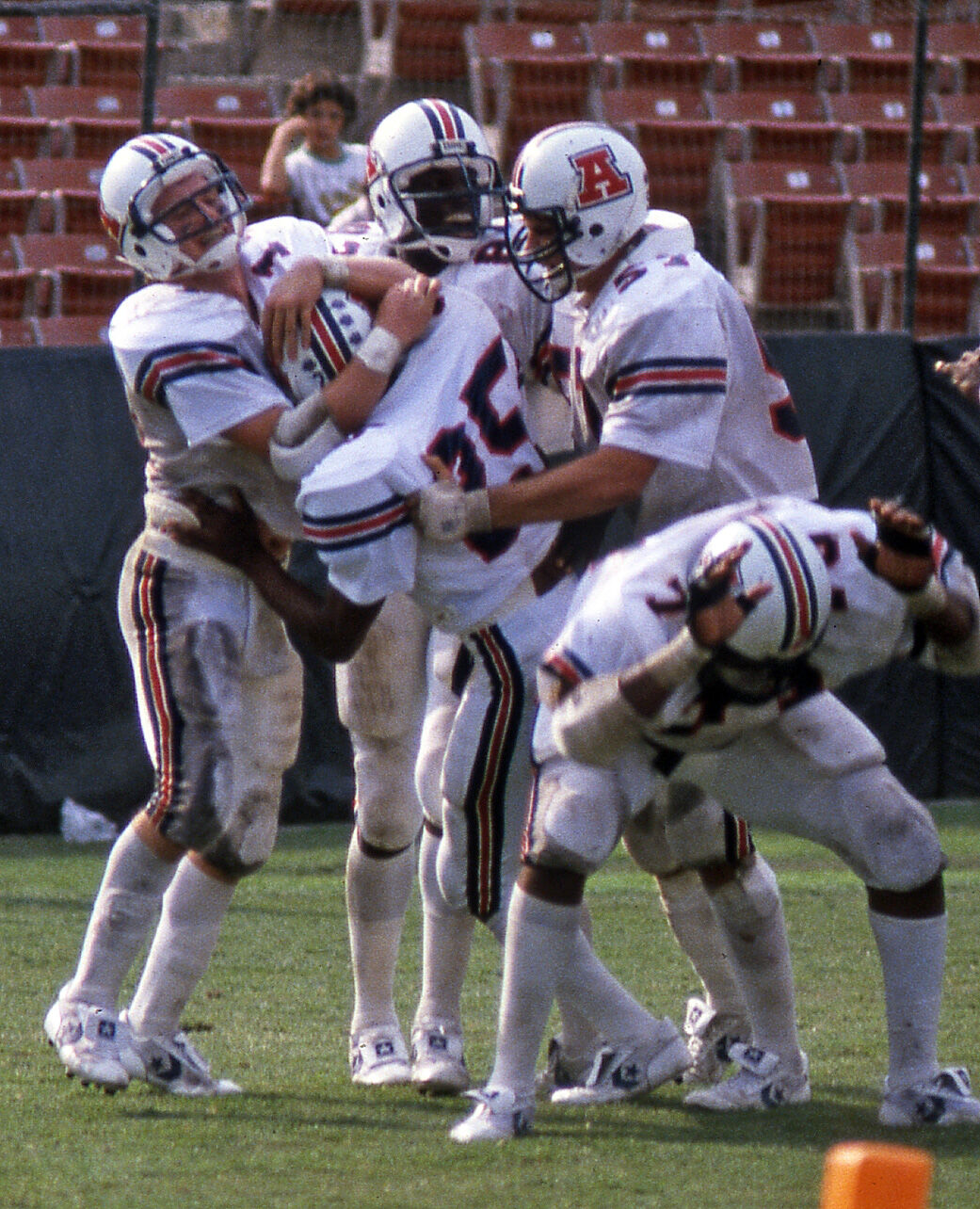
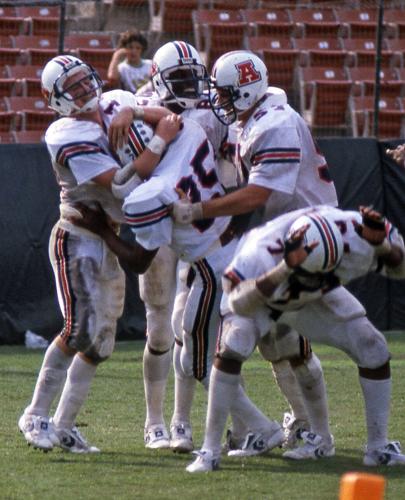
Arizona players mob freshman receiver Vance Johnson after he scored the go-ahead touchdown during the Wildcats' 1981 upset of No. 1 USC in Los Angeles.
Dear Mr. Football: Who was the star of that Arizona victory over the No. 1 Trojans?
A: Quarterback Tom Tunnicliffe and linebacker Ricky Hunley — now the UA’s defensive line coach — were the two biggest impact players that day in what might be the top victory in school history.
But you wouldn’t be far off to say two young players from Tucson — junior offensive lineman Jeff Kiewel and freshman running back Vance Johnson were just as valuable.
Kiewel, a Sabino High School grad who is now general manager of a Goodman’s Interior Structures, a commercial furniture dealer in Tucson, is surely one of the top three or four offensive linemen in the UA’s Pac-12 years. He was a first-team all-conference player in 1982. He now is an assistant coach at Tanque Verde High School.
Johnson, a Cholla High School grad, also lives in Tucson. He is working as ambassador for America’s Rehab Campuses. The company’s primary treatment and detox facility opened in Tucson five years ago.
It’s good timing. Johnson moved back to Tucson this year — just in time to be inducted into the UA’s Ring of Honor at the USC game. He caught the game-winning touchdown pass in that historic 1981 game, a 13-yarder in which he sprinted untouched down the sideline to overcome USC’s late third-quarter 7-6 lead.
Johnson long ago qualified for Ring of Honor induction. He was a first-team All-Pac-10 running back in 1982 and then played 10 years years as a Denver Broncos receiver, through 1995, appearing in three Super Bowls and catching 415 passes for 5,695 yards and 37 touchdowns.
But Johnson delayed his return to Tucson and Ring of Honor induction while battling well-publicized substance abuse problems after his NFL career. He told me last year that he was now ready to return to his hometown and get re-involved with his alma mater.
How good was Johnson? He was a lot like Arizona’s Jacob Cowing — on a path to become a first-team all-Pac-12 receiver himself — but with more speed.
Dear Mr. Football: Who would you rather have as defensive coordinator: Arizona’s Johnny Nansen or No. 21 North Carolina’s Gene Chizik, former head coach at Auburn and Iowa State and defensive coordinator at Texas?
A: Nansen is having a better year than Chizik, whose defense is yielding 476 yards per game, dead last of the 65 Power Five programs. Arizona’s defense is at 454 yards per game, No. 60 in Power Five.
But 6-1 North Carolina loaded up on cupcakes. Wins over Florida A&M, Appalachian State and Georgia State makes UNC’s defensive statistics much less radioactive than they have been at Arizona.
The Wildcats are likely to give up at least 454 yards to USC — the Trojans are averaging 474 yards per game. If USC gets 500 or 550 yards, it won’t be a surprise. If so, Nansen will again be the center of discontent among Arizona fans.
But I truly believe that if USC defensive coordinator Alex Grinch held the same job at Arizona, he, too, would be in charge of the No. 60 defense in Power Five football, with statistics no better than those produced by Nansen’s young and often over-matched defense.
But Grinch spent the last four years as the DC at Oklahoma and Ohio State, rosters loaded with NFL prospects and all-conference players, so his reputation is gold. Arizona has no legitimate all-conference prospects on defense.
I also believe that if Jedd Fisch was USC’s head coach, the Trojans would be 6-1, minimum, and ranked at least No. 10, as is the case under Lincoln Riley.
Coaching won’t win the UA-USC game. The players Fisch and Riley inherited will.
USC 49, Arizona 34.
Photos: Every University of Arizona homecoming since 1914
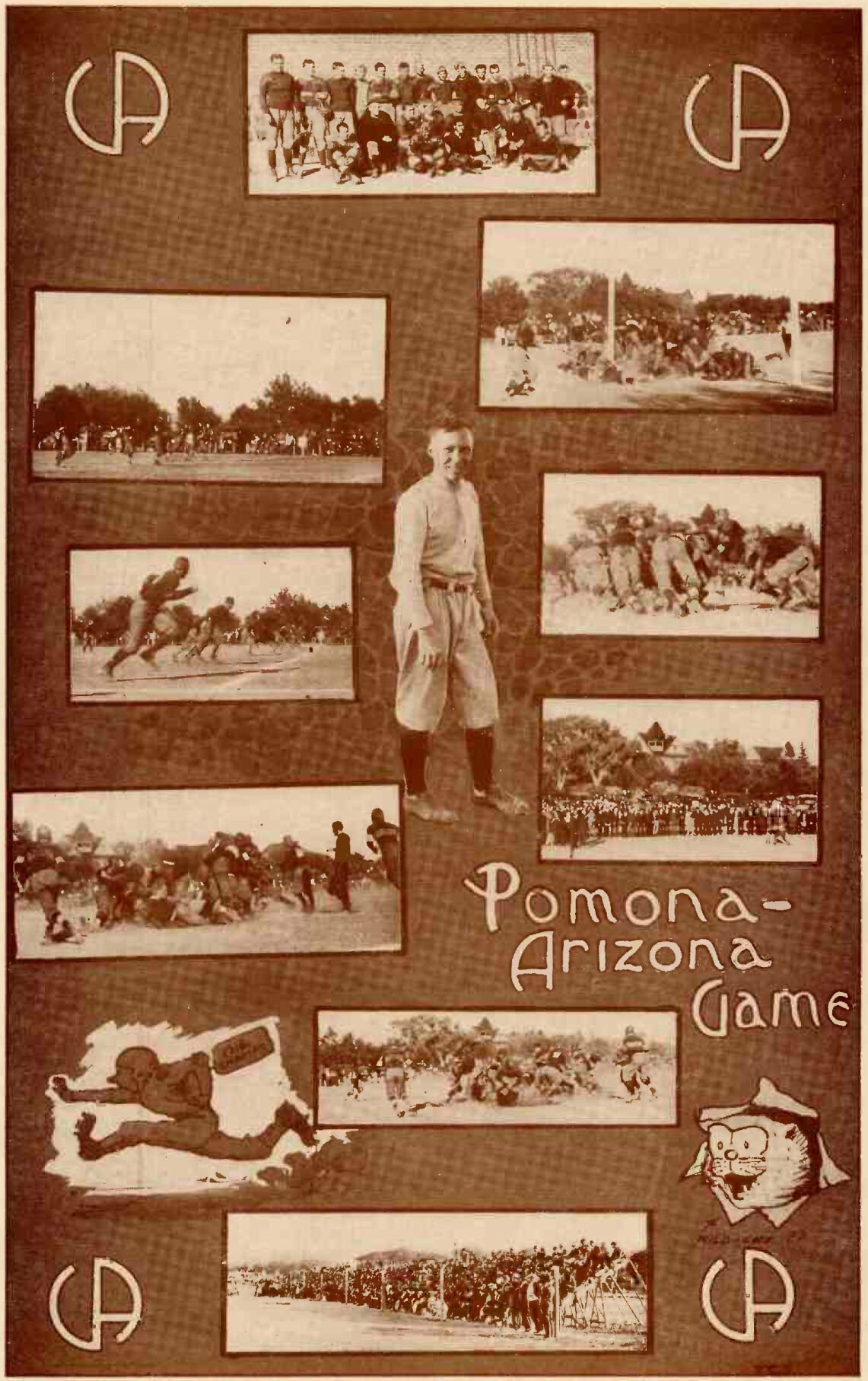
1914: The University of Arizona defeated Pomona College, 7-6, on Thanksgiving Day, Nov. 26, 1914, at the first Homecoming game. The Wildcats got their name that year after a tough football game against the Occidental College Tigers on November 7, 1914. The team "showed the fight of Wildcats," according to the Los Angeles Times.
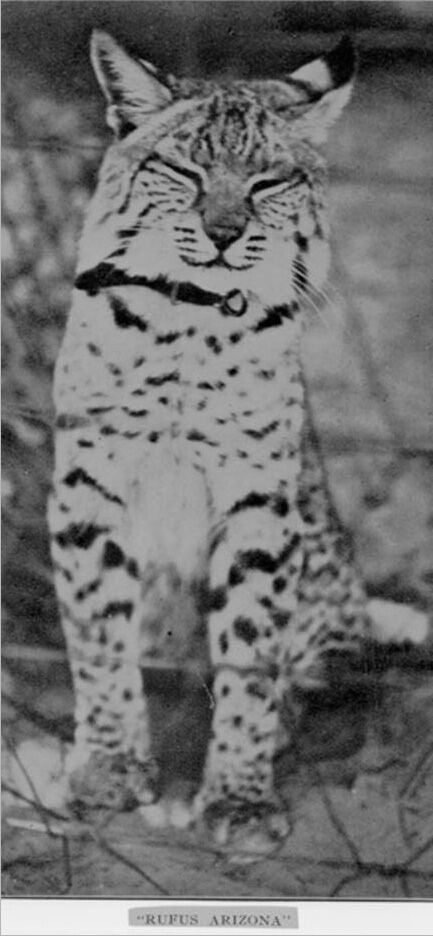
1915: University of Arizona Wildcat Mascot "Rufus Arizona." The original mascot, first called, "Tom Easter", arrived on campus on October 17, 1915, and was introduced to the student body the following day at assembly in Herring Hall. He was the gift of the freshman, who, with George Schreer, raised funds ($9.91) to purchase him from one F.W. Fawkins. blacksmith in Troop B, 9th Cavalry, U.S. Army, stationed atDouglas. He was official named "Rufus Arizona" after President Rufus B. von Kleinsmid.

1916: University of Arizona football team in the 1916-17 UA yearbook. The team beat the New Mexico Aggies at the 1916 homecoming game, 73-0. The game synopsis in the yearbook included this line: "At the beginning of the season Coach McKale stated that he would rather win the Aggie game than any other two games."

1917: "Big Bill" McGowan, center, played right tackle and even handled punting the ball. He was elected captain of the UA football team that defeated Whittier College at the 1917 Homecoming game. He joined the military at the end of the school year to fight in World War I.

1918: The "Seniors" chapter page from the 1919 University of Arizona yearbook, which shows an American warplane. There was no Homecoming or football that season due to World War I.

1919: Texas Miners 0, UA 46. The Homecoming game was Occidental, which UA won, 27-0.

1920: The 1920-21 UA football team caption and quarterback "Slony" Slonaker led the team to victory with a broken rib on the last two games of the season, New Mexico and Redlands.

1921: UA football team, seen in this photo playing against Whittier College, shellacked an embarrassed and overmatched New Mexico Military Institute, 110-0.

1922: Florine Pinson, a junior English major from Miami, Ariz, was selected as "Queen of the 1923 Desert" yearbook. It's not Homecoming royalty (though possibly a predecessor), since the first official Homecoming queen was crowned until 1947. Besides, traditional Homecoming royalty typically don't opt for risque poses.

1923: "Yell leaders" during the 1923 UA football season. Gotta love the hats.

1924: The 1925 UA Desert Yearbook makes one of the first yearbook references to the homecoming during the recap of the 1924 game against the California Aggies: "The annual Homecoming Day football classic found the Wildcats in tip top form, and for the first time throughout the season, the team played real football, and were rewarded with a 12-6 victory."

1925: The 1926 UA Desert yearbook details the 1925 Homecoming game against the Nevada Wolfpack: "The game ended in a 0-0, but it was clearly a moral victory for the crippled and desperate group of Wildcats. For four heartbreaking quarters they held, and at times outplayed, a startled and wondering Nevada team."

1926: Homecoming snapshots from 1926 from the 1927 Desert Yearbook, including the parade through downtown Tucson.

1927: The 1928 UA Desert Yearbook referred to the 1927 Homecoming against at UCLA as one of the best of the season. "The Bruins came here with the idea that the tussle would be a practice game, but the learned differently from the start." The clincher was a pass to to "Swede" Sorenson in the third quarter to set up a Wildcat touchdown. "Sorenson took the ball while smothered by two UCLA backs, and ran five yards, with players hanging to him."
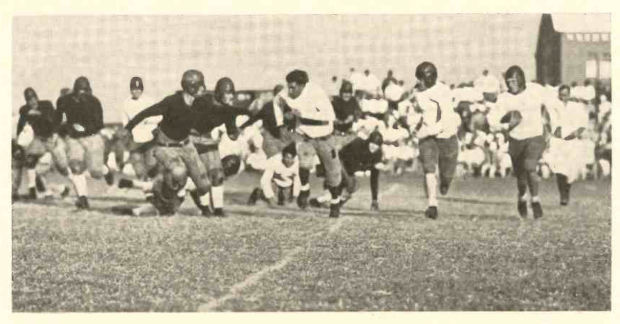
1928: Arizona battled New Mexico to a 6-6 tie on Homecoming day in 1928. The Desert Yearbook notes, "Arizona underrated the strength of the Lobos and did not take advantage of chances to score until it was too late." The team would have settled for a tie the following week, when they faced national champions USC and "were trimmed," 78-7.

1929: UA defeated Caltech, 35-0, on Oct. 12, 1929, the first homecoming game played in the new Arizona Stadium. It was dedicated by Gov. J.C. Phillips before a crowd of 6,000.

1930: Scenes from the 1930 UA Homecoming as presented in the 1931 Desert Yearbook. Note the huge "A" constructed over the entrance at Main Gate.

1931: UA Homecoming game against Rice was the first played under stadium lights. Rice "broke a string of gridiron Homecoming day victories, which lasted since 1915, to mercilessly trounce the Cats, 32-0," according to the 1932 Desert yearbook.

1932: The Kappa Alpha Theta float, an airplane called the Spirit of A, on University Boulevard at UA Homecoming circa 1932-35.

1933: Desert Yearbook makes no reference of the 1933 Homecoming. However, Arizona won its last two games of the season, against NAU and Whittier College.

1934: Homecoming week as presented in the 1935 Desert Yearbook.

1935: Coach Oliver of the Arizona Wildcats bemoaned the loss of a tackle, flanker and two backs to injuries two days before the 1935 game against the mightly Oklahoma City Goldbugs. Turns out it was it wasn't worth losing any sleep over it. Arizona won, 27-0.
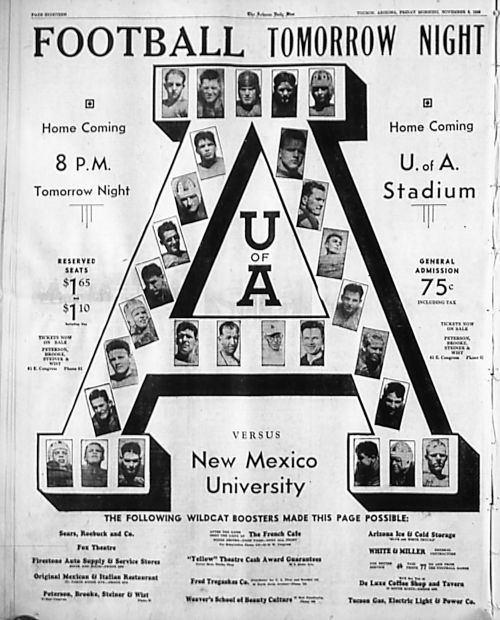
1936: An ad in the Arizona Daily Star on the day of the 1936 UA Homecoming game, urges last-minute holdouts to get their tickets. Primo reserved seats were a steep $1.65, but worth it.

1937: Homecoming parade. The Wildcats defeated the Kansas Jayhawks 9-7 on November 20, 1937.

1938: University of Arizona and Montana played for the Homecoming football game. Arizona lost, 7-0.

1939: Kappa Sigma house won for Homecoming decoration in 1939, the second year in a row for the honor. The Desert yearbook described it as "an Alley Oop bearing down on a red-nosed gentleman" to depict the Wildcats game against Centenary College. Arizona won, 7-0.

1940: UA Homecoming got a two-page spread in the Desert Yearbook, the last big splash before World War II. The yearbook noted more than 1,000 "old grads" returned to campus. Delta Gamma took first place in the float contest. The Wildcats won their game agains Louisiana's Centenary Gentleman, 29-6.

1941: A large "cat-astrophe" cutout sits in front of a student residence. The two wildcats hold a score sign.

1942: The Wildcats beat the Oklahoma A&M Aggies, 20-6, in a subdued 1942 Homecoming game that had no formal campus events due to World War II.
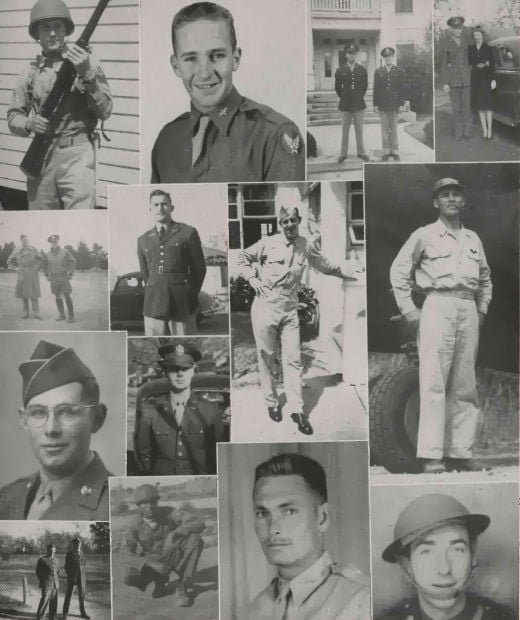
1943: Football was suspended in 1943 and 1944 due to World War II. The Desert yearbook published pages of snapshots of former Wildcats now serving in the military. The campus became home to U.S. Navy cadet pilots, who lived in Yavapai Hall, had classroom instruction campus and flight instruction Gilpin Airfield at Kino and I-10, which is now home to Costco and Walmart.

1944: Football was suspended for the 1944 season at UA due to the war. The pages of the 1945 Desert Yearbook show hundreds of U.S. Navy cadets at attention during ceremonies on the UA campus, including graduation of the Navy Indoctrination School, which was decommissioned in Spring, 1945, as the war came to close.

1945: University of Arizona football team.

1946: With World War II in the rear view mirror, the 1946 UA Homecoming came back with a big splash. The Desert Yearbook noted that more than 1,500 alumni returned to campus. A huge red "A" welcomed guests to Old Main. The football team battled Santa Clara to a 21-21 tie.

1947: Ruth Tackett of Alpha Phi was crowned the first official UA Homecoming Queen during a dance at Bear Down Gym in 1947.

1948: Alpha Phi float for the Homecoming parade in 1948.

1949: UA Homecoming featuring the Aggie House float.

1950: The oft-forgotten UA Homecoming princesses of 1950 - the ones who narrowly missed the big honor - as seen in the 1951 Desert Yearbook.

1951: The 1951 University of Arizona and Idaho football game. Arizona won 13-6.

1952: University of Arizona Homecoming Rally at Stone and Pennington, October 25, 1952

1953: Les Brown and the Band of Renown entertained alums and students at the 1953 UA Homecoming Dance, as seen in this photo spread in the 1954 yearbook. Brown also crowned Homecoming Queen Kay Mason. According to Wikipedia, "Les Brown and the Band of Renown performed with Bob Hope on radio, stage and television for almost fifty years. They did 18 USO Tours for American troops around the world, and entertained over three million people."

1954: University of Arizona Homecoming float shaped as a whale in 1954.

1955: UA Homecoming queen Joey Holter in the homecoming parade in Oct. 1955.

1956: UA Homecoming queen Nancy Haddad, with attendants Pat Finley, left, and Bobbi Corr in 1956.

1957: UA Homecoming parade on Stone Ave in downtown Tucson passed by the Pioneer Hotel and Tucson's biggest department stores: Steinfeld's, Jacomé's and J.C. Penney.

1958: Kappa Sigma fraternity members won first place in the "Proposition 200" category with a funeral procession in protest to the controversial ballot initiative to change the name of Arizona State College in Tempe to "Arizona State University." Tucsonans took issue, since UA was the defacto state university for 73 years.

1959: Alpha Xi Delta Sorority depicted snapshots of UA coeds - vintage 1900s - in the 1959 UA Homecoming parade.

1960: Last-minute float construction (never!) on the UA Campus prior to the Homecoming game in 1960. From the 1961 Desert yearbook.

1961: The caption for this 1961 UA Homecoming parade photo in the Tucson Citizen was both sweet and sexist: "Four beaming coeds set the tone for the slogan put on the Pi Beta Phi float in the annual University of Arizona Homecoming Parade. The girls also, as a lesson in economics, carry symbols of items which Arizona produces, along with pretty girls."

1962: Caption from the Tucson Citizen: "Today's Homecoming parade theme, "Smoke signals to satellites: Communications," was all the inspiration Gamma Phi Beta sorority members needed to come up with this float. At left, Bobbi Stephenson, Phoenix, and Sue David, Fullerton, Calif., portray Indian girls sending smoke signals. Vicki Carlson, also of Phoenix, holds the Navy semaphore flags, while at right, a satellite "orbits" the Earth.

1963: Sigma Chi's "Cough it Up!" float in the 1963 UA Homecoming Parade, a nudge for UA alumni to donate money to start a medical school. The College of Medicine was founded in 1967.

1964: Delta Chi fraternity members and others work on their UA Homecoming float, "We Grew, We Fought, We Prospered," outside the the fraternity house in November, 1964

1965: The message on this float, "Arizona's Finest Woman," in the 1965 UA Homecoming parade is anyone's guess.

1966: UA cheerleaders ride in the back of a 1955 Chevy Bel Air during the 1966 UA Homecoming football game against BYU at Arizona Stadium.

1967: Alpha Epsilon Phi sorority won first place for their 1967 UA Homecoming float, "All Hail Pop McKale," Arizona's famous football coach, who died on June 1 that same year. The float shows the proposed "fieldhouse" to be named after McKale (McKale Center, which opened in 1973). One minor glitch on the float: They spelled McKale's name wrong (McHale).
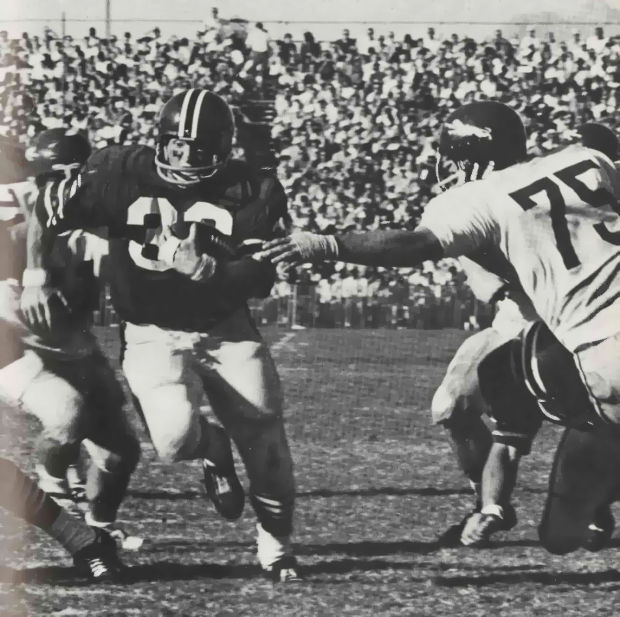
1968: Three interceptions helped seal a 28-14 victory over Washington State in the 1968 Homecoming game. The photo shows halfback Dan Hustead on an eight-yard touchdown run to give the Cats at 21-0 lead.

1969: Students protesters of Vietnam War gathered around a coffin with an American flag draped over it. Students listen to Reverend Don Eckstrom read scripture aloud at the University of Arizona mall during the 1969 UA Homecoming week.

1970: Rufus the Wildcat died in October, 1970, before the Homecoming game against Air Force. The Desert Yearbook said the autopsy indicated stress brought on by an ulcerous condition or a virus. The veterinarian was quoted as saying the games "were a terrible stress on the animal." The ASUA Senate passed a resolution abolishing the use of a live animal as mascot. The yearbook went on: "So there will no longer be a Rufus. The only University mascot will have to be Wilbur...."

1971: UA President John P. Scheafer kisses 1971 Homecoming queen Mattie Green during the halftime ceremony on Oct. 30 at Arizona Stadium. Green was the first African-American to be crowned in the university's history.

1972: This UA Homecoming float pays tribute to Arizona's A1 beer, favorite for college students in 1940s-70s

1973: UA Homecoming Queen finalists paint a mural at El Con Mall on Oct. 28, 1973, in advance of the big game. From left, Nancy Miller, Denise Bina, Lisa PIckett, Rachel Gjerding, and Sherri Giuendelsberger.
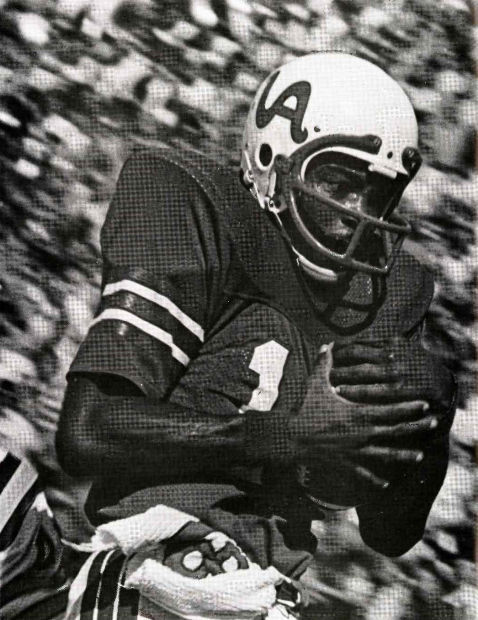
1974: The UA football team lost to BYU in October, but swept Colorado State, Air Force, Wyoming and ASU to finish the season.

1975: Jim Young's Wildcats lost to the New Mexico Lobos at the 1975 Homecoming Game, 44-34, diminishing their hopes for a WAC title.

1976: Earl Mendenhall escorts 1976 UA Homecoming Queen Natalie Fabric.

1977: Orville "Speedy" McPherson, a fullback on the 1914 UA football team, left, reminisces with Harold C. Schwalen, a 1917 distinguished engineering grad, during the 1977 UA Homecoming alumni dinner at the Ramada Inn Tucson. McPherson, on the famous Pop McKale team that "fought like wildcats" spent 30 years in journalism. Schwalen was professor and department head in agriculture engineering until 1965.

1978: Getting down with the sounds of that Disco beat at the 1978 UA Homecoming Ball at the Doubletree Hotel on Alvernon.

1979: Dancers swing their heads and hair to the music of Chuck Wagon and the Wheels during a 1979 Homecoming Rally on UA Mall.

1980: University of Arizona mascot Wilbur the Wildcat tries to lead cheers at a 1980 Homecoming Pep Rally on the UA Mall. Under the Wilbur head? Sophomore student Nancy Benedict.

1981: UA students donned homemade soda cans of Orange and Grape Crush (and little else) in keeping with the 1981 Homecoming Parade theme of "Crush Washington State."

1982: UA's 1931 football head coach Fred Enke Sr., left, talks over good times with players Milton Morse, center, and Peter Kusian during a 1982 UA alumni Homecoming Reunion at the Plaza International Hotel in Tucson.

1983: UA football head coach Larry Smith leads his team, including All-American linebacker Ricky Hunley (right), during a cheer at the 1983 UA Homecoming bonfire rally on the UA Mall.

1984: Students and faculty took turns beating up a junk car painted with "Crush the Cardinal" during a 1984 UA Homecoming Rally on the UA Mall in advance of the Stanford football game. People could take home any parts that fell off after they took their whacks.

1985: The UA Homecoming Pep Rally on the UA Mall included an egg toss. The participant at left is wearing a guitarist Eric Clapton tour shirt. Clapton was nicknamed "Slow Hand." But an egg toss requires quick hands or there could be a mess.

1986: UA students do their best surfing moves on a float in the 1986 UA Homecoming parade on the UA Mall on Nov. 1, 1986.

1987: Homecoming royalty nominees participated in a "Dating Game" on the UA Mall on Nov. 3. The participants were given questions by the m.c. and the audience.

1988: Wilbur the Wildcat beckons all fans to the UA Homecoming bonfire on the UA Mall on Oct. 28.

1989: A mud tug-o-war marked the first day of UA Homecoming week festivities on Oct. 23, 1989. Some homecoming royalty, including Diane Kocour, center, tried their hand at avoiding the muck. It was sponsored by the Bobcats senior honorary.

1990: Actor Craig T. Nelson, who attended the University of Arizona on a drama scholarship, waves to the crowd at the 1990 UA Homecoming parade on the UA Mall. Nelson struggled after college, but got a good role in the Al Pacino film, "And Justice for All." He went on to a lead role in Steven Spielberg's "Poltergeist." But he may be best known for the TV series, "Coach."

1991: A University of Arizona band alumnus, with Lite Beer can wedged firmly into the bell of his alto saxophone, marches with fellow Pride of Arizona alumni during the 1991 UA Homecoming Parade on the UA Mall.

1992: Members of Sigma Pi Epsilon fraternity raise their beers during the 1992 UA Homecoming Parade on the UA Mall on Nov. 7.

1993: Anne Marie Hall dons her UA game sweatshirt on Nov. 2, 1993. At the time, Hall was 90-years-old and had been to every UA game for the previous 50 years.

1994: Members of Gamma Phi Beta and Sigma Phi Epsilon fend off a beer attack during the 1994 UA Homecoming Parade on the UA Mall on Nov. 5. The theme of their float was, "It's a Wildcat World."

1995: UA cheerleaders jog along the route of the 1995 UA Homecoming Parade on the UA Mall on Nov. 11.

1996: Members of the Gamma Phi Beta sorority and Fiji fraternity cheer from the top of a truck complete with football and a goal post during the Homecoming parade.

1997: Jeremy Crutchfield, president of the Bobcats, a senior group at the University of Arizona, puts mud on the head of homecomming queen finalist Robyn Connolly during a mud tug-o-war on the UA Mall to promote the UA spirit during homecoming week.

1998: Alpha Phi girls and Beta Theta Phi guys work making flowers for the Beta's homecoming float. Hundreds of the paper flowers were made for the float.

1999: The UA's Homecoming Parade on the UA Mall prior to the game on Nov. 6.
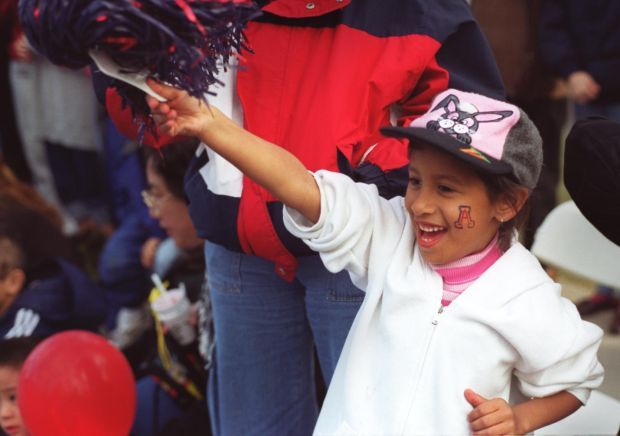
2000: Danielys Zepeda, 7, cheers during the UA homecoming parade on University Blvd.

2001: The Pride of Arizona marches along the UA Mall by Old Main during the homecoming parade on November 10, 2001.

2002: Homecoming festivities included a celebration of the 100th year of the UA band. Here, Jack Lee, 81, a former band director at the UA who wrote "Bear Down Arizona" fifty years ago, waves his napkin while accepting a standing ovation in Bear Down Gym.

2003: University of Arizona cheerleader Taylor Hendrickson gets tossed into the sky on Nov. 8, 2003 during the homecoming parade along the UA Mall.

2004: It was an emotional Homecoming on Saturday at the UA-Oregon State football game, when longtime twirling coach Shirlee Bertolini was honored at halftime. Bertolini, who came to the University of Arizona as its first female twirler in 1954, became the twirling coach in 1958.

2005: One of thousands of fans who stormed the field at Arizona Stadium gets a ride off after Arizona's Homecoming victory over UCLA. The Wildcats, who had won only one Pac-10 conference game, scored the first four times they had the ball Saturday on the way to a 52-14 victory over the Bruins. UCLA came into the game undefeated and ranked No. 7 in the country.

2006: C.L. “Stub” Ashcraft, No. 20, show in this 2006 photo reflected in a University of Arizona team photograph from 1941. By his count, it was his 388th straight home game since he returned from World War II duty in 1945.
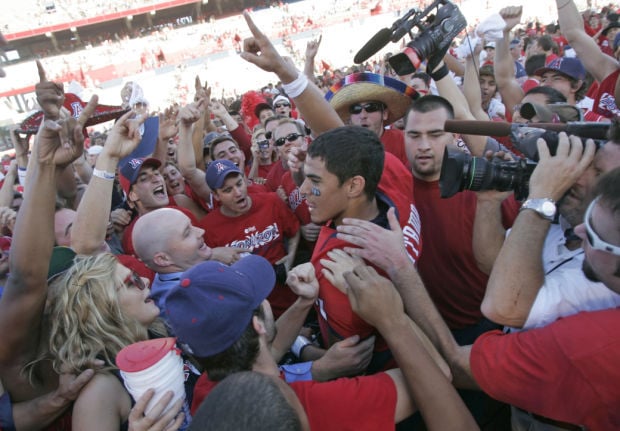
2007: Arizona's quarterback Willie Tuitama gets surrounded by fans after their Homecoming win against UCLA, 34-27, on Nov. 3, 2007.

2008: Rowdy Arizona fans get pumped up before the Wildcats' homecoming game against Southern California at Arizona Stadium on Oct. 25, 2008.

2009: University of Arizona students partake in the unofficial homecoming kick-off tradition of running across campus in their underwear on the UA Mall on Nov. 5, 2009.

2010: A group of University of Arizona students get into the school spirit after Pie-in-the-Pants on the University of Arizona mall on Wednesday October 20, 2010 in preparation for homecoming.

2011: Junior Honorary League "chain gang" member Leo Oppenheimer, center, cheers from a bus during the annual homecoming parade on the UA Mall, Saturday, Nov. 5, 2011. The grand marshall was Ron Barber, a member of Congresswoman Gabrielle Gifford's staff when he was shot on Jan. 8, 2011.

2012: The national champion University of Arizona baseball team hitches a ride on Tucson Fire Department's Ladder 1 during the 98th UA Homecoming Parade on Saturday, Nov. 10, 2012. Alumni and fans braved chilly temperatures to attend the Friday night bonfire, and Saturday alumni breakfasts, tailgate parties, the parade and the homecoming football game against the Colorado Buffaloes.

2013: Sebastian Adamski comes out of the crowd to get a high five from the Irish Elvis for the Homecoming before the game against UCLA at Arizona Stadium, Saturday, November 9, 2013.

2014: Wilbur the Wildcat rides a Tucson Fire Department ladder truck during the 100th Homecoming Parade at the University of Arizona.

2015: Judy Sutter, right, class of 1971, runs out to meet fellow twirler alum John Lee as he marches with the Alumni Band at the 101st University of Arizona Homecoming Parade.

2016: A dismal season redeemed. After eight straight sometimes embarrassing losses, the Wildcats with Jacob Alsadek (holding the Territorial Cup) celebrate a 56-35 pasting of the ASU Sun Devils at Arizona Stadium.

2017: The "A" on Sentinel Peak ("A" Mountain) is lit with flares signaling the start of University of Arizona Homecoming week in Tucson on Oct. 22, 2017. Members of the Bobcat Senior Honorary set up flares on the mountain as part of their tradition. The UA Alumni Association has a concise history of the "A":
Back-to-back victories over Pomona College in 1914 and 1915 inspired football player and civil engineering student Albert H. Condron. He went to one of his professors and suggested building an “A” in rocks on the side of Sentinel Peak as a class assignment.
Construction began on Nov. 13, 1915. It was completed on March 4, 1916.
The land was cleared and rocks were hauled up the mountain by six-horse teams. Students worked week after week and the “A” was finally white-washed nearly four months after construction began. Total cost of the project? $397.

2018: Homecoming king and queen Ahmed Al-Shamari, left, and Jalon Jackson wave to the crowd during the 2018 University of Arizona homecoming parade on campus, Oct. 27, 2018, in Tucson, Ariz.

2019: Harper Pastore, 5, waves to a passing car during the the University of Arizona homecoming parade on the UA Mall on Nov. 2, 2019. The grand marshal was UA women’s basketball head coach Adia Barnes, who led her team to WNIT Championship in April.

2020: Nikita Ganesh, a senior at the University of Arizona studying Psychology and Chinese, stands for a portrait on the rugby pitch at William David Sitton Field. Ganesh who has been playing rugby since she was a senior in high school and throughout college was the homecoming queen.

Fans rushed the field after University of Arizona defeated Cal, 10-3, at homecoming for the only win of the football season.

2022: A fan narrowly misses catching a t-shirt chucked into the stands by former Arizona standout and NFL star Rob Gronkowsi in the second quarter of the Wildcats game against USC at Arizona Stadium in Tucson on Oct. 29.

