

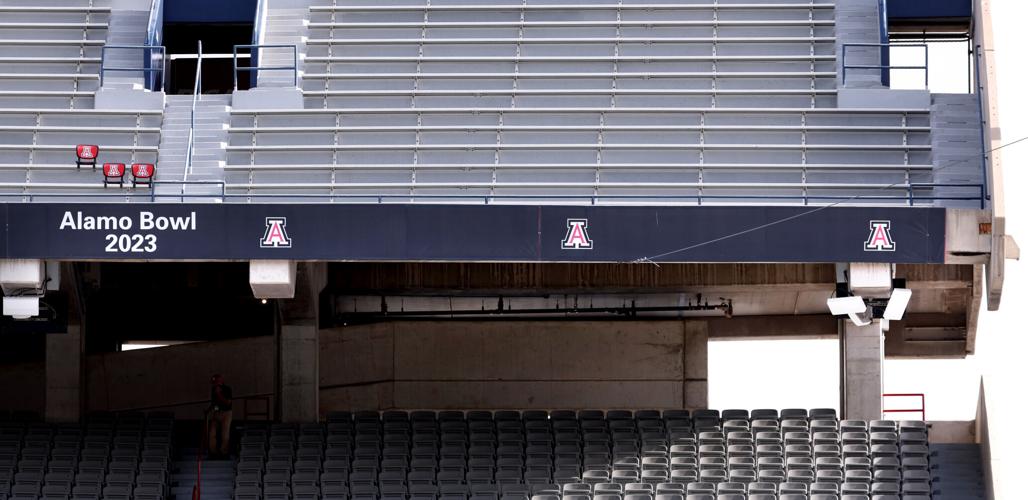



Someday soon, the football architects at Casino Del Sol Stadium are going to have to create a new place to display the UA's bowl history.
There is space to display 24 bowl game appearances on the lower facade of the upper deck at the stadium; when the 2025 Holiday Bowl script is put into place, that will leave one vacancy.

Only two spots remain to commemorate Arizona's bowl appearances in the ring along the upper section of the east stands at Casino Del Sol Stadium, Dec. 27, 2025, in Tucson.
That would have been a wild concept 40 years ago. As the Wildcats entered the 1985 season, they had played in a paltry four bowl games: 1921, 1949, 1968 and 1979.
Now it's news if a Power 4 school doesn't go to one of the 30-something bowl games.
Today, Arizona's bowl history is both sad and prolific.
It's sad because the Wildcats never made it to the Rose Bowl. The grief of that 0-for-48 streak won't soon, if ever, go away. But otherwise, Arizona's bowl history is a reflection on what is right and wrong with college football, today and more than 100 years ago.
Let's start at the 1921 East-West Christmas Classic bowl game in San Diego. There were only three — yes, three — bowl games in 1921, but Pop McKale's Wildcats got one of those coveted berths when Western powerhouse Cal went to the Rose Bowl. Incredibly, the Wildcats of ’21 were seen as the West's next best option and why not? McKale's club had won games by inconceivable scores of 110-0, 84-13, 74-0 and played mighty Texas A&M close in a 13-7 road game.
We couldn't have imagined that what happened before, during and after the 1921 East-West Christmas Classic would be a preview of what college football would be like 104 years later, but it was.
For example, Arizona appealed to its donors for money to support the football program. In a statewide appeal, the UA raised $243 so that McKale's Wildcats could buy new uniforms for the bowl game. That's about $4,000 in today's purchasing power.
Centre College of Kentucky, then a national powerhouse, was led by quarterback Bo McMillin, a first-team All-American. Much like today, McMillin sought compensation for his talent. He was 26, far beyond the limits of eligibility standards, but he was so popular he left Centre immediately after the game to become the head coach at Centenary College for $10,000 a year, or about $185,000 today. (Incidentally, Centre routed Arizona 38-0 that day in San Diego in what the Daily Star previewed by writing "this is the greatest game in the history of Arizona football for the unsung, unknown Wildcats."
Making money off college football was hardly a new concept in the "amateur" game of the 1900s.
When Arizona was invited to its second bowl game, in 1949, the New Year's Day Salad Bowl in Phoenix, a story leaked that the UA football players had demanded $175 per player to participate in the game. (That is roughly $2,500 today). UA coach Mike Casteel said the United Press International story was not accurate, and that the 39 Wildcats on the roster would instead donate their share of the Salad Bowl purse, about $12,500, to Phoenix charities.
Coaching in 1949 was a transient business, much like today's coaching business. Even though Casteel had gone 41-26-3 in his Arizona years, a 14-13 loss to lowly Drake in the Salad Bowl so frustrated UA fans and the administration that Casteel was fired.
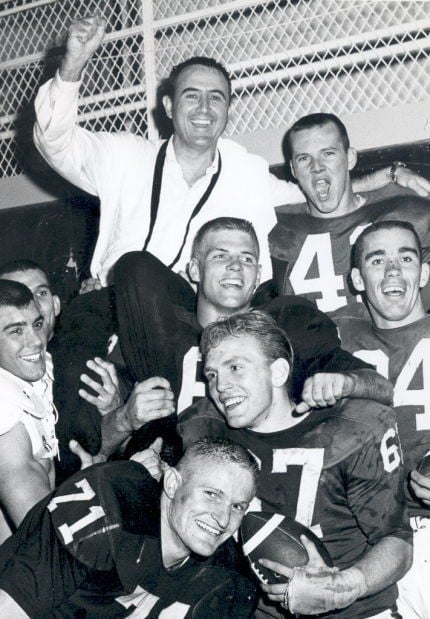
Coach Jim LaRue led the UA to an 8-1-1 season in 1961.
The next time Arizona seemed qualified for a bowl game, 1961, the State Board of Regents blocked coach Jim LaRue's hope that his terrific 8-1-1 team would be allowed to play in the Sun Bowl or the Liberty Bowl. The Board of Regents denied the request, proclaiming that 10 games was enough for a "student-athlete" each season. Unbelievably, the best team in UA history to that point didn't play in a bowl game.
Incredibly, Frank Kush's remarkable ASU Sun Devil teams of the ’50s and ’60s were also shut out of bowl games, except for one 1951 Salad Bowl matchup. The Sun Devils produced records of 10-0 in 1957, 10-1 in 1959 and 8-1 in 1963. ASU didn't play in a bowl game from 1951-70.
By 1968, the Board of Regents had relaxed its "no-bowl" stance and created one of the most infamous bowl scenarios in history. The ’68 Wildcats were 8-1 under coach Darrell Mudra as they prepared to face Kush's 7-2 Sun Devils in the Territorial Cup. A week before the game, the Sun Bowl made it known it would take the winner of the UA-ASU game. That didn't sit well with Mudra, who went public with a declaration that the Sun Bowl had to offer Arizona a bid before the Territorial Cup. The Ultimatum Bowl was born.
The Sun Bowl caved in and agreed that Arizona was its choice. Alas, the Sun Devils roasted Arizona 30-7. The Wildcats were then routed 34-10 by Auburn. UA president Richard Harvill was humiliated by the entire process. He and Mudra quarreled so much that Mudra resigned after an 8-3 season.
And you think college football in the 2020s is over the line?
By 1986, Arizona had righted its football ship. Coach Larry Smith had six consecutive winning seasons, climbing to No. 11 in the final AP poll, ending ASU's long reign by knocking the Sun Devils out of the Rose Bowl twice and beating their ’86 Rose Bowl team. The 8-3 Wildcats were offered berths in the Liberty, Bluebonnet and Aloha bowls and, predictably, voted unanimously to play North Carolina on Christmas Day in Honolulu.
All was right with the football world in Tucson, right?
Unfortunately, Smith had begun negotiations to become USC's football coach a few weeks before the Aloha Bowl. His inevitable departure from Tucson was the elephant in the room even after the Wildcats beat the Tar Heels in Honolulu, 30-21.
On the night before the game, Smith's wife, Cheryl, walked into the hospitality room at a beach-side hotel. As she did, 15 or 20 UA fans and sports media began chanting USC's "Fight On" song. Cheryl laughed and said, "Well, what would you do?"
Larry Smith became USC's coach 24 hours later.

Arizona head coach Rich Rodriguez and his staff try to get the offensive play into the game in the third quarter against Boise State in the Fiesta Bowl, Dec. 31, 2014, in Glendale.
Over the next 40 years, Arizona's bowl games have seen the predictable highs and lows. A happy Fiesta Bowl rout over the Miami Hurricanes was offset 20 years later by a Fiesta Bowl loss to underdog Boise State. A historic 1998 Holiday Bowl victory over Nebraska, allowing Arizona to finish a best-ever 12-1, came tumbling down a decade later in a humbling 33-0 Holiday Bowl loss to the same Cornhuskers on the same field.
In its 22 bowl appearances, Arizona has seen it all. It all began in 1921 when Arizona Gov. Thomas E. Campbell sent Pop McKale a telegram before the Wildcats' game in the East-West Classic in San Diego. "I know you are up against Goliath," wrote Campbell, "but I have hopes in the Davids of Arizona.''
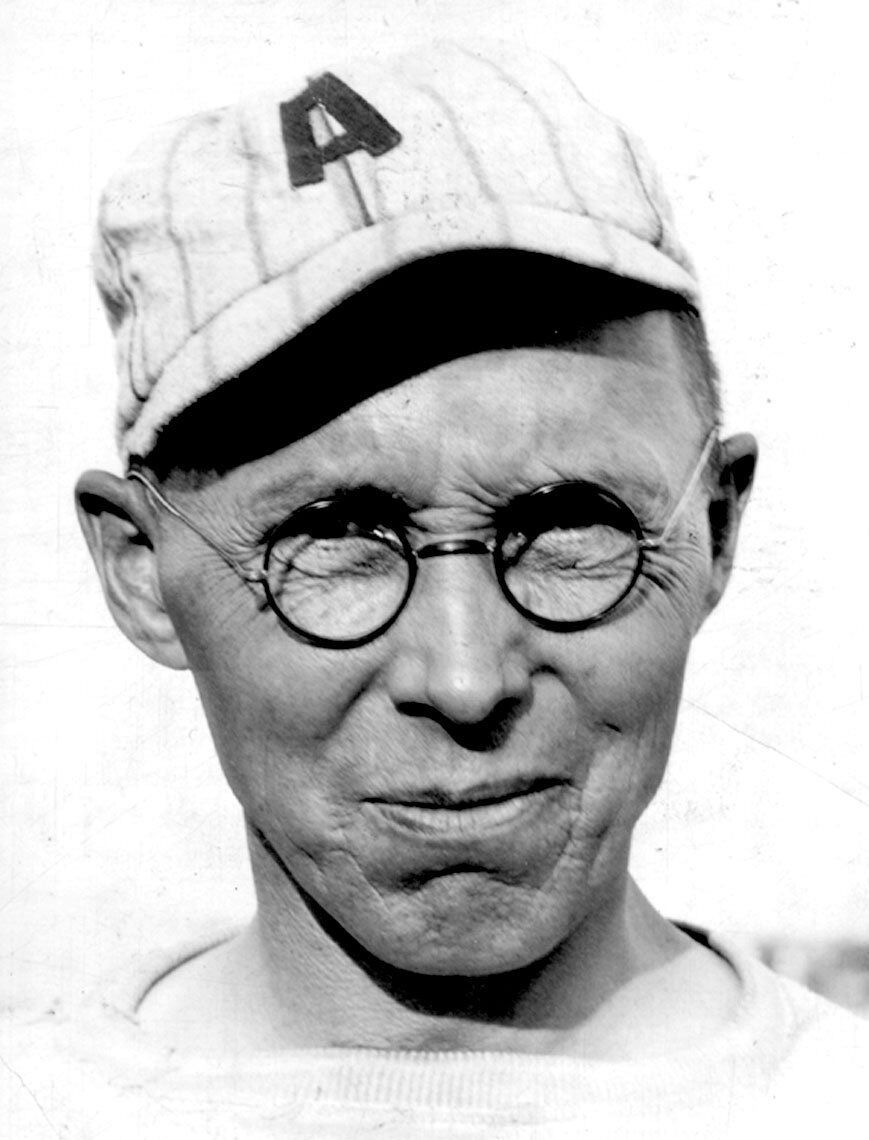
University of Arizona football coach James F. "Pop" McKale in 1936.
The Arizona-SMU match will be Arizona's fourth bowl game in San Diego in 104 years. If nothing else, it will be the first time the Wildcats won't be playing the role of David.


