



In the old days of college basketball — like, maybe a year or two ago — Carter Bryant’s stay-or-go decision might be mostly about whether to bet on himself or not.
Now projected as a mid-first-round NBA Draft pick, Arizona’s 19-year-old forward could return to college and become a lottery pick if he shows enough improvement as a sophomore next season — and slip if he does not. Or he could stay in the draft, and if his projection holds up, earn about $3 million to $5 million as a first-round pick next season.
Arizona’s Carter Bryant throws in 360 and reverse dunks during the Wildcats’ warmups before playing Oklahoma State on Tuesday, Jan. 21, 2025. Video by Bruce Pascoe, Arizona Daily Star
That’s the NIL-free way of viewing it.
But at a time when booster-paid dollars are being furiously frontloaded into 2025-26 college basketball deals — so they won’t be scrutinized as they will likely be as a condition of the pending House settlement — the equation is a little more complicated than that.

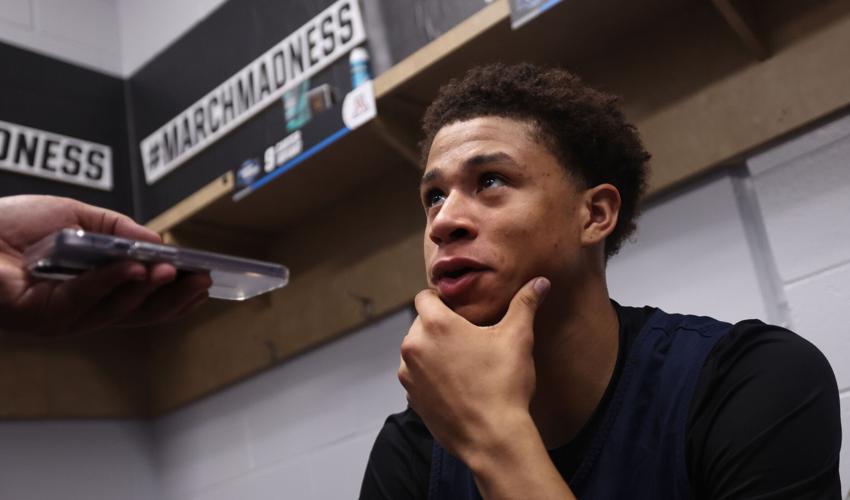
Arizona forward Carter Bryant answers a few questions from his locker on the eve of a Sweet 16 matchup with Duke in the men’s NCAA Tournament in Newark, N.J., March 26, 2025.
First-round NBA picks will earn at least $2.7 million next season, while the rookie minimum is expected to be about $1.27 million … but some top college players are reportedly pulling in more than that. Texas Tech forward JT Toppin, a possible first-round NBA Draft pick, even skipped the draft process to return to the Red Raiders and earn a reported $4 million next season.
The co-founder of NIL advisory firm Opendorse, Blake Lawrence, told the Star that most high-level college men’s basketball programs will need “millions of outside-the-cap” support, or NIL money on top of the revenue-sharing dollars schools can pay players if the landmark House antitrust settlement is finalized this spring.
Travis Branham, an analyst for 247 Sports, posted this week that eight men’s basketball programs now have budgets of $10 million or more, while CBS said there’s a “golden tier” of 10 programs with budgets at least that high.
Arizona was not listed in that tier, and the school isn’t disclosing what it is offering players. But UA is expected to pay at least $4 million to its men’s basketball players on top of a booster-funded NIL budget that might be about as much, suggesting Bryant could command a deal that approaches or surpasses the NBA minimum.
In other words, there’s now a significant financial cushion if Bryant returns to Arizona, something else to consider in his decision.
The sort of decision Bryant faces also complicates life for college coaches and GMs.
UA coach Tommy Lloyd said this week that Bryant would enter the NBA Draft but signed to play again for Arizona if he returns to college. That means, as transfer portal options dwindle this spring, Lloyd will have to keep conditionally recruiting to fill Bryant’s potential vacancy while also keeping UA’s budget in mind.
“With the portal moving so fast — and assuming there’s a seven-figure offer from Arizona — I’m not sure coach Lloyd can afford to wait until after the (NBA pre-draft) combine for a decision,” said NBA Draft analyst Matt Babcock, a former UA walk-on player. “Roster building in college is happening in real time, and if Carter doesn’t take the deal soon, Arizona might have to spend that money on someone else.”
Lloyd faced a similar situation last spring when guard Caleb Love declared for the NBA Draft and went nearly to the late May deadline to withdraw and return to college. But Lloyd has expressed patience with both players.
Bryant hasn’t declared publicly for the NBA Draft but has until April 26 to do so, while players have until May 28 to withdraw if they want to return to college.
“Carter has options, and we’re supportive of him,” Lloyd said. “We’ve been in a communication and Carter has signed a rev-share agreement with the University of Arizona if he comes back to college.”
If Bryant opts to stay in the draft, one NBA scout said, he’s generally rated between late lottery to late first round, or expected to go between picks 12-28. He could jump higher in 2026 if he improves his shot-creation and ballhandling at Arizona, the scout said, but faces “a chance he could hurt himself if he doesn’t.”
That’s the equation that hasn’t changed.
Babcock, a veteran of many basketball roles whose father and two uncles ran NBA front offices, said developing young talents can help or hurt their NBA standing anytime they step on the floor with scouts watching.
“This is a high-stakes industry for everyone involved — there’s no way around it,” Babcock said. “With Carter, though, it’s not just about scoring. It’s about overall impact. Sure, you’d like to see a jump in his scoring production, but his potential as a rebounder, versatile defender, off-ball scorer, and floor spacer holds real value.”
Babcock sat courtside at UA’s games in the Thanksgiving-week Battle 4 Atlantis, when the Wildcats lost two of three games, and Bryant had a combined three points in them.
But a few weeks later, after bottoming out with a 57-54 loss to UCLA on Dec. 14 and losing injured center Motiejus Krivas for the season, the Wildcats developed a more efficient rotation and more minutes for Bryant.
“Carter came in highly rated but began the season in a limited role and didn’t produce much early, which naturally raised questions about his readiness,” Babcock said. “As scouts, we can often read between the lines, but there’s no denying that a larger sample size makes it easier to reach a high level of confidence in an evaluation.
“As the season progressed, Carter’s role expanded, his production picked up, and so did the belief that he may be ready to make the jump.”
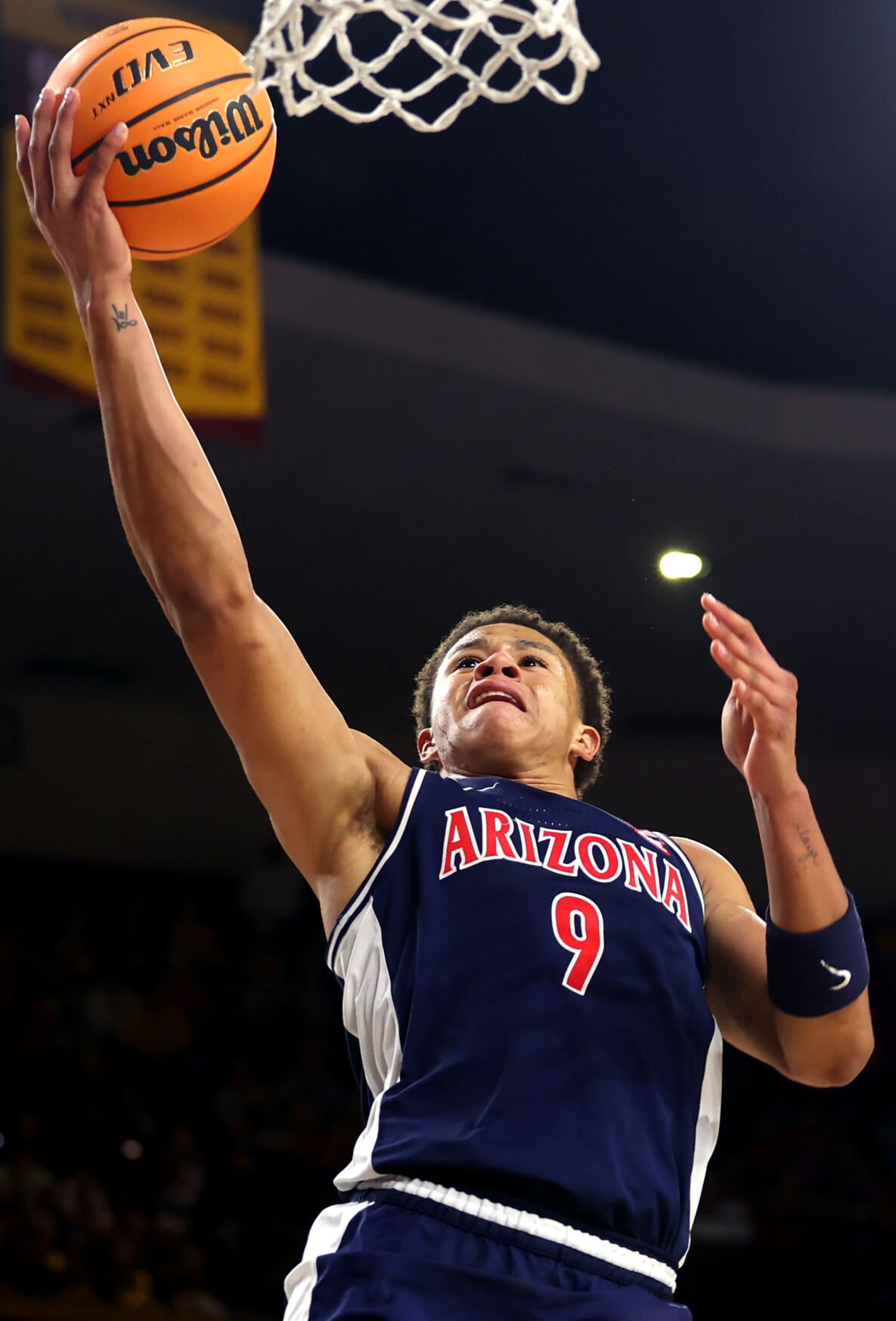
Arizona forward Carter Bryant (9) attempts a lay-up during the first half of the game against Arizona State University at Desert Financial Arena, Feb. 1, 2025.
Overall, though, Bryant averaged just the seventh-most minutes (19.3) on the Arizona roster last season, even as The Athletic’s Sam Vecenie noted in his March mock draft that the “Wildcats are drastically better with him on the court than off it.”
In a way, Bryant’s reserve role may have made him more intriguing to NBA scouts, a 19-year-old dripping with abilities that may not have fully surfaced on a team that relied heavily on Love and other veterans.
“He has one of the lowest usage rates of any player projected to go in the top 30,” wrote The Ringer, rating Bryant No. 6 on its Big Board of NBA prospects. “But Bryant would pass even the most rudimentary of eye tests: His Vitruvian frame, agility, and explosiveness would stand out in just about any game he’s in.
“The clincher? He’s only a freshman.”
But he won’t be next season. Bryant will either be a sophomore with, for better or worse, a more known résumé — or an NBA rookie. He has five weeks to decide which.

