




Pro golf isn’t always about privilege, ego and kids who grew up at the country club. It’s not always about Phil Mickelson, reckless and incendiary, suggesting he’s not making enough money.
Golf is a game of middle-class success and appreciation, too.
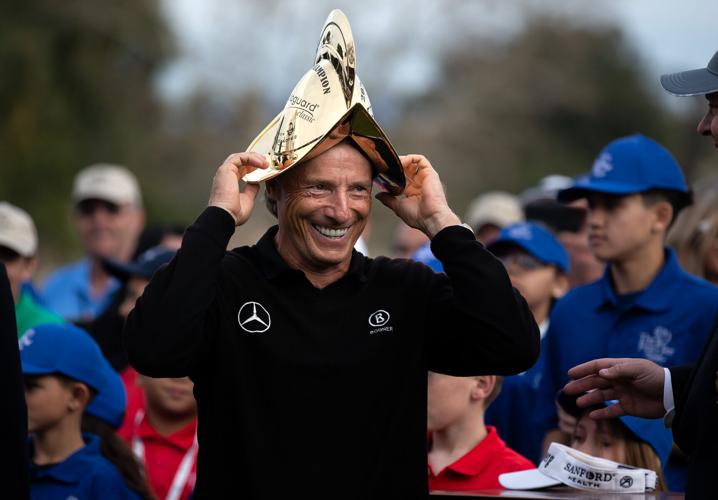
Bernhard Langer, the 2020 Cologuard Classic champion, winner of $63.8 million in official prize money, is the son of a German bricklayer, Erwin Langer. In 1944, Erwin escaped from a Russian prisoner-of-war camp, jumping from a train upon which he was bound for almost certain death in Serbia. Bernhard Langer quit school at 15 to get a job as a caddy, wearing hand-me-down clothes from his brother.
Mark Calcavecchia, who has earned $31.2 million in pro golf, is the son of Nebraska bowling alley proprietor. In his first Tucson pro golf tournament, 1984, Calcavecchia was the first player eliminated from the Seiko Tucson Match Play Championships. Calcavecchia carried his clubs to the parking lot at Randolph North, leaned against the trunk of his car and changed his golf shoes in the rain. It was like a scene out of “Caddyshack.”
Woody Austin, winner of the 2016 Cologuard Classic, has earned $26.3 million in official prize money. In his long journey to make the PGA Tour, Austin worked as a teller at a Florida credit union and as stock clerk in a drug store. At his first PGA Tour Qualifying school, he messed up his knee, requiring surgery, delaying his PGA Tour debut by two years.
It takes a lot more than money to be a success in pro golf. Almost nobody starts out on a pedestal, as Mickelson did in 1991, winning the Tucson Open as a junior at Arizona State.
As a group, the 80 Cologuard Classic golfers who will tee it up Friday at the Omni Tucson National — including Langer, Calcavecchia and Austin — don’t struggle to pay the mortgage. But it wasn’t predestined. Do you realize how difficult it is to be successful at pro golf?
Jim Furyk was never the No. 1 player on his Arizona golf team; Furyk, who has earned $74 million on Tour, was the No. 4 player on the UA lineup when it won the 1992 NCAA championship. The 2018 USA Ryder Cup captain earned every penny of that $74 million through an old-fashioned American work ethic.
In 2007, Furyk returned to Tucson to help his UA coach, Rick LaRose, stage a fundraising event at Tucson Country Club. Furyk spent all afternoon hitting tee shots at the No, 12 hole, rewarding any golfer who hit a tee shot closer to the pin with a dozen golf balls. At day’s end, Furyk noticed that no one had come to the 12th hole to disassemble the awning and collect golf balls, folding tables and advertising signs. So Furyk did it himself, piece by piece, piling it into a golf cart and driving it to the equipment shack just before sundown.
Over the last few weeks Mickelson threatened the relevance and legacy of the PGA Tour and its attendant events such as the Cologuard Classic. Fellow PGA Tour pro Billy Horschel called Mickelson’s comments “idiotic.”
Rocco Mediate, the son of a barber, has won $23 million in golf. Vijay Singh, whose father was an airline mechanic in Fiji, has earned $76 million on tour.
That’s what I try to keep in mind as Mickelson’s greed and ego dominates golf headlines this week. Much of America is middle class, which finds it hard to sympathize for Mickelson, winner of three Tucson Opens and more than $94 million in official PGA Tour earnings.
But it would be a mistake to bunch the fabulously wealthy Bernhard Langers and Jim Furyks in the same ungrateful category.
Langer is an overcoming-the-odds story like few in modern golf history, matching Hall of Famer Lee Trevino, who worked on a driving range at a hardscrabble golf club in El Paso, shining shoes, caddying — whatever it took to help take money home to his impoverished family. Trevino later spent four years in the Marine Corps before winning 22 PGA Tour events, including six majors and the 1971 Tucson Open.
The ever-personable Trevino was one of the most popular players in golf history.
Langer has a lot of Trevino in him, He spent 18 months in the German Air Force as a young man. He rode a bike five miles each way to his caddying job because his father, the former Russian POW, couldn’t afford an automobile.
On Wednesday afternoon, rather than blow off a media Q&A session on an outdoor patio at Tucson National, Langer showed up on time in the wind, rain and cold. He answered questions patiently and with insight.
“I will never forget the first tournament I ever won,” he said. “I was 16 and I won 500 deutsche marks, which is nothing, but at the time it was huge.”
“Then I won the German Championship when I was 17. I won 6,000 deutsche marks, which basically bought me my first car. There were many steppingstones.”

Bernhard Langer won the 2020 Cologuard Classic, and is viewed as one of the favorites to win again this week.
One of those steppingstones came in 1988. Langer played in his first Tucson Open, the old Northern Telecom Open at Starr Pass. He missed the cut. So did Furyk, then a freshman at the UA.
The ’88 Northern Telecom was won by David Frost, who helped to fund his early golf career as a cigarette salesman in South Africa. Now a millionaire many times over, Frost doesn’t have much in common with Phil Mickelson. Nor do Langer or Furyk.
Mickelson said the PGA Tour “desperately needs to change.”
That’s not what Langer said Wednesday.
“I hope to be an inspiration for the younger generation but also for the older generation,” he said. “When many people play our game between the age of 40 and 80,many of them say, ‘Oh, I’m too old, or I started too late or my back’s bad.’ I want to prove them wrong.”
Langer has had back surgery and a half-dozen injuries that have kept him off tour. Yet at 64, he’s on the brink of passing Hale Irwin’s once-unassailable record of 45 victories on the Champions Tour.
“I want to show them, ‘This guy can do it, he’s got a bad back, he’s 64 years old, he still thinks he can get better,’” said Langer. “Maybe I can do the same thing. Yeah, I’d like to be that kind of role model.”
Thank you, Mr. Langer, The golf community needed that.

