



Dear Mr. Football: Are there any bad feelings between NAU and Arizona?
A: Do you mean to suggest NAU’s 21-19 victory over the Wildcats in 2021 opened a festering sore similar to the UA’s 70-7 loss to the Sun Devils a year earlier?
No way. That’s not Arizona athletic director Dave Heeke’s style. He’s a competitor but not a grudge-carrier.

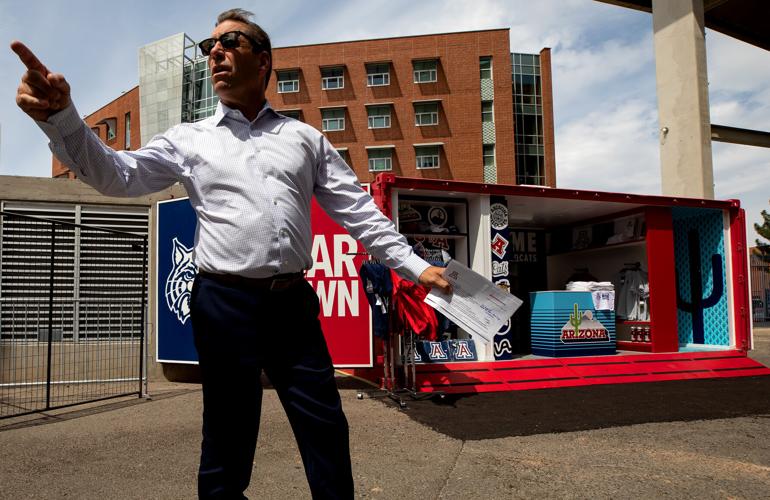
Arizona athletic director Dave Heeke (pictured in 2022) will host former UA athletic director Jim Livengood, former Washington State and Oregon AD Bill Moos, and current Northern Arizona AD Mike Marlow in his suite in the Arizona Stadium press box for Saturday’s matchup between the Wildcats and Lumberjacks.
In fact, Heeke’s guest in his press box suite Saturday night will be NAU athletic director Mike Marlow. Heeke and Marlow make up part of one of the most impressive athletic director “family trees’’ in college sports history, joined by former Oregon/WSU athletic director Bill Moos and former WSU/Arizona AD Jim Livengood.
All four — Moos, Livengood, Heeke and Marlow — will sit together Saturday night. Oh, the stories they could tell. Here’s how their connection began:
Livengood hired Moos to be an assistant AD at Washington State in the mid 1980s. Moos soon became the AD at Oregon, inheriting Heeke, who had worked for the Ducks for about seven years. In 1998, Moos hired Marlow to work for the Ducks, paired with Heeke, the UO’s senior associate AD.

The college athletics careers UA athletic director Dave Heeke(left), former Arizona AD Jim Livengood (right), former Oregon and Washington State AD Bill Moos and current NAU athletic director Mike Marlow (center) are interconnected.
Marlow was the FCS Athletic Director of the Year in 2021-22.
Moos and Livengood are now retired. Marlow is climbing the ranks and in the last year or two Heeke has emerged as one of the ranking ADs not just in the Pac-12 but in college sports.
Dear Mr. Football: Could NAU beat Arizona in any sport?
A: Unknown to most, NAU is the NCAA’s leading men’s cross country program. That’s no exaggeration. The Lumberjacks are better than Pac-12 powerhouse Stanford. Better than self-proclaimed distance (leftrunning giant Oregon.
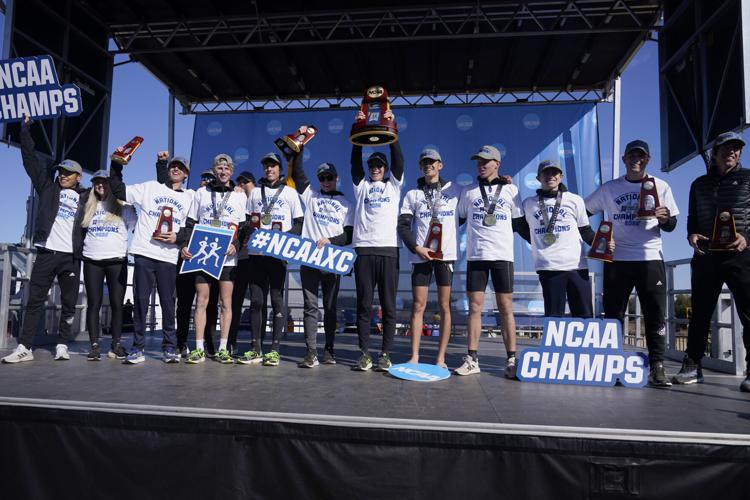
Coach Mike Smith’s Lumberjacks distance runners have won six of the last seven NCAA championships. That’s called a dynasty. NAU won it all in 2016, 2017, 2018, 2020, 2021 and 2022. Part of that epic run included Tucson’s Andy Trouard of Salpointe Catholic, who was an All-American in NAU’s title team of 2017.

The Northern Arizona men's team celebrates with their trophies after winning the team title in the NCAA Cross Country Championships Nov. 19, 2022, in Stillwater, Oklahoma.
More people in the distance running community are more familiar with Arizona’s cross country coach, four-time Olympian Bernard Lagat, but nobody has been able to poach Smith and pay him a small fortune to leave Flagstaff. Smith just signed a five-year contract with NAU, through 2027.
Dear Mr. Football: Will Arizona continue to play NAU once it goes to the 16-team Big 12?
A: Arizona and NAU are connected at the football hip. They will play in Tucson in 2024, 2026, 2027, 2030, 2031, 2032 and 2033. That’s seven games. The only other Big Sky team on Arizona’s schedule the next 10 years is Weber State (2025).

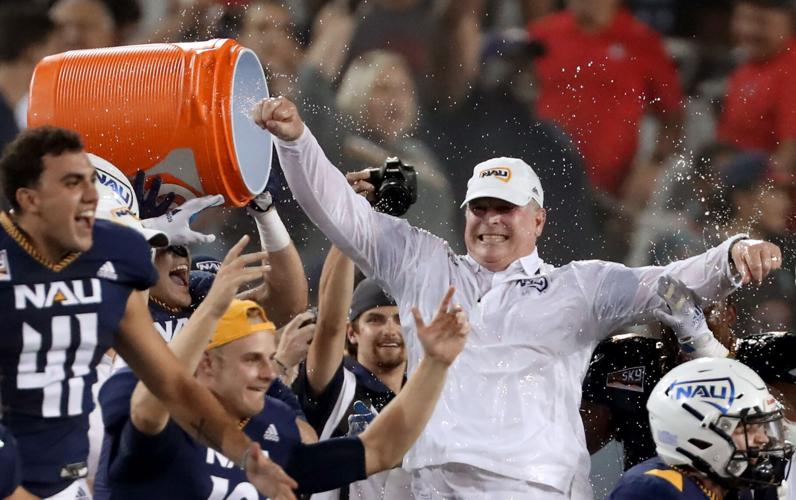
Northern Arizona head coach Chris Ball, soaking wet from a water dump, jumps for joy as the Lumberjacks upset instate rivals Arizona 21-19, in September 2021.
Dear Mr. Football: What type of a coaching staff advantage does Arizona have over NAU?
A: Jedd Fisch has been able to expand the UA staff to include seven full-time analysts and four graduate assistant coaches. Those men can’t recruit or participate in on-field coaching, but, oh, can they evaluate game film, help prepare game plans and make it seem like there are 20 coaches in the room.
By comparison, NAU has no analysts.
Dear Mr. Football: What’s the biggest difference between the football programs at NAU and Arizona?
A: Arizona’s football revenue from the 2021 fiscal year was $26.9 million. NAU’s was a mere $577,413, according to the school’s 2021 fiscal report.
The biggest source of income to NAU’s athletic department was $2.8 million from student fees. Arizona’s was $30.8 million from media/TV rights.
NAU’s athletic department has roughly 75 full-time employees. Arizona: about 250.
Saturday’s game is the only time all season that NAU will get “national exposure,’’ if you can call the Pac-12 Networks national exposure. The only other time NAU will play on linear, non-streaming TV this season is next week at North Dakota. The game will be broadcast on Midco Sports, an independent TV station in Grand Forks, N.D.
Otherwise the other nine NAU games will be available on ESPN-plus, a streaming system.
Dear Mr. Football: What best defines the decline of community interest in Arizona football the last five or six years?
A: Look no further than the attendance figures for the UA-NAU game. From 2005-2015, Arizona and NAU played six games in Tucson and never drew fewer than 50,000 fans. The average across that period was 52,672, which is more than the modern capacity at the stadium.
If nothing else, the Mike Stoops years marked a prolific rise in local interest and attendance. His UA teams drew 55,728, 52,638, 50,623 and 51,761 against NAU. The Zona Zoo section was often at 100 percent capacity.
But the last three times NAU has played in Tucson it has averaged a thin 39,280 at the gate. At mid-week, Arizona announced it had sold 44,200 tickets for Saturday’s game, far better than the 2021 low of 33,481, and perhaps the most encouraging sign that interest in UA football is climbing.
Dear Mr. Football: What’s a likely naming rights partner for Arizona Stadium?
A: About 20 years ago, the UA and Casino del Sol had serious talks about naming the football field after the casino. It sounded good at the time – about $3 million over 15 years –but in retrospect that would’ve been a nickel and dime job.
All that has changed. Mid-level Colorado State recently sold naming rights to its new football stadium to Canvas Credit Union for $37 million over 15 years. If Arizona does sell out to a corporate partner as ASU, Washington, WSU, OSU, Cal and USC have, it’ll have to be worth at least $5 million a year, minimum.
That’s life in the fast lane of college football. When NAU built the Walkup Skydome in 1977 for $8 million, it was funded in part by student fees and, believe it or not, by a $2 million savings fund created by then-NAU president J. Lawrence Walkup.
For several years, Walkup ordered all the nickels and dimes from on-campus vending machines to be dumped into a fund for a future indoor football/basketball arena. It netted about $2 million.
Such is the difference between a Pac-12 school and a Big Sky school.
Saturday’s final score will have a similar disparity. Wildcats 52, Lumberjacks 13.

