


Two things can be true:
– Arizona quarterback Noah Fifita needs to play better.
– The UA coaching staff and his teammates can do a better job of helping him be the best version of himself.

The Wildcats are a third of the way through the 2025 season — enough time to take a step back and analyze Fifita’s performance so far.
That’s our mission in this Oklahoma State-week edition of “Cats Stats.” But before we dive in, it’s important to consider a critical piece of context:
Fifita is playing in his third offensive system in as many years. He’s had different coordinators and position coaches in each of those seasons. That’s difficult for anyone.
Patience is probably the best prescription to cure Fifita’s inconsistency. But there are ways first-year OC/QB coach Seth Doege can steer Fifita in the right direction.
After poring through data accumulated by Pro Football Focus, we believe the Wildcats should be utilizing play-action more and throwing more screen passes. Those were two of the ways your favorite former head coach and play-calling guru, Jedd Fisch, put Fifita in a position to succeed.

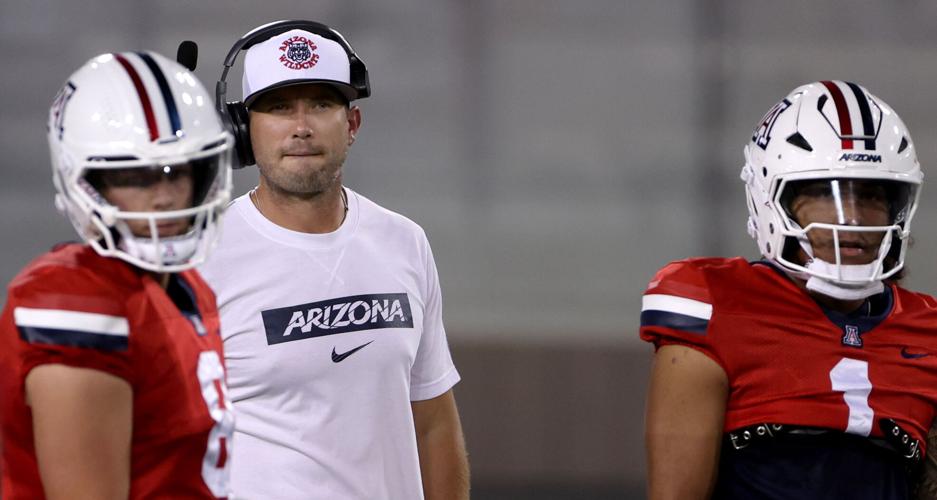
Offensive coordinator/quarterbacks coach Seth Doege watches with a couple of his charges, Braedyn Locke, left, and Noah Fifita, as the Wildcats run offensive drills in preseason training camp, Aug. 9, in Tucson.
In 2023 — Fifita’s breakout season and best campaign to date — he used play-action fakes on 27% of his dropbacks, per PFF. That number fell to 18.4% last year, when Arizona’s offense was a hot mess. It’s at 23.8% so far this year.
Fifita completed a robust 70.3% of his passes with a 6-2 touchdown-to-interception ratio when using play-action in 2023. He’s at 65.5% with a 3-1 TD-INT ratio this year. His completion rate without play-action is 60.2%.
Despite numerous reps during training camp, Arizona’s offense has not used screen passes very often. Fifita has executed a screen-pass concept on only 10.9% of his dropbacks — down from 15.6% last year and 18.4% in 2023.
Fifita has been incredibly efficient in the screen game. He has completed 86.7% of passes thrown with screens so far this season. That figure was 93.7% in ‘23. Fifita had only four incomplete screen passes in 63 attempts, per PFF.
In short, Fisch created easy, or at least easier, passes for Fifita to complete. The ‘23 team also had multiple NFL-bound skill-position players; we’ll address the personnel side of this in a little bit.

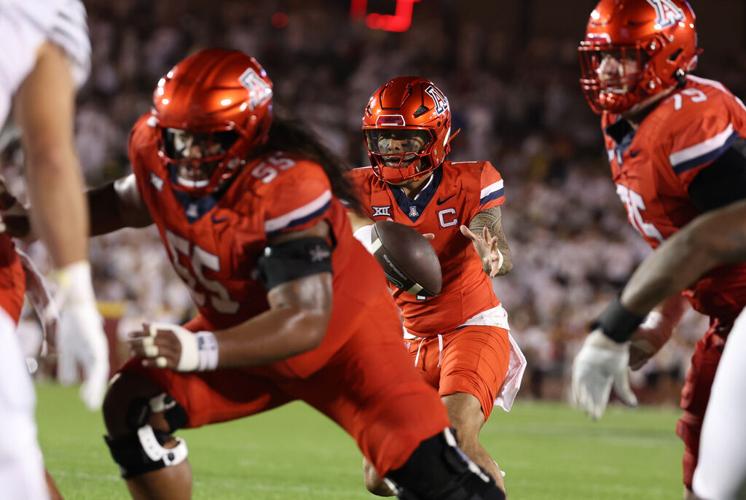
Arizona quarterback Noah Fifita reaches to catch a snap against Iowa State on Sept. 27 in Ames, Iowa.
Another way of looking at Fifita’s pass distribution is the depth of his throws. Unsurprisingly, fewer screen passes has meant fewer passes thrown behind the line of scrimmage.
Just 9.4% of Fifita’s pass attempts have been thrown behind the line so far this season. Last year that number was 21.6%. In 2023, it was 24.2%.
Fifita has completed all 12 passes attempts thrown behind the line this season. He has averaged just 4.5 yards per attempt, but still — you can’t do better than 100%, and those types of gains can keep the offense on schedule.
In ‘23, Fifita completed 93.8% of his passes thrown behind the line. The raw numbers, again, are mind-blowing — 76 of 81.
Fifita’s overall average depth of target (ADOT) in 2023 was 7.8 yards. It climbed to 8.7 last year. It’s currently sitting at 10.6 — second highest in the Big 12 behind Kansas’ Jalon Daniels, who’s at 10.7.
Is that by design? By choice? Is it the best course of action? Will it change over the course of the season as Doege and Fifita become more comfortable with each other?
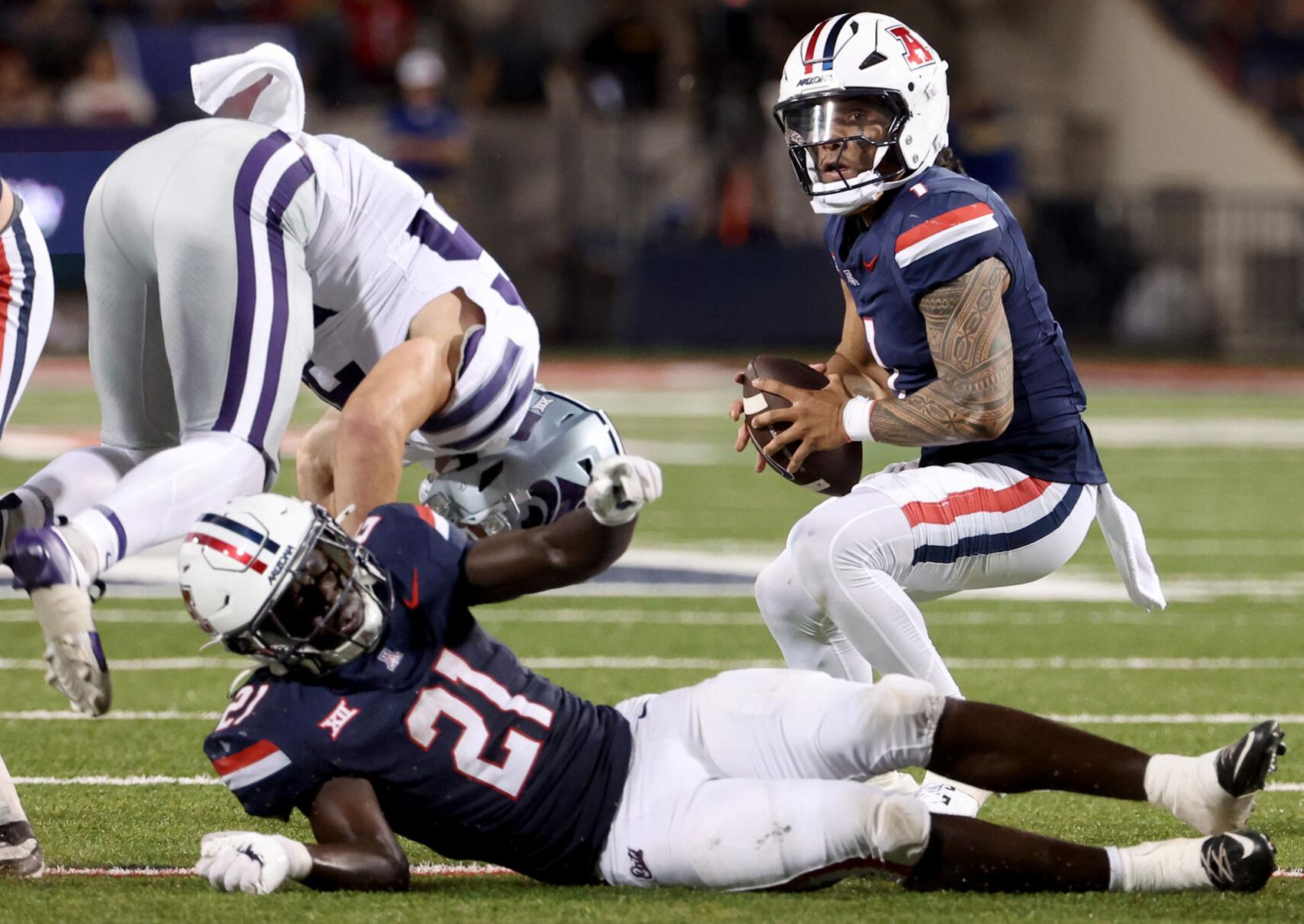
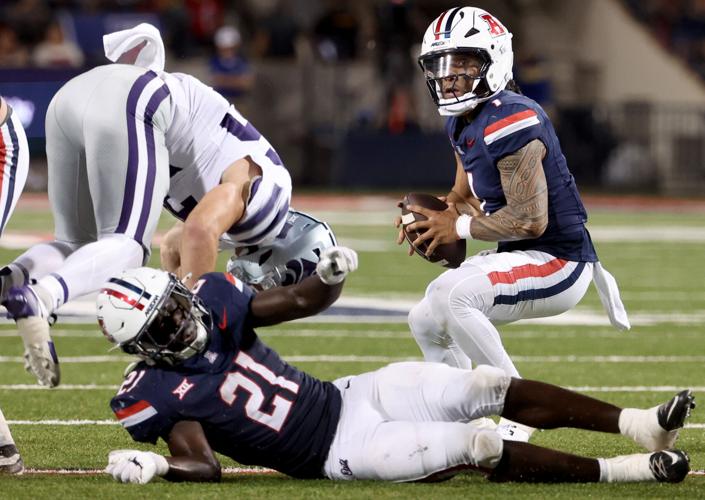
Arizona running back Ismail Mahdi (21) flies in to block Kansas State safety Jack Fabris (36) at the ankles on the blitz and give quarterback Noah Fifita time to get off the pass in the third quarter, Sept. 12, 2025, at Arizona Stadium.
Doege spoke at length earlier this week about Fifita trusting his reads — and his play-caller. It’s still a work in progress.
“Sometimes you assume that we’re on the same page,” Doege said.
Sometimes, it turns out, they aren’t. Fifita sees something different on the field than Doege does in the coaches’ booth. The ball goes to the wrong place. Or it comes out a hair late. Just like that, a would-be first down becomes a punt or, even worse, a turnover.
Such was the case in last week’s game at Iowa State. Fifita and the offense were off-kilter just enough to kill drives. Arizona scored a season-low 14 points.
PFF charted 45 targets for the Wildcats’ would-be pass-catchers in that game. Forty-one went to wide receivers or tight ends. Running backs had just four. They’re the ones left out when the vast majority of passes are thrown downfield.
Running backs have accounted for 9.8% of the pass targets this season, down from 15.5% last year and 16.1% in 2023. Not coincidentally, Arizona’s average YAC (yards after catch) has followed a similar pattern — 5.3 this year, 5.8 last year and 7.2 in ‘23.

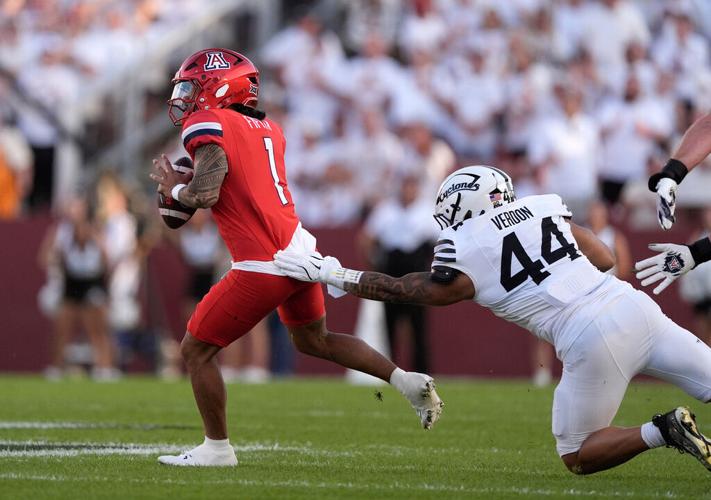
Arizona quarterback Noah Fifita, left, pulls away from Iowa State defensive lineman Trey Verdon during the first half of their game on Sept. 27, 2025, in Ames, Iowa.
Another way to look at it: Running backs account for 24.9% of Arizona’s YAC so far this season, down from 29.4% last year and 31.3% in ‘23.
The Wildcats haven’t used backs out of the backfield nearly as much as most of us expected. Again, maybe that will change. It’s another way Doege could make Fifita’s job easier.
Fifita’s friends could give him some assistance, too. UA pass-catchers have a drop rate of 11.4%. It was 6.8% a year ago and just 4.0% in 2023.
PFF has a stat called adjusted completion percentage that takes drops into account. It’s the “percentage of aimed passes thrown on target,” per the site.
Fifita’s adjusted completion rate this year is 75.9%. It was 73.4% last year and 78.4% in 2023. Overall, not a huge difference.
One area where Fifita can help himself is handling pass-rush pressure better. He’s gotten progressively worse when under pressure or facing blitzes.
In ‘23, Fifita completed 55.7% of his passes when under pressure and 72.4% when being blitzed. Those numbers fell to 46.7% and 62.4% last year. They’re at 38.5% and 50.0% this year.
What’s behind that? Fifita doesn’t seem skittish when facing pressure; if anything, he’s been more patient in the pocket this season.
It might have to do with how opponents are defending him. It might have to do with the structure of the offense and Fifita’s comfort level in it — knowing where his outlets are when pressure arrives. His processing speed in those situations should, in theory, improve over time.

