



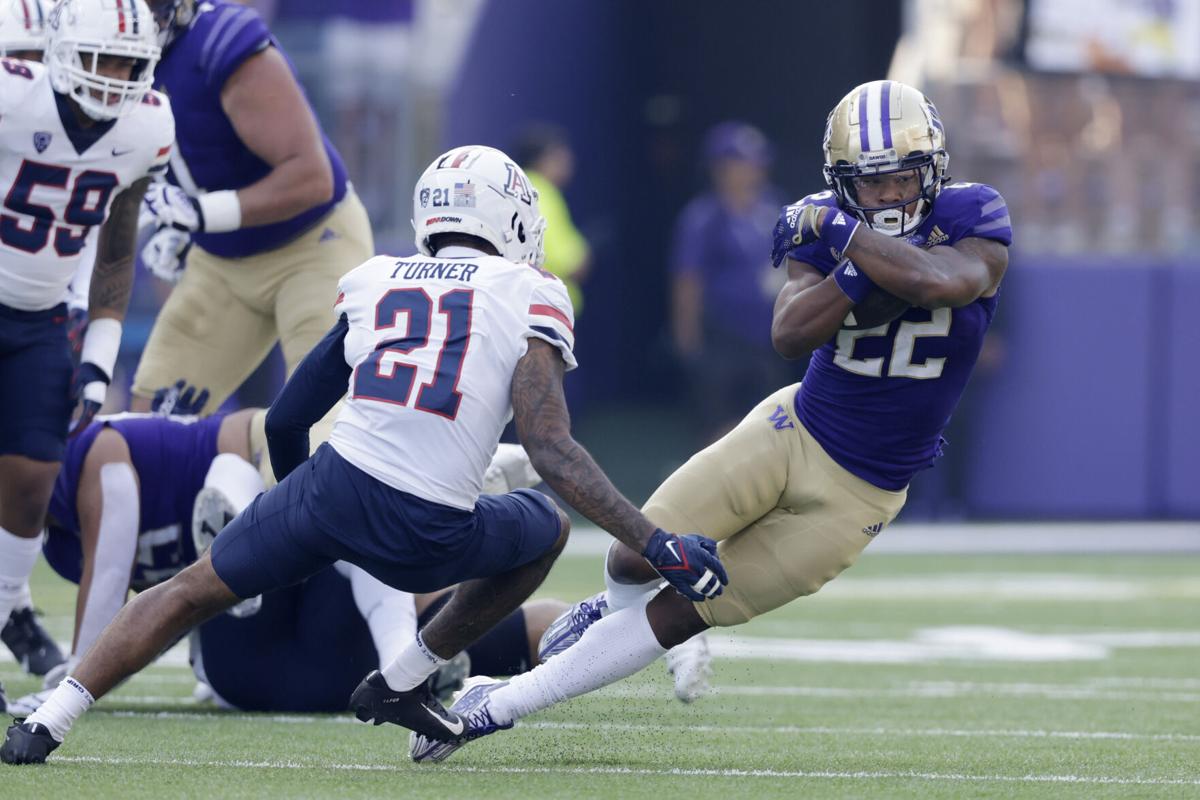
Ricky Hunley and Chuck Cecil built their College Football Hall of Fame brands at Arizona in the 1980s and the one thing they shared was that defense rocked, rolled and ruled.
In the decade of the ‘80s, Arizona yielded 40 or more points just three times. That seems insane today. Impossible. But, indeed, Arizona can make a solid case that it was the Pac-10’s leading defensive franchise of the both the ’80s and ’90s.
As preposterous as it seems today, UA fans sometimes grumbled when the Wildcats’ defense-first approach won 6-3 against mighty Oklahoma, 9-6 and 10-7 over Washington State and 5-3 at Iowa.
Yes, 5-3.
Oh, what an Arizona fan would give for a 5-3 win today.
That’s why it seems so irregular this season. Hunley and Cecil are assistant coaches for an Arizona defense that has given up exactly 49 points three times this season — against Cal, Oregon and Washington. Do you realize that over the last 100 years, Arizona had yielded exactly 49 points to an opponent just five times?
Now it’s like first one to 49 wins.
Arizona’s defense has become bottomless. Wildcat opponents are averaging 36 points per game, which is No. 121 of the 131 FBS teams and is better than just two Power Five conference schools, Colorado and Vanderbilt.
Not exactly favored company.
UA coach Jedd Fisch has not ducked questions about his club’s defensive struggles. He is surely more sensitive to it than a UA fan shouting at the big screen TV in his living room. Can’t you guys tackle anyone?
“The Pac-12 is about scoring and quarterbacks,” Fisch said at his Monday Q&A session with reporters. “We’re very fortunate to have the one (Jayden de Laura) we have.”
The truth is that Arizona’s historic defensive struggles began long before anyone in Tucson knew who Jedd Fisch was. They began in 2016, when Rich Rodriguez’s program began to erode and allowed 38.3 points and 499 yards per game, both school records at the time.
Since then, in order, the Wildcats’ defense has finished 118th, 109th, 98th, 118th, 121st and 107th in scoring defense nationally. On its current backward roll — with upcoming games against USC, UCLA and Utah — it’s conceivable Arizona could finish dead last in FBS football, No. 131 overall.
That dreaded No. 131 spot is occupied by the Charlotte 49ers, whose schedule now eases up. They’ll play FIU, Rice and Louisiana Tech, none of whom have winning records.
Fisch was correct Monday when he added light to college football’s not-so-subtle change to an offense-first game. Two days earlier, Alabama scored 49 points and found it wasn’t as friendly as Arizona opponents have found. The Crimson Tide allowed 52 to Tennessee.
A few hours later that day, USC scored 42 and lost to Utah, 43-42.
More? As impossible as it seems, Oklahoma has given up 42, 49, 55 and 41 points in its last four games.
Yes, the game has changed — and not so subtly.
“I just think college football right now, for the most part, a lot of teams are playing a lot of good offenses,” said Fisch. “And offenses are doing a good job of scoring points.”
Fisch said the changes make it fun for offensive play-callers, such as himself, but “challenging” for defensive coordinators like the UA’s first-year man, Johnny Nansen.
What happened to those 6-3 games?
College football coaches are limited to 20 hours per week — the combined limit for on-field and in film study — with their players.
“I think 20 hours a week to prepare is very challenging on defenses,” Fisch said. “You have a lot of different formations you can throw at teams on offense. In pro football you don’t have those same formations that you can use, all the unbalanced sets are very different. You have a ton of space with the way the hash marks are set up in college football. You have the RPO game, which is officiated different in college football.”
And then Fisch nailed the heart of the changes that fortify offenses: “And have a lot of kids that are great athletes playing quarterback.”
Here’s how the game has become so offensive friendly the last 50 years:
In the 1970s, Arizona opponents scored 40 or more points just five times.
In the ’80s, it was just three games.
In the ’90s, it climbed to 13.
In the 2000s, it stretched to 19.
And in the 2010s, it became ridiculous, with 32 UA opponents scoring at least 40.
“Defensively, you have to adjust all the time.” said Fisch. “You have to actually defend all that. And that becomes a challenge. And I think that’s what’s kind of happening. There is less and less tackling going on in training camp. There’s a lot of awareness of (minimizing practice in) full pads and how you prepare.”
Scoring is up — way up — across the college football board, but Arizona has become a model for how damaging changing head coaches three times in five years can blow recruiting to smithereens.
Get this: after Arizona’s memorable Pac-12 South championship of 2014, the Wildcats have ranked No. 64 among the 65 Power Five schools in scoring defense.
Kansas has allowed 37.8 points since 2014. Arizona is the next worst at 35.5.
I would argue that Arizona’s defensive coaching staff is among the most qualified in school history, in a category with those Desert Swarm staffs of Larry Mac Duff, Rich Ellerson and Duane Akina, and with Larry Smith’s 1980s high-level defensive staffs of Moe Ankney, Tom Roggeman and Bob April.
Fisch isn’t exactly staging on-the-job training for his defensive staff.
Nansen, Hunley, Cecil and fellow defensive coaches DeWayne Walker and Jason Kafusi have combined for 43 coaching seasons in Power Five football and 35 in the NFL. Together, they played 18 years of Power Five football.
It’s not that they don’t know how to coach or what plays to call; it’s that they haven’t had time to sign and develop players since Rodriguez and Sumlin’s six empty seasons left Arizona without enough resources to regularly limit opponents to less than 40 points per game.
No one wants to hear “wait ’til next year,” but that legitimately applies to the UA’s 2022 defense.

