


Michael Wiley was stumped.
The Arizona running back was asked to compare Wildcats quarterback Jayden de Laura to another signal-caller. Whom does he remind you of, Mike?
Wiley couldn’t think of anyone. In his defense, de Laura just might be one of a kind.
There is a useful comparison to be made, though. It’s between de Laura and ... de Laura.

The fourth-year quarterback has played just about as much football for Arizona as he did Washington State. He has appeared in 14 games for the Wildcats compared to 16 for the Cougars; he has attempted 505 passes here after throwing 488 there.
So we have similar sample sizes. We have enough data to answer some questions that have bubbled to the surface amid de Laura’s erratic play to start the 2023 season:
Has he improved since his WSU days? Has he changed? Will he ever?
We’ll begin that exercise in this week’s UTEP edition of “Cats Stats” by examining de Laura’s “conventional” numbers. Then we’ll delve into some more advanced analytics.

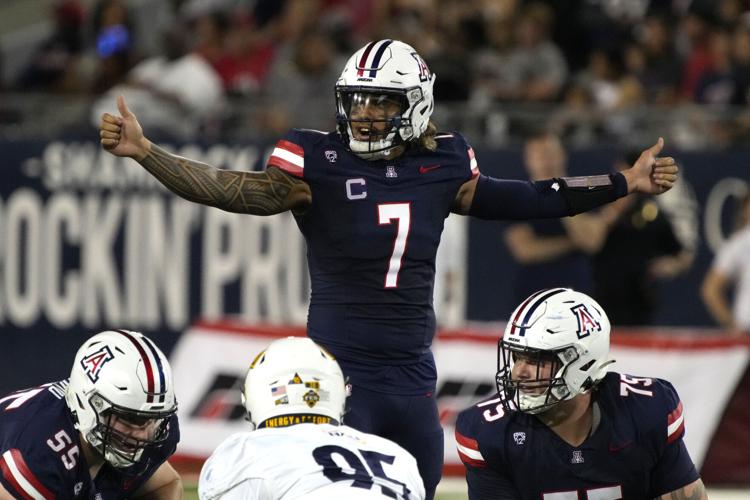
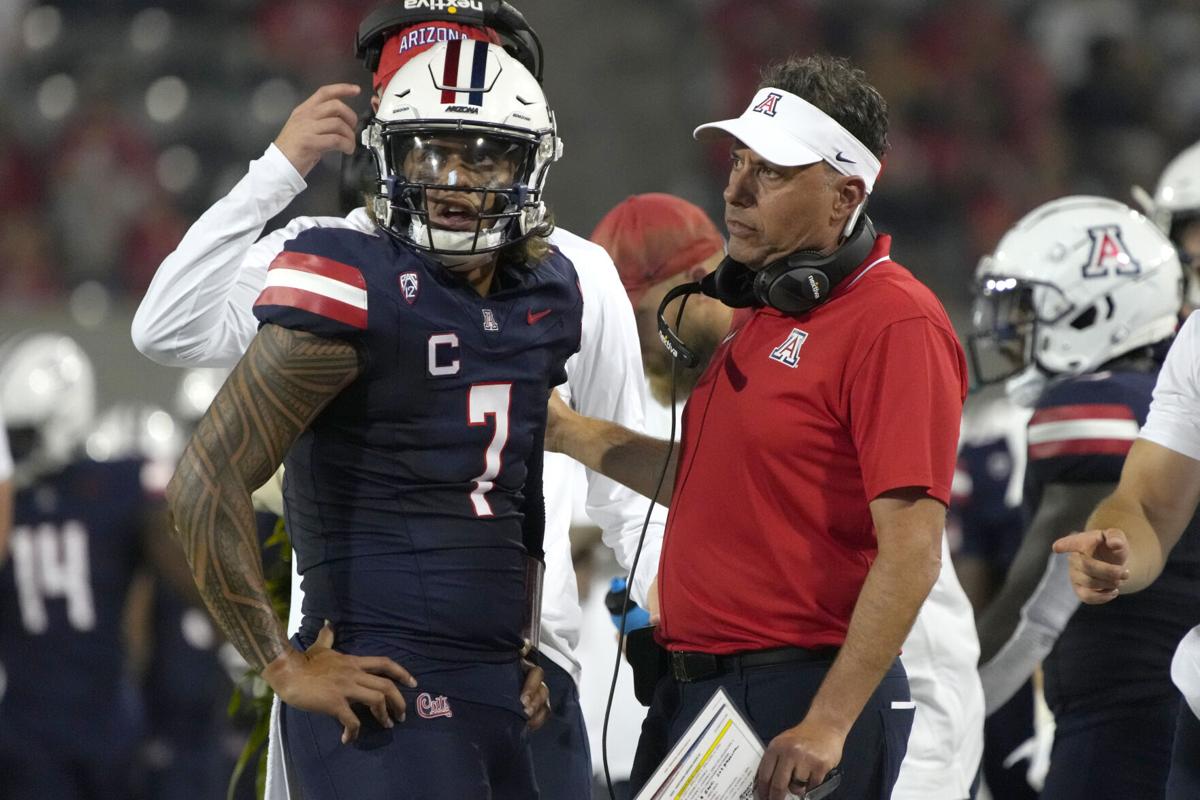
Arizona quarterback Jayden de Laura makes a call at the line during the Wildcats’ season opener against Northern Arizona at Arizona Stadium on Sept. 2. Through two games so far in 2023, de Laura has five touchdowns, but also five interceptions (and a lost fumble).
As far as standard stats go, de Laura has improved in almost every area — with ALMOST being the key word in that sentence.
His completion percentage is higher at Arizona (63.8%) than at WSU (62.5), and he’s currently hitting at a personal best — by far — of 71.4%.
His yards per attempt are higher by a full yard — 8.5 vs. 7.5. His 2023 figure of 9.0 would be a career high.
His NCAA passing efficiency rating is better at Arizona (148.0) than it was at WSU (139.5). Again, his current mark of 156.0 is the best he’s ever produced.
Looking at those numbers alone, it seems indisputable that de Laura has been a better quarterback here than in Pullman. They also would suggest he’s trending toward a career year.
But that pesky touchdown-to-interception ratio cannot be ignored. It’s gotten worse.
De Laura threw 28 touchdown passes and 13 interceptions as a Cougar — a ratio of 2.15 to 1. As a Wildcat, he has posted 30 TDs and 18 picks — 1.67 to 1.

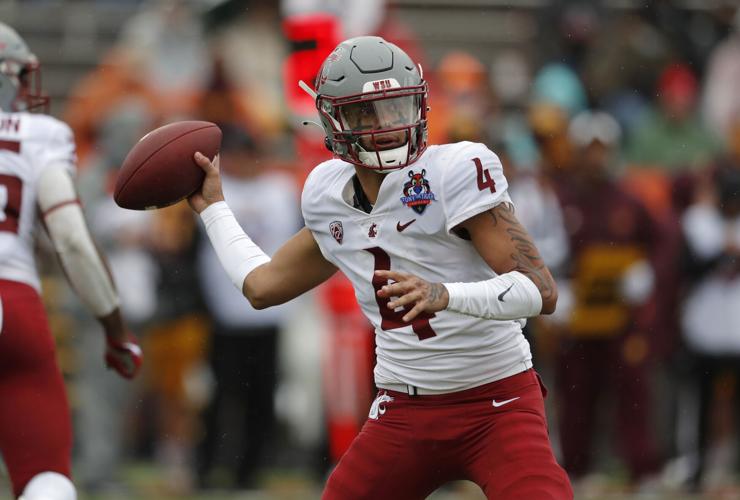
Jayden de Laura looks downfield while playing for Washington State against Central Michigan in the Sun Bowl in El Paso, Texas, on Dec. 31, 2021. That was de Laura’s last game with the Cougars before transferring to Arizona.
After throwing four interceptions last week at Mississippi State — a game in which he also accounted for 386 yards of offense and three touchdowns — de Laura has as many picks as he does TD passes this season (five apiece).
Those numbers are in line with his freshman year (five touchdowns, four interceptions), which was played under the most challenging of circumstances: a global pandemic that wreaked havoc on the Pac-12 football schedule. WSU played only four games that season, Arizona five. The Cougars also had a new coach in Nick Rolovich who wasn’t the coach de Laura had committed to, plus the restrictions on workouts and practice time that every Pac-12 school faced. You wouldn’t expect de Laura to thrive in that scenario.
We’re only two games into the 2023 season, so the current numbers are fluid and subject to change. One aberrant performance can alter the entire look and feel of a stat line.
What’s worrisome with de Laura is that his four interceptions last week weren’t an aberration. It’s the second time in four outings that he has thrown four picks. He has 10 in all during that span. In his first 10 games at Arizona, he threw eight interceptions.
What’s particularly puzzling about his current career-high interception rate of 7.1% is that, by at least one measure, de Laura is playing more conservatively than he ever has.
De Laura’s ADOT — average depth of target — so far this season is 6.8 yards, according to Pro Football Focus. He’s never had a season-long ADOT of less than 10 yards.
Per PFF’s charting, de Laura has thrown 36.4% of his passes behind the line of scrimmage — easily the highest rate of his career. Last year that figure was 21.1%. At WSU, albeit in a different offensive system, it was 14.4% in 2021 and 8.3% in 2020.
Running backs Wiley (14), Jonah Coleman (six) and DJ Williams (one) have combined for 21 of Arizona’s 53 receptions. Jedd Fisch’s offensive system has built-in checkdown options, and de Laura is taking advantage of them. He’s forcing the ball downfield less than he ever has.
And yet ... de Laura’s TWP rate — his percentage of turnover-worthy plays — is at an all-time high of 8.4%, per PFF. (The site defines turnover-worthy plays as “a pass that has a high percentage chance to be intercepted or a poor job of taking care of the ball and fumbling.”) That figure has steadily increased during de Laura’s college career — from 3.9 to 4.0 to 4.5 — which is exactly the opposite of what you’d expect as a quarterback learns and grows as a player.

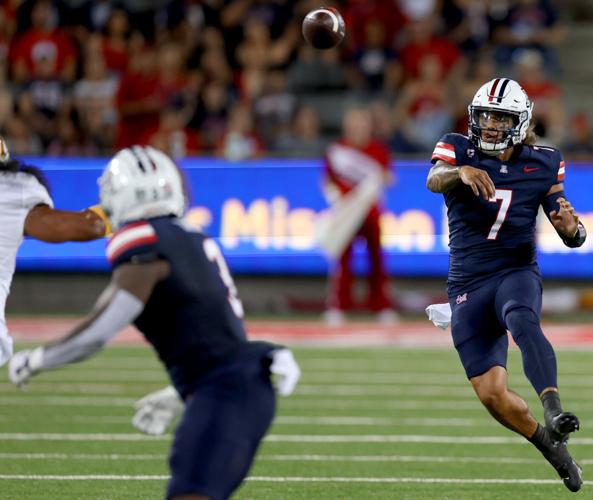
Arizona quarterback Jayden de Laura, right, picks out a wide-open Jonah Coleman in the first quarter of their game against NAU at Arizona Stadium on Sept. 2.
You’d like to think, barring extenuating circumstances, that a talented, hard-working QB like de Laura would make a linear ascent in all relevant categories. A radical system change, going from Rolovich’s run-and-shoot to Fisch’s pro-style look, might qualify as an extenuating circumstance.
It doesn’t explain why de Laura has become more turnover-prone in recent games, dating to the end of last season. If anything — with a higher comfort level in the offense and a lower ADOT — that part of his game should be headed in the other direction.
Then again, nothing about de Laura’s play style is conventional. At times it defies description — or comparison.
Is the JDL of now better than the JDL of old? In most ways, yes. But the area in which he continues to struggle remains problematic.
Arizona running back Michael Wiley and linebacker Justin Flowe spoke to local media on Tuesday. Video by Justin Spears / Arizona Daily Star

