


This story was originally published on Sept. 6, 2016
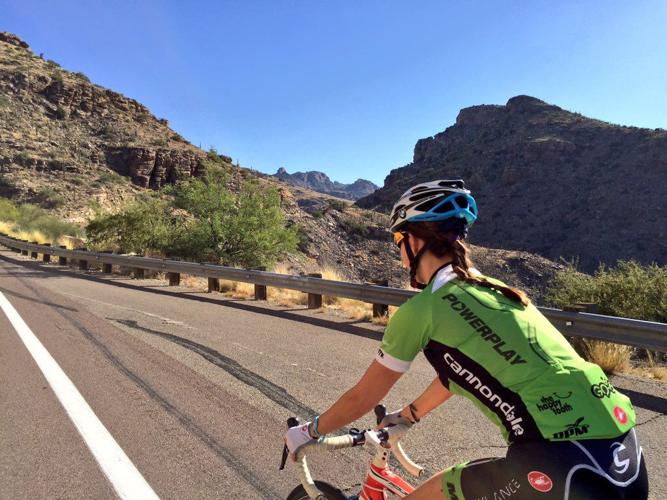
Tucsonan Kathryn Bertine's resume reads: "Petitioned the Tour de France to add a women's race. Succeeded."
And as if that weren't enough, the professional cyclist recently made a documentary about gender inequity in the sport of cycling. She earned an MFA in creative writing from the UA in 2000 and has written and published three books. She also wrote a column for ESPN from 2006-2008 called, “So You Wanna Be an Olympian?” and was a senior editor for ESPNw.
Bertine says she identifies most as an athlete, writer and activist, but she’s also the first to admit she wears many hats in life.
Bertine loves to drink all of the teas and her favorite place is Mt. Lemmon. She is Bicycling Magazine’s September 2016 cover story.
Last year, Bertine faced death twice after dealing with a serious bike crash and situational depression.
The Tucson cyclist called to talk about her activism work, cycling, depression and being a badass:
On crashing, burning and recovering
Given the events of an interesting journey in pro cycling and social activism, I’m just very happy to be here. I had a couple crazy crashes this year that almost rendered me not being here.
I was out there in Mexico and a crash vaulted me straight into a brain injury so they weren’t really sure if I was going to make it or not. So I’m really happy that somehow the stars aligned on that one.
On always wearing multiple hats
I think from the standpoint of women’s professional sports, it’s very rare that anybody can make a financial living. So for a lot of us, especially in cycling, we have to multi-task and do other jobs. But for me, I’ve always identified as an athlete and writer. Those are my two areas. Hopefully when I retire from the sport, I can work full time in the writing and social activism areas. And I do have some projects — we’ll have to touch base later in the year too, because I’ll be working on some new areas there.
You can only do so much when you’re actually on the call for racing. You have to make sure you’re rested and recovered, and writing something, you have to be able to sit down, put your feet up and work on your laptop for a little bit.
On petitioning the Tour de France
I felt the need to create a pressure group/task force that wasn’t just comprised of myself pushing for change. That we had a set of intellectual, terrific people who could stand behind this movement so it came across as well organized and planned, so it really would affect any sort of change. So we formed Le Tour Entier, which is French for “The Whole Tour.” And that group is myself, Marianne Vos, Emma Pooley and Chrissie Wellington, and we banded together to bring that change.
It felt incredibly rewarding to share with the world that we truly do have the power to create change, whether it’s for cycling or any other endeavor in life. The fact that we were able to call attention to something that really had been flying under the radar of “tradition” for far too long, and people just accepted that the Tour de France was for men only, when in reality, both genders should be there. That’s what we wanted to draw attention to.
On being an activist
As a writer — because that’s another hat I wear in life — that is what I want to tackle next, really bringing the power of social activism to the forefront in terms of a writing project, so people can understand how they can go about changing things for the better.
What’s most captivating to me is gender equity across the board. Women in almost all professions are still making that 77 cents on the dollar. That’s something that really needs to go. Whether that’s in cycling or journalism or being a CEO, it doesn’t matter what the field is, but that branch of gender equity and salary is something that I think we need to pay attention to, and not just in American society. Hopefully that will be something we can change globally, too.
I see a little bit of research for me there — seeing which countries are doing it right.
On exploring cycling gender inequity with film
After being physically in the world of women’s cycling for a number of years — and after I understood how the sport works and what parts were wonderful and what parts were failing in terms of the leadership side of it — I started talking to some other women and saying, hey, why aren’t we racing the same distances as the men, or being offered the same salary, or even the same prize money? You know, what’s going on here? Where’s the media coverage?
And all the other women kind of agreed and said, “Yeah, it’s backward. It shouldn’t be like that. It should be different and better.” And once I knew other women felt this way too, I wanted to create a visual medium where we could explore that topic, and being in the world of journalism for so long, I knew that one thing I’d never seen was a documentary that explored women’s cycling.
So I wanted to put a visual on how we could create that change, and really draw out what’s not working in the sport, but also really talk about the love of cycling. Nobody wants to watch a documentary that’s just a bitchfest for an hour and a half.
["Half the Road: The Passion, Pitfalls & Power of Women's Professional Cycling"] premiered at the Loft in January 2014 and we were able to sell out the entire theater, which was a cool thing to have happen.
On finding community in Tucson
Originally a New Yorker, I came up to Tucson for grad school. And I thought, “Okay, I’ll be here for two years and then I’ll move onward.” But I got into triathlon and then cycling and what ended up happening was I really fell in love with the communal aspect of both those communities. Here I am, riding my bike, trying to be a professional athlete, and other people were out there riding their bikes, doing their sport — they happened to be lawyers and mechanics and dentists. Then all of the sudden you’ve built this great community of other people you can interact with so your own life just has a great camaraderie of friendship and businesses intertwined.
I love that about Tucson. There are great communities we have in this town and I would only move away if work opportunities called me in that direction. Right now, I feel like Tucson is my home and if the city wants me to stick around, then I’m more than happy to oblige.
On her recent Bicycling Magazine cover story
It’s an interesting thing, you know, when you put your story out there like that. It’s empowering, but there’s also an element of vulnerability. I definitely felt vulnerable, but I also received feedback from strangers when that piece came out, and they were talking about that hard stuff, whether it's divorce or depression or any of the obstacles in life we go through that are very difficult. But it was really interesting to see total strangers reach out that said, “Thank you for sharing, I don’t feel alone now in what I’ve gone through, what I’ve had to keep inside, keep private.” And if people felt any sort of comfort knowing they weren’t alone going through what they’ve gone through in their lives, then it really made me feel calm and fortunate that anything in that article could be helpful to others. That felt good.
On dealing with situational depression from her divorce
I should say this out loud. I’m very careful when I use that term, depression. Because what I went through in that article that led me down that path, it was a very situational depression for what I was going through then, in that time, as opposed to the depression that many people are born with. That chemical imbalance type of depression.
But you don’t necessarily have to suffer from depression to go through times in your life when you are dealing with a depressed element.
As a writer, it affected me in the form that I knew I was entering a stretch where I could not write about any of that. It was something I had to understand and cope with and process and deal with and know that it would take a long time to write about those issues. It definitely had an effect on me as a writer. You know — “This is a learning stage. There is nothing new I can write about right now.” But as an activist, I could professionally, at least, channel my writing toward activism, and that was helpful to keep it steered away from anything personal at that point.

On cycling as a coping mechanism
As an athlete, one of the interesting things is, I was under really such mental and emotional hardship — and it even affected me physically, a little bit — but I also was able to concentrate on my cycling to an extent where I was able to take out a lot of frustrations and anxiety and difficulty throughout the physical realm of being a cyclist that I actually became better and stronger and faster over the last two years.
Sometimes when you’re coping with difficult things, if you can find a way to grasp that side of it and say, “Ok. I’m going through some tough stuff, I have to make sure I’m careful with the physical element,” of something like cycling. I have to make sure that I’m training correctly, that I’m sleeping correctly, eating correctly, working out correctly so that I reap the benefits of this stressful period than have it go the other way, and then all of the sudden you’re using cycling as a coping mechanism rather than something you love. I was able to retain that true love of cycling, and that did make me strive, but I’ll be the first to admit it was very grueling and difficult.
On identifying as a feminist
I do. Absolutely. And the only thing I think is controversial about the term “feminist” is that people hang on to an outdated version of the term. You know, way back in the day, feminism was misunderstood and people thought it had to do with, “Oh, women are better than men! Women think they’re better than men?” When really feminism was all about women being equal to men. It’s not a scary weird term, we just need to make sure the next generation understands where we are with that term now.
On her passion for cycling
I’ve been cycling for nine years, but before that I was a triathlete, so I’ve been on a bike for a while. The first five years were amateur and the last five years — because I’m almost hitting 10 years — the last five years have been professional.
There’s something amazing about the sport where it doesn’t matter if you’re training hardcore for a race or you’re out there commuting from your house to your job. Whatever way you use a bicycle, there’s an amazing brain and body connection where there’s a calming effect. I think it generates an excellent platform for just plain thinking. You can think when you’re on a bike. You can let your mind wander. You can think about anything from daily chores to intellectual concepts while you’re riding along. I think the brain and the body like that, and that’s what makes it such a terrific sport.
On being a badass
It’s a funny thing — I can’t imagine calling myself that. Badass. But let’s say maybe I’ve been through enough things in life to realize if I’m still standing at this point, I must be a little bit badass.
Editor's note: This interview has been edited and condensed for clarity.
Your name, age, occupation.
Kathryn Bertine, 41, professional cyclist.
I'm on a mission to _______________________.
Empower others.
What's your astrology sign? Does it fit you?
Taurus. Yes. I'm stubborn and I sleep a lot.
Your first-ever job?
Babysitter
How long have you lived in Tucson?
18 years!
Who and/or what inspires you?
Anyone who takes a chance and makes the world a better place.
The secret to coping with stress is ________________.
Moving your body. Often.
Your favorite Tucson spot?
Mt. Lemmon on a road bike.
Your go-to order at your favorite Tucson restaurant?
Le Buzz. Everything there.
What's your favorite Tucson-only thing?
Monsoons!
You know you're a Tucsonan when _____________.
You come here for grad school, then you stay 18 years.
What constitutes your morning getting-ready routine and how long does it take?
Training. Takes all morning!
Favorite app at the moment?
Whatsapp. Keeps me well connected to my foreign buddies.
Give us a two-sentence pep talk.
Never let anyone tell you something is impossible. The end.
What would you tell your teenage self?
Hang in there. Life after 40 is well worth all your teenage angst.
What's a quality you got from your mama?
How about my dada? He always raised me to believe women are equal.
And one you hope to pass onto your kids, if you have any?
Perseverance. That stuff helps.
The last great book you read?
The Art of Asking by Amanda Palmer.
The last great movie you watched?
Half The Road. ;) You'll see.
People would be surprised to hear you're actually a(n) ______________ expert.
Drinking tea. Love that stuff.
Is there something you've always wanted to learn, but haven't had the time?
Patience. But I'm getting much better at it.
Anything you've always wondered about Tucson?
I think Tucson is a wonder.
Favorite ice cream flavor?
Mint chocolate chip.
Where can our readers follow you on social media?
On twitter @kathrynbertine and on FB, I've got an author page and a Half The Road page.
Is there something you REALLY nerd out about?
GRAMMAR! In all caps, yo.
What's your spirit animal?
Anything in an animal shelter. Adopt them, friends!
What celebrity just gets you?
Robin Williams.
What makes you feel the most confident?
Experience.
The best piece of advice you ever received?
"Live deliberately..." -Henry David Thoreau

