

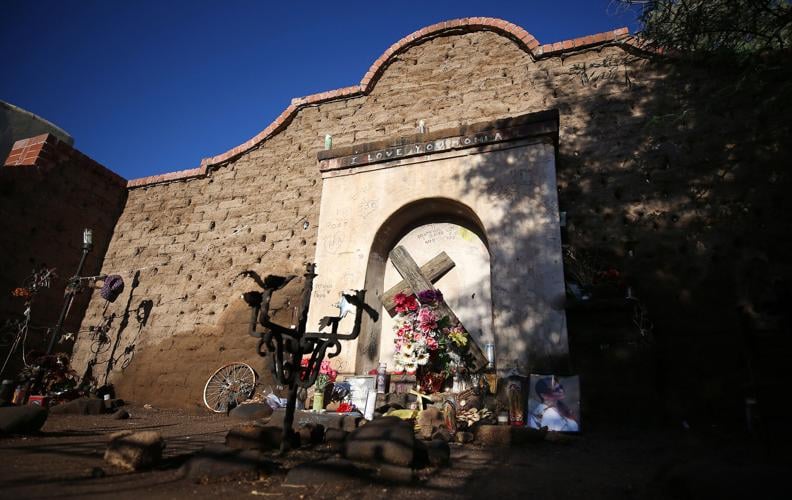
Tucked behind El Minuto Café in Tucson’s Barrio Viejo sits El Tiradito, a wishing shrine tied to the folktale of 18-year-old Juan Oliveras.
For more than 140 years, Oliveras has lived as a local legend about an affair setting off a chain of violence and heartbreak, according to the National Register of Historic Places.

Listed on the National Register of Historic Places, El Tiradito, 400 S. Main Ave., is a place where people light candles and leave notes in the hope their prayers may be answered. A local legend about the shrine tells of a love triangle setting off a chain of violence and heartbreak.
Today, the shrine is a reminder of how layered — and often messy — Tucson’s history can be, a past that guides like Scott Darlage use to bring their walking tours to life.
As the story goes, according to Darlage's favorite interpretation of the myth, Oliveras’ father-in-law found young Juan in bed with his mother-in-law, chased him with an axe, and killed him near the original shrine site a block east. The mother-in-law killed herself in shame. The father-in-law fled toward Sonora, Mexico, but was later raided and killed by Apaches. Oliveras’ young wife, devastated by the betrayal and Juan's death, jumped from a bridge.

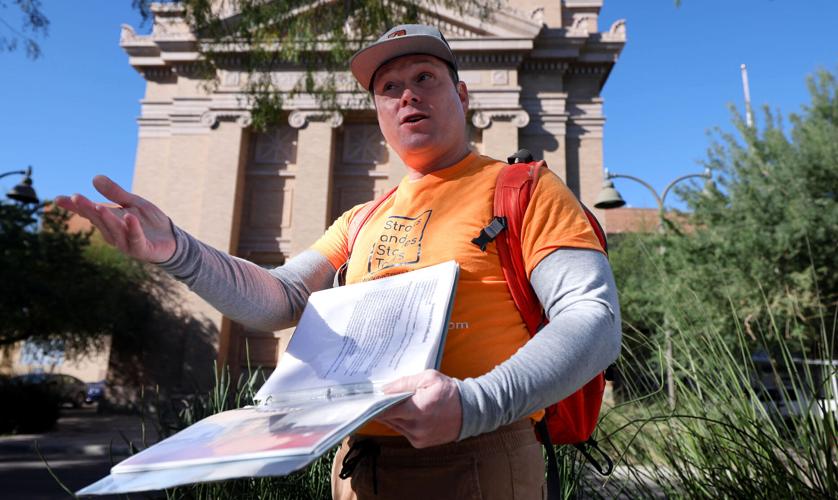
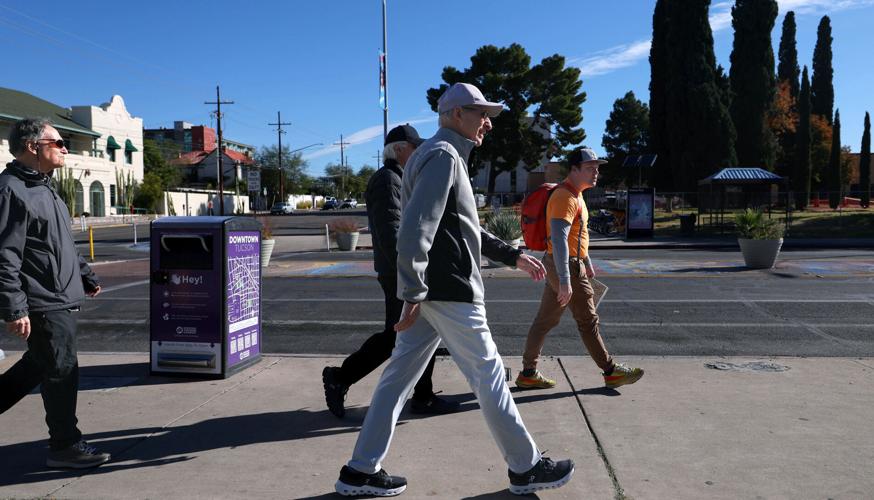
Scott Darlage leads a small group through a Strolls and Stories guided walking tour in historic neighborhoods around downtown Tucson. "There are so many fascinating tales of how our pioneering founders ended up in Tucson, the businesses they ran and what life was like in the Wild West," he says.
Listed on the National Register since 1971, the shrine evolved into a place where community members and visitors leave candles and written wishes, Darlage noted. The original structure was demolished in 1927 for highway construction, but a shrine was rebuilt in the 1940s. When a freeway proposal in the early 1970s threatened to displace 1,200 Barrio Viejo residents, locals rallied around the shrine and neighborhood to save them.

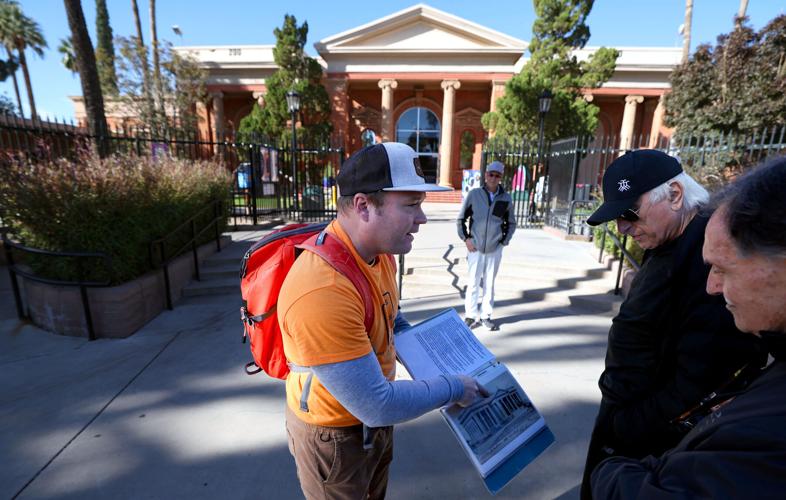
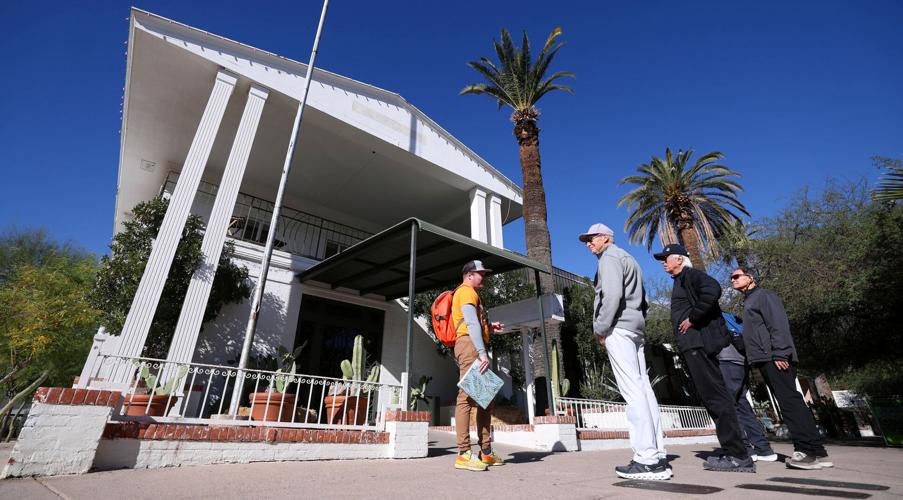
Scott Darlage, tour leader, shows Victor Press and Lenny Holzman, right, the history of the Carnegie Free library building that now houses the Tucson Children’s Museum, during a Strolls and Stories guided walking tour. The Carnegie Free library, which opened in 1901, was designed by prominent local architect Henry Trost.
"So if you think about it, if young Juan hadn’t slept with his mother-in-law, there’s a good chance this neighborhood might not be here today," said Darlage, owner of Strolls and Stories Tours.
The story of El Tiradito is one of many stories Darlage shares on his two-hour Barrio Viejo and Scott Avenue walking tour, though he says that legend is one of his favorites.
"I just think it’s incredible that this tale of sexual infidelity ends up being the catalyst that helps save the neighborhood," he said. "We bulldozed half of the Barrio Viejo and then almost bulldozed the rest. Today, it’s the largest concentration of mud-adobe structures in a single neighborhood in the United States," despite "urban renewal" demolition in the 1960s-'70s.

Scott Darlage leads a small group through a Strolls and Stories guided walking tour in historic neighborhoods around downtown. "I started researching what I already knew at the Arizona Historical Society, and these stories just came to life," Darlage says.
Darlage, originally from Indiana, started Strolls and Stories about two and a half years ago after a turning point in his career. He had worked in the hotel industry and later as an independent meeting planner, where he often caught himself droning on about Tucson history when recommending places for visitors to explore.
"One of the sales managers at Visit Tucson told me, 'If you ever find yourself at a crossroads in your career, you’re so good at storytelling that you should consider doing guided walking tours,'" he said. "I started researching what I already knew at the Arizona Historical Society, and these stories just came to life."
As of December, Darlage offers two tours: the Barrio Viejo and Scott Avenue tour and a Downtown and El Presidio tour.
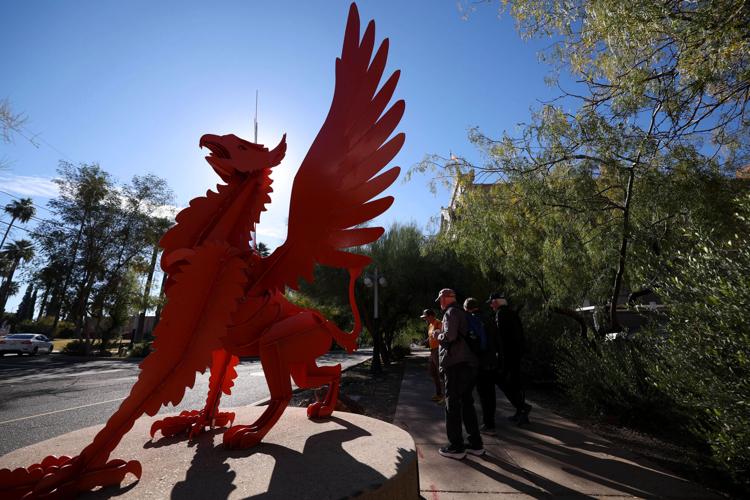
The Barrio tour highlights the 18-inch adobe walls of the Sonoran row houses, the origins of the Owls Club speakeasy's name — it's named after an 1880s bachelors' social club that had a mansion downtown — and the story behind the griffin sculpture on Scott Avenue. The artwork honors the stone griffins that once guarded the old Carnegie Library, which burned in 1938; legend has it that one griffin ran away to escape.

The Strolls and Stories guided walking tour stops by the large griffin statue on South Scott Avenue. The artwork honors the stone griffins that once guarded Tucson's old Carnegie Library, which burned in 1938; legend has it that one griffin ran away to escape.
Walkers on the Downtown and El Presidio tour learn about the Old Pueblo's early settlers and business leaders in the 1800s, such as businessman Sam Hughes, who arrived in Tucson in 1858 and whose home the tour passes.
"There are so many fascinating tales of how our pioneering founders ended up in Tucson, the businesses they ran and what life was like in the Wild West," Darlage said.
Strolls and Stories also offers audio tour packages for those who prefer to explore at their own pace.

Scott Darlage leads Lenny Holzman, left, Victor Press, back, and Ian Fisher to the Children’s Museum during a Strolls and Stories guided walking tour of historic downtown neighborhoods.
Cori Erin, a Barrio Viejo resident, took a tour with Darlage earlier this year after finding out her apartment was once a Chinese market in the early 1900s.
"He walks by my apartment on his tours," Erin said. "I realized I needed to educate myself and become more aware of the history of the barrio."

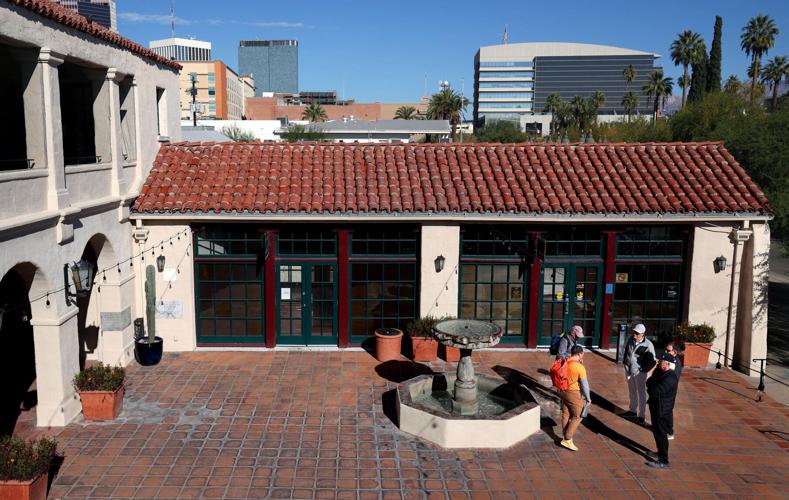
Scott Darlage leads a small group through the Arizona Theatre Company Palice courtyard at the Temple of Music and Art, 330 S. Scott Ave., during a Strolls and Stories guided walking tour. The Temple of Music and Art was built in 1927 in Spanish Colonial Revival style.
Erin said she was blown away to learn about the community dynamic within the neighborhood "that is still alive in the barrio."
"I just think it's so beautiful that this area was based on community and really helping each other out," she said. "Even though the neighborhood has obviously changed a lot, that (energy) still threads through the community."
The two-hour walking tours cost $35 per person. More information is available at strollsandstoriestours.com.

