

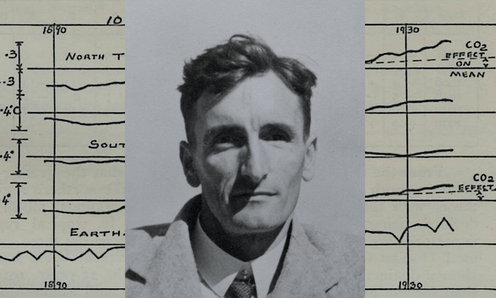
Guy Stewart Callendar connected carbon dioxide concentrations with rising temperatures. GS Callendar Archive, University of East Anglia
In 1938, a British engineer and amateur meteorologist made a discovery that set off a fierce debate about climate change.
Scientists had known for decades that carbon dioxide could trap heat and warm the planet. But Guy Callendar was the first to connect human activities to global warming.
He showed that land temperatures had increased over the previous half-century, and he theorized that people were unwittingly raising Earth’s temperature by burning fossil fuels in furnaces, factories and even his beloved motorcycles.
When Callendar published his findings, it set off a firestorm. The scientific establishment saw him as an outsider and a bit of a meddling gentleman scientist. But, he was right.
His theory became widely known as “the Callendar Effect.” Today, it’s known as global warming. Callendar defended his theory until his death in 1964, increasingly bewildered that the science met such resistance from those who did not understand it.
Building on over a century of climate science
A theoretical basis for climate change had been developed over the 114 years leading up to Callendar’s research.
Scientists including Joseph Fourier, Eunice Foote, John Tyndall and Svante Arrhenius had developed an understanding of how water vapor in the Earth’s atmosphere trapped heat, noted that carbon dioxide in the atmosphere also absorbed large quantities of heat and speculated about how increasing fossil fuel use could raise Earth’s temperature and change the climate.
However, these scientists spoke only of future possibilities. Callendar showed global warming was already happening.

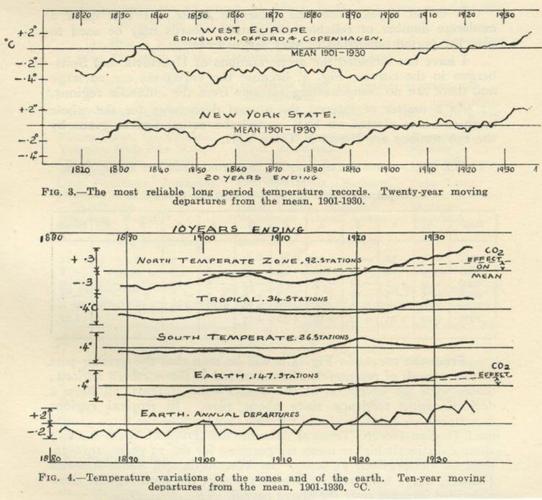
A page from Guy Callendar’s 1938 paper shows how he tracked and calculated CO2 changes, all in his spare time. GS Callendar, 1938
An engineer runs his own climate experiments
Callendar received a certificate in mechanics and mathematics from City and Guilds College, London, in 1922 and went to work for his father, a well-known British physicist. The two shared interests in physics, motorcycles, racing and meteorology.
Callendar would later join the U.K. Ministry of Supply in armament research during World War II and continued to conduct war-related research at Langhurst, a secret research facility, after the war.
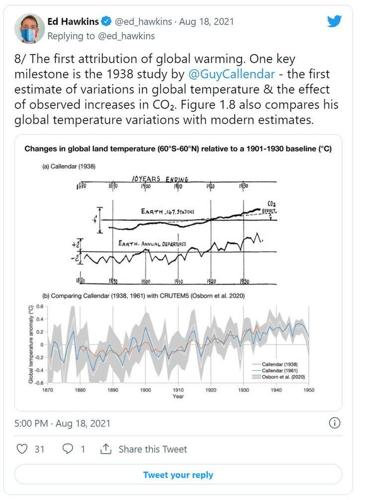
But his climate change work was done on his own time. Callendar kept journals with detailed weather data, including carbon dioxide levels and temperature. In an innovative paper published in 1938, he claimed there was an “increase in mean temperature, due to the artificial production of carbon dioxide.”
He averaged diverse sets of temperature data from all over the world, primarily using the Smithsonian publication “World Weather Records,” and derived global average temperatures that track very well with current estimates of the average temperatures of the time.

He also calculated how much carbon dioxide humans were putting into the atmosphere — the annual net human addition. In 1938, it was about 4.3 billion tons, which compares well with current estimates for that year of about 4.2 billion tons. Note that global carbon dioxide emissions in 2018 were about 36 billion tons.
Gathering published data on carbon dioxide levels in the atmosphere, Callendar created a graph correlating temperature increases over time with increases in atmospheric carbon dioxide levels.
What Callendar discovered
Perhaps most importantly, Callendar recognized that new data on the heat absorption of carbon dioxide at wavelengths different from that of water vapor meant that adding carbon dioxide would trap more heat than water vapor alone.
In the period before Callendar’s paper, key scientists thought the huge volume of water vapor in the atmosphere, one of the “greenhouse” gases that keep Earth warm, would dwarf any contribution by carbon dioxide to Earth’s heat balance. However, heat is radiated out to space as waves, with a range of wavelengths, and water vapor absorbs only some of those wavelengths. Callendar knew that recent, more precise absorption data showed that carbon dioxide absorbed heat at wavelengths that water missed.

Guy Stewart Callendar in 1934. G.S. Callendar Archive, University of East Anglia
Callendar also considered different layers in the atmosphere. Carbon dioxide concentrates at a higher altitude in the atmosphere than water vapor. Atmospheric water vapor evaporates and then precipitates out of the atmosphere as rain or snow, but adding carbon dioxide severely upsets Earth’s energy balance because it stays in the atmosphere for hundreds of years. Carbon dioxide forms a heat-trapping layer high in the atmosphere, absorbing heat that radiates upward from Earth’s surface and then emitting it back towards Earth’s surface. Callendar’s paper provided insight into this mechanism.
After Callendar published his paper, global warming caused by human activities generating carbon dioxide was widely referred to as the “Callendar Effect.”
[Over 140,000 readers rely on The Conversation’s newsletters to understand the world. Sign up today.]
However, his 1938 view was limited. Callendar did not foresee the magnitude of temperature rise that the world now faces, or the danger. He actually speculated that by burning carbon we might forestall “the return of the deadly glaciers.”
His paper projected a 0.39 degree Celsius temperature rise by the 21st century. The world today is already 1.2 C (2.2 F) warmer than before the industrial era — three times the magnitude of the effect Callendar predicted.
Backlash to the human connection
The “Callendar Effect” faced immediate resistance. Comments of initial reviewers questioned his data and methods.
The debate Callendar ignited continued through the rest of the 20th century. Temperature and carbon dioxide data, meanwhile, accumulated.
By the late 20th century, reviews of climate science held stark warnings about the path the world was on as humans continued to burn fossil fuels. The debate Callendar triggered is long since over.
Scientists from around the world, brought together by the United Nations and the World Meteorological Organization, have been reviewing the research and evidence since 1990. Their reports confirm: The science is clear about humans’ role in climate change. The danger is real and the effects of climate change are already evident all around us.
Neil Anderson, a retired chemical engineer and chemistry teacher, contributed to this article.
Sylvia G. Dee receives funding from the National Science Foundation (NSF), the National Oceanic and Atmospheric Administration (NOAA), and the National Aeronautics and Space Administration (NASA).
This article is republished from The Conversation under a Creative Commons license.
How 8 natural disasters can be mitigated with climate-resilient construction
How 8 natural disasters can be mitigated with climate-resilient construction
Updated
Climate scientists continue to prove the link between climate change and extreme weather events, from hurricanes to droughts to floods. With each new weather event comes the potential for damage to people’s homes and possessions. This is not just emotionally damaging and physically dangerous, but also comes with a steep associated financial cost.
To discover how climate-resilient construction can help to mitigate natural disasters, Stacker first determined the economic damage within the United States caused by eight types of natural disasters between 2010 and 2020, based on data compiled by Our World In Data. Economic damage data spanning 2010–20, provided by EM-DAT, is expressed as a portion of U.S. gross domestic product (GDP), provided by the World Bank.
Fortunately, some of these costs can be avoided with climate-resilient construction to mitigate natural disasters. In order to understand how different natural disasters can be better anticipated and mitigated through building strategy, we outlined various climate-resilient construction and projects being used to minimize the effects of those disasters using data from the U.S. government, design firms, and media outlets. Choosing the building location carefully and with advice from experts, universally, can help mitigate many of these natural disasters.
You may also like: Space discoveries that will blow your mind

Volcanic eruption
Updated
- Economic damages between 2010–20: 0.0002% of GDP
If you live near an active volcano, evacuating remains the most important safety measure when warned of a potential eruption. However, there are ways to construct a building to make it more resilient in the face of a volcanic eruption. As eruptions can whip up fierce winds, mostly flat roofs with a slight, 15-degree slope will be less likely to be hit by the wind. The slope will allow ash to slide off the roof. Triple roof support and using smooth materials for roofing will also help ash slide away.
Similarly, concrete structures’ natural wind resistance fares better than timber-framed buildings. Lastly, designing simpler architectural structures will leave less room for ash to settle, creating a safer environment.
Landslide
Updated
- Economic damages between 2010–20: 0.0004% of GDP
Following proper land-use procedures will help mitigate the impacts of landslides on your property. These procedures include avoiding building near steep slopes, close to the edges of mountains, along natural erosion valleys, and near drainage ways. The use of sandbags and retaining walls are techniques that can protect buildings from floodwaters and mud caused by landslides. In areas prone to mud and debris flow, build channels or deflection walls to redirect the flow of debris around the structure—but be sure not to direct it into someone else’s building.
In 2005, a landslide destroyed 19 homes and forced the evacuation of more than 300 homes in Bluebird Canyon in Laguna Beach, California, leading to a 2.5-year reconstruction project using clever building strategies. Beyond smarter architecture, drainage systems were installed and edges along the land were stabilized to protect against another disaster. Consulting with a geotechnical professional before building will help mitigate further damage as well.
Earthquake
Updated
- Economic damages between 2010–20: 0.0005% of GDP
When working on a building resilient to earthquake damage, be sure to include base isolators. Conventional buildings will shake with the ground during an earthquake, and when they shake too much, structural elements can sustain heavy damage, sometimes to the point of destruction.
Base isolators act as shock absorbers between the building and the moving ground. This lets the building slide back and forth instead of shaking during an earthquake, so it will still remain upright. Layers of steel and rubber with a lead core built between the floor and the foundation will also help to isolate the building from ground motion. Steel plate wall systems can mitigate earthquake damage as well.
The Ritz-Carlton/JW Marriott hotel building in Los Angeles is the first to use an advanced steel plate shear wall system to resist earthquakes. At 54 stories tall, the hotel must be able to withstand earthquakes.
Extreme temperature
Updated
- Economic damages between 2010–20: 0.0015% of GDP
There are a number of ways to make your home more resilient to extreme heat caused by climate change. In order to keep heat out, cover windows with drapes or shades and weather-strip windows and doors. Insulation will help keep the heat out, and window reflectors can help by reflecting heat back outside.
When possible, install window air conditioners to cool the house or building and insulate around them, so the cool air doesn’t escape and the hot air doesn’t come in. For those unable to afford the costs associated with adding these climate-resilient measures, the Low Income Home Energy Assistance Program (LIHEAP) can provide financial support.
For new constructions, passive houses may be the solution to beat increasing global temperatures. A type of housing that dates back centuries, passive houses rely on building walls, roofs, and windows with more insulation and seals, including triple-paned windows, highly insulated wall systems, and energy-efficient heat pumps. Implementing these architectural elements leads to a nearly air-tight building, reducing the amount of hot air that can enter.
Flood
Updated
- Economic damages between 2010–20: 0.0225% of GDP
To prevent or reduce damage from flooding, there are a few elements that must be taken into account when designing a building or home. Preventing water ingress will ensure a safer structure. Constructing the building with concrete or steel with concrete protects against water entering—as both of these materials are more impervious to flooding than other materials.
Installing raised windows, doors with materials to prevent water damage, and floor guards can also protect the structure. Finally, it’s important to have a drainage system in place in case water does get in, which could be sub-floor drainage, sump pumps, and non-return valves.
You may also like: How communities are dealing with invasive species across the U.S.
Wildfire
Updated
- Economic damages between 2010–20: 0.0233% of GDP
When constructing buildings and homes to avoid wildfires, choosing the right location is crucial. Ideally, construction wouldn’t take place in any danger zones, but that’s not always possible. It’s important to consider the climate, wind patterns, vegetation, and escape routes when choosing where to build.
Consider the structure itself—for example, patios are more resilient than decks. Typically, patios are made from non-flammable materials whereas decks are made from wood and can trap vegetation beneath them, which act as fuel. For similar reasons, slab-on-grade and full basement foundations provide more protection as opposed to pier foundations or crawl spaces, where vegetation and other flammable debris can accumulate. Building a house from concrete and other masonry materials provide the greatest protection from fire, and insulated windows contribute even more to architectural resilience.
Drought
Updated
- Economic damages between 2010–20: 0.024% of GDP
Buildings must be designed as a source of water to be resilient to drought. The type of water that can be produced or collected from a building include graywater, blackwater, rainwater, stormwater, or foundation drainage.
Graywater is the leftover water collected from showers, washing machines, and bathroom sinks, and it’s the cleanest kind of water that could be collected from a building. While it is not potable water, graywater can be used for irrigation, laundry, and for flushing toilets. This makes it so potable water does not have to be used for those purposes. In San Francisco, the capture and reuse of this non-potable water is mandated for new buildings.
Storm
Updated
- Economic damages between 2010–20: 0.2313% of GDP
Residences continue to be built and bought close to oceans, in spite of the rising sea levels and increasing storms caused by climate change. To make these homes more resilient in the face of storms, there are a number of techniques that builders and designers can use.
For example, when homes are round they are more aerodynamic, deflecting airflow around the structure instead of absorbing the force. These round buildings get 30% less pressure building around them than a conventionally shaped home. The use of high-quality materials plays a big role as well—materials such as plywood and metal—and roofs should be anchored well so they don’t fly off. The elevation is important, too: Deltec Homes, a company that builds storm-resilient homes, recommends building at least 2 feet above flood surge.
While all these tips are important, when storms are bad enough and evacuation orders go into effect, the most important thing is still to listen to that guidance and evacuate.

