

Young and aching; recycling war material; sex trafficking ring suit
Odd and interesting news from the Midwest.
- By MIKE TIGHE La Crosse Tribune
By MIKE TIGHE
La Crosse Tribune
LA CROSSE, Wis. (AP) — Emotions ran close to the surface during the open house and blessing of the new Sister Leclare Beres Learning Resource Center at Mayo Clinic Health System-Franciscan Healthcare.
The sentiment flowed from the fact that the $1.1 million center is named for one of the city's most revered health care icons — the late member of the Franciscan Sisters of Perpetual Adoration who was a longtime nursing educator and founder of the St. Clare Health Mission, which provides free health care for uninsured and underinsured people.
"This would be perfect for Sister Leclare," St. Clare director Sandy Brekke said during a tour of the facility in Mayo-Franciscan's Professional Arts Building, which housed the St. Francis School of Nursing from 1902 to 1970. "She was so devoted to students."
During the dedication ceremony last Monday, Mayo-Franciscan official Joe Kruse became choked up when reminiscing about Beres and a picture of her on a mural caught his eye, the La Crosse Tribune (http://bit.ly/1VBtxwV ) reported.
In addition to developing the center, the chief administrative officer teared up as he said, "We also wanted to honor a treasure, Sister Leclare. She's a treasure to us, and we wanted to honor her.
"I miss her," Kruse said plaintively.
FSPA Sister Helen Elsbernd, vice president of the order, also referred to Beres as she gave a thumbnail history of the hospital, tracing to its founding in 1883.
When city officials asked the sisters to establish the hospital, "it was said that a doctor could carry all the tools he needed — and it always was 'he' then — in a little black bag," she said.
Now, doctors — male and female — have giant machines and unlimited technology at their fingertips to help treat patients, she said.
Elsbernd recalled that Beres, who died in 2014 at the age of 88, used to marvel at the emerging technology and its capacity to improve patient care.
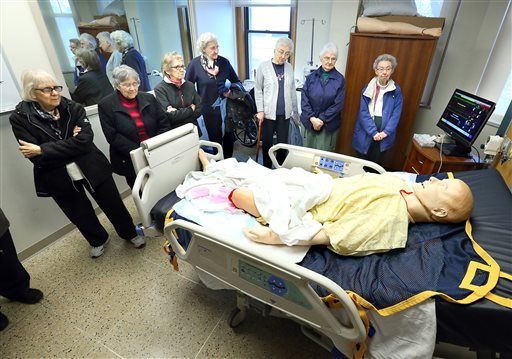
Among the technological aids that Mayo-Franciscan staffers and local nursing students will be able to use in the center are two patient simulators — lifelike mannequins programmed to mimic human traits.
"The star of the show," as training center faculty member Bob Milisch labeled one mannequin, can speak, have seizures, perspire from the forehead and shoot pulsing blood from his severed leg, among other maladies to test the mettle of staff and students.
Named Gene or Jean, depending on the drill, the mannequin features male and female body parts — again, depending on the skill. Students are able to monitor blood pressure and breathing, with Gene/Jean's lips turning blue when oxygen is too low, and adjust accordingly, Milisch said.
Jean/Gene's neck can be made to swell so staffers can practice inserting breathing tubes through a small opening, he said.
Although the simulators, which include one that gives birth, are sophisticated, volunteer patients will be used for some exercises at the center, which the Franciscan Healthcare Foundation and other benefactors financed.
Gene/Jean also can be used to help train housekeeping staffers and other personnel how to respond if they are in a room and a patient says something or has a reaction to something, Milisch said.
The pregnant mannequin can monitor the mini-mannequin baby's heartbeat and learn to deliver a breech infant or handle other complications, nursing education specialist Barb Reardon said during a demonstration.
Asked whether nurses don't learn such skills in school, Reardon said, "They learn it, but they don't always see the process. . Even in nursing school, folks can go through their whole rotation and don't get to see a delivery."
The simulation rooms have computers and viewing stations from which instructors can manipulate symptoms and guide people through each procedure needed.
Another sim room includes a mannequin to practice various procedures, as well as stations to practice using ultrasound to insert IVs and catheters, place a chest tube and even treat an ingrown toenail.
One plastic body part, used to teach how to treat bedsores, goes by the name of Seymour Butts, a moniker the vendor dreamed up, hospital officials said.
"Our business is taking care of people," Kruse said before the blessing of the center. "This whole project is to help our staff get ready to take care of people."
___
Information from: La Crosse Tribune, http://www.lacrossetribune.com
This is an AP Member Exchange shared by the La Crosse Tribune
- By JESSIE BEKKER The Minnesota Daily
- Updated
MINNEAPOLIS (AP) — Aching muscles were no more than background noise to Claire Stephens until the pain started to creep into her wrists.
Stephens, then a music education first-year at Winona State University, worried that daily violin practice could be inducing the pangs.
One year later, she set down the instrument for good, The Minnesota Daily (http://bit.ly/1ScEG1P ) reported.
Despite giving up the hobby she intended to make her career, the ache continued to spread — first to her back and ribs and then to her head, until Stephens noticed herself feeling dizzy and was unable to remember important moments in her life. Just months into her second year at school, she moved back home.
A doctor diagnosed Stephens with fibromyalgia, muscle pain throughout the body often associated with anxiety and poor memory. The doctor told the 20-year-old she would feel off for the rest of her life.
Now a journalism junior at the University of Minnesota, she's among many young adults that suffer from one of the most under-researched disorders of the age group.
About one in four adults aged 18 to 29 report experiencing chronic pain, according to one estimate. Often, having the disorder means tossing loved activities to the wayside — as it did for Stephens — and adopting special habits to maintain health.
Health professionals differ in their treatments, with recommendations ranging from opioids to natural remedies such as chiropractic care and acupuncture.
Despite medical marijuana's legalization for intractable, or chronic, pain in Minnesota last year, doctors across the board say there's no proof that the drug could be a cure.
To be considered chronic, pain must last three or more months. But the kind of pain included in the condition's definition can range from migraines to spinal pain or injury-induced discomfort and more.
The wide range makes finding a conclusive solution for chronic pain intangible, further veiling the disorder for young adults who are already isolated by stigmas that pain is disabling, that young people can't feel pain and that those who claim to be feeling achy must be lying.
___
Chronic pain is difficult to study objectively, said Roni Evans, an associate professor in the University's Center for Spirituality and Healing.
"You can't see that someone has pain. It's not like a broken leg or a broken arm; it is something that someone experiences, so you really have to rely on what they're telling you," she said. "And that makes it hard to study."
When Shweta Kapoor, a postdoctoral psychiatry and behavioral sciences fellow at Emory University, began her dissertation on young adults with chronic pain in 2012, she immediately noticed a lack of precedent research.
Though recent data has shown pain is almost as prevalent in young people as it is in older generations, Kapoor said, they're less likely to ask for help for fear of seeming weak. And when young adults in pain don't step forward, it becomes difficult to build a research base.
"At this age, it is associated with being in the prime of our lives. We're supposed to be healthy and doing what other people are doing," she said. "While your friends are moving on and doing things people generally do in college, you are basically stuck."
As part of her study, Kapoor interviewed five focus groups about their experiences with lasting pain.
She quickly found that those students, all from the University of Alabama, were missing out on major college traditions. Some refrained from the strenuous process of greek life recruitment or left football games because the standing made them ache.
Still, others would power through parties and game days in excruciating pain, fearing judgment if they complained.
"When we talk about chronic pain, we don't imagine a young person," she said. "And that becomes a huge barrier in living their life."
Kapoor found students experiencing chronic pain were also more likely to be depressed and dissatisfied with life. And because pain levels could be unpredictable, students reported high levels of stress.
For several students suffering from chronic pain at the University of Minnesota, stress, isolation and stigmas are familiar acquaintances.
Third-year computer science doctoral student Tim Snyder said his fibromyalgia causes him daily body ache. At its worst, the pain feels like he has been set on fire, he said. When he's around big groups of people, Snyder's pain and anxiety levels flare.
"It makes me far more of a hermit than I'd like to be," he said.
Though a disability accommodations letter gave him the extra leeway to finish classwork at an altered pace as an undergraduate, he said graduate professors haven't been so lenient.
"A lot of people in general just don't understand pain," Snyder said. "It seems like people mostly just feel like I should suck it up and that people in general, when they're in pain, suck it up. And they don't understand that it's something that is really draining."
Stephens, the journalism student with fibromyalgia, spent two years searching for an accurate diagnosis. As doctor after doctor sent her home with a new opinion, Stephens began to wonder if she was imagining it.
"I would tell my parents, 'You know, my back is really sore, too, and I've been having these issues.' And I started talking to them more openly about that sort of stuff," she said. "I didn't want to feel like I was whining."
Some members of her family accused her of crying wolf, Stephens said.
"There were some times I'd be at the nurse's office, and I'd call my mom from school, and she didn't believe me," she said. "I just felt like a wimp all the time. I think it's hard not to judge someone who doesn't get their laundry done for a week because they honestly don't have the energy to pick that basket up and go downstairs."
Dr. Alfred Anderson, the owner and medical director at the Realief Medical Pain Clinic in St. Louis Park, said his college-aged patients often come into the clinic in search of treatment for debilitating conditions some people ignore.
"We have patients with severe fibromyalgia, which everyone just kind of looks at like, 'Oh yeah, sure, just pull yourself up by the bootstraps,'" he said.
Kids and young adults who are ignored by parent and teacher figures can be more likely to hide their pain for fear of rejection, said Dr. James Fricton, a University dentistry professor and pain specialist at the Minnesota Head and Neck Pain Clinic.
"You think that kids are so resilient — and they are resilient, and their muscles do get better faster — and that's why we need to pay attention when kids complain of pain," he said. "Teachers need to wake up to the reality that kids who don't have pain are going to study and be better students."
___
University chemical engineering and computer science first-year Vee Livermore starts each day after a minimum of eight hours of sleep.
Livermore braves an obstacle course of chairs each morning to shut off an alarm across the room. A morning shower helps soothe their muscles, and they also eat breakfast to avoid hunger, which can trigger migraines.
Livermore has experienced from head-throbbing pain since childhood, which worsened in high school. At that point, a couple of days ache-free were a blessing.
Eventually, their mother, a migraine-sufferer herself, took Livermore to the emergency room after a monthlong migraine left the teenager delirious.
"I'd wake up, and it was bad," Livermore said. "I'd go to bed, and it was still bad."
An injection at the hospital should've sent them home pain-free for two weeks. The migraine returned the following evening.
Now, Livermore takes 25 milligrams of Escitalopram, their third medication since that ER visit. Even on the daily preventative pill, tension headaches hit Livermore about two to three times weekly, and migraines once every two weeks.
Some doctors say self-care is the best method of treatment for those with chronic aches, and failing to follow personalized routines can intensify symptoms.
Research suggests changing habits can help manage pain, said Fricton, the Minnesota Head and Neck Pain Clinic pain specialist. Clenching teeth or eating too much sugar, for example, can lead to headaches and migraines.
Livermore carries snacks to munch on throughout the day. Stephens makes sure to get 10 hours of sleep nightly and avoids strenuous workouts. Some others with chronic pain schedule regular chiropractic adjustments.
"I kind of had to reinvent myself because I really didn't know what I was interested in very much past (playing the violin and viola). It really just left me feeling pretty lost and unsure of what I was doing," Stephens said. "I had to completely re-meet myself."
___
Because chronic pain comes in varying forms, doctors and patients alike can struggle to treat it.
Anderson, the doctor from the Realief Medical Pain Clinic, said he prescribes opioids to treat pain only when patients have exhausted all other care options.
Guidelines released last week by the Centers for Disease Control and Prevention addressed what they called an "ongoing prescription opioid overdose epidemic" and said a limited number of studies show chronic pain patients benefit from opioid use. More than 165,000 deaths were attributed to opioid overdose from 1999 to 2014, according to the CDC.
For non-cancer patients, the CDC discourages opioid treatments for chronic pain, but Anderson said all patients suffer equally.
"The difference is, of course, that non-cancer patients get looked upon as weak, and non-desirable and untouchable, as if they have leprosy," he said. "(They) are severely limited as to what they can have for medication."
But other physicians, like Fricton, worry opioids don't get to the source of a person's ailment.
Some, like first-year University chemistry student Julia Amaral, choose to refrain from taking a daily pain medication altogether and turn instead to alternative methods.
As a high school freshman, a file cabinet fell on and broke Amaral's foot. Now, she wakes each morning to burning, cooling and vibrating sensations shooting intensely through her foot — pain she said doctors describe as worse than childbirth.
She was supposed to regain full mobility, but when she went to her podiatrist five months after surgery with a blue, vibrating foot, Amaral found she was suffering from complex regional pain syndrome, a rare sympathetic nervous system disorder.
Amaral's go-to treatment is biofeedback, a meditative method of heart rate and breath monitoring used to relax muscles and raise the body's temperature.
Roni Evans, an associate professor in the University's Center for Spirituality and Healing, said while more traditional approaches to health management, like surgery and medication, can be necessary for some, trying less conventional methods can empower a patient to care for themselves.
Evans said research shows that pain is one of the most common reasons for people to use nontraditional medicine.
There's an increasing body of evidence that treatments like massage therapy, yoga, meditation, chiropractic care and acupuncture can help treat chronic pain, she said, though the research for these methods focuses on older adults.
"We pay attention where we see the most impact," she said. "So in adults, when they can't work, we see that more; we pay attention more."
Still, it can be difficult to teach patients about nontraditional forms of care when the convention is to seek help from an M.D., said Larry Spicer, executive director of the Minnesota Board of Chiropractic Examiners.
And while alternative care methods are backed by peer-reviewed studies, doctors agree there's limited proof that medical cannabis is an effective means of stopping pain.
Daily marijuana use in those under 25 is linked with diminished IQ and addiction and can trigger psychotic disorders like schizophrenia in those predisposed, said Dr. Erin Krebs, a University associate professor of medicine and a panelist on the Intractable Pain Advisory Panel with the Minnesota Department of Health.
The panel reviewed scientific data and heard from the public before approving medical marijuana for intractable, or chronic, pain in the state last year.
Krebs said she'd prefer to take the guesswork out of doctor's hands and legalize marijuana recreationally.
"During prohibition on alcohol, people argued that physicians could prescribe alcohol," Krebs said. "Clearly, as soon as alcohol was legal, no one thinks that physicians should prescribe it or that it's medical."
Evans said care comes down to one common goal: doing what's best for a patient.
And because everyone experiences pain differently, there's no one solution, said John Mullen, a University pain management psychologist.
Mullen helps patients understand pain can't always be cured, but management is within reach.
"What I find exciting about my work as a health psychologist is . providing the message to people that there is hope to feel better and do better," he said, "even if the pain can't be completely controlled or eliminated."
___
Information from: The Minnesota Daily, http://www.mndaily.com/
This is an AP Member Exchange shared by The Minnesota Daily
- By KEVIN BURBACH Associated Press
- Updated
ST. PAUL, Minn. (AP) — Rick Wheeler has spent nearly three decades trying to soothe the middle-school blues for his students. A ball of energy, he sprints around the halls of Hastings Middle School to fill out bullying reports and check in with students in between being a full-time counselor for almost 500 kids.
But even Wheeler, the 2013 Minnesota middle school counselor of the year and an avid marathoner, doesn't have the time, energy or resources to help all the hundreds of students he oversees each year — and he's not alone.
For decades, the ratio of students to counselors in Minnesota has ranked near the very bottom nationwide. Across the state, there's an average of nearly 800 students for each counselor.
Now, some lawmakers say Minnesota has been in last long enough. They're trying to get money for more counselors and support staff — but it's going to take some serious political will to make any headway this year while more pressing legislative issues loom large.
"We do so many things well and this one we're clearly dropping the ball on," said Sen. Susan Kent, a Woodbury Democrat sponsoring the proposal again this year.
Kent last year pushed for $90 million for school counselors. She scaled that back this year to $20 million in one-time spending due to a reduced budget surplus and the fact it's not a budget year.
Her proposal would allow schools to enter into a six-year grant program and hire a counselor or more support staff, like chemical dependency counselors or social workers. The state would split an employee's salary with a local district evenly for the first four years and cover 25 percent for the remaining two. Kent's hope is that after six years of the new positions, districts will realize they need to permanently fill that job.
Counselors say the additional help is needed so they can actually connect with students and spot issues before they start. The bill includes all support staff, Kent said, since schools may have enough counselors but not have any psychologists or social workers.
At White Bear Lake High School, administrators recently shifted some funding to hire two more counselors in order to restructure its counseling divisions. Now, they have about eight counselors for four grade levels at a ratio of 275 students per counselor. Each counselor is assigned half of a grade level and sticks with that class through their four years in high school.
"A lot of these other things get moved to the back burner (with too many students) — college and career counseling, minor issues," said Brian Merhar, a counselor at White Bear Lake who used to be responsible for over 400 students each year. "You're putting out a lot of fires, that's how you're prioritizing your job."
Merhar said now he has more time to connect with students and build relationships instead of just handling emergencies.
But many lawmakers question why the state needs to dedicate even more money to help school counseling when the Legislature already moved to add millions more in general education spending last year.
Republican Rep. Jenifer Loon, who chairs the education finance committee, said she could understand the push for extra funding if it wasn't keeping up with inflation, but she said it is. And if schools want to shift money around to hire more counselors — like White Bear Lake did — then they should, she said.
Nationwide, Minnesota has ranked last or almost last for years when it comes to its ratio of counselors to students. In the 2013-2014 school year, Minnesota had a ratio of 743 students to every one counselor, third only to Arizona and California, according to the American School Counselors Association.
Kent, the Democrat pushing the legislation, said many states have mandates requiring low ratios. At the AMSA, Assistant Director Jill Scott said other state governments recommend schools keep low ratios when allocating funds.
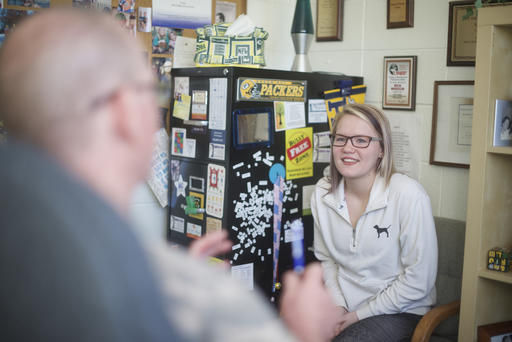
In Wheeler's office in Hastings one recent Friday morning, the longtime school counselor sat down with two of his colleagues before meeting with one of his regular students. One of the counselors, Charlie Black, said people in his profession often aren't good about promoting their own work, especially since they can't talk about their sessions with students with anyone else.
Black said counselors need to speak up and let people know that their work is important and that they need help.
"We're really good advocates for kids, but we're not the best self-advocates," he said. "But we're important, we need to advocate for ourselves."
- By BOB SHAW St. Paul Pioneer Press
- Updated
By BOB SHAW
St. Paul Pioneer Press
ST. PAUL, Minn. (AP) — Joy McBrien's necklaces hold a few morbid secrets.
What is in her drop-dead gorgeous jewelry once made people actually drop dead.
McBrien sells jewelry made from the recycled refuse of war, fashioned by women in poverty or in war-torn areas of the world, the St. Paul Pioneer Press (http://bit.ly/1RxqFzN ) reported. Women in Ethiopia, for example, scavenge bullet shell casings in their villages, melt the metal into beads, then string them together to make earrings and necklaces.
McBrien, 26, of St. Paul sells the jewelry through a business called Fair Anita, named after an inspirational social worker she met while working in Peru.
"It's the whole idea of women investing in other women," said McBrien, speaking from Santiago, Chile, where she is conducting a six-month business-development trip. "Success comes when we lift each other up."
By providing jobs and money to women, she said, they are lifted out of poverty and can stand up for themselves, which is how entire communities can be helped.
___
McBrien said her burning desire to help women has its roots in a horrible crime.
As a high school senior in Woodbury, McBrien said, she was raped. She did not report the attack to police, and it left a long-lasting emotional wound.
"I had to figure out how to heal. I wondered what violence against women looked like in different cultural contexts. It was my way of coping," she said.
McBrien turned a crime against women into a business to help women — almost like turning bullets into earrings.
Another turning point came at the Carlson School of Management at the University of Minnesota, where she learned how to start and manage nonprofits. But more important, she said, was the training in running a business.
She is proud of the fact that Fair Anita is not a nonprofit, entirely dependent on donations. It is an independent and self-sustaining business, she said.
"I was determined that it would not be based on pity. It would not be, 'Oh, buy this so this poor woman can have water,' " McBrien said.
"A lot of the time, that's how things are sold, trying to create some empathetic relationship between the customer and the artisan. I wanted to sell cool stuff that people wanted."
___
She began to travel the world, visiting with women and searching for the best way to get involved. In Peru, she helped establish a women's shelter.
"I intended to start a group focused on social work," McBrien said.
But that sounded like charity to the women, which they did not want, she said. "All the women I met said, 'That is a nice idea, but what I need is a job,'" McBrien said.
And what was the one job they could do? Making handicrafts.
Wherever McBrien went, she said, local women thrust their handicrafts at her. "They would all say, 'Take these back to the U.S. and sell them for me,' " she said.
McBrien thought it sounded ridiculous at first. She said the items didn't look like jewelry that American customers would buy.
But the idea germinated. "I went back and thought about it. If I could make some tweaks on the design work, I could sell this," McBrien said.
She found women in India making jewelry from tightly rolled newspapers. Other women made scarves or adorned shoes with colorful cloth. McBrien is currently working with Cambodian women who use recycled bomb casings to make various items.
Last year, Fair Anita sold about $50,000 in merchandise, said McBrien. She said she has given about 8,000 women in 16 countries full- or part-time work.
She sells about 45 percent of her material through her website, fairanita.com. The products are also sold at Ten Thousand Villages in St. Paul and the Weisman Museum and the craft shop Regala de Oro in Minneapolis.
This year, she said that as she travels in South America, developing sources and markets, one question obsesses her: "How can we empower women around the world?"
"We are getting there," she said. "I have seen it happen."
___
Information from: St. Paul Pioneer Press, http://www.twincities.com
This is an AP Member Exchange shared by the St. Paul Pioneer Press
- Updated
DES MOINES, Iowa (AP) — The three northern Iowa counties being sued by a Des Moines water utility have received $900,000 in donations to cover most of their legal bills, but officials won't identify the donors.
The Des Moines Register reports (http://dmreg.co/1NisBXM ) Sac, Buena Vista and Calhoun counties recently released about 260 pages of legal records to several newspapers and the Iowa Freedom of Information Council.
The counties have racked up nearly $1.1 million in legal bills so far.
Officials don't believe they are required to identify the donors because state law exempts donations from foundations that support government.
Still, one of Calhoun County's attorneys, David Wollenzien, said the counties are trying to get permission from donors to share more.
The lawsuit filed last year by Des Moines Water Works alleges the three counties that oversee 10 agricultural drainage districts should be required to obtain federal water pollution discharge permits because they release pollutants into rivers much like regulated factories.
The lawsuit could affect the way farm drainage tiles are treated by environmental regulators who monitor levels of nitrogen and phosphorus.
Randy Evans, the Iowa Freedom of Information Council's executive director, said identifying the donors is important because their interests may differ from taxpayers. For example, farming groups or large agriculture corporations may be donating to the defense fund.
"Those who are paying the bills to fight the lawsuit may have a deep financial interest ... in not losing the lawsuit," Evans said. But "if the counties lose and there are damages to pay, it's the taxpayers who are on the hook."
Four Iowa agriculture groups have acknowledged making contributions to the counties' defense fund, but they have primarily done so through the Agricultural Legal Defense Fund. That makes it difficult to learn details of their contributions.
The Agribusiness Association of Iowa's members all agreed to pay 5 cents per ton of fertilizer sold over three years to help support the legal defense fund.
The Iowa Corn Growers Association donated $200,000, and the Iowa Soybean Association contributed $20,000. The Iowa Farm Bureau Federation has also donated to the fund, but officials there declined to say how much.
___
Information from: The Des Moines Register, http://www.desmoinesregister.com
- Updated
ST. PAUL, Minn. (AP) — A Minnesota woman who spent four years in jail after she was accused of participating in a sex trafficking ring has filed a lawsuit against the city of St. Paul and a key police investigator.
In her federal lawsuit, 26-year-old Hamdi Ali Osman alleges St. Paul Sgt. Heather Weyker framed Osman as the "madam" in the sex ring of mostly Somali-American immigrants and refugees.
The original child sex-trafficking indictment in which 30 people were charged came in 2010. Last month, a federal judge reversed convictions for several people and the 6th U.S. Circuit Court of Appeals upheld the reversal after concluding that Weyker was repeatedly caught lying, and that the sex trafficking claims by two of the alleged victims were likely fictitious.
The U.S. attorney's office in Nashville dismissed all pending cases against the remaining defendants last month. Osman was released from the county jail in Bowling Green, Kentucky, where she said she and other inmates spent 23 hours a day locked in their cells. She'd been there for four years and on home arrest for two years.
Osman's lawsuit says Weyker's actions deprived her of her freedom for six years. She's also suing three unnamed supervisors who she said allowed Weyker to continue fabricating facts.
Public records do not list a phone number for Weyker.
The St. Paul Police Department does not comment on litigation, the St. Paul city attorney said he would not speak immediately about the lawsuit and the attorney for the St. Paul police union declined to comment, according to the Pioneer Press.
Osman is seeking $2 million for each year she was in pretrial detention — a total of $12 million.
St. Paul police began an internal affairs investigation into Weyker on March 3, the day after the court's finding was filed, and they placed her on paid administrative leave. On March 9, Weyker returned to work and the department put the internal investigation on hold.
St. Paul police spokesman Steve Linders said officials are awaiting more information from federal agencies that led the case before taking any more action against Weyker.
- Updated
JEFFERSON CITY, Mo. (AP) — A Missouri Supreme Court ruling last month has given new hope to more than 80 inmates who were convicted as juveniles of first-degree murder and sentenced to life in prison without parole.
In response to two U.S. Supreme Court rulings — one in 2012 that required two sentencing options for juveniles convicted of first-degree murder, and another in January that said the earlier ruling was retroactive — the Missouri high court on March 15 ordered that all juvenile offenders sentenced to life without parole in the prison system be granted a parole hearing after serving 25 years.
That means people like Joseph Dayringer, who was 16 in 1987 when he was sentenced for fatally stabbing his 26-year-old Joplin neighbor 39 times, will get their first chance for parole.
Dayringer, who was 15 when he killed Joyce Holland, has been in prison ever since, the Joplin Globe (http://bit.ly/1VfSArg ) reported.
Before 2005, there were two sentencing options for Missouri juveniles convicted of first-degree murder — the death penalty or life in prison without parole.
But that year, the U.S. Supreme Court ruled in a different Missouri case that sentencing someone younger than 18 to death was unconstitutional. That left Missouri with just the option of life without parole.
Many states corrected their statutes after the 2012 ruling, but Missouri didn't, said Greg Mermelstein, an attorney with the state Public Defender's Office.
Some states required at least 25 years in prison before juvenile killers were eligible for parole, some offered it as early as 15 years and others required 40 years before a parole hearing.
Since Missouri legislators have not passed any laws fixing the state's sentencing law since the 2012 ruling, the state Supreme Court took action, Mermelstein said.
Lawmakers have tried to pass new sentencing guidelines, but attempts in each of the last three sessions were unsuccessful.
Sen. Bob Dixon, a Springfield Republican, is sponsoring a bill that would make juveniles whose offenses happened before they were 16 eligible for parole after 25 years. Those whose offenses happened when they were 16 or older would have to wait 50 years.
The bill was debated by the full Senate last week but has not received initial approval.
Some, including former Joplin detective Ken Copeland, don't believe Dayringer should receive parole.
Copeland, who is now Newton County sheriff, was the first to notice deep scratch marks on Dayringer's face that led him to become a suspect.
Copeland remembers Holland's kitchen covered in blood and said he would be glad if Dayringer is never released.
"Some people never deserve to be on the streets again," he said.
___
Information from: The Joplin (Mo.) Globe, http://www.joplinglobe.com
- Updated
WICHITA, Kan. (AP) — Sedgwick County commissioners are being warned not to ask participants in a federal nutrition program about their citizenship status or risk losing its ability to administer the program.
In a letter commissioners and the county counselor received last week, the Kansas Department of Health and Environment said asking about the status of participants in the Women, Infants and Children program before a change in state eligibility requirements could result in termination of the county's contract to operate WIC.
"The current state and local operating procedures do not limit participation in the WIC program," the KDHE letter said. "Before participation is limited, the KDHE must amend the procedures for participation and provide USDA with the amended procedures."
The letter does not address whether the state would seek such a change in the program, which provides checks to low-income families for nutritional foods, The Wichita Eagle (http://bit.ly/1SD6X2j ) reported.
Sedgwick County Commissioner Richard Ranzau suggested last fall that the county health department start using a questionnaire that would ask about the immigration status of all who use health department services, including WIC recipients. Some commissioners said the intent was to gather useful data on who the department serves.
E-mails obtained by The Eagle showed that U.S. Department of Agriculture authorities told state officials that asking for WIC clients' immigration status would be out of compliance and endanger federal grant dollars.
If Sedgwick County lost its contract to administer the WIC program, someone else would take up operations and participants in the program would continue receiving assistance.
Public health and immigrant advocacy groups have blasted Ranzau's proposal, saying it would have a chilling effect on people seeking services and put community health at risk.
The commissioner also proposed last fall that the state redefine its eligibility requirements to block illegal immigrants from participating in WIC. Ranzau was chairman last fall when the commission formally asked the state to review those policies in an October letter.
Commissioner Karl Peterjohn said he wasn't comfortable with "welfare ... provided to folks who have broken our laws."
Blocking people from WIC was not a good use of the commission's time, Commissioner Dave Unruh said later.
"A child born here by our laws is an American citizen, and we wouldn't want to exclude that child from receiving those benefits, whether their parent was legal or illegal," he said. "We just need to provide these services as long as we have the resources to folks who need them."
Ranzau said he was frustrated over the lack of a clear answer from the state about whether it plans to block illegal immigrants from getting WIC aid.
"They've failed to answer any of our questions, basically," he said.
___
Information from: The Wichita (Kan.) Eagle, http://www.kansas.com
- Updated
BLOOMINGTON, Ind. (AP) — Indiana's public access counselor says trustees at private colleges shouldn't hold meetings in private when they decide whether to authorize public charter schools.
Luke Britt, the state's public access counselor, said in an advisory opinion issued earlier this month that while other meetings of a private university's trustees aren't required to be public, a private college is a public entity when decisions are made regarding authorizing charter schools.
Private authorizers didn't officially know previously that trustees acted as a public entity during meetings to authorize charter schools, meaning that those meetings should have been open to the public, Britt said.
His advisory opinion was issued in reference to Trine University in Angola, which can authorize charter schools. But The (Bloomington) Herald-Times (http://bit.ly/1q7IjQg) reports the opinion would apply to all 30 private institutions the state Legislature has given the authority to oversee charter schools.
That includes Grace College in northern Indiana's Winona Lake, which authorized Seven Oaks Classical School to open in Monroe County.
Grace College's board of trustees held a meeting closed to the public in January to consider authorizing the charter school, and trustees' votes have been kept private.
There were two other attempts by Seven Oaks to open a Monroe County charter school. The state charter school board denied its application in 2014, and last year Seven Oaks withdrew its application before it could be voted on by the board.
Despite Britt's opinion, Grace College continues to refuse requests for minutes and voting tallies from its January meeting.
"It is our understanding via legal counsel that the Open Door Law did not apply to private institutions such as Grace College at the time of our January 13" meeting, Grace College spokeswoman Amanda Banks said in an email.
Britt's opinion is backed up by a change in state law signed last month by Gov. Mike Pence.
That law requires that private schools make meetings on authorizing charter schools public by requiring transfer of authorization authority to another legal entity that the college's trustees oversee. That part of the law goes into effect Jan. 1.
Banks said Grace College will comply with that new law after the end of the year.
___
Information from: The Herald Times, http://www.heraldtimesonline.com
- Updated
MADISON, Wis. (AP) — Officials at the University of Wisconsin-Madison plan to award a graduate student who died last year a rare posthumous degree.
The State Journal reports (http://bit.ly/1S3LJNs ) 30-year-old Craig Schuff died in October. Schuff had already earned a master's degree in nuclear engineering and was preparing to defend his thesis to earn a doctorate in electrical engineering.
The university registrar's office says a posthumous graduate degree has only been awarded once before. A student must have completed all course requirements, be near completion of a thesis and have done work that's "substantial" and "worthy of a degree."
Schuff's research was centered on neutron generation from a device that could be used to scan packages and detect clandestine materials, such as chemicals or nuclear materials.
Schuff's parents will accept his degree in May.
___
Information from: Wisconsin State Journal, http://www.madison.com/wsj
- By JIM SALTER Associated Press
- Updated
ST. LOUIS (AP) — A St. Louis nonprofit is helping people with Alzheimer's disease stay in their homes longer, which its founder says benefits patients while saving taxpayers money that would otherwise go toward paying for nursing home care.
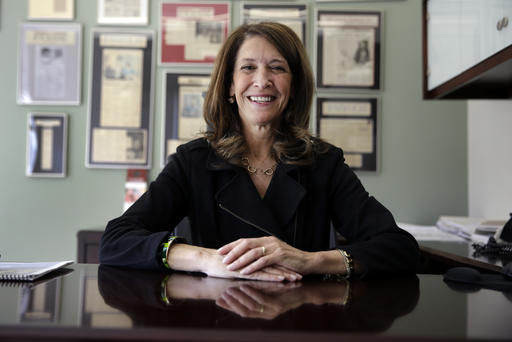
Lisa Baron, who founded Memory Care Home Solutions, testified Wednesday before the U.S. Senate's Special Committee on Aging during a hearing that focused on the financial and emotional toll that Alzheimer's disease has on the 5.4 million Americans who suffer from the disease and their loved ones.
Baron told the committee that America is "facing a national crisis caused by Alzheimer's and dementia."
Democratic Missouri Sen. Claire McCaskill, who co-chairs the committee along with Republican Sen. Susan Collins of Maine, cited studies showing that dementia care could cost the nation $1 trillion annually by 2050. She said Medicare and Medicaid pay "the vast majority" of that cost.
"The model of Lisa's organization not only helps seniors to remain in their homes, but also provides critical assistance to family caregivers who are so often overlooked," McCaskill said.
In an interview Thursday, Baron told The Associated Press that she started her nonprofit in 2002, not long after her mother-in-law, suffering from Alzheimer's, wandered away from home. Firefighters later found her. She had fallen and wasn't able to get up, but was otherwise unharmed.
"That was the moment I knew I had to help other families dealing with the destruction of this disease," Baron told The Associated Press.
Baron said she was inspired by the dignity with which her father-in-law treated his stricken wife, allowing her to remain home as long as possible. She said that on average, her clients stay home a full year longer than others at similar stages of the disease.
Memory Care Home Solutions uses donations to help mostly low-income families that are coping with the disease — more than half of the organization's clients earn less than $20,000 annually. Services are provided at no cost.
It isn't just memory that abandons someone with Alzheimer's. Their vision is affected, depth perception, balance. Being forced into an unfamiliar environment often makes things much harder for them, Baron said.
"Therapeutically it's the best thing to stay in their home, the environment they know so well," Baron said.
So her organization trains caregivers to deal with the side effects of the disease, and establish safeguards that can allow the Alzheimer's sufferer to stay out of a care facility as long as possible.
Caregivers are taught the basics, ranging from how to change a diaper to how to lessen the risk of falling out of bed. The organization provides an alarm that sounds if the person with dementia opens a door to the outside. The program also helps the caregiver deal with problems common for dementia patients, such as dehydration, urinary tract infections, hallucinations and falls.
Easing the burden of the caregiver is vital, too.
For example, a common side effect is disorientation when awakening. A person with dementia might wake up in the middle of the night and believe it is breakfast time. Memory Care teaches caregivers to leave breakfast items out at night so that the person with the illness can eat without requiring the caregiver to get out of bed.
Baron estimates that by allowing clients to remain at home longer, her program has saved the Missouri Medicaid program more than $30 million.
"It really helps in terms of quality of life, and it diminishes costs," she said.
- Updated
DAYTON, Ohio (AP) — Dayton is banning its employees from non-essential government travel to Mississippi and North Carolina, saying recent laws passed in the two states discriminate against lesbian, gay, bisexual and transgender people.
A Thursday memo from Dayton Mayor Nan Whaley forbids city dollars paying for non-essential travel to the states.
The Dayton Daily News reports (http://bit.ly/1RXCHzt ) Whaley said the new laws conflict with the city's values and anti-discrimination ordinances enacted by city commissioners.
At issue is a Mississippi law that allows people and groups with religious objections to refuse service to gay people, and a North Carolina law that prevents transgender people from using the restroom of his or her preference.
Cuyahoga (ky-uh-HOH'-guh) County has also banned travel to North Carolina.
Other cities and states have issued similar travel bans.
___
Information from: Dayton Daily News, http://www.daytondailynews.com
- By MIKE TIGHE La Crosse Tribune
By MIKE TIGHE
La Crosse Tribune
LA CROSSE, Wis. (AP) — Emotions ran close to the surface during the open house and blessing of the new Sister Leclare Beres Learning Resource Center at Mayo Clinic Health System-Franciscan Healthcare.
The sentiment flowed from the fact that the $1.1 million center is named for one of the city's most revered health care icons — the late member of the Franciscan Sisters of Perpetual Adoration who was a longtime nursing educator and founder of the St. Clare Health Mission, which provides free health care for uninsured and underinsured people.
"This would be perfect for Sister Leclare," St. Clare director Sandy Brekke said during a tour of the facility in Mayo-Franciscan's Professional Arts Building, which housed the St. Francis School of Nursing from 1902 to 1970. "She was so devoted to students."
During the dedication ceremony last Monday, Mayo-Franciscan official Joe Kruse became choked up when reminiscing about Beres and a picture of her on a mural caught his eye, the La Crosse Tribune (http://bit.ly/1VBtxwV ) reported.
In addition to developing the center, the chief administrative officer teared up as he said, "We also wanted to honor a treasure, Sister Leclare. She's a treasure to us, and we wanted to honor her.
"I miss her," Kruse said plaintively.
FSPA Sister Helen Elsbernd, vice president of the order, also referred to Beres as she gave a thumbnail history of the hospital, tracing to its founding in 1883.
When city officials asked the sisters to establish the hospital, "it was said that a doctor could carry all the tools he needed — and it always was 'he' then — in a little black bag," she said.
Now, doctors — male and female — have giant machines and unlimited technology at their fingertips to help treat patients, she said.
Elsbernd recalled that Beres, who died in 2014 at the age of 88, used to marvel at the emerging technology and its capacity to improve patient care.
Among the technological aids that Mayo-Franciscan staffers and local nursing students will be able to use in the center are two patient simulators — lifelike mannequins programmed to mimic human traits.
"The star of the show," as training center faculty member Bob Milisch labeled one mannequin, can speak, have seizures, perspire from the forehead and shoot pulsing blood from his severed leg, among other maladies to test the mettle of staff and students.
Named Gene or Jean, depending on the drill, the mannequin features male and female body parts — again, depending on the skill. Students are able to monitor blood pressure and breathing, with Gene/Jean's lips turning blue when oxygen is too low, and adjust accordingly, Milisch said.
Jean/Gene's neck can be made to swell so staffers can practice inserting breathing tubes through a small opening, he said.
Although the simulators, which include one that gives birth, are sophisticated, volunteer patients will be used for some exercises at the center, which the Franciscan Healthcare Foundation and other benefactors financed.
Gene/Jean also can be used to help train housekeeping staffers and other personnel how to respond if they are in a room and a patient says something or has a reaction to something, Milisch said.
The pregnant mannequin can monitor the mini-mannequin baby's heartbeat and learn to deliver a breech infant or handle other complications, nursing education specialist Barb Reardon said during a demonstration.
Asked whether nurses don't learn such skills in school, Reardon said, "They learn it, but they don't always see the process. . Even in nursing school, folks can go through their whole rotation and don't get to see a delivery."
The simulation rooms have computers and viewing stations from which instructors can manipulate symptoms and guide people through each procedure needed.
Another sim room includes a mannequin to practice various procedures, as well as stations to practice using ultrasound to insert IVs and catheters, place a chest tube and even treat an ingrown toenail.
One plastic body part, used to teach how to treat bedsores, goes by the name of Seymour Butts, a moniker the vendor dreamed up, hospital officials said.
"Our business is taking care of people," Kruse said before the blessing of the center. "This whole project is to help our staff get ready to take care of people."
___
Information from: La Crosse Tribune, http://www.lacrossetribune.com
This is an AP Member Exchange shared by the La Crosse Tribune
- By JESSIE BEKKER The Minnesota Daily
MINNEAPOLIS (AP) — Aching muscles were no more than background noise to Claire Stephens until the pain started to creep into her wrists.
Stephens, then a music education first-year at Winona State University, worried that daily violin practice could be inducing the pangs.
One year later, she set down the instrument for good, The Minnesota Daily (http://bit.ly/1ScEG1P ) reported.
Despite giving up the hobby she intended to make her career, the ache continued to spread — first to her back and ribs and then to her head, until Stephens noticed herself feeling dizzy and was unable to remember important moments in her life. Just months into her second year at school, she moved back home.
A doctor diagnosed Stephens with fibromyalgia, muscle pain throughout the body often associated with anxiety and poor memory. The doctor told the 20-year-old she would feel off for the rest of her life.
Now a journalism junior at the University of Minnesota, she's among many young adults that suffer from one of the most under-researched disorders of the age group.
About one in four adults aged 18 to 29 report experiencing chronic pain, according to one estimate. Often, having the disorder means tossing loved activities to the wayside — as it did for Stephens — and adopting special habits to maintain health.
Health professionals differ in their treatments, with recommendations ranging from opioids to natural remedies such as chiropractic care and acupuncture.
Despite medical marijuana's legalization for intractable, or chronic, pain in Minnesota last year, doctors across the board say there's no proof that the drug could be a cure.
To be considered chronic, pain must last three or more months. But the kind of pain included in the condition's definition can range from migraines to spinal pain or injury-induced discomfort and more.
The wide range makes finding a conclusive solution for chronic pain intangible, further veiling the disorder for young adults who are already isolated by stigmas that pain is disabling, that young people can't feel pain and that those who claim to be feeling achy must be lying.
___
Chronic pain is difficult to study objectively, said Roni Evans, an associate professor in the University's Center for Spirituality and Healing.
"You can't see that someone has pain. It's not like a broken leg or a broken arm; it is something that someone experiences, so you really have to rely on what they're telling you," she said. "And that makes it hard to study."
When Shweta Kapoor, a postdoctoral psychiatry and behavioral sciences fellow at Emory University, began her dissertation on young adults with chronic pain in 2012, she immediately noticed a lack of precedent research.
Though recent data has shown pain is almost as prevalent in young people as it is in older generations, Kapoor said, they're less likely to ask for help for fear of seeming weak. And when young adults in pain don't step forward, it becomes difficult to build a research base.
"At this age, it is associated with being in the prime of our lives. We're supposed to be healthy and doing what other people are doing," she said. "While your friends are moving on and doing things people generally do in college, you are basically stuck."
As part of her study, Kapoor interviewed five focus groups about their experiences with lasting pain.
She quickly found that those students, all from the University of Alabama, were missing out on major college traditions. Some refrained from the strenuous process of greek life recruitment or left football games because the standing made them ache.
Still, others would power through parties and game days in excruciating pain, fearing judgment if they complained.
"When we talk about chronic pain, we don't imagine a young person," she said. "And that becomes a huge barrier in living their life."
Kapoor found students experiencing chronic pain were also more likely to be depressed and dissatisfied with life. And because pain levels could be unpredictable, students reported high levels of stress.
For several students suffering from chronic pain at the University of Minnesota, stress, isolation and stigmas are familiar acquaintances.
Third-year computer science doctoral student Tim Snyder said his fibromyalgia causes him daily body ache. At its worst, the pain feels like he has been set on fire, he said. When he's around big groups of people, Snyder's pain and anxiety levels flare.
"It makes me far more of a hermit than I'd like to be," he said.
Though a disability accommodations letter gave him the extra leeway to finish classwork at an altered pace as an undergraduate, he said graduate professors haven't been so lenient.
"A lot of people in general just don't understand pain," Snyder said. "It seems like people mostly just feel like I should suck it up and that people in general, when they're in pain, suck it up. And they don't understand that it's something that is really draining."
Stephens, the journalism student with fibromyalgia, spent two years searching for an accurate diagnosis. As doctor after doctor sent her home with a new opinion, Stephens began to wonder if she was imagining it.
"I would tell my parents, 'You know, my back is really sore, too, and I've been having these issues.' And I started talking to them more openly about that sort of stuff," she said. "I didn't want to feel like I was whining."
Some members of her family accused her of crying wolf, Stephens said.
"There were some times I'd be at the nurse's office, and I'd call my mom from school, and she didn't believe me," she said. "I just felt like a wimp all the time. I think it's hard not to judge someone who doesn't get their laundry done for a week because they honestly don't have the energy to pick that basket up and go downstairs."
Dr. Alfred Anderson, the owner and medical director at the Realief Medical Pain Clinic in St. Louis Park, said his college-aged patients often come into the clinic in search of treatment for debilitating conditions some people ignore.
"We have patients with severe fibromyalgia, which everyone just kind of looks at like, 'Oh yeah, sure, just pull yourself up by the bootstraps,'" he said.
Kids and young adults who are ignored by parent and teacher figures can be more likely to hide their pain for fear of rejection, said Dr. James Fricton, a University dentistry professor and pain specialist at the Minnesota Head and Neck Pain Clinic.
"You think that kids are so resilient — and they are resilient, and their muscles do get better faster — and that's why we need to pay attention when kids complain of pain," he said. "Teachers need to wake up to the reality that kids who don't have pain are going to study and be better students."
___
University chemical engineering and computer science first-year Vee Livermore starts each day after a minimum of eight hours of sleep.
Livermore braves an obstacle course of chairs each morning to shut off an alarm across the room. A morning shower helps soothe their muscles, and they also eat breakfast to avoid hunger, which can trigger migraines.
Livermore has experienced from head-throbbing pain since childhood, which worsened in high school. At that point, a couple of days ache-free were a blessing.
Eventually, their mother, a migraine-sufferer herself, took Livermore to the emergency room after a monthlong migraine left the teenager delirious.
"I'd wake up, and it was bad," Livermore said. "I'd go to bed, and it was still bad."
An injection at the hospital should've sent them home pain-free for two weeks. The migraine returned the following evening.
Now, Livermore takes 25 milligrams of Escitalopram, their third medication since that ER visit. Even on the daily preventative pill, tension headaches hit Livermore about two to three times weekly, and migraines once every two weeks.
Some doctors say self-care is the best method of treatment for those with chronic aches, and failing to follow personalized routines can intensify symptoms.
Research suggests changing habits can help manage pain, said Fricton, the Minnesota Head and Neck Pain Clinic pain specialist. Clenching teeth or eating too much sugar, for example, can lead to headaches and migraines.
Livermore carries snacks to munch on throughout the day. Stephens makes sure to get 10 hours of sleep nightly and avoids strenuous workouts. Some others with chronic pain schedule regular chiropractic adjustments.
"I kind of had to reinvent myself because I really didn't know what I was interested in very much past (playing the violin and viola). It really just left me feeling pretty lost and unsure of what I was doing," Stephens said. "I had to completely re-meet myself."
___
Because chronic pain comes in varying forms, doctors and patients alike can struggle to treat it.
Anderson, the doctor from the Realief Medical Pain Clinic, said he prescribes opioids to treat pain only when patients have exhausted all other care options.
Guidelines released last week by the Centers for Disease Control and Prevention addressed what they called an "ongoing prescription opioid overdose epidemic" and said a limited number of studies show chronic pain patients benefit from opioid use. More than 165,000 deaths were attributed to opioid overdose from 1999 to 2014, according to the CDC.
For non-cancer patients, the CDC discourages opioid treatments for chronic pain, but Anderson said all patients suffer equally.
"The difference is, of course, that non-cancer patients get looked upon as weak, and non-desirable and untouchable, as if they have leprosy," he said. "(They) are severely limited as to what they can have for medication."
But other physicians, like Fricton, worry opioids don't get to the source of a person's ailment.
Some, like first-year University chemistry student Julia Amaral, choose to refrain from taking a daily pain medication altogether and turn instead to alternative methods.
As a high school freshman, a file cabinet fell on and broke Amaral's foot. Now, she wakes each morning to burning, cooling and vibrating sensations shooting intensely through her foot — pain she said doctors describe as worse than childbirth.
She was supposed to regain full mobility, but when she went to her podiatrist five months after surgery with a blue, vibrating foot, Amaral found she was suffering from complex regional pain syndrome, a rare sympathetic nervous system disorder.
Amaral's go-to treatment is biofeedback, a meditative method of heart rate and breath monitoring used to relax muscles and raise the body's temperature.
Roni Evans, an associate professor in the University's Center for Spirituality and Healing, said while more traditional approaches to health management, like surgery and medication, can be necessary for some, trying less conventional methods can empower a patient to care for themselves.
Evans said research shows that pain is one of the most common reasons for people to use nontraditional medicine.
There's an increasing body of evidence that treatments like massage therapy, yoga, meditation, chiropractic care and acupuncture can help treat chronic pain, she said, though the research for these methods focuses on older adults.
"We pay attention where we see the most impact," she said. "So in adults, when they can't work, we see that more; we pay attention more."
Still, it can be difficult to teach patients about nontraditional forms of care when the convention is to seek help from an M.D., said Larry Spicer, executive director of the Minnesota Board of Chiropractic Examiners.
And while alternative care methods are backed by peer-reviewed studies, doctors agree there's limited proof that medical cannabis is an effective means of stopping pain.
Daily marijuana use in those under 25 is linked with diminished IQ and addiction and can trigger psychotic disorders like schizophrenia in those predisposed, said Dr. Erin Krebs, a University associate professor of medicine and a panelist on the Intractable Pain Advisory Panel with the Minnesota Department of Health.
The panel reviewed scientific data and heard from the public before approving medical marijuana for intractable, or chronic, pain in the state last year.
Krebs said she'd prefer to take the guesswork out of doctor's hands and legalize marijuana recreationally.
"During prohibition on alcohol, people argued that physicians could prescribe alcohol," Krebs said. "Clearly, as soon as alcohol was legal, no one thinks that physicians should prescribe it or that it's medical."
Evans said care comes down to one common goal: doing what's best for a patient.
And because everyone experiences pain differently, there's no one solution, said John Mullen, a University pain management psychologist.
Mullen helps patients understand pain can't always be cured, but management is within reach.
"What I find exciting about my work as a health psychologist is . providing the message to people that there is hope to feel better and do better," he said, "even if the pain can't be completely controlled or eliminated."
___
Information from: The Minnesota Daily, http://www.mndaily.com/
This is an AP Member Exchange shared by The Minnesota Daily
- By KEVIN BURBACH Associated Press
ST. PAUL, Minn. (AP) — Rick Wheeler has spent nearly three decades trying to soothe the middle-school blues for his students. A ball of energy, he sprints around the halls of Hastings Middle School to fill out bullying reports and check in with students in between being a full-time counselor for almost 500 kids.
But even Wheeler, the 2013 Minnesota middle school counselor of the year and an avid marathoner, doesn't have the time, energy or resources to help all the hundreds of students he oversees each year — and he's not alone.
For decades, the ratio of students to counselors in Minnesota has ranked near the very bottom nationwide. Across the state, there's an average of nearly 800 students for each counselor.
Now, some lawmakers say Minnesota has been in last long enough. They're trying to get money for more counselors and support staff — but it's going to take some serious political will to make any headway this year while more pressing legislative issues loom large.
"We do so many things well and this one we're clearly dropping the ball on," said Sen. Susan Kent, a Woodbury Democrat sponsoring the proposal again this year.
Kent last year pushed for $90 million for school counselors. She scaled that back this year to $20 million in one-time spending due to a reduced budget surplus and the fact it's not a budget year.
Her proposal would allow schools to enter into a six-year grant program and hire a counselor or more support staff, like chemical dependency counselors or social workers. The state would split an employee's salary with a local district evenly for the first four years and cover 25 percent for the remaining two. Kent's hope is that after six years of the new positions, districts will realize they need to permanently fill that job.
Counselors say the additional help is needed so they can actually connect with students and spot issues before they start. The bill includes all support staff, Kent said, since schools may have enough counselors but not have any psychologists or social workers.
At White Bear Lake High School, administrators recently shifted some funding to hire two more counselors in order to restructure its counseling divisions. Now, they have about eight counselors for four grade levels at a ratio of 275 students per counselor. Each counselor is assigned half of a grade level and sticks with that class through their four years in high school.
"A lot of these other things get moved to the back burner (with too many students) — college and career counseling, minor issues," said Brian Merhar, a counselor at White Bear Lake who used to be responsible for over 400 students each year. "You're putting out a lot of fires, that's how you're prioritizing your job."
Merhar said now he has more time to connect with students and build relationships instead of just handling emergencies.
But many lawmakers question why the state needs to dedicate even more money to help school counseling when the Legislature already moved to add millions more in general education spending last year.
Republican Rep. Jenifer Loon, who chairs the education finance committee, said she could understand the push for extra funding if it wasn't keeping up with inflation, but she said it is. And if schools want to shift money around to hire more counselors — like White Bear Lake did — then they should, she said.
Nationwide, Minnesota has ranked last or almost last for years when it comes to its ratio of counselors to students. In the 2013-2014 school year, Minnesota had a ratio of 743 students to every one counselor, third only to Arizona and California, according to the American School Counselors Association.
Kent, the Democrat pushing the legislation, said many states have mandates requiring low ratios. At the AMSA, Assistant Director Jill Scott said other state governments recommend schools keep low ratios when allocating funds.
In Wheeler's office in Hastings one recent Friday morning, the longtime school counselor sat down with two of his colleagues before meeting with one of his regular students. One of the counselors, Charlie Black, said people in his profession often aren't good about promoting their own work, especially since they can't talk about their sessions with students with anyone else.
Black said counselors need to speak up and let people know that their work is important and that they need help.
"We're really good advocates for kids, but we're not the best self-advocates," he said. "But we're important, we need to advocate for ourselves."
- By BOB SHAW St. Paul Pioneer Press
By BOB SHAW
St. Paul Pioneer Press
ST. PAUL, Minn. (AP) — Joy McBrien's necklaces hold a few morbid secrets.
What is in her drop-dead gorgeous jewelry once made people actually drop dead.
McBrien sells jewelry made from the recycled refuse of war, fashioned by women in poverty or in war-torn areas of the world, the St. Paul Pioneer Press (http://bit.ly/1RxqFzN ) reported. Women in Ethiopia, for example, scavenge bullet shell casings in their villages, melt the metal into beads, then string them together to make earrings and necklaces.
McBrien, 26, of St. Paul sells the jewelry through a business called Fair Anita, named after an inspirational social worker she met while working in Peru.
"It's the whole idea of women investing in other women," said McBrien, speaking from Santiago, Chile, where she is conducting a six-month business-development trip. "Success comes when we lift each other up."
By providing jobs and money to women, she said, they are lifted out of poverty and can stand up for themselves, which is how entire communities can be helped.
___
McBrien said her burning desire to help women has its roots in a horrible crime.
As a high school senior in Woodbury, McBrien said, she was raped. She did not report the attack to police, and it left a long-lasting emotional wound.
"I had to figure out how to heal. I wondered what violence against women looked like in different cultural contexts. It was my way of coping," she said.
McBrien turned a crime against women into a business to help women — almost like turning bullets into earrings.
Another turning point came at the Carlson School of Management at the University of Minnesota, where she learned how to start and manage nonprofits. But more important, she said, was the training in running a business.
She is proud of the fact that Fair Anita is not a nonprofit, entirely dependent on donations. It is an independent and self-sustaining business, she said.
"I was determined that it would not be based on pity. It would not be, 'Oh, buy this so this poor woman can have water,' " McBrien said.
"A lot of the time, that's how things are sold, trying to create some empathetic relationship between the customer and the artisan. I wanted to sell cool stuff that people wanted."
___
She began to travel the world, visiting with women and searching for the best way to get involved. In Peru, she helped establish a women's shelter.
"I intended to start a group focused on social work," McBrien said.
But that sounded like charity to the women, which they did not want, she said. "All the women I met said, 'That is a nice idea, but what I need is a job,'" McBrien said.
And what was the one job they could do? Making handicrafts.
Wherever McBrien went, she said, local women thrust their handicrafts at her. "They would all say, 'Take these back to the U.S. and sell them for me,' " she said.
McBrien thought it sounded ridiculous at first. She said the items didn't look like jewelry that American customers would buy.
But the idea germinated. "I went back and thought about it. If I could make some tweaks on the design work, I could sell this," McBrien said.
She found women in India making jewelry from tightly rolled newspapers. Other women made scarves or adorned shoes with colorful cloth. McBrien is currently working with Cambodian women who use recycled bomb casings to make various items.
Last year, Fair Anita sold about $50,000 in merchandise, said McBrien. She said she has given about 8,000 women in 16 countries full- or part-time work.
She sells about 45 percent of her material through her website, fairanita.com. The products are also sold at Ten Thousand Villages in St. Paul and the Weisman Museum and the craft shop Regala de Oro in Minneapolis.
This year, she said that as she travels in South America, developing sources and markets, one question obsesses her: "How can we empower women around the world?"
"We are getting there," she said. "I have seen it happen."
___
Information from: St. Paul Pioneer Press, http://www.twincities.com
This is an AP Member Exchange shared by the St. Paul Pioneer Press
DES MOINES, Iowa (AP) — The three northern Iowa counties being sued by a Des Moines water utility have received $900,000 in donations to cover most of their legal bills, but officials won't identify the donors.
The Des Moines Register reports (http://dmreg.co/1NisBXM ) Sac, Buena Vista and Calhoun counties recently released about 260 pages of legal records to several newspapers and the Iowa Freedom of Information Council.
The counties have racked up nearly $1.1 million in legal bills so far.
Officials don't believe they are required to identify the donors because state law exempts donations from foundations that support government.
Still, one of Calhoun County's attorneys, David Wollenzien, said the counties are trying to get permission from donors to share more.
The lawsuit filed last year by Des Moines Water Works alleges the three counties that oversee 10 agricultural drainage districts should be required to obtain federal water pollution discharge permits because they release pollutants into rivers much like regulated factories.
The lawsuit could affect the way farm drainage tiles are treated by environmental regulators who monitor levels of nitrogen and phosphorus.
Randy Evans, the Iowa Freedom of Information Council's executive director, said identifying the donors is important because their interests may differ from taxpayers. For example, farming groups or large agriculture corporations may be donating to the defense fund.
"Those who are paying the bills to fight the lawsuit may have a deep financial interest ... in not losing the lawsuit," Evans said. But "if the counties lose and there are damages to pay, it's the taxpayers who are on the hook."
Four Iowa agriculture groups have acknowledged making contributions to the counties' defense fund, but they have primarily done so through the Agricultural Legal Defense Fund. That makes it difficult to learn details of their contributions.
The Agribusiness Association of Iowa's members all agreed to pay 5 cents per ton of fertilizer sold over three years to help support the legal defense fund.
The Iowa Corn Growers Association donated $200,000, and the Iowa Soybean Association contributed $20,000. The Iowa Farm Bureau Federation has also donated to the fund, but officials there declined to say how much.
___
Information from: The Des Moines Register, http://www.desmoinesregister.com
ST. PAUL, Minn. (AP) — A Minnesota woman who spent four years in jail after she was accused of participating in a sex trafficking ring has filed a lawsuit against the city of St. Paul and a key police investigator.
In her federal lawsuit, 26-year-old Hamdi Ali Osman alleges St. Paul Sgt. Heather Weyker framed Osman as the "madam" in the sex ring of mostly Somali-American immigrants and refugees.
The original child sex-trafficking indictment in which 30 people were charged came in 2010. Last month, a federal judge reversed convictions for several people and the 6th U.S. Circuit Court of Appeals upheld the reversal after concluding that Weyker was repeatedly caught lying, and that the sex trafficking claims by two of the alleged victims were likely fictitious.
The U.S. attorney's office in Nashville dismissed all pending cases against the remaining defendants last month. Osman was released from the county jail in Bowling Green, Kentucky, where she said she and other inmates spent 23 hours a day locked in their cells. She'd been there for four years and on home arrest for two years.
Osman's lawsuit says Weyker's actions deprived her of her freedom for six years. She's also suing three unnamed supervisors who she said allowed Weyker to continue fabricating facts.
Public records do not list a phone number for Weyker.
The St. Paul Police Department does not comment on litigation, the St. Paul city attorney said he would not speak immediately about the lawsuit and the attorney for the St. Paul police union declined to comment, according to the Pioneer Press.
Osman is seeking $2 million for each year she was in pretrial detention — a total of $12 million.
St. Paul police began an internal affairs investigation into Weyker on March 3, the day after the court's finding was filed, and they placed her on paid administrative leave. On March 9, Weyker returned to work and the department put the internal investigation on hold.
St. Paul police spokesman Steve Linders said officials are awaiting more information from federal agencies that led the case before taking any more action against Weyker.
JEFFERSON CITY, Mo. (AP) — A Missouri Supreme Court ruling last month has given new hope to more than 80 inmates who were convicted as juveniles of first-degree murder and sentenced to life in prison without parole.
In response to two U.S. Supreme Court rulings — one in 2012 that required two sentencing options for juveniles convicted of first-degree murder, and another in January that said the earlier ruling was retroactive — the Missouri high court on March 15 ordered that all juvenile offenders sentenced to life without parole in the prison system be granted a parole hearing after serving 25 years.
That means people like Joseph Dayringer, who was 16 in 1987 when he was sentenced for fatally stabbing his 26-year-old Joplin neighbor 39 times, will get their first chance for parole.
Dayringer, who was 15 when he killed Joyce Holland, has been in prison ever since, the Joplin Globe (http://bit.ly/1VfSArg ) reported.
Before 2005, there were two sentencing options for Missouri juveniles convicted of first-degree murder — the death penalty or life in prison without parole.
But that year, the U.S. Supreme Court ruled in a different Missouri case that sentencing someone younger than 18 to death was unconstitutional. That left Missouri with just the option of life without parole.
Many states corrected their statutes after the 2012 ruling, but Missouri didn't, said Greg Mermelstein, an attorney with the state Public Defender's Office.
Some states required at least 25 years in prison before juvenile killers were eligible for parole, some offered it as early as 15 years and others required 40 years before a parole hearing.
Since Missouri legislators have not passed any laws fixing the state's sentencing law since the 2012 ruling, the state Supreme Court took action, Mermelstein said.
Lawmakers have tried to pass new sentencing guidelines, but attempts in each of the last three sessions were unsuccessful.
Sen. Bob Dixon, a Springfield Republican, is sponsoring a bill that would make juveniles whose offenses happened before they were 16 eligible for parole after 25 years. Those whose offenses happened when they were 16 or older would have to wait 50 years.
The bill was debated by the full Senate last week but has not received initial approval.
Some, including former Joplin detective Ken Copeland, don't believe Dayringer should receive parole.
Copeland, who is now Newton County sheriff, was the first to notice deep scratch marks on Dayringer's face that led him to become a suspect.
Copeland remembers Holland's kitchen covered in blood and said he would be glad if Dayringer is never released.
"Some people never deserve to be on the streets again," he said.
___
Information from: The Joplin (Mo.) Globe, http://www.joplinglobe.com
WICHITA, Kan. (AP) — Sedgwick County commissioners are being warned not to ask participants in a federal nutrition program about their citizenship status or risk losing its ability to administer the program.
In a letter commissioners and the county counselor received last week, the Kansas Department of Health and Environment said asking about the status of participants in the Women, Infants and Children program before a change in state eligibility requirements could result in termination of the county's contract to operate WIC.
"The current state and local operating procedures do not limit participation in the WIC program," the KDHE letter said. "Before participation is limited, the KDHE must amend the procedures for participation and provide USDA with the amended procedures."
The letter does not address whether the state would seek such a change in the program, which provides checks to low-income families for nutritional foods, The Wichita Eagle (http://bit.ly/1SD6X2j ) reported.
Sedgwick County Commissioner Richard Ranzau suggested last fall that the county health department start using a questionnaire that would ask about the immigration status of all who use health department services, including WIC recipients. Some commissioners said the intent was to gather useful data on who the department serves.
E-mails obtained by The Eagle showed that U.S. Department of Agriculture authorities told state officials that asking for WIC clients' immigration status would be out of compliance and endanger federal grant dollars.
If Sedgwick County lost its contract to administer the WIC program, someone else would take up operations and participants in the program would continue receiving assistance.
Public health and immigrant advocacy groups have blasted Ranzau's proposal, saying it would have a chilling effect on people seeking services and put community health at risk.
The commissioner also proposed last fall that the state redefine its eligibility requirements to block illegal immigrants from participating in WIC. Ranzau was chairman last fall when the commission formally asked the state to review those policies in an October letter.
Commissioner Karl Peterjohn said he wasn't comfortable with "welfare ... provided to folks who have broken our laws."
Blocking people from WIC was not a good use of the commission's time, Commissioner Dave Unruh said later.
"A child born here by our laws is an American citizen, and we wouldn't want to exclude that child from receiving those benefits, whether their parent was legal or illegal," he said. "We just need to provide these services as long as we have the resources to folks who need them."
Ranzau said he was frustrated over the lack of a clear answer from the state about whether it plans to block illegal immigrants from getting WIC aid.
"They've failed to answer any of our questions, basically," he said.
___
Information from: The Wichita (Kan.) Eagle, http://www.kansas.com
BLOOMINGTON, Ind. (AP) — Indiana's public access counselor says trustees at private colleges shouldn't hold meetings in private when they decide whether to authorize public charter schools.
Luke Britt, the state's public access counselor, said in an advisory opinion issued earlier this month that while other meetings of a private university's trustees aren't required to be public, a private college is a public entity when decisions are made regarding authorizing charter schools.
Private authorizers didn't officially know previously that trustees acted as a public entity during meetings to authorize charter schools, meaning that those meetings should have been open to the public, Britt said.
His advisory opinion was issued in reference to Trine University in Angola, which can authorize charter schools. But The (Bloomington) Herald-Times (http://bit.ly/1q7IjQg) reports the opinion would apply to all 30 private institutions the state Legislature has given the authority to oversee charter schools.
That includes Grace College in northern Indiana's Winona Lake, which authorized Seven Oaks Classical School to open in Monroe County.
Grace College's board of trustees held a meeting closed to the public in January to consider authorizing the charter school, and trustees' votes have been kept private.
There were two other attempts by Seven Oaks to open a Monroe County charter school. The state charter school board denied its application in 2014, and last year Seven Oaks withdrew its application before it could be voted on by the board.
Despite Britt's opinion, Grace College continues to refuse requests for minutes and voting tallies from its January meeting.
"It is our understanding via legal counsel that the Open Door Law did not apply to private institutions such as Grace College at the time of our January 13" meeting, Grace College spokeswoman Amanda Banks said in an email.
Britt's opinion is backed up by a change in state law signed last month by Gov. Mike Pence.
That law requires that private schools make meetings on authorizing charter schools public by requiring transfer of authorization authority to another legal entity that the college's trustees oversee. That part of the law goes into effect Jan. 1.
Banks said Grace College will comply with that new law after the end of the year.
___
Information from: The Herald Times, http://www.heraldtimesonline.com
MADISON, Wis. (AP) — Officials at the University of Wisconsin-Madison plan to award a graduate student who died last year a rare posthumous degree.
The State Journal reports (http://bit.ly/1S3LJNs ) 30-year-old Craig Schuff died in October. Schuff had already earned a master's degree in nuclear engineering and was preparing to defend his thesis to earn a doctorate in electrical engineering.
The university registrar's office says a posthumous graduate degree has only been awarded once before. A student must have completed all course requirements, be near completion of a thesis and have done work that's "substantial" and "worthy of a degree."
Schuff's research was centered on neutron generation from a device that could be used to scan packages and detect clandestine materials, such as chemicals or nuclear materials.
Schuff's parents will accept his degree in May.
___
Information from: Wisconsin State Journal, http://www.madison.com/wsj
- By JIM SALTER Associated Press
ST. LOUIS (AP) — A St. Louis nonprofit is helping people with Alzheimer's disease stay in their homes longer, which its founder says benefits patients while saving taxpayers money that would otherwise go toward paying for nursing home care.
Lisa Baron, who founded Memory Care Home Solutions, testified Wednesday before the U.S. Senate's Special Committee on Aging during a hearing that focused on the financial and emotional toll that Alzheimer's disease has on the 5.4 million Americans who suffer from the disease and their loved ones.
Baron told the committee that America is "facing a national crisis caused by Alzheimer's and dementia."
Democratic Missouri Sen. Claire McCaskill, who co-chairs the committee along with Republican Sen. Susan Collins of Maine, cited studies showing that dementia care could cost the nation $1 trillion annually by 2050. She said Medicare and Medicaid pay "the vast majority" of that cost.
"The model of Lisa's organization not only helps seniors to remain in their homes, but also provides critical assistance to family caregivers who are so often overlooked," McCaskill said.
In an interview Thursday, Baron told The Associated Press that she started her nonprofit in 2002, not long after her mother-in-law, suffering from Alzheimer's, wandered away from home. Firefighters later found her. She had fallen and wasn't able to get up, but was otherwise unharmed.
"That was the moment I knew I had to help other families dealing with the destruction of this disease," Baron told The Associated Press.
Baron said she was inspired by the dignity with which her father-in-law treated his stricken wife, allowing her to remain home as long as possible. She said that on average, her clients stay home a full year longer than others at similar stages of the disease.
Memory Care Home Solutions uses donations to help mostly low-income families that are coping with the disease — more than half of the organization's clients earn less than $20,000 annually. Services are provided at no cost.
It isn't just memory that abandons someone with Alzheimer's. Their vision is affected, depth perception, balance. Being forced into an unfamiliar environment often makes things much harder for them, Baron said.
"Therapeutically it's the best thing to stay in their home, the environment they know so well," Baron said.
So her organization trains caregivers to deal with the side effects of the disease, and establish safeguards that can allow the Alzheimer's sufferer to stay out of a care facility as long as possible.
Caregivers are taught the basics, ranging from how to change a diaper to how to lessen the risk of falling out of bed. The organization provides an alarm that sounds if the person with dementia opens a door to the outside. The program also helps the caregiver deal with problems common for dementia patients, such as dehydration, urinary tract infections, hallucinations and falls.
Easing the burden of the caregiver is vital, too.
For example, a common side effect is disorientation when awakening. A person with dementia might wake up in the middle of the night and believe it is breakfast time. Memory Care teaches caregivers to leave breakfast items out at night so that the person with the illness can eat without requiring the caregiver to get out of bed.
Baron estimates that by allowing clients to remain at home longer, her program has saved the Missouri Medicaid program more than $30 million.
"It really helps in terms of quality of life, and it diminishes costs," she said.
DAYTON, Ohio (AP) — Dayton is banning its employees from non-essential government travel to Mississippi and North Carolina, saying recent laws passed in the two states discriminate against lesbian, gay, bisexual and transgender people.
A Thursday memo from Dayton Mayor Nan Whaley forbids city dollars paying for non-essential travel to the states.
The Dayton Daily News reports (http://bit.ly/1RXCHzt ) Whaley said the new laws conflict with the city's values and anti-discrimination ordinances enacted by city commissioners.
At issue is a Mississippi law that allows people and groups with religious objections to refuse service to gay people, and a North Carolina law that prevents transgender people from using the restroom of his or her preference.
Cuyahoga (ky-uh-HOH'-guh) County has also banned travel to North Carolina.
Other cities and states have issued similar travel bans.
___
Information from: Dayton Daily News, http://www.daytondailynews.com


View this profile on Instagram#ThisIsTucson 🌵 (@this_is_tucson) • Instagram photos and videos
Most viewed stories
-
Surprise! Wildflower season is starting early. Here's where to find the best blooms 🌼
-
Jamie vs. Sonoran dogs: Follow me as I take on Visit Tucson's Sonoran Dog Trail 🌭
-
43 events you won't want to miss, February 20-22! 🤠🐎
-
Over 60 fun events happening in Tucson in February 💖🐎
-
Nearly 40 fun events this Valentine's Day weekend February 13-15! 💖
-
A new chapter: Crossroads Restaurant is back open after fire
-
This Tucson chef has been named a semifinalist for prestigious James Beard Award 🎉
-
Step back into the 14th century at Arizona Renaissance Fair 🫅