


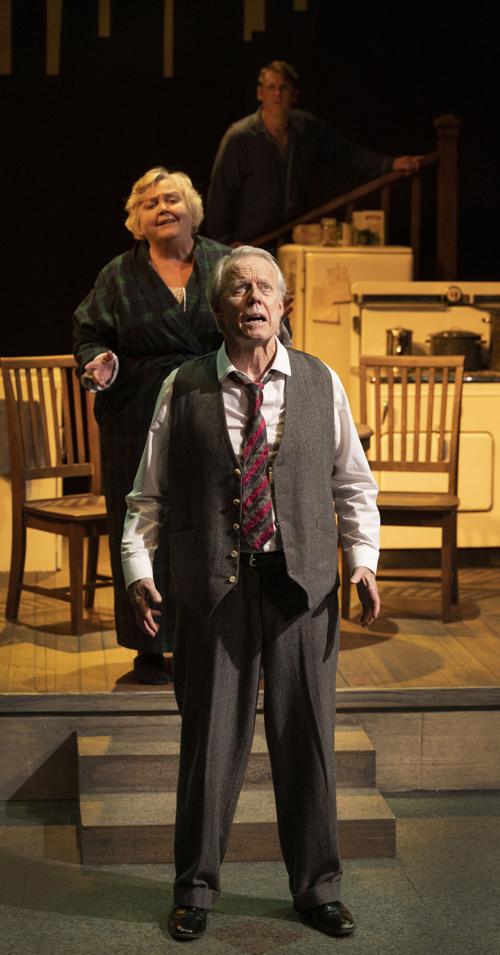
“Death of a Salesman” is over a half century old and about a traveling salesman — a near-obsolete breed.
Yet, the Arthur Miller play, now on stage at The Rogue Theatre, feels fresh and relevant.
That’s because Willy Loman, the salesman in the title, is us: He aches, he makes mistakes, he loves deeply, he hopes and he fails. No way that will ever be anything but relevant.
Matt Bowdren directed this tragedy about Willy who dreams big, is delusional, desperate to be liked and full of hope that his sons would wildly succeed — something neither is particularly interested in.
Joseph McGrath took on the heavy shoulders of Willy and made his madness, his passions, his fears, vivid. Christopher Johnson did a fine job as Biff, the older son and Willy’s biggest hope and disappointment.
Hunter Hnat effectively played Happy, the younger son desperate for attention. There’s a point in the play when emotions are boiling over and all attention is on Biff.
Happy turns to his mother and tells her in a timid voice that he is getting married. He is not; he just wants some acknowledgement of his existence. His mother is focused on the argument between Willy and Biff and pays Happy no mind. It’s a small moment but a heartbreaking one that Hnat drove home beautifully.
But it was Cynthia Meier as Linda, Willy’s wife, who stole the spotlight. The character’s warmth, wrath, love and her heartbreak were palpable in Meier’s very capable hands.
This strong production had a few missteps. On opening night, the pace in the first act was so quick that we were robbed of the nuance. The second act, however, was more settled. Perhaps it was opening night jitters.
The other flaw in the production was that the anger, which consumes both Willy and Biff, often started on such a high note that it had nowhere to go. More modulation would have upped the emotional impact of the powerful story.
But even with the hiccups, the Rogue’s “Salesman” has given us a play that speaks eloquently and effectively about the human psyche. Its wallop has not diminished since it first opened on Broadway in 1949.

