


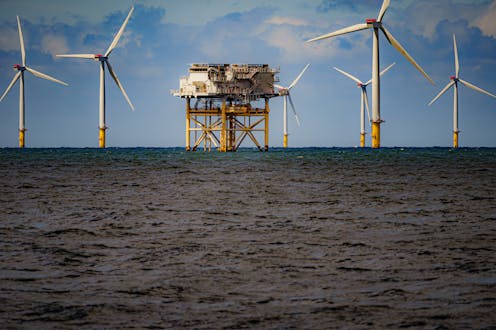
 Coming soon to Texas and Louisiana? Turbines and a support platform at Gwynt y Mor off North Wales. Ben Birchall/PA Images via Getty Images
With passage of the Inflation Reduction Act, which contains US$370 billion for climate and energy programs, policy experts are forecasting a big expansion in clean electricity generation. One source that’s poised for growth is offshore wind power.
Today the U.S. has just two operating offshore wind farms, off of Rhode Island and North Carolina, with a combined generating capacity of 42 megawatts. For comparison, the new Traverse Wind Energy Center in Oklahoma has 356 turbines and a 998-megawatt generating capacity. But many more projects are in development, mostly along the Atlantic coast.
The Biden administration has identified two zones for offshore wind power development in the Gulf of Mexico, which up until now has been firmly identified with oil and gas production. As part of his climate strategy, President Joe Biden has set a goal for the deployment of 30 gigawatts (30,000 megawatts) of offshore wind generating capacity by 2030 — enough to power 10 million homes with carbon-free electricity.
As energy researchers based in Texas, we see this as an exciting new phase in our nation’s ongoing clean power transition. In our view, offshore wind in the Gulf of Mexico presents a unique opportunity for a geographic region with a strong energy workforce and infrastructure to help meet society’s need for reliable low-carbon energy.
Why go offshore?
Wind power on land has seen remarkable growth in the U.S. over the last 15 years, including in Texas, the top wind-generating state in the nation. Wind power’s comparative ease of permitting and siting, affordable installation costs, abundant resources, free fuel and low marginal operating costs have reduced electricity costs for consumers. And wind power avoids significant amounts of air pollution, greenhouse gas emissions and water demand for cooling — impacts associated with power plants that burn coal, oil or natural gas.
But onshore wind has downsides. Winds often are weakest in the hottest hours of summer, when air conditioners are working hard to keep people cool. And many of the best wind energy zones are far from electricity demand centers. For example, most wind farms here in the Lone Star State are located on the high plains in west Texas, and were only built after the state spent billions of dollars on long-distance transmission lines to move their power to where it’s needed.
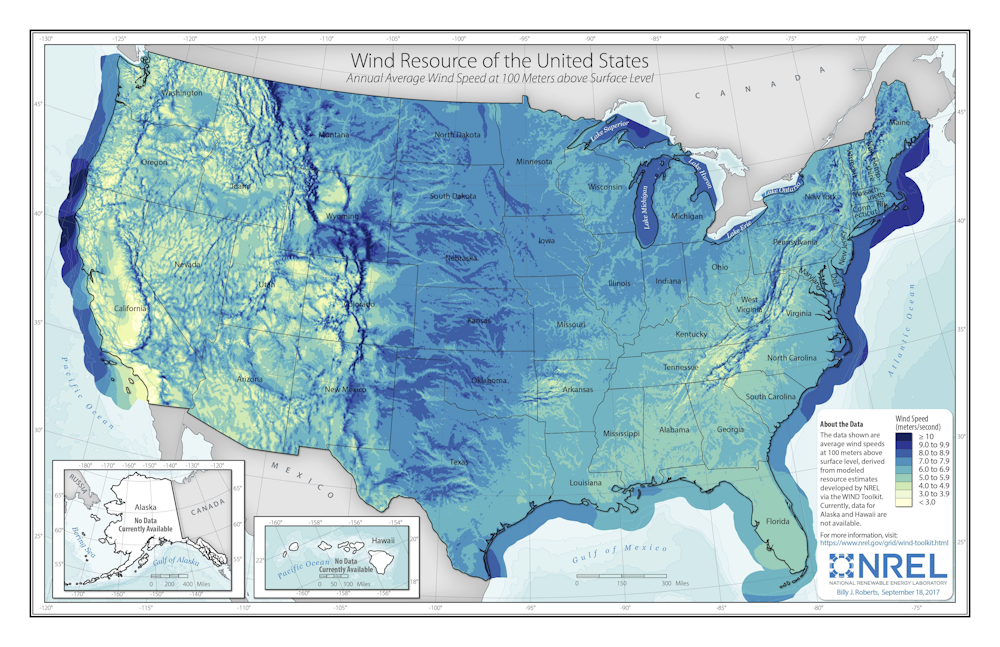 Many of the best U.S. land-based wind generating areas (dark blue zones) are far from coastal population centers, but those cities could be served by offshore wind farms. NREL
Solar power and batteries can solve some of these problems. But generating wind offshore also offers many benefits.
Just as onshore wind lowered electricity costs for consumers, offshore wind is expected to do the same.
More than half of the U.S. population lives within 50 miles of a coast, so offshore wind sites are close to electricity demand centers. This is especially true in the Gulf of Mexico, which is home to major cities such as Houston and New Orleans and a large concentration of petrochemical facilities and ports. Power companies can use subsea cables to bring wind energy to industrial facilities, instead of building hundreds of miles of overhead wires, with associated right-of-way and land access disputes.
Importantly, offshore wind complements onshore wind. As air speeds slow in west Texas on a hot summer afternoon, coastal winds pick up, helping to meet summer peak demand and improving grid reliability.
The offshore wind market is already robust globally, but until now has been practically non-existent in the U.S. Abundant land here has spurred growth of onshore wind, but inhibited a rush to the water.
That’s changing with tighter setback rules in leading wind states like Iowa that limit how close to homes turbines can be placed, which are driving up construction costs and limiting the availability of acceptable sites. Transmission capacity limits on the U.S. power grid are also making it harder to move wind-generated electrons to market.
Constructing offshore wind farms requires specialized ships, port facilities and labor. Many of these resources are already available along the U.S. Gulf Coast, a major offshore oil and gas production region.
Welcome to the Gulf, y'all
Thanks to these development trends, plus measures in the climate bill that increase support for offshore wind, it looks as though a U.S. offshore wind industry is finally ready for prime time. We see the Gulf of Mexico as an especially attractive place to do business.
Compared to cold and bitter conditions in regions like the North Sea, the North Atlantic and coastal Japan, where offshore wind generation is already happening, the Gulf’s shallower water depths, warmer temperatures and calmer waves are relatively easy to manage. Water depths up to 160 feet — currently the maximum depth for fixed-bottom wind turbines — extend nearly 90 miles off the coasts of southeast Texas and southern Louisiana, compared with only about 40 miles off Nantucket and Martha’s Vineyard in the Northeast.
The Gulf’s seafloor topography features a more even and gentle slope than areas already under consideration for development off the coast of Virginia. This means that fixed-bottom wind turbines can be used in more places, rather than floating systems, which reduces complexity.
Importantly, the Gulf Coast has a robust offshore industry that was established to serve oil and gas producers, with many specialized companies offering services such as underwater welding, platform manufacturing and helicopter and boat services to get people and equipment to sea. Gulf of Mexico oil and gas production supported an estimated 345,000 jobs in 2019.
Wind farms in the Gulf can leverage existing infrastructure. There are nearly 1,200 miles of existing subsea power cables that could transfer wind energy to shore. Wind generation could also be incorporated into a larger energy system that includes green hydrogen generation and storage and carbon sequestration.
A boost for workers and vulnerable communities
We also believe that offshore wind energy can help advance environmental justice goals. Generating more clean, carbon-free electricity will help to displace refineries and plants that process fossil fuels and generate power from them. These facilities disproportionately harm the health of communities of color in cities like Houston and across the U.S..
Wind power development in the Gulf also offers an opportunity for a smooth labor transition as the U.S. gradually reduces its reliance on fossil fuels. Louisiana is already moving to set rules for offshore wind in state waters, and is seeking federal funding together with Arkansas and Oklahoma for a regional clean hydrogen hub.
Green means go
Permitting for energy projects is notoriously slow at the federal level, and wind energy projects in federal waters may require multi-year lead times. But projects in state waters — extending up to three nautical miles from shore in most areas, and nine miles from shore in Texas — could proceed more rapidly.
Much depends on whether energy states like Texas and Louisiana see opportunities to extend their reputations as energy leaders into offshore wind. As we see it, an offshore wind boom in the Gulf would be good for the region, the nation and the world’s climate.
Michael E. Webber is affiliated with IdeaSmiths LLC, an independent engineering consultancy, and Energy Impact Partners, a cleantech venture fund. Neither entity stands to benefit from this article.
Hugh Daigle receives funding from the National Science Foundation and the U.S. Department of Energy.
This article is republished from The Conversation under a Creative Commons license.
What's in Democrats' big bill? Climate, health care, deficit reduction
What's in the 'Inflation Reduction Act'?
Updated
The biggest investment ever in the U.S. to fight climate change. A hard-fought cap on out-of-pocket prescription drug costs for Medicare recipients. A new corporate minimum tax to ensure big businesses pay their share.
And billions left over to pay down federal deficits.
All told, the Democrats' “Inflation Reduction Act” may not do much to immediately tame inflationary price hikes. But the package that won final congressional approval in the House on Friday and heading to the White House for President Joe Biden's signature will touch countless American lives with longtime party proposals.
Not as robust as Biden's initial ideas to rebuild America's public infrastructure and family support systems, the compromise of health care, climate change and deficit-reduction strategies is also a stunning election year turnaround, a smaller but not unsubstantial product brought back to political life after having collapsed last year.
Democrats alone support the package, with all Republicans voting against it Friday. Republicans deride the 730-page bill as big government overreach and point particular criticism at its $80 billion investment in the IRS to hire new employees and go after tax scofflaws.
Voters will be left to sort it out in the November elections, when control of Congress will be decided.
Here's what's in the estimated $740 billion package — made up of $440 billion in new spending and $300 billion toward easing deficits..
Lower prescription drug costs
Updated
Launching a long-sought goal, the bill would allow the Medicare program to negotiate some prescription drug prices with pharmaceutical companies, saving the federal government some $288 billion over the 10-year budget window.
The result is expected to lower costs for older adults on medications, including a $2,000 out-of-pocket cap for older adults buying prescriptions from pharmacies.
The revenue raised would also be used to provide free vaccinations for seniors, who now are among the few not guaranteed free access, according to a summary document.
Seniors would also have insulin prices capped at $35 a month.
Help paying for health insurance
Updated
The bill would extend the subsidies provided during the COVID-19 pandemic to help some Americans who buy health insurance on their own.
Under earlier pandemic relief, the extra help was set to expire this year. But the bill would allow the assistance to keep going for three more years, lowering insurance premiums for some 13 million people who are purchasing their own health care policies through the Affordable Care Act.
'Single biggest investment in climate change in U.S. history'
Updated
The bill would infuse nearly $375 billion over the decade in climate change-fighting strategies that Democrats believe could put the country on a path to cut greenhouse gas emissions 40% by 2030, and “would represent the single biggest climate investment in U.S. history, by far.”
For consumers, that means tax rebates to buy electric vehicles — $4,000 for used vehicle purchase and up to $7,500 for new ones, eligible to households with incomes of $300,000 or less for couples, or single people with income of $150,000 or less.
Not all electric vehicles will fully qualify for the tax credits, thanks to requirements that component parts be manufactured and assembled in the U.S. And pricier cars costing more than $55,000 and SUVs and trucks priced above $80,000 are excluded.
There's also tax breaks for consumers to go green. One is a 10-year consumer tax credit for renewable energy investments in wind and solar.
For businesses, the bill has $60 billion for a clean energy manufacturing tax credit and $30 billion for a production tax credit for wind and solar, seen as ways to boost and support the industries that can help curb the country's dependence on fossil fuels.
The bill also gives tax credits for nuclear power and carbon capture technology that oil companies such as Exxon Mobil have invested millions of dollars to advance.
The bill would impose a new fee on excess methane emissions from oil and gas drilling while giving fossil fuel companies access to more leases on federal lands and waters.
A late addition pushed by Sen. Kyrsten Sinema, D-Ariz., and other Democrats in Arizona, Nevada and Colorado would designate $4 billion to combat a mega-drought in the West, including conservation efforts in the Colorado River Basin, which nearly 40 million Americans rely on for drinking water.
How to pay for all of this?
Updated
One of the biggest revenue-raisers in the bill is a new 15% minimum tax on corporations that earn more than $1 billion in annual profits.
It's a way to clamp down on some 200 U.S. companies that avoid paying the standard 21% corporate tax rate, including some that end up paying no taxes at all.
The new corporate minimum tax would kick in after the 2022 tax year and raise more than $258 billion over the decade.
There will also be a new 1% excise tax imposed on stock buybacks, raising some $74 billion over the decade.
Savings from allowing Medicare’s negotiations with the drug companies is expected to bring in $288 billion over 10 years, according to the non-partisan Congressional Budget Office.
The bill sticks with Biden’s original pledge not to raise taxes on families or businesses making less than $400,000 a year.
Yet money is also raised by boosting the IRS to go after tax cheats. The bill proposes an $80 billion investment in taxpayer services, enforcement and modernization, which is projected to raise $203 billion in new revenue — a net gain of $124 billion over the decade.
Extra money to pay down deficits
Updated
With some $740 billion in new revenue and around $440 billion in new investments, the bill promises to put the difference of about $300 billion toward deficit reduction.
Federal deficits spiked during the COVID-19 pandemic when federal spending soared and tax revenues fell as the nation's economy churned through shutdowns, closed offices and other massive changes.
The nation has seen deficits rise and fall in recent years. But overall federal budgeting is on an unsustainable path, according to the Congressional Budget Office, which recently put out a new report on long-term projections.
What's left behind?
Updated
The package, nowhere near the sweeping Build Back Better program Biden once envisioned, remains a sizable undertaking and, along with COVID-19 relief and the GOP 2017 tax cuts, is among the more substantial bills from Congress in years.
While Congress did pass and Biden signed into law a $1 trillion bipartisan infrastructure bill for highways, broadband and other investments that was part of the White House's initial vision, the Democrats' other big priorities have slipped away.
Gone, for now, are are plans for free pre-kindergarten and community college, as well as the nation's first paid family leave program that would have provided up to $4,000 a month for births, deaths and other pivotal needs. Also allowed to expire is the enhanced child care credit that was providing $300 a month during the pandemic.

