

SHERWOOD, Ore. — Deep inside a forest in Oregon’s Willamette Valley stands a dead “Tree of Life.”
Its foliage, normally soft and green, is tough and brown or missing altogether. Nonetheless, the tree’s reddish bark, swooping branches and thick, conical base identify it as the Pacific Northwest’s iconic western red cedar.
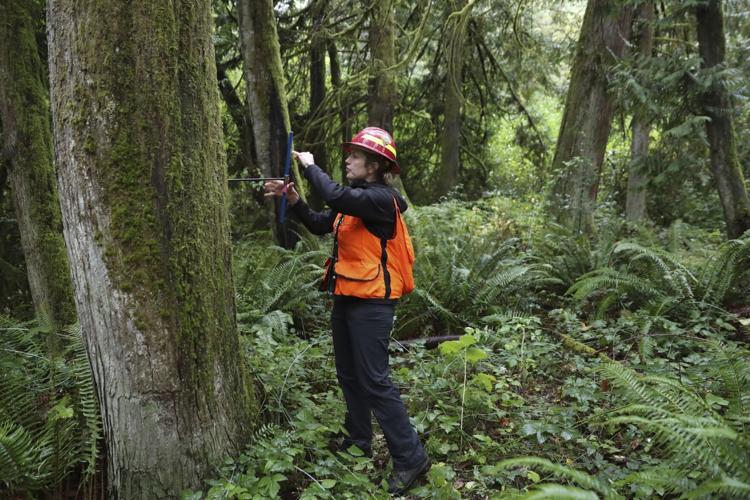
Christine Buhl, a forest health specialist for the Oregon Department of Forestry, plunges a tool called an increment borer into the dead tree’s trunk. Twisting the handle of the corkscrew-like borer, Buhl extracts a long, thin sample of the tree’s inner growth rings.

Christine Buhl, a forest health specialist for the Oregon Department of Forestry, uses an increment borer Oct. 11 to core a dead western red cedar at Magness Memorial Tree Farm in Sherwood, Ore.
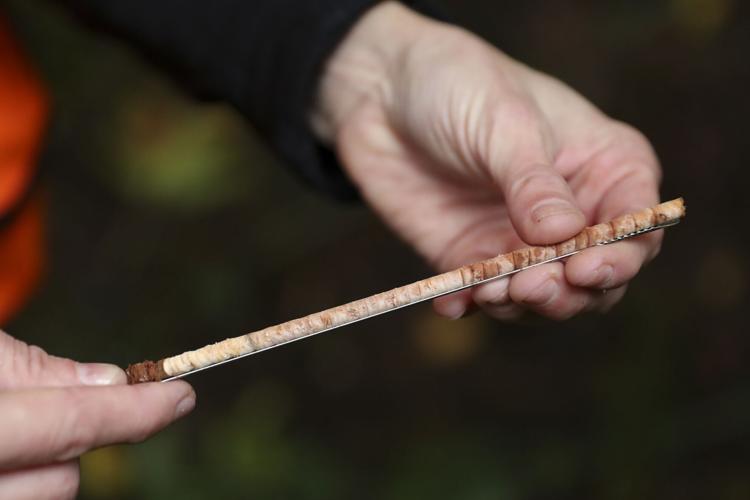
The rings become thinner over time, indicating the tree’s growth slowed before the tree finally died, a sign that this red cedar, like thousands of others in Oregon and Washington, died from drought.
“That’s why it’s the canary,” says Buhl. “Any tree that’s less drought-tolerant is going to be the canary in the coal mine. They’re going to start bailing (out).”
For thousands of years, people have used red cedar to make everything from canoes to clothing.
Red cedar’s many uses have earned the species endearing names, including the “Tree of Life.” More recently, scientists have started calling this water-loving relative of redwoods by a less flattering name: “the climate canary.”
Last year, Buhl and colleagues reported that red cedars were dying throughout the tree’s growing range not because of a fungus or insect attack, but due to the region’s “climate change-induced drought.”
Red cedars aren’t alone.

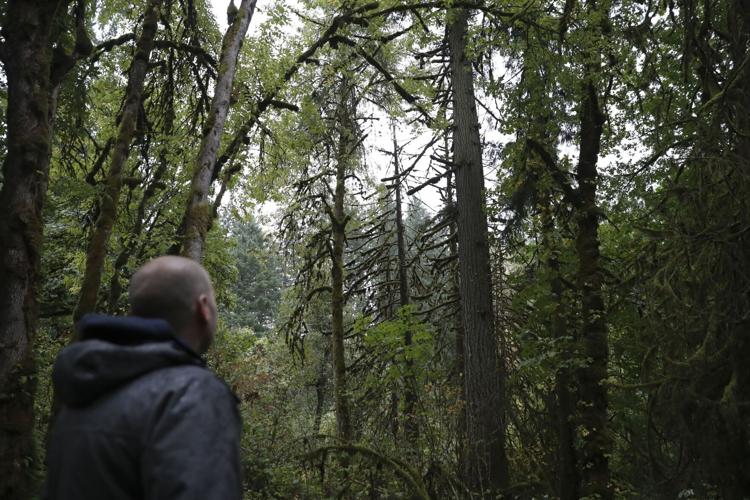
Property manager James Bailey looks at a dead Douglas fir among several dead western red cedars Oct. 11 at Magness Memorial Tree Farm in Sherwood, Ore., in the Pacific Northwest, where die-offs have been linked to a combination of drought and insects.
In recent years, at least 15 native Pacific Northwest tree species have experienced growth declines and die-offs, 10 of which have been linked to drought and warming temperatures, according to recent studies and reports.
Many researchers, Buhl included, are now arguing that these drought-driven die-offs are the beginning of a much larger and long-predicted shift in tree growing ranges due to climate change.
Trees, and plants generally, have growing ranges that are largely determined by climate factors, namely moisture and temperature.
For decades, scientists have argued that as atmospheric warming continues, growing ranges in the Northern Hemisphere will shift upslope in elevation and farther north, leaving many trees stranded in a warmer, drier world.
As climate mismatch sets in, trees are expected to die-off and not grow back, according to predictions.

Douglas fir trees that died as a result of insect damage following heat stress are visible Oct. 27 in the Willamette National Forest, Ore.
Daniel DePinte, Forest Service aerial survey program manager, suspects range changes are driving “Firmageddon.” A term coined by researchers, including DePinte, “Firmageddon” refers to the more than 1,875 square-mile die-off of five fir species in Oregon, Washington and northern California.
“The forests are moving uphill,” said DePinte.
DePinte and colleagues first identified and named the massive, drought-driven fir “mortality event” last year while surveying area forests via airplane.
According to tree-range predictions, climate-induced die-offs are expected to start at the edges of growing ranges, including at lower-elevation locations that are predicted to become too warm and dry for many species.
DePinte’s survey revealed that the largest die-offs associated with Firmageddon are occurring at lower-elevation sites.
Buhl and colleagues found a similar pattern with western red cedar. Mortality was greatest at sites less than about 650 feet in elevation west of the Cascade Range, according to their analysis.

Christine Buhl, a forest health specialist for the Oregon Department of Forestry, holds a tree core from a dead western red cedar, showing healthier rings toward the right of the sample and more drought-affected rings to the left on Oct. 11 at Magness Memorial Tree Farm in Sherwood, Ore.
Scientists have also observed a similar pattern for Douglas fir, the region’s leading commercial timber species. Douglas fir is currently experiencing a 720-square-mile die-off, the majority in the Klamath Mountains near the southern Oregon cities of Ashland and Medford.
The die-off is limited to the lower elevations but is likely to move uphill as temperatures warm in the coming decades, according to a study in the Journal of Forestry.
“Our analysis concluded that if climate change continues as predicted, we could see increased Douglas fir mortality at higher elevations,” said study coauthor, David Shaw, a professor and forest health specialist at Oregon State University.
Shaw called the die-off “consistent with predictions for climate change.”
But whereas red cedar is believed to be dying from drought alone, the Firmageddon and Douglas fir die-offs have been linked to a combination of drought weakening trees and insect pests moving in for the kill.
“These insects are not normally tree killers,” said DePinte. “This is evidence that the forests are reacting to climate change and droughts.”
Douglas fir is not considered a true fir and is not officially part of Firmageddon, according to DePinte.
The combination of drought-induced stress and pests, said Patrick Tobin, associate professor of disturbance ecology at the University of Washington, is analogous to a person with a weakened immune system dying from the flu.
As for the climate canary, Buhl believes red cedar is unlikely to disappear from the landscape entirely but probably won’t grow back in areas where it’s dying off.
“Unless we turn back climate change, there is no reason to hope western red cedar is going to make a comeback,” said Buhl.
Massive die-off of Pacific Northwest trees linked to climate change

Christine Buhl, a forest health specialist for the Oregon Department of Forestry, uses an increment borer to core a dead western red cedar at Magness Memorial Tree Farm in Sherwood, Ore., Oct. 11, 2023. Iconic red cedars — known as the "Tree of Life' — and other tree species in the Pacific Northwest have been dying because of climate-induced drought, researchers say. Last year, Buhl and colleagues reported that red cedars were dying throughout the tree’s growing range not because of a fungus or insect attack, but due to the region’s “climate change-induced drought.”

Christine Buhl, a forest health specialist for the Oregon Department of Forestry, holds a tree core from a dead western red cedar, showing healthier rings toward the right of the sample and more drought-affected rings to the left, at Magness Memorial Tree Farm in Sherwood, Ore., Oct. 11, 2023. In recent years, at least 15 native Pacific Northwest tree species have experienced growth declines and die-offs, 10 of which have been linked to drought and warming temperatures, according to recent studies and reports.

Three dead western red cedars, center, at Magness Memorial Tree Farm in Sherwood, Ore., Oct. 11, 2023. Iconic red cedars — known as the "Tree of Life' — and other tree species in the Pacific Northwest have been dying because of climate-induced drought, researchers say. A term coined by researchers, “Firmageddon” refers to the more than 1,875 square-mile die-off of five fir species in Oregon, Washington and northern California.

Bark on a dead western red cedar at Magness Memorial Tree Farm in Sherwood, Ore., Oct. 11, 2023. Iconic red cedars — known as the "Tree of Life' — and other tree species in the Pacific Northwest have been dying because of climate-induced drought, researchers say. The die-off is likely to move uphill as temperatures warm in the coming decades, according to a study in the Journal of Forestry.

Christine Buhl, a forest health specialist for the Oregon Department of Forestry, uses an increment borer to core a western red cedar at Magness Memorial Tree Farm in Sherwood, Ore., Oct. 11, 2023.

Woodpecker nesting holes in a dead western red cedar tree at Magness Memorial Tree Farm in Sherwood, Ore., Oct. 11, 2023.

Property manager James Bailey looks at a dead Douglas fir among several dead western red cedars at Magness Memorial Tree Farm in Sherwood, Ore., Oct. 11, 2023. Firmageddon and Douglas fir die-offs have been linked to a combination of drought weakening trees and insect pests moving in for the kill.

Moss grows on the branches of a dead western red cedar at Magness Memorial Tree Farm in Sherwood, Ore., Oct. 11, 2023. Iconic red cedars — known as the "Tree of Life' — and other tree species in the Pacific Northwest have been dying because of climate-induced drought, researchers say.

An increment borer attaches to a vest worn by Christine Buhl, a forest health specialist for the Oregon Department of Forestry, after taking tree core samples at Magness Memorial Tree Farm in Sherwood, Ore., Oct. 11, 2023.

A section of a Douglas fir tree with the bark removed by scientists to examine insect damage that led to the tree's death following heat stress in the Willamette National Forest, Ore., Oct. 27, 2023. Firmageddon and Douglas fir die-offs have been linked to a combination of drought weakening trees and insect pests moving in for the kill.

Douglas fir trees that died as a result of insect damage following heat stress are visible in the Willamette National Forest, Ore., Oct. 27, 2023.

Sun shines on leaves on a big leaf maple tree in the Willamette National Forest, Ore., Oct. 27, 2023. In recent years, at least 15 native tree species in the region have experienced growth declines and die-offs, with 10 linked to drought and warming temperatures, according to recent studies and reports.

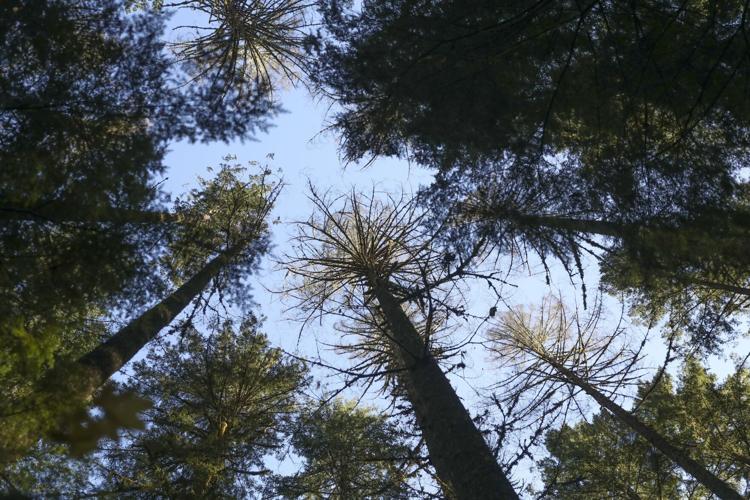
Dead needles hang on a western red cedar tree in the Willamette National Forest, Ore., Oct. 27, 2023. Iconic red cedars — known as the "Tree of Life' — and other tree species in the Pacific Northwest have been dying because of climate-induced drought, researchers say.

James Bailey, property manager, right, and Christine Buhl, a forest health specialist for the Oregon Department of Forestry, walk along a trail in the forest at Magness Memorial Tree Farm in Sherwood, Ore., Oct. 11, 2023. In recent years, at least 15 native tree species in the region have experienced growth declines and die-offs, with 10 linked to drought and warming temperatures, according to recent studies and reports. (AP Photo/Amanda Loman)

