



Arizona’s baseball team entered the 2012 season with all the ingredients for a championship squad. The Wildcats were ranked fifth by Baseball America in the preseason and had a seasoned pitching staff led by Kurt Heyer, a balanced lineup featuring several future draft picks and, most importantly, a chip on their shoulder.
The Wildcats’ 2011 campaign ended with a loss to Texas A&M in College Station in the NCAA regionals. Worse, the baseball gods had pulled a hidden-ball trick on them.
“Not a lot of people know this,” Andy Lopez says now, his coaching career in the rear-view mirror, “but we went to Texas A&M, we were a (No.) 2 seed, got beat (in) a game early, beat Texas A&M to set up the final game, and there was a lightning delay. It never rained, but there was constant lighting, and the game was never played, so they sent us home. We went back to the hotel and we had no rooms — they said, ‘We thought you guys were gonna play and get out of town.’ ”
It took some quick planning, but the Wildcats finally found lodging — in separate hotels.
Worse than a bad night’s rest, the Aggies’ stud pitcher, Michael Wacha, had an extra day’s rest.
“I remember flying home disappointed,” Lopez said. “When we got back to Tucson, after a couple days I was talking to the staff, and I said to them, ‘Guys, we have to do a good job with this group.”
And they did.
Here’s a look back at Arizona’s 2012 College World Series run, as told through interviews with Lopez, Heyer, pitchers Konner Wade, James Farris and Tyler Crawford, shortstop Alex Mejia and equipment manager David Bodzin.
• • •
You could say it all started back in College Station in 2011. But Arizona’s run to the title really began at different intervals throughout 2012.
Some credit the momentum to a sweep of Stanford, and others said it was the disappointment of a series loss to Oregon in early May. By June, the Wildcats were streaking. They sailed through the regionals, winning three games by a combined score of 47-10, and swept St. John’s in the Super Regional at Hi Corbett Field. Then came the College World Series, in Omaha, Nebraska.
Bodzin: “When we went to Omaha, UCLA picked us up – we chartered an airplane and shared it with them. They’d been (to Omaha) the year before and they were in the front of the plane. One thing ‘Lopes’ said (was), ‘You worked hard all year, this is your reward. Well, you get a bunch of 18- to 22-year-old kids who want to have fun with it, but in the front of the plane, they were quiet. Silent. Then Arizona was in the back, whooping, hollering, yelling at each other. I sat there thinking … UCLA isn’t going to make it very far.”
Once they landed, though, things smoothed over a bit. They got a hero’s welcome.
Heyer: “Everything was first-class. You feel like a rock star. Everything there is baseball, there’s not a piece of football apparel. It’s your team or another team’s. You walk through the street and people are stopping you. How do you know me? And they say, we know everybody here.”
Crawford: “When you first show up, you want to enjoy it. The regular season is such a grind, the postseason is kind of a reward. We really shifted our focus at our first practice at TD Ameritrade (Park); up until then, we tried to enjoy the circus of the city.”
Heyer: “You get to the field and it really starts sinking in. You never thought about playing at this park.”
Lopez: “Our first practice set the tone. I’m not going to try to defend what I did and how I did it, but I was very intense in practice. I had a saying and I had it my whole career — practices belong to me, games belong to you. We had a freshman — I won’t mention his name — but he was just happy to be there, screwing around, just acting goofy. I stopped practice, and … in a very loving way, I told this young freshman that if I see you screwing around in practice I’m going to put you on a plane and you’re going to watch on TV. I told the club, if you’re not here to win this thing, we shouldn’t even be here. I could see when I was talking to them — to be honest, yelling at them — the majority were nodding their heads. Their heads were bobbing. We’re not happy to be here, let’s make a run at this thing. I could see the attitude.”
Arizona opened against Florida State, a dangerous squad. The Seminoles were plenty familiar with Omaha, having advanced to the CWS in 2008 and 2010 under legendary coach Mike Martin. FSU cruised through regionals and defeated Stanford by a combined score of 35-8.
The Wildcats, though, didn’t blink. With Joey Rickard on second base in the top of the 12th inning of a 3-3 game, Johnny Field smacked a double to give the Wildcats the lead, and Mat Troupe struck out the Seminoles’ Devon Travis to strand a runner at third.
Mejia: “Florida State, they were a good team. Winning that game gave us some momentum. Those are games, it’s tough to lose but great to win.”
Heyer: “It was a battle of who would give in first.”
The win sent Arizona into a matchup with Pac-12 co-champion UCLA, which had thumped Stony Brook in its first game. UA starter Wade was sensational, outdueling Nick Vander Tuig in a 4-0 complete game.
Wade: “The first time I threw against UCLA that season, I got roughed up. I was excited for another opportunity to pitch against them and redeem myself. To be honest, I felt like we’d be more nervous than we were. That was probably the loosest we played all year.”
Lopez: “Our game plan was three things – throw strikes, low strikes; offensively, don’t strike out; and defensively, just play catch, don’t try to make anything special.”
Crawford: “Everybody was pulling on the same rope. We knew what the end result was going to be.”
And so it was: The win over UCLA set Arizona up with a rematch against Florida State. The Seminoles committed three first-inning errors, Arizona scored six first-inning runs, and the Wildcats cruised into the best-of-three championship series with a 10-3 win. It was Arizona’s ninth straight win, and its 16th victory in 18 games. Their prize: A date with South Carolina, two-time defending national champions, and coach Ray Tanner, who’d led the Gamecocks to a 23-1 playoff record since 2010.
Lopez: “I called it the Ray Tanner Invitational. We were just happy to be invited.”
Heyer: “After we won the first three games, we had to take on South Carolina, and I think they felt more comfortable than we did.”
Lopez: “Now that I’m done coaching, I can say this: I told them, ‘Fellas, I worked in the SEC for seven years … I’ve coached against South Carolina. The problem is you’ve been watching ESPN, and they’re all talking about South Carolina, and I can tell you right now, you’re better than South Carolina. After these two or three games, I can guarantee you’ll know you were better than South Carolina.’”
Arizona jumped to a four-run lead in Game 1, and Wade went the distance in a 5-1 win. Wade allowed just six hits in nine innings, while the Wildcats pounded 12 of their own, including three by No. 8 hitter Riley Moore.
Wade: “They had a lot of experience in the lineup, I knew they’d be aggressive and I just tried to let the defense work. The defense played great behind me like they had for three months. It was really like any other game.”
Mejia: “Those are the teams you want to face. We saw all the teams there, and we wanted to face a team like that. It was really exciting to play against them.”
Now Lopez had a decision to make: Go with Heyer in Game 2 and try to shut the door on the Gamecocks, or tab Farris to take the mound. Farris, the team’s Sunday starter, hadn’t pitched in three weeks. South Carolina went with its ace, Michael Roth, who’d compiled a sub-1.50 ERA in four College World Series starts the previous two years.
Lopez: “Roth was the stud on two national championship teams. His numbers were absolutely ridiculous. We knew we had our hands full.”
Mejia: “Farris deserved it. He battled his butt off all year. It was great for him to get a chance. I remember seeing Lopez in the elevator, and we all wanted Farris.”
Lopez: “Woooo, man. Going up the elevator after Game 1, I’m thinking, ‘Was I going to pitch Heyer to close it?’ I didn’t want to bring him in on one day’s rest. Elevator opens up, son of a gun, there’s Joey Rickard, Robert Refsnyder and Alex Mejia. And I can’t remember who it was, I think Refsnyder, said, ‘Hey Lopes, who you goin’ with?’ In my mind, I’m going with Farris. I didn’t want to push Kurt’s arm — I said, ‘I dunno, who do you got?’ All three said, ‘Give it to Farris, Lopes, he’s ready.’”
Lopez told Farris he’d be pitching on the morning of Game 2. Farris was excited, and needed to calm down.
Farris: “This is going to sound stupid, but I watched a lot of ‘Workaholics.’ I did. I needed the comedy. It relaxed me. I wasn’t nervous — I only say that because I really, really wanted to be a part of Omaha. When that chance came up, I wasn’t going to be timid about it. … Honestly, I had no idea who Roth was. I heard he was really good. I don’t keep up with stats or anything; honestly I don’t even really watch sports. I think that helped me. I was totally ignorant we were playing South Carolina and Michael Roth was pitching.”
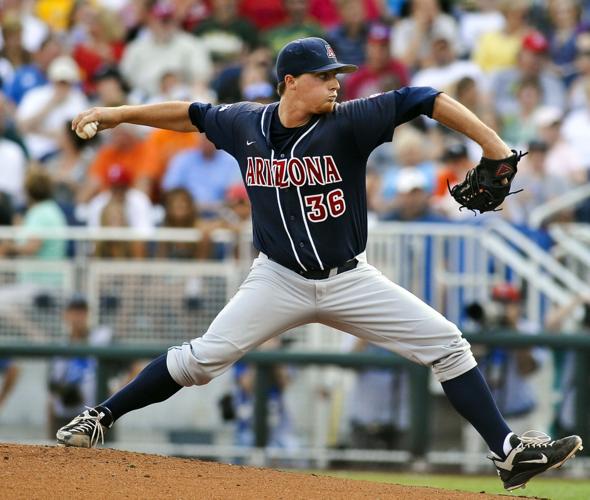
Farris focused on himself, throwing seven-plus innings of one-run ball.
Farris: “After the first inning, I blacked out, I don’t remember anything after that. I’ve had people ask me, ‘Do you remember this?’ No. I was so locked in, I kind of just forgot about everything else. I’ve never felt like that. I had to rewatch the game. I don’t remember anything. I don’t even remember being taken out of the game.”
Lopez: “I had to go out in about the fourth inning because they were getting some movement going, and I thought I’d go chat with him, and before I could open my mouth, he said, ‘Hey man, I’m good. Don’t worry about me, I’m good. I joked with him, ‘I’m just out here because I need some TV time!’ ”
Heyer: “I’m actually getting all fuzzy thinking about it. It was funny watching a big game like that — I’m so used to pitching in big games. It was like an out-of-body experience. It was like I was pitching, but I wasn’t. I don’t think I moved the entire game.”
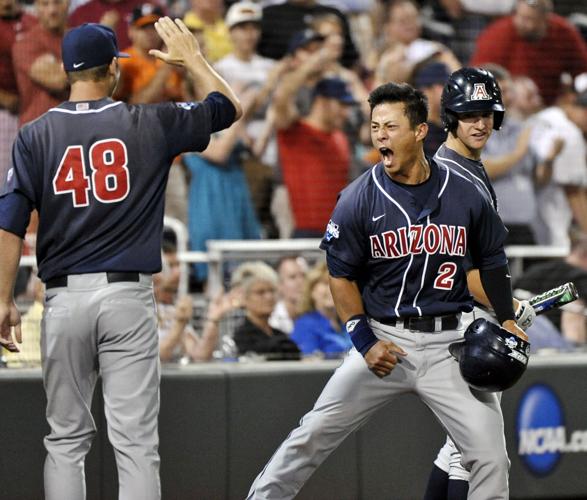
Farris gave way to Troupe with two outs in the bottom of the eighth inning and the game tied 1-1. In the top of the ninth, Refsnyder got on base with a leadoff single, and moved to second on a sacrifice bunt by Seth Mejias-Brean. Bobby Brown was walked intentionally, then reserve outfielder Brandon Dixon came up for his second at-bat. He stroked a double down the left-field line, scoring Refsnyder to give Arizona a 2-1 lead. Trent Gilbert then extended the lead with a two-run single.
Wade: “That was incredible. He’d struggled part of the year, got an at-bat earlier in the game he thought he could hit, and he got the same pitch. He did not miss the second time. I couldn’t have been happier for Brandon. He came up big when our team needed him the most.”
But Troupe, a freshman, would have to come out for one last frame.
Farris: “It was very nerve-wracking. The game was out of my hands at that point. I knew Troupe could go out there and do it. I worked seven-plus inning, I didn’t want that to go in a box score of us losing. I was more nervous for that than me pitching.”
Bodzin: “When I look back at the last two innings, it was the only time in my life I couldn’t chew sunflower seeds. It was one of the coolest things, Troupe got a strikeout in the eighth, a called strikeout in the corner, and he was pacing ready to get back out there. I thought to myself, ‘When I get back to Tucson, I have no idea what I’m doing with my life, no job leads. But for the next inning, nothing else matters.’”
Mejia: “Each out was added pressure, and that last out, the pressure was so big. Troupe on the mound, got the popout to Refsnyder. It was like a burst of relief.”
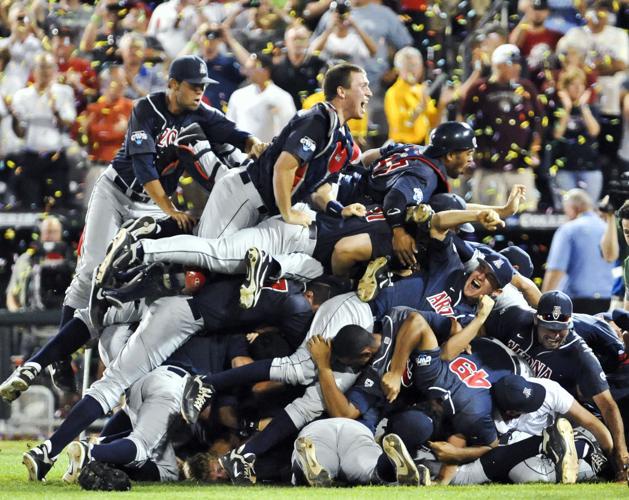
And that was it. Troupe induced a flyout to end the game, 4-1, and the celebration ensued.
Heyer: “I was holding my breath, looking at everybody in the dugout, like, ‘When are we going to tackle everybody?’ … I really do wish I could relieve the whole moment. If there was one moment I could put in a spinning cycle and relive over and over again, that’s it.”
Lopez: “I remember so clearly the joy of winning a national title — happy for my sons, my team, my city — but I remember a little emptiness. My dad was no longer here, and he and I were really close, and when I got into the coaching ranks I used to talk to him after every game. Now that I have a lot of time to reflect, I don’t worry about the stresses of coaching, and I do remember it. Doggone, I wish Dad was here. I missed him. There was so much joy, but I won’t lie, there was a little ping.”
Crawford: “I thought it was easy! That’s what I tell my teammates now. I thought it was just something you did. This time around, I’m so happy for this group. I hope they really appreciate what it is. It goes by fast, and you really want to appreciate it.”
Lopez: “One thing I’ve said to every club, right after the game, get them off to the side, under the clubhouse, I said, ‘This is a great moment, a phenomenal moment, you’ll remember the rest of your life, but it’s not your identity, it’s not who you are as a person. It’s a moment. Cherish the moment. But your identity is who you are as a man and as a father.’”

