


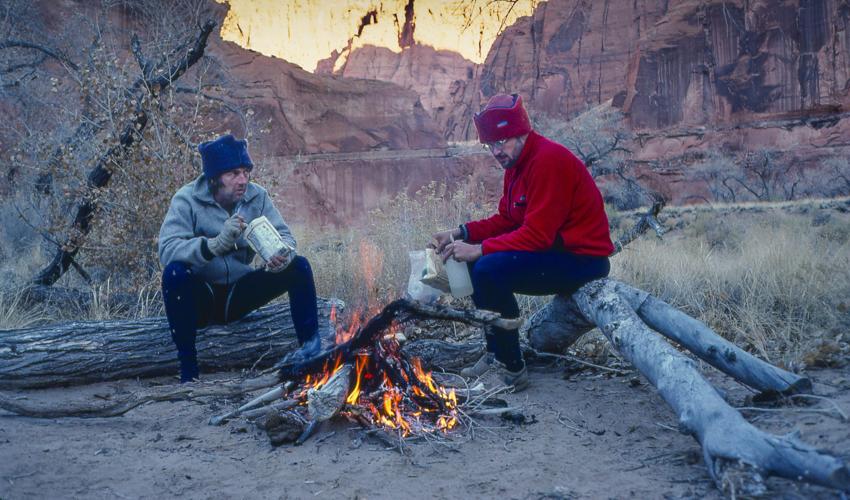
It was January 1986 and a couple of young journalists had John Lee’s journal for a re-enactment of sorts. We were following the Paria River’s narrow defile on the route Lee drove a small herd of cattle into the frigid, sunless canyon. Lee, after whom Lees Ferry is named, was fleeing federal authorities after the 1857 Mountain Meadows Massacre. Chuck Bowden and I were fleeing civilization.
So it was on a trip forged in friendship, pain and hardship, that Bowden and I were “baptized” in basins of striated sandstone. The mingling of colors engulfed us with intense beauty we could “feel.” We would never be the same.
This was a place that demanded our love.
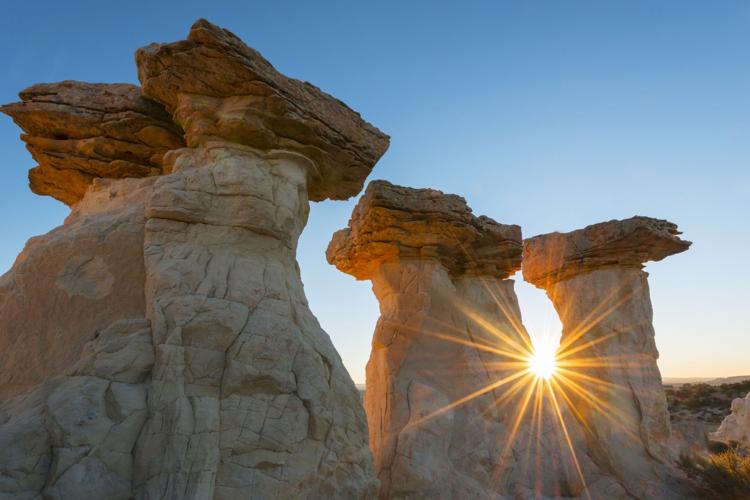
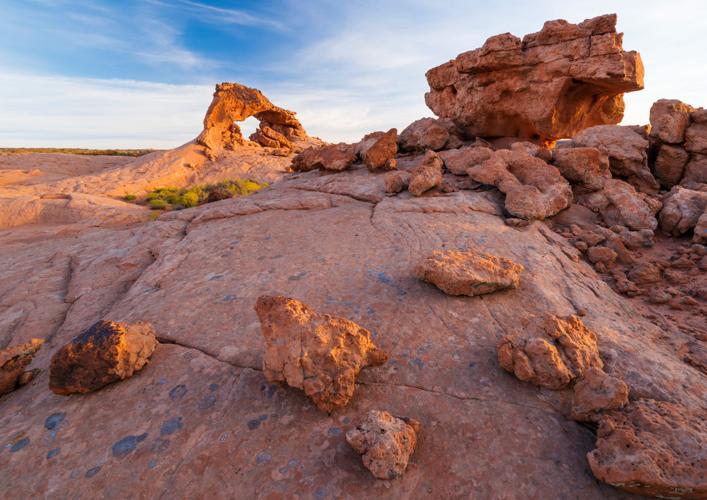
Chuck and I set about to prove it by publishing a book that would be a catalog of the wilderness wonders worth protecting. Our model was already on the table in the form of Edward Abbey and Phillip Hyde’s “Slickrock.” We ventured deep into the canyons of Escalante, a world of sheer desert-varnished canyon walls, towering “hoodoos,” lush verdant grottos and contorted stone arches defined by a deafening silence and profound solitude. The area became my spiritual home. Sand Creek, Calf Creek, Devil’s Garden, Carcass Wash and Death Hollow evoke memories of delight.
Yet even while being wrapped in the canyon stillness, we feared the effects of development. Wild places everywhere were being opened for development. I think back to the Eagles’ song, “The Last Resort”: “Call someplace paradise, kiss it good by.” We wanted to preserve this magical place. So it was that “Stone Canyons of the Colorado Plateau” was published in 1996, calling for the preservation of the Escalante and Paria River drainages.
In September that year, in a ceremony at the Grand Canyon, President Bill Clinton created the Grand Staircase-Escalante National Monument. Clinton and his Secretary of Interior and former Arizona Gov. Bruce Babbitt wanted to preserve 1.9 million acres of sandstone wilderness. They were following the lead of Harold L. Ickes, who was secretary of Interior in the administration of Franklin D. Roosevelt. Ickes’ son, Harold M. Ickes, was Clinton’s deputy chief of staff.
At roughly the same time, people in Escalante, Utah, were hanging Clinton in effigy.
Yet as the years went by, tourism dollars slowly changed minds as local businesses cashed in on the tourists eager to explore canyon country.
The simmering anger went underground, but apparently never went away. Antipathy toward the federal government found renewed support when Sen. Orin Hatch and Utah Gov. Gary R. Herbert embraced a like-minded, pro-development president and a pro-ranching and mining secretary of Interior. President Trump and Ryan Zinke suggest slicing the monument into smaller sections.
They offer sugar-coated lies of affording the land “better” protection, when in fact they’re opening the region to increased off-road use, unrestricted grazing and mining.
THIS IS NOT IN ANY WAY PROTECTION.
The familiar arguments of local control is “exploit-speak” for taking federal management away from the public at large and allowing locals to wring as much usage and cash as possible out of a fragile landscape. The fundamental question is: Will we as a people continue to be a nation with the foresight to preserve our wild heritage? Our high regard for land preservation sets us apart from other countries. We have a national parks and monuments system that’s the envy of the world.
Twenty years ago, Bowden and I were honored to play a small part as Clinton and Babbitt joined the Southern Utah Wilderness Alliance to create something for the ages.
Yet who could have envisioned that a president, whose idea of wilderness appears to be a groomed golf club fairway, would break precedent and undo the hard work of scientists and environmentalists?
Declassifying the Grand Staircase-Escalante National Monument literally would rip the heart out of the red-rock wilderness. We cannot let that happen.

