


WASHINGTON — The Supreme Court upheld a tax on foreign income Thursday over a challenge backed by business and anti-regulatory interests, declining their invitation to weigh in on a broader, never-enacted tax on wealth.
The justices, by a 7-2 vote, left in place a provision of a 2017 tax law that is expected to generate $340 billion, mainly from the foreign subsidiaries of domestic corporations that parked money abroad to shield it from U.S. taxes.
The law, passed by a Republican Congress and signed by then-President Donald Trump, includes a provision that applies to companies that are owned by Americans but do their business in foreign countries. It imposes a one-time tax on investors’ shares of profits that have not been passed along to them, to offset other tax benefits.
But the larger significance of the ruling is what it didn’t do.
The case attracted outsize attention because some groups allied with the Washington couple who brought the case argued that the challenged provision is similar to a wealth tax, which would apply not to the incomes of the very richest Americans but to their assets, like stock holdings. Such assets now get taxed only when they are sold.

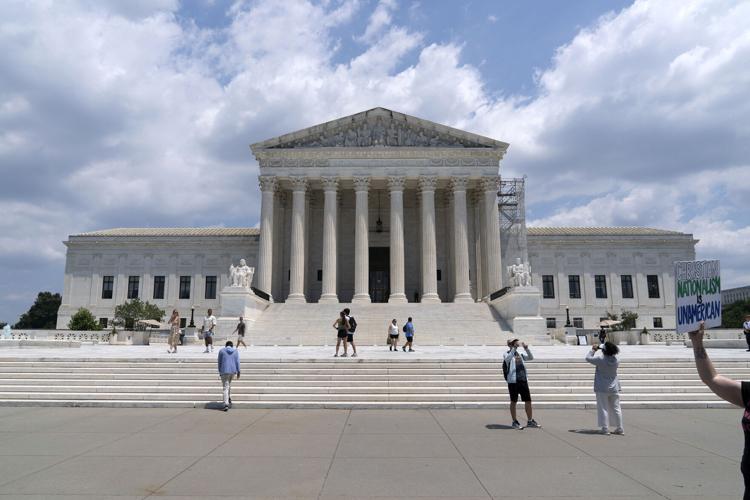
Visitors pose for photographs Tuesday outside the U.S. Supreme Court in Washington.
Justice Brett Kavanaugh wrote in his majority opinion that “nothing in this opinion should be read to authorize any hypothetical congressional effort to tax both an entity and its shareholders or partners on the same undistributed income realized by the entity.”
Underscoring the limited nature of the court’s ruling, Kavanaugh said as he read a summary of his opinion in the courtroom, “the precise and very narrow question” of the 2017 law “is the only question we answer.”
The court ruled in the case of Charles and Kathleen Moore, of Redmond, Washington. They challenged a $15,000 tax bill based on Charles Moore’s investment in an Indian company, arguing that the tax violates the 16th Amendment.
Ratified in 1913, the amendment allows the federal government to impose an income tax on Americans. Moore said in a sworn statement that he never received money from the company, KisanKraft Machine Tools Private Ltd.
Kavanaugh said the tax the Moores disputed was akin to other taxes, including those on foreign-earned income and partnerships.
A ruling for the Moores could have called into question those other provisions of the tax code and threatened losses to the U.S. Treasury of several trillion dollars, Kavanaugh noted, echoing the argument made by the Biden administration.

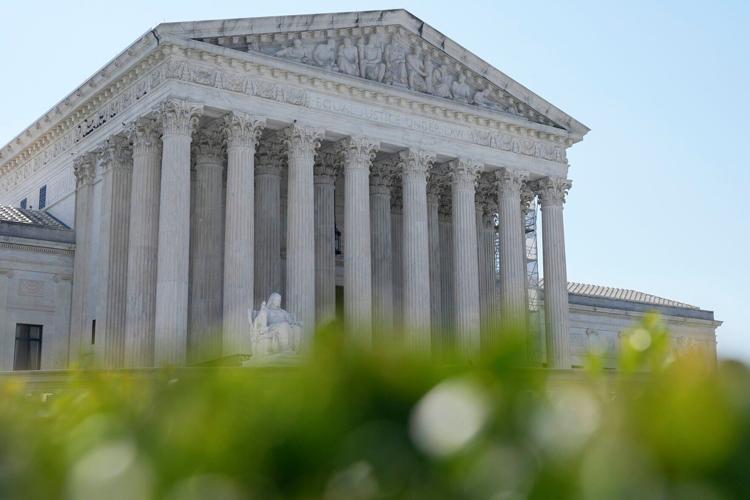
The U.S Supreme Court is seen June 14 in Washington.
Justice Clarence Thomas, joined by Justice Neil Gorsuch, wrote in dissent that the Moores paid taxes on an investment “that never yielded them a penny.” Under the 16th Amendment, Thomas wrote, the only income that can be taxed is “income realized by the taxpayer.”
Lawyers for the Moores said they were disappointed by the ruling, but took some hope from its narrowness.
“What this means is that the constitutionality of other species of future taxes — such as a national wealth tax — remains entirely unaddressed by the court’s opinion,” said Dan Greenberg, general counsel of the Competitive Enterprise Institute.
Greenberg pointed to a separate opinion from Justice Amy Coney Barrett, joined by Justice Samuel Alito, that agreed the Moores should lose this case. But Barrett also sided with the dissenters in arguing that income has to be realized — in essence, received — to be taxed in accord with the Constitution.
Kavanaugh’s opinion left the issue of realization open and there are now four justices, one shy of a majority, who have declared their opposition to taxes, like a wealth tax, that don’t require realization.
Leslie Samuels, a tax expert who served in the Treasury Department during the Clinton administration, said the court’s decision was unsettling because it seemed to encourage more legal challenges to taxes and warn Congress that its ability to impose new taxes could be restricted.
“While the government won, the Moores’ backers effectively achieved some important and disquieting successes for the future,” Samuels said.
The case also kicked up ethical concerns and raised questions about the story the Moores’ lawyers told in court filings. Alito rejected calls from Senate Democrats to step away from the case because of his ties to David Rivkin, a lawyer who is representing the Moores.
Public documents show that Charles Moore’s involvement with the company, including serving as a director for five years, is far more extensive than court filings indicate.
The case is Moore v. U.S., 22-800.
Notable Supreme Court cases of 2024
Review key cases decided by the United States Supreme Court in 2024.


Both laws aimed to address conservative complaints that the social media companies were liberal-leaning and censored users based on their viewpoints, especially on the political right.

Supreme Court makes it harder to charge Capitol riot defendants with obstruction, charge Trump faces
Roughly 170 Capitol insurrection defendants have been convicted of obstructing or conspiring to obstruct the Jan. 6 joint session of Congress, including the leaders of two far-right extremist groups.

The current high court, with a 6-3 conservative majority, has been increasingly skeptical of the powers of federal agencies.

The case is the most significant to come before the high court in decades on the issue and comes as a rising number of people in the U.S. are without a permanent place to live.

The high court had put the settlement on hold last summer, in response to objections from the Biden administration.

The ruling came after a day an opinion was briefly posted on the court's website accidently and quickly taken down, but not before it was obtained by Bloomberg News.

The justices ruled that people accused of fraud by the SEC, which regulates securities markets, have the right to a jury trial in federal court.

The Supreme Court is putting the Environmental Protection Agency’s air pollution-fighting “good neighbor” plan on hold while legal challenges continue, the conservative-led court’s latest blow to federal regulations.

The justices ruled in favor of a 1994 ban on firearms for people under restraining orders to stay away from their spouses or partners.

The high court found 6-3 that the Trump administration did not follow federal law when it reversed course and banned bump stocks.

The Supreme Court has preserved access to a medication that was used in nearly two-thirds of all abortions in the U.S. last year.

The unanimous opinion reverses a lower court decision tossing out the gun rights group’s lawsuit against ex-New York State Department of Financial Services Ssuperintendent Maria Vullo.

The Supreme Court has preserved a Republican-held South Carolina congressional district, rejecting a lower-court ruling the district discriminated against Black voters.

The Supreme Court has rejected a conservative-led attack that could've undermined the Consumer Financial Protection Bureau.

The Supreme Court on Monday restored Donald Trump to 2024 presidential primary ballots, rejecting state attempts to hold the Republican former president accountable for the Capitol riot.

