

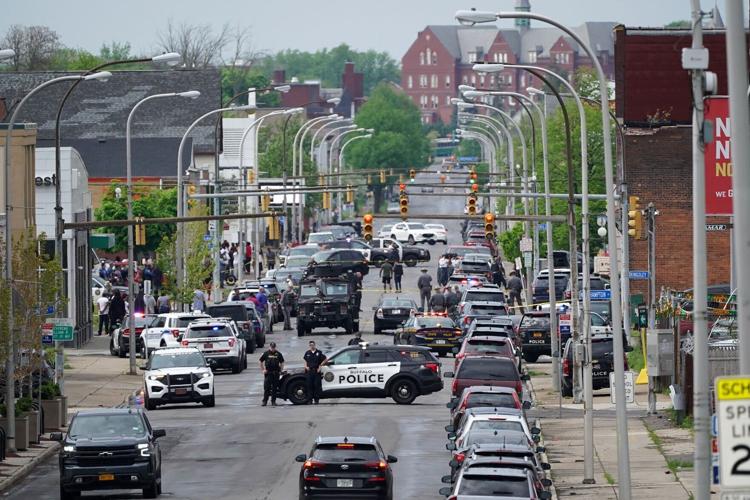
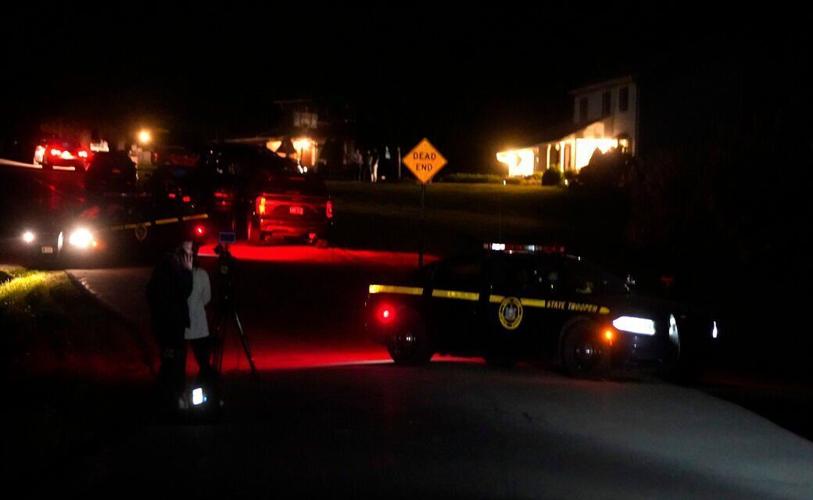
The mass shooting that left 10 people dead Saturday afternoon at a Tops Markets in Buffalo would have been tragic no matter the motivation.
But that fact that it appeared to be racially motivated made it even more painful, authorities said.
"It was straight up, a racially motivated hate crime," Erie County Sheriff John Garcia said. "This person was pure evil."
Of the 13 people shot, 11 were Black and two were white, Buffalo Police Commissioner Joseph Gramaglia said.
"We have evidence in custody right now that shows there is some racial component to these actions," Erie County District Attorney John J. Flynn said.
The shooter, identified in court as Payton Gendron, 18, of Broome County, appeared to have left a racist online manifesto and live-streamed the shooting to social media sites.
A screenshot of the video showed a racial epithet used against Black people written in bold lettering on the barrel of the shooter's high-powered assault rifle.
Down the street from the chaotic scene, where dozens of police officers blocked off Jefferson Avenue, Cedric Holloway was inside the Johnnie B. Wiley Pavilion trying to keep teenagers calm.
Holloway, the Wiley Pavilion's director, is also a retired member of the Buffalo Police SWAT team. He recognized the writing and markings on the gun as similar to those of a shooter in New Zealand who killed 51 people at a mosque in 2019.
The video of that shooter, who was a white supremacist, was eerily similar to the Tops Markets shooter in Buffalo, Holloway said, adding that it was difficult but necessary for him to speak with the teenagers at Wiley – all who were Black – about the fact that some people want to hurt them because of their skin color.
“It’s important that they know it’s out there," Holloway said. "You can’t shield them from the real world.”
The neighborhood where the shooting occurred is 79% Black, 13% Asian and 3% white, according to U.S. Census data.
Studies have consistently found Buffalo to be one of the most racially segregated cities in the nation, but Mayor Byron W. Brown stressed that the shooter was from outside Western New York. It remains unclear why he traveled to Buffalo.
Brown drew on Buffalo's "City of Good Neighbors" motto and said he hopes the shooting would not inflame tensions.
"We are a loving community," Brown said. "We are prayerful that this will not exacerbate racial tensions. We can’t let an evil person divide this community, and an evil person divide our country."
U.S. Attorney Trini E. Ross, the first woman of color to hold her position, said the shooting "should bring us together, not tear us apart."
Ross, the niece of the late civil rights leader and Common Council President George K. Arthur, said the community's response to the shooting was an opportunity to show the world that Buffalo is anything but a hateful city.
"And that’s what I’m hoping," she said, "that as we go through the process of justice in this case, that we all band together to let the world know who Buffalo is, who the people in Buffalo are, and what we’re going to do for our community and other communities in this great nation to make sure this type of crime is stopped."
Coverage of this story is being provided free to all readers. Please support our journalism and the newsroom providing this coverage by subscribing to The Buffalo News.


