

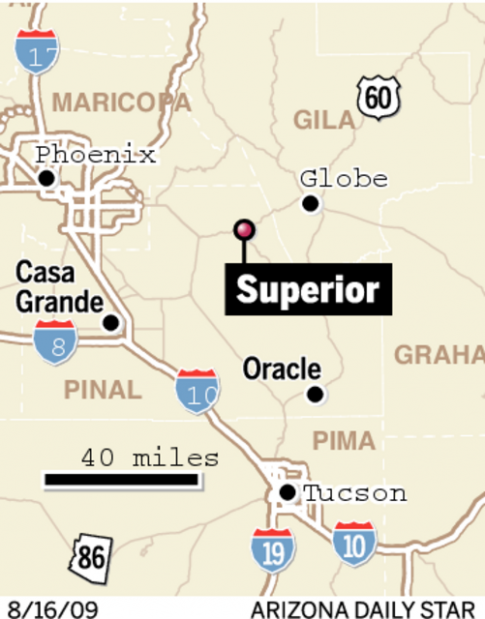
What could become the largest copper mine in the lower 48 states gets center stage Friday when U.S. Interior Secretary Ken Salazar visits the site of a proposed land exchange in the historic Pinal County mining town of Superior.
For years now, Resolution Copper Company has been trying to win congressional approval of a proposal to give it about 3,000 acres of Forest Service lands in return for 5,500 acres of privately owned lands that the company says are worthy of being preserved.
The exchange has been bogged down in controversy and congressional stalemates, most recently over a change in position by the Obama administration's Forest Service from that of the Bush administration.
Salazar will be coming to tour the proposed underground-mine site and to hear interest groups on both sides give their views, said a top aide to Arizona Republican Sen. John McCain, who has been pushing hard for the exchange involving Forest Service and Interior Department lands.
In a speech last week to about 100 members of the Society for Mining, Metallurgy, and Exploration in Tucson, Resolution Copper President and CEO David Salisbury said he expects the effort to get the mine approved will be a big challenge. He predicted that "every issue will be thrown at us," and foresaw a "99 percent chance of litigation" to block the project. His goal is to get permits for the mine by 2013 and to have it built and ready to open 10 years later.
"We are not going away. This is not a mine that is going to be built by a small company. We're here to stay," Salisbury said. "Our success will spell the success for future mining in this country."
Resolution, a joint venture of the multinational Rio Tinto and BHP-Billiton mining giants, is promising the mine will employ 1,400 people to produce about 500,000 tons of copper annually. That's about 20 percent more than the country's largest mine today, Freeport McMoRan Copper and Gold Inc.'s Morenci operation. The proposed Pebble Project Mine in Alaska, which could open before Resolution, would be about the same size.
Another 4,400 jobs would be created indirectly because of the Resolution mine's presence in Superior, about 120 miles north of Tucson, the company said. They would be created by companies that would supply the mine with equipment and other goods and services, and through new commercial developments to serve the people who work for the mine and its suppliers.
Ninety-one percent of people hired at the mine would be Arizonans and 40 percent would come from the Superior area, Salisbury told the gathering. The company has pledged to spend $1 billion in investments to study and build the project and expects to go down as deep as 7,000 feet to dig for copper.
But the issues dogging the project have been debated intensely for years with no sign of resolution:
• Some environmentalists welcome the lands that Resolution would trade to get access to one of the country's largest copper deposits, but others disparage them.
• While the company has made concessions to quell opposition from neighboring Indian tribes, the statewide Intertribal Council remains steadfast in its view that the mine would damage sacred lands.
• While the company pledges to limit its use of potable water to process the copper, opponents question whether there will be enough non-potable supplies such as treated sewage effluent to make a difference.
• While the company says it needs access to the mine site to study its environmental effects, opponents want the studies done before the land is swapped. Salisbury calls it a "chicken-and-egg" dispute.
Hardball politics have come into play on both sides. In the Senate, McCain put appointments of two top Interior Department officials on a procedural hold until Obama officials took a position on the land exchange, as a way of getting the proposal moving. The hold was lifted after Salazar agreed to make the visit to Superior.
"We want him to hear from people on the ground about the need for this project," said Mark Buse, McCain's chief of staff. "We want him to recognize how valuable and important this project is.
"This is the type of stimulus legislation that Arizona needs. It will provide $46 billion in economic impacts and $11 billion in tax revenues over the life of the project," Buse said.
In the House, the legislation has stalled in the National Parks, Forests and Public Lands Subcommittee, chaired by Rep. Raúl Grijalva, a Tucson Democrat. He has refused to advance the exchange legislation since his subcommittee held a hearing on the proposal in November 2007.
Via a spokeswoman, Grijalva said that he believes the company hasn't been transparent enough about the environmental-review process and hasn't made enough of an effort to talk to tribal leaders about their concerns.
"As chairman, his job is to do due diligence as a public servant because he is not a flack for the company and he feels they want him to do that," said Natalie Luna Rose, Grijalva's press secretary. "Oversight is part of his responsibility. Once they get the land, there will be no oversight for Resolution. They will do what they want."
The Obama administration probably represents the project's biggest uncertainty. At a Senate hearing in July, Forest Service Deputy Chief Joel Holtrop declined to take a stand on the bill and listed a series of preliminary concerns. His position was a 180-degree shift from his testimony about the exchange a year earlier when he worked for the Bush administration and supported the proposal, while acknowledging concerns about it.
In July's testimony, Holtrop singled out the question of when the environmental review would be done, saying the purpose of the federal law requiring such reviews is to inform decision-makers about potential impacts in advance.
But in an interview after his talk last week, Salisbury said he's offering a compromise on that point, contained in a bill pending in the House. It would allow an environmental review of only the land exchange to be done before the exchange is approved, while the review of the mine's effects would be done once the company takes over the property.
The environmentalist split over the project also appears wide. The Superstition Land Trust, which tries to protect open spaces near the Superstition Mountains, testified in favor of the exchange after its members visited many of the properties that the feds would obtain. Among them is the 7B Ranch near Mammoth, which contains about 7 miles of San Pedro riverfront — a dry stretch — and an 800-acre mesquite bosque, one of the few remaining in Arizona.
Because of that forest, which has been the subject of two Arizona Academy of Sciences studies and draws 95 bird species, the Nature Conservancy has also expressed interest in obtaining the property, although it hasn't taken a stand on the exchange.
"Our interest is seeing that mesquite bosque as part of a larger ecosystem of the San Pedro which does include perennially flowing stretches," said Tom Collazo of the Nature Conservancy's Tucson office.
But the Maricopa Audubon Society and the Tucson-based Groundwater Awareness League, which oppose the exchange, denounce the private lands as "overgrazed ranches." The lands' environmental values are "very marginal or limited," said Bob Witzeman, Maricopa Audubon's conservation chairman.
"Where there are riparian properties they are being degraded by trespass cattle who go through broken-down fences and eat saplings and seedlings along the river," Witzeman said.

