

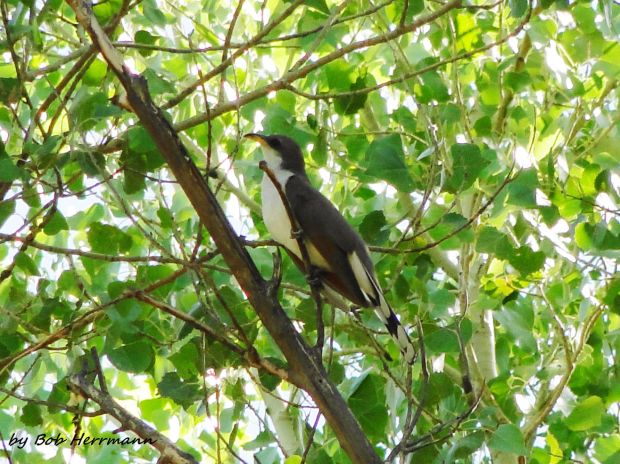

A rare bird that could gain federal protected status lives and in some cases breeds along three streams and creeks near the proposed Rosemont Mine site, federal reports show.
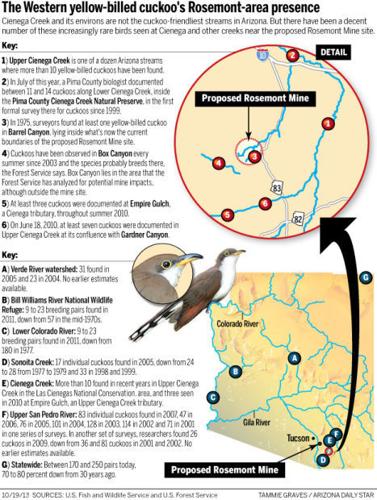
Particularly flush with cuckoos is Cienega Creek, source of a heated debate about possible impacts from the mine. More than 20 cuckoos total have been seen in the upper section of the creek inside the Las Cienegas National Conservation Area, and the lower section inside the Pima County Cienega Creek Natural Preserve.
The cuckoo, recently proposed for federal protection as a threatened species, also was documented nearly 40 years ago on a fourth stream within the proposed mine site’s current boundaries.
The Western yellow-billed cuckoo could become imperiled species No. 10 around the 4,600-acre mine site, joining the jaguar, ocelot, Gila topminnow and lesser-long-nosed bat. The U.S. Fish and Wildlife Service proposed in late September to place the cuckoo on its threatened list.
But there’s strong disagreement between mining company officials and environmentalists about impacts on the cuckoo if the mine, with its 3,000-foot-deep open pit, is built. The mine, slated to be the third largest copper mine in the U.S., would employ about 450 people to take 243 million pounds of copper annually out of the Santa Rita Mountains southeast of Tucson.
Cienega Creek, where the vast majority of cuckoos have been found in this area, is a prime source of disagreement about the mine’s impacts between the U.S. Forest Service and the Environmental Protection Agency, the Bureau of Land Management and several state and local agencies.
But Rosemont Copper officials say there’s no need to worry about the mine’s impact on the cuckoo. That’s because the Forest Service already spelled out detailed mitigation plans in the latest draft of its Rosemont environmental impact statement to protect the cuckoo in anticipation of a possible federal listing.
For one, Rosemont Copper would buy water rights for both upper and lower Cienega Creek, to increase streamflows in Pima County’s Cienega Creek Preserve and the Las Cienegas National Conservation Area.
Overall, the Forest Service says the mine could hurt individual cuckoos, but not badly enough push the population below the point of viability.
“The yellow-billed cuckoo is addressed in Forest Service requirements for mitigation and monitoring and there is no effect on the Rosemont project,” said Jamie Sturgess, Rosemont Copper’s senior vice president for corporate development and government affairs.
But environmentalists note that several other agencies — the EPA, the Army Corps of Engineers and the Arizona Game and Fish Department — have found these mitigation proposals unacceptable or raised questions about them.
The EPA and the BLM have also challenged the Forest Service’s conclusion that the mine probably won’t significantly reduce stream flows in Cienega Creek. A drier creek could damage or kill cottonwood and willow trees the cuckoo depends on.
If the mine should “dewater” Cienega Creek by lowering the water table to dig the open pit, “there’s no way the cuckoos along the creek will survive,” said Randy Serraglio, a conservation advocate for the Center for Biological Diversity. “If we lose one population, it’s one step closer to extinction.”
Cuckoos have been found in the various streams around the Rosemont site since 2003, the Forest Service’s latest draft of the Rosemont environmental impact statement shows. One cuckoo was seen inside the current mine boundaries, in Barrel Canyon, back in 1975.
An estimated 22,110 acres of potential cuckoo habitat exists within the area where mine impacts have been analyzed, the Forest Service says.
For mitigation measures, the Forest Service also cited Rosemont Copper’s plan to buy the 1,200-acre Sonoita Creek Ranch and additional water rights in Santa Cruz County. This would eliminate agriculture irrigation there, so water can be used to create wetlands and riparian habitat.
Vegetation clearing also would be forbidden in areas within about 150 yards of an active cuckoo nest to avoid disturbing them during nesting season. A $2 million Cienega Creek watershed conservation fund would be used for future restoration projects. The other federal agencies, however, have also questioned the ecological value of the Sonoita Creek Ranch purchase and whether the Cienega Conservation fund will be big enough.

