

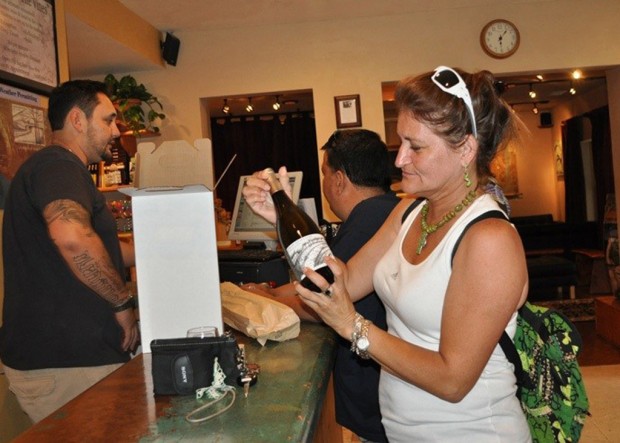
COTTONWOOD - The wine-tasting room at Page Springs Cellars and Vineyard bustled with tourists from all over the country on a recent weekday, including Patricia Ramirez and Richard Morales of Irvine, Calif.
The pair liked the wine so much that they bought memberships in the winery's club, entitling them to discounts when they shop online and have wine shipped directly to them.
The winery has more than 1,000 members across the country, driving online sales that are a significant source of revenue, said Paula Woolsey, who manages national sales. "It's very important for us to ship our wine across state lines," she said.
But Woolsey and representatives of the growing number of small wineries in Arizona fear that a bill pending in Congress could lead to their losing the ability to sell directly to customers beyond - and perhaps even within - the state.
Under Arizona law, any winery, regardless of whether it's based in the state, can sell directly to retailers and consumers if it produces less than 20,000 gallons a year.
Small wineries and tasting rooms have flourished in Arizona. In 2009, Arizona had 44 licensed wineries producing about 66,000 gallons of wine, said a Northern Arizona University survey.
House Resolution 1161 is called the Community Alcohol Regulatory Effectiveness Act, CARE Act for short. It is supported by the National Beer Wholesalers Association and the Wine & Spirits Wholesalers of America, and would allow states to enact laws that Tom Pitts, president of the Arizona Wine Consortium, said could prevent small producers from selling directly to customers, including in wine-tasting rooms and through wine clubs and online sales.
The Commerce Clause of the U.S. Constitution grants Congress the power to regulate interstate commerce. But HR 1161 would affirm that states have authority to regulate alcohol and allow them to pass laws discriminating against out-of-state producers if the measures advance "a legitimate local purpose that cannot be adequately served by reasonable nondiscriminatory alternatives." Some opponents argue this would grant states leeway in interest of protecting tax revenues.
A similar bill failed last year.
Michael Johnson, executive vice president and chief advocacy officer of the National Beer Wholesalers Association, said that if the bill comes law it would neither force nor forbid a change in Arizona's law on direct shipping. That would be up to the Legislature, he said.
"Anyone who tells you the CARE Act is a bill that will end direct shipping is simply talking about red herrings," he said. "It's time to change the hyperbole and scare tactics."
But Pitts, Woolsey and Peggy Fiandaca, president of the Arizona Wine Growers Association, fear states could abuse such a law to force small wineries to use middlemen. They say that would drive up consumer prices to the detriment of small producers, and they contend that wholesalers prefer to deal with larger wineries.
Woolsey said losing the ability to sell via the Internet would harm small operators such as Page Springs Cellars and Vineyard.
Pitts called the legislation, introduced by Rep. Jason Chaffetz, R-Utah, an attempt by wholesalers to monopolize the distribution of alcohol. "There are only about half a dozen major wine distributors in the U.S. due to mergers and acquisitions," he said. "They're trying to change the federal law to guarantee that their business model would be effective."
The Arizona Wine Growers Association and individual wine growers have responded to the bill by sending letters to Rep. David Schweikert, R-Ariz., the only Arizona representative who has signed on as a co-sponsor. A spokeswoman for Schweikert's office said he would not be available to comment.

