


Blood used as paint; eliminating zero-tolerance; 'Fifty Shades' comment brouhaha
Odd and interesting news from the Midwest.
- By CORY MATTESON Lincoln Journal Star
- Updated
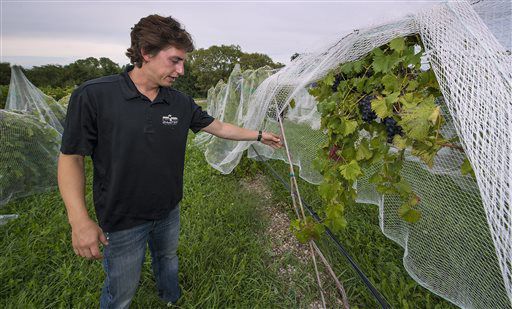
PALMYRA, Neb. (AP) — The winter of 2014 wasn't kind to Glacial Till Vineyard's grapes, specifically the chambourcin variety. The wine made from it is one of Glacial Till's most popular varieties, as the two gigantic decorative bottles of Chambourcin in the farm winery's event space suggest, the Lincoln Journal Star (http://bit.ly/2cLS1nf ) reported.
The two bottles flank a set of taps that feature a few Nebraska-made craft beers and three varieties of the beverage Glacial Till turned to in absence of those Chambourcins — hard apple cider.
The 2014 winter didn't wipe out the entire grape crop by any means, but it did leave a 1,000-gallon tank usually filled with fermenting wine glaringly empty, said Tim Murman. He is the middle of three brothers who, along with their father Mike, put in many of the hours at the family vineyard in Palmyra and at the tasting room in Ashland.
"We knew we'd be all right, but we had the capacity to do something else," Tim Murman, 30, said.
Their thoughts turned a half-hour down Nebraska 2, to the apple groves in Kimmel Orchard in Nebraska City.
The Murmans knew that hard cider sales, thanks in part to people seeking gluten-free alternatives to beer, had skyrocketed in recent years. (Though nationwide sales increased by a little under 11 percent in 2015, that followed two years in which hard cider sales ballooned by 71 and 89 percent.) And although cider with an 8.5 percent alcohol volume or lower is classified as beer according to Nebraska law, the process of fermenting wine and hard cider isn't so different, said John Murman, 33.
"The only thing that's been a learning curve is getting (the cider) clarified," said John Murman, the head winemaker, and now also cider-maker, at Glacial Till.
Last summer, John Murman did some test runs with the first vat of fresh-pressed cider driven from Kimmel Orchard up the gravel drive to the winery.
"Kind of took off from there," Tim Murman said.
John Murman's first-ever batch remains the basis for the Glacial Till Original Cider recipe, one they describe as a blend of sweet and tart apples with bit of lemon and citrus bite to it. They started to offer free samples to a few friends and visitors when they visited the Palmyra vineyard. A rep they work with at K&Z Distributing Company, after trying it, implored them to make more.
Much more.
"It wasn't until the cider when we really needed these bad boys," Tim Murman said as he gazed up at a recently installed, towering 2,200-gallon tank inside the Glacial Till facility.
They've since ordered hundreds of kegs and growlers that feature the logo commissioned by Craig Murman, 26, who's become the marketing arm of both the wine and cider operations. Tim Murman said the winery has sold about 6,300 gallons of hard cider so far, and produced around 7,000 gallons. A few other Nebraska farm wineries, including James Arthur Vineyards, have started to produce their own ciders, according to Nebraska Liquor Commission statistics, but not in such large quantities, yet.
"As of last year, we were the largest and one of the first to get it out there and mass distribute it," Tim Murman said.
Federal law, which unlike Nebraska law, still classifies hard cider as a wine, limits Nebraska microbreweries without winery licenses from making craft versions of a gluten-free hard cider.
Ploughshare Brewing Co.'s Matt Stinchfield said it's not yet worth it for him to go through the hoops of getting a winery licence to make a cider. The downtown brewery instead has a cider on tap, and has rotated several Glacial Till varieties over the past year.
"What John Murman is doing over at Glacial Till is making really good ciders," Stinchfield said, citing the Barrel-Aged and Hibiscus Ginger varieties.
So far, John Murman has made a few seasonal and small-batch varieties to go along with the original made from the Kimmel Orchard apples. (They still get fresh-pressed cider from the Nebraska City orchard. But they also contract with a processor in New York that has a lab attached. It's a godsend to John Murman, he said, because it gives him information on the many ways in which each batch of cider he gets is nutrient-starved.)
The toughest part now is keeping up with demand. They ran out of the Glacial Till Hibiscus Ginger variety, saving the last kegs for a wedding reception late this summer held at the winery's event space in Palmyra. They used the last of it on a take on the Moscow Mule cocktail, replacing the ginger beer with their cider, and now they're waiting on the next batches of Hibiscus Ginger to ferment in a set of wine-stained casks.
"We're growing, but we don't want to grow too fast to where we can't satisfy our customers," Tim Murman said.
There are a few Glacial Till ciders available in a few Lincoln and Omaha bars -- Hopcat in the Haymarket regularly has it on tap as does the Blue Blood Brewing Co. It's also for sale in growlers at Glacial Till's Haymarket farmers market stand. And on Sept. 23, Glacial Till's final Fermented Friday of the season, cider varieties will be for sale at the Palmyra vineyard, 344 S. 2nd Rd.
And this weekend, when apple fanatics back up traffic in Nebraska City, the Murman brothers will be there. On Saturday, from 8 a.m. to 6 p.m. and Sunday from 9 a.m. to 3 p.m., the Murman brothers will take their 10-keg capacity kegerator to the Fox Center, 424 Central Ave. in Nebraska City, and pour draws and growlers of hard cider in the beer garden during the 2016 AppleJack Festival. They're not sure if they'll have enough or not.
___
Information from: Lincoln Journal Star, http://www.journalstar.com
An AP Member Exchange shared by the Lincoln Journal Star.
- Updated
FLAT ROCK, Mich. (AP) — After raising thousands of dollars, supporters of a cemetery in southeastern Michigan have repaired headstones that were vandalized over the Memorial Day weekend by a teen.
The Vreeland cemetery in Flat Rock was the original burial site of a Revolutionary War soldier and his family.
TV station WXYZ (http://bit.ly/2d0C4Z9 ) says cemetery restorer Dave Carter was hired to fix the damaged headstones. He did similar work just a few years ago. He says it's a "rewarding job," especially when the markers belong to war veterans.
The job was completed Sunday.
The Vreeland cemetery was started by Michael Vreeland after the Revolutionary War. He was buried there and eventually was moved. But other descendants who served in wars still are buried at Vreeland.
___
Information from: WXYZ-TV, http://www.wxyz.com
- By ROXANA HEGEMAN Associated Press
- Updated
WICHITA, Kan. (AP) — Kansas budget woes haven't touched the state's executive aircraft, which is getting a new paint job, a spruced up interior and upgraded avionics this year.
Along with regular operating costs, the improvements will cost taxpayers nearly $900,000, according to interviews and other documents obtained through an open records request by The Associated Press.
Senate Democratic Leader Anthony Hensley called the spending "highly ironic" at a time when funding for highway projects has been slashed. Gov. Sam Brownback and his allies have taken billions of dollars from the transportation department's highway fund over the years to balance the state budget. Hensley said the expenditures for the state's plane went unnoticed during lawmakers' discussions on the $15.7 billion budget for the 2017 fiscal year, which began July 1.
"It is not a huge sum of money obviously compared to the budget as a whole, but it is symbolic of, you know, our misguided priorities in terms of where money should be spent," Hensley said.
Brownback spokeswoman Eileen Hawley defended the added expenditures, noting the plane's age. She also said the plane was being used according to state law.
"The state plane is used by Kansas universities, a number of independently elected officials and state agencies to conduct official business of the State of Kansas," she said.
Newly released Kansas Highway Patrol records show the operating budget for the state's Raytheon King Air 350 for fiscal year 2016 is $267,325, not including wages for the pilots. The amount is unchanged in the 2017 budget.
This year's expenditures also include an additional $69,249 for painting, $157,744 to refurbish the interior, and $397,825 to upgrade the plane's aviation electronics systems, said Lt. Adam Winters, spokesman for KHP. Total cost of the project is $624,818.
The nine-passenger plane has the original paint, interior and avionics it had when it was purchased new in 2001, and the aging plane is now showing wear, Winters said. Painting is needed to control corrosion, as well as for its aesthetic appeal and general maintenance, he said. The complete avionics upgrade would also replace equipment with the latest technology that pilots rely on for every flight.
"It is definitely safety," he said.
Kansas has struggled to balance its budget since the Republican-dominated Legislature slashed personal income taxes in 2012 and 2013 at Brownback's urging in an effort to stimulate the economy.
Bob Totten, executive vice president of the Kansas Contractor's Association, downplayed any "quibbling" over the expenditures for the plane given that more than $2 billion has been diverted from the highway projects since the state's transportation program started in 2010.
"And realistically your state officials do need to get around the state," Totten said.
- By IVAN MORENO Associated Press
- Updated
SPRINGFIELD, Ill. (AP) — Illinois schools are now required to limit long-term suspensions and expulsions under a new law that also eliminates the use of zero-tolerance policies used to severely punish students for certain offenses.
The law that took effect last week is designed to reduce the number of days students are pulled from classrooms and encourage school administrators to use suspensions as a last resort.
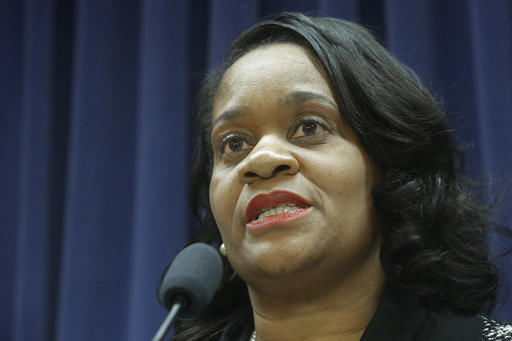
"So it becomes a school system that says, 'What can we do to keep this student in an academic setting?'" said Sen. Kimberly Lightford, a Chicago Democrat who sponsored the legislation.
Illinois lawmakers passed the bill with overwhelming support last year. States have been rethinking the zero-tolerance policies that gained prominence following the mass shooting at Colorado's Columbine High School in 1999.
Colorado and North Carolina eliminated zero-tolerance policies in 2011. Florida passed a law in 2009 that encouraged schools to consider alternative forms of discipline instead of referring problem students to law enforcement.
The new Illinois law requires schools to suspend students more than three days only in cases where they pose a threat to the school and all other disciplinary options, including counseling them or involving them in after-school programs, have been exhausted. For longer suspensions, schools will be required to give students support services while they're away and allow them to make up work they missed. The law says schools also will need to explain their rationale for expelling someone.
"I think it's going to allow some better communication between the parents and the teachers and the staff," said Joe Burgess, superintendent of the Genoa Kingston School District.
Jennifer Gill, superintendent of Springfield Public Schools, said the district has spent the last year training and informing teachers, security guards, nurses and other staff in preparation of the law. She said the state gave the schools no additional funding to implement changes the law requires.
"It does put a burden on the school, however the spirit of the law is something we believe in and we're going to follow it wholeheartedly," he said.
School suspensions have decreased the last two years, but there are still racial disparities, according to figures from the Illinois State Board of Education.
During the 2015 school year, more than 296,400 students were suspended, down from nearly 340,000 in 2014. Suspensions longer than 10 days also decreased, from nearly 1,200 in 2014 to just over 650 in 2015.
Students were suspended for fighting, using drugs and having dangerous weapons, but most were placed in the "other" category, which the school board data doesn't explain.
Black students are far more likely to be suspended than their peers, a trend that has persisted since 2009 when an Associated Press analysis found that more than half of all children suspended from Illinois public schools were black, even though they represented less than one-fifth of enrollment.
The percentage of black students being suspended has decreased only slight since 2009. They made up nearly 45 percent of the suspensions in 2014, and just over 47 percent in 2015.
___
Online:
Senate Bill 100: http://bit.ly/1XFdSMu
___
Follow Ivan Moreno on Twitter: http://twitter.com/IvanJourno
- Updated
GRAND RAPIDS, Mich. (AP) — A butcher has entered the annual ArtPrize competition in western Michigan with paintings made from animal blood.
Bob Long of LaGrange, Indiana, uses buckets of blood for his art, partly to ensure that nothing is wasted when he processes meat.
"I went to Hobby Lobby and got a canvas and the next day at work I saved a bucket of blood and I sat down at the picnic table outside the shop and put my hands in the blood and just started putting it on there and it just took off from there," Long, 49, told WOOD-TV (http://bit.ly/2cHF0fF ).
Long's ArtPrize entries are displayed at a leather supply company in Grand Rapids. He said he paints with his fingers, not brushes.
"I think of God a lot when I'm painting ... and then I think about space, outer space," Long said.
ArtPrize starts Wednesday and runs through Oct. 9. It's an international competition where the public and experts pick their favorites. Art is displayed at nearly 200 locations throughout Grand Rapids and can be viewed for free.
___
Information from: WOOD-TV, http://www.woodtv.com
- Updated
TOPEKA, Kan. (AP) — Victim advocates are criticizing a Kansas judge's recent reference to the novel "Fifty Shades of Grey" in an alleged rape case.
The Topeka Capital-Journal reports (http://j.mp/2cVqna7 ) that Jacob C. Ewing faces sex crime charges that include rape, criminal sodomy and aggravated indecent liberties with a child under the age of 14.
A woman testified Wednesday that Ewing forced her to have sex though she didn't believe she had been raped.
Jackson County Judge Norbert Marek Jr. then asked: "Is this 'Fifty Shades of Grey' or 50 shades of illegal?" referring to the novel depicting sadomasochistic themes.
Sonja Willms, president of the Topeka chapter of the National Organization for Women, called the comment "dangerous" and said it downplayed the "heinous" accusations against Ewing.
___
Information from: The Topeka (Kan.) Capital-Journal, http://www.cjonline.com
- Updated
NICKERSON, Kan. (AP) — Several students and parents at two Reno County schools were interviewed after sheriff's investigators received reports of reports of inappropriate pictures being circulated on phones at the schools, Reno County authorities said.
Phones also were confiscated at Reno Valley Middle School and Nickerson High School after law enforcement was notified of a problem Wednesday and spent the day interviewing people, The Hutchinson News reported (http://bit.ly/2cWTTYT).
Reno County Sheriff Capt. Steve Lutz said Friday the investigation is ongoing. Lutz did not know who notified law enforcement but he thought it was a teacher or school administration.
The Nickerson-South Hutchinson school district "is cooperating with the Reno County Sheriff's Office," Superintendent Dawn Johnson said in a statement.
"We are taking appropriate action to ensure the safety and well-being of our students," said Johnson, who declined to release more information.
Parents learned of the investigation from their children. Reno Valley Principal Vince Naccarato said in an email that two officers were at the school Wednesday but "due to student confidentiality," he could not disclose why.
"If this were an issue regarding the safety of our students, I would reach out to the parents and let them know as much as I possibly could," Naccarato wrote. "With this situation, the safety of our students was not at risk. In regards to this incident, the parents of the students involved were notified of what was happening and came to the school to visit with the officer."
Reno County District Attorney Keith Schroeder said students sending nude or suggestive pictures of themselves to fellow students, known as sexting, has become the biggest problem in his county.
"For some reason, we have individuals - both teenagers and not - who think that is acceptable and think they're technologically superior to adults," Schroeder said of sexting. Law enforcement is able to retrieve data and images after they have been deleted, Schroeder said.
Possible criminal charges could include sexual exploitation of a child or manufacturing and distributing child pornography.
___
Information from: The Hutchinson (Kan.) News, http://www.hutchnews.com
- Updated
COLUMBUS, Ohio (AP) — A Columbus police officer was taken by surprise when an Ohio man he saved as a child from drowning nearly 20 years ago.
Both Christopher Jones, 24, and officer James Poole, 43, were overcome with emotion Friday when they met at the Columbus Police Academy since the 1997 incident, The Columbus Dispatch (http://bit.ly/2cwjlUz ) reported.
"I never thought that something I would do 19, 20 years later would come back, and somebody would thank me," Poole said.
Last month, Jones said he saw a photo of Poole on the police division's Facebook page and recognized his name as the officer who pulled him from the bottom of a Columbus swimming pool when he was 5 years old. He commented, asking if the Poole in the picture might be the same officer.
He was then contacted by the division to organize a surprise reunion.
On Friday, Poole thought he was attending a discussion with the media about his role as a community liaison officer. Jones was waiting outside.
Both men were tearful as they recalled the incident in the summer of 1997. Jones, of New Albany, said he doesn't remember all the details, but he knows he had been underwater for 15 or 20 minutes and that his heart stopped.
Jones had his daughter with him when he met Poole.
"Because of you, I'm still here," Jones told Poole. "Because of you, this 5-year-old little girl right here is here."
- Updated
OREGON, Ill. (AP) — A well-known statue in Ogle County will likely spend another winter encased in protective material to prevent weathering of the landmark.
Illinois Department of Natural Resources spokesman Chris Young told the Daily Gazette (http://bit.ly/2cI0V4w ) the Black Hawk statue will likely be covered in mid-November. The Lorado Taft statue in Lowden State Park falls under the natural resources department's jurisdiction.
The 50-foot statue was unveiled in 1911 and has been on the National Register of Historic Places since 2009. Despite numerous repair efforts, parts of the statue have crumbled and fallen off over the years, particularly due to winter weather.
Sterling residents Frank and Cherron Rausa formed the nonprofit Friends of the Black Hawk Statue nearly eight years ago to develop a plan and raise funds for its repair. More than $750,000 of the estimated $900,000 that is needed was raised through fundraisers, private donations, and a $350,000 grant from the Illinois Department of Commerce and Economic Opportunity to the natural resources department. Only the grant and about $70,000 remains, Frank Rausa said.
Simpson Gumpertz & Heger Inc. of Chicago still is the architectural and engineering firm handling repairs to the weather-damaged statue, Young said.
"They are finishing up the plans and specifications for the work now, and will submit those to IDNR for review," Young wrote in an email. "Once the documents are finalized, the conservators will enter into a contract with IDNR through the recommendation of the Illinois Conservation Foundation."
The statue spent a year and a half wrapped in a green protective mesh around scaffolding that was erected in December 2014. The material came down in June.
___
Information from: The Daily Gazette, http://www.saukvalley.com
- Updated
COLUMBUS, Ohio (AP) — A statewide program in Ohio that offers free college credit to middle- and high-schoolers may save parents and students money, but taxpayers in school districts will be left with the tab.
The College Credit Plus program cost schools in the South-Western City School District in Columbus about $250,000 for the 2015-16 school year. The Hilliard district reached a final cost calculation of $185,000. Those districts are among many facing thousands of dollars in costs, The Columbus Dispatch (http://bit.ly/2cAqBl0 ) reported.
The newspaper reported that the amount per credit hour that a district ends up paying can depend on where the student takes classes, who teaches them, and the deals the district can cut with colleges.
Districts are able to negotiate with colleges on the price of tuition and textbooks.
While the state education department pays the cost rather than the districts, it deducts the amount from each district's per-pupil state funding.
Westerville schools reported that they spent a little under $70,000 last year on the College Credit Plus program. Officials at the Dublin district said college textbooks cost about $25,000 last year.
These figures are numbers that some local district treasurers reported to The Dispatch. The education department won't have last year's final College Credit Plus numbers until late this month because districts are still confirming the data.
School groups have said the program— which allows students to accumulate up to 30 college credit hours —is too expensive, and are advocating for financially able parents to assume some of the cost.
According to Aaron Rausch, director of school funding for the education department, local school officials can set up their program in a way that lowers the cost.
"My sense in talking to (district) treasurers is that they have worked over the year to strike better agreements that were more fair and equitable," he said.
___
Information from: The Columbus Dispatch, http://www.dispatch.com
- By LESLIE RENKEN (Peoria) Journal Star
- Updated
PEORIA, Ill. (AP) — In 1973 a black teacher named Evelyn Stafford presented "In Search of Black History" at the Alpha Park Library in Bartonville.
While highlighting the work of many brilliant African Americans, Stafford decried the fact that black contributions were frequently left out of history books.
Evelyn turned 95 earlier this year, and her husband, Dr. James Stafford, became 95 on September 16. The following day their son, James Stafford III, will be at Carver Community Center signing copies of his book, "Topspin: The story of Dr. James Bazelle Stafford Jr."
While "Topspin" focuses on James Jr., the book also tells the story of the Stafford family. James and Evelyn prospered in spite of segregation and discrimination. Both broke racial barriers — James was the first African-American president of the Illinois Optometric Association, and Evelyn was the first black president of the organization's women's auxiliary. James was also the first black Peoria City Council member, appointed in 1959 after William Kumpf resigned. And both worked to make a better society for their children and subsequent generations.
By publishing "Topspin," James III is ensuring that his parents' contributions will not be forgotten.
"Today a lot of kids, and even some adults, forget where they came from as African Americans," said James III during a recent telephone interview from his Memphis home. "We forget about these people who blazed the trail to help us get where we are today."
Both born in 1921, James and Evelyn remember segregation well. There were many places African Americans were not welcome, including restaurants and public swimming pools.
James Jr. grew up in Alton. His father was a World War I veteran and the cook at a white prep school.
"My father was very civic minded. He was always active in the community, and he was always pushing for more rights for blacks. He started the first black Boy Scout troop," said James during an interview at his Peoria home. His father believed scouting was a good way to teach important life skills. For black males, one of those skills was negotiating a segregated world.
"We had to learn how to swim to get the badge, but the colored boys weren't allowed in the swimming pool until the end of the season," James said. "After we swam in it, they emptied the pool."
The experience taught resourcefulness — instead of waiting to use the pool, many learned to swim in the area's lakes and creeks. It took extra effort, but they earned their badges.
"We had the first black Eagle Scouts in the state," James said. "Four of us became Eagle Scouts."
Years later, when he was a father, James started a black troop in Peoria. Though segregation had eased by that time, there was still plenty of discrimination.
"We had some problems at Camp Wokanda with some of the white scouts," he said.
Evelyn was raised in Oklahoma. Her father was the janitor at an upscale apartment building for whites, and her mother was a teacher.
"My mother had a high school education, and that was very unusual at that time," Evelyn said. The family had an apartment in the back of the complex, and Evelyn played with the manager's children.
"For two years my playmates were white, and I was never told I was any different," she said. "But I learned quickly when I went to grade school."
Though Evelyn and her sister found out that little black girls were treated differently, their mother instilled them both with a strong sense of self worth.
"She always said 'Be clean, smell good, be sweet, and do your best in everything you do. You are no better than anybody else, and nobody is better than you,'" Evelyn said.
Education was encouraged by both families. For James, inspiration came from the black doctor he visited as a child, and for Evelyn, skipping college was not an option — her mother told both daughters they were going to become teachers, and they did. Evelyn lived with an aunt in Bloomington, while working on a degree in home economics at Illinois State University. James went to Drake University, transferring after a year to Iowa Wesleyan College, where blacks were welcomed on the football field. Both Evelyn and James later got advanced degrees — Evelyn went to Bradley University, where she earned master's degrees in both education and speech therapy, and James went to Monroe College of Optometry in Chicago.
The couple met during World War II at Fort Huachuca, Ariz. Evelyn was a second lieutenant in the Women's Army Auxiliary Corps, and James, newly graduated from Officer Candidate School in at Camp Barkley, Texas, was a second lieutenant in the Medical Administration Corps of the U.S. Army.
After a three-month courtship, they married in December 1943.
Though James went through officer school with whites, the Army's policy on segregation limited his options after graduation.
"At the time black officers could not command white troops, so the officers who graduated with my dad were assigned to all black units," wrote James III in "Topspin."
Nonetheless, James had a very interesting assignment — the 335th Station Hospital in Burma.
"My dad and two other officers were the first complement of men to staff this hospital," wrote James III. From the top executive down to the nurses, the hospital was staffed by African Americans. It was set up on the Ledo Road in Burma.
"The Ledo Road was built in part by all black engineers . so that the Chinese could drive convoys with supplies to support their forces," wrote James III.
An all-black hospital was unheard of at that time. James III compared the operation to the celebrated Tuskegee Airmen, a group of black pilots who flew missions during World War II.
After the war James went home to his family. Evelyn had resigned her commission in the WAACs when she became pregnant with Sylvia, who was born in 1945. James III was born in 1947. Shortly after James finished optometry school and began practicing in Alton, he was called back into the Army to serve in the Korean War as an optometrist in the Medical Services Corps.
"Dad's second tour of duty was quite different from the first; President Truman had issued orders stating that there would be no more segregation of the armed services," wrote James III. "Dad now examined all patients regardless of their race, creed or color."
James was also allowed to bring his family with him. Evelyn, Sylvia and James III packed up and got on a ship for the two-week trip to Okinawa.
"I was about 5 years old when we were in Okinawa, and I remember a whole lot of it," James III said. "We had a good time, my sister and I."
After Korea the family moved to California, where Evelyn had family, but later decided to return to Illinois, where James was licensed to practice optometry. They moved to Peoria in 1954 at the advice of a friend, a business owner who could help them get started. The family rented a building at 1320 S. Adams St., where James saw patients on the first floor and the family lived upstairs. It was difficult to find an appropriate building because African Americans weren't welcome just everywhere.
"Blacks couldn't rent office space downtown," James said.
The optometry practice thrived from the beginning.
"I had plenty of patients, and plenty of white patients," James said. "Caterpillar was just getting an eye program, and employees would come to me because I was close."
James was also welcomed into the community by other eye doctors — he had gone to school with three of them. There were very few black teachers in Peoria Public Schools at that time, and Evelyn was discouraged to find she couldn't get a job teaching high school, though she was offered a position at the grade school. Instead she took a job with the Department of Public Welfare as a caseworker.
In those years blacks couldn't eat in most restaurants and were barred from many good jobs. But the NAACP, which the Staffords joined, was having some success in fighting segregation. They organized sit-ins at segregated restaurants and area businesses that refused to hire African Americans. James III remembers participating at a sit-in at CILCO in the late '60s when he was a teenager.
"We were sitting in for job opportunities," he said. "We were arrested, and they took us to jail, but when we got down there they let us go."
When Martin Luther King was assassinated, the Peoria NAACP sent a contingent to join the march in Memphis.
"I was one of those they selected to go," James III said. "A friend and I got on a bus and rode to Memphis. We marched on Third Street. I remember that vividly."
Today James III is 69 years old and retired from a career in banking. After contemplating it for many years, he's finally completed the little book on his father, 42 pages of facts, photos and fond accolades. In addition to his father's accomplishments, James III talked about his father's lifelong love of athletics. Until a recent surgery on his leg, James was still playing tennis three times a week.
"My dad's love for tennis is why I named his story 'Topspin,'" James III said. "I could never beat him, even when he got into his 80s, and part of the reason is his topspin — the ball goes high and when it hits the ground, it bounces away from you."
To James III, topspin exemplified his Dad's attitude toward life.
"He's always on the move, always starting something — like the Mt. Zion food pantry, or the neighborhood association. There was always something he saw that he could do better and open up for others."
___
Source: (Peoria) Journal Star, http://bit.ly/2cmUaDm
___
Information from: Journal Star, http://pjstar.com
This is an AP-Illinois Exchange story offered by the (Peoria) Journal Star.
- By VIRGINIA OLSON Argus Leader
- Updated
SIOUX FALLS, S.D. (AP) — Earlier this month, Roger and Julie Risty met the stranger who has their grandson's heart.
The Sioux Falls couple traveled to Pennsylvania, along with their daughter, Janece Risty, to meet Lance Frye, a college-bound young man who two years ago received 16-year-old Tyler Liebl's heart through organ donation, the Argus Leader (http://argusne.ws/2cM6NKA ) reported.
The Ristys were blindsided during the summer of 2014 when Tyler suffered a brain aneurism and died. An athlete, an avid snowboarder and a great student, Tyler was the oldest of five Risty grandchildren. He and his mother had lived in Sioux Falls, where Janece was assistant trainer for the SkyForce and Tyler attended Laura Wilder Elementary, before they moved to Newnan, Ga.
Roger and Julie Risty went to Georgia to say their goodbyes and attend Tyler's funeral.
"I have lost both of my parents, but nothing has been as bad as this. Losing Tyler has been the most difficult experience I have had to endure in my life," says Roger Risty, owner of Risty Benefits and a former Sioux Falls School Board member.
Though the loss of Tyler still weighs heavy, the family feels Tyler lives on. On the weekend of Sept. 2, Roger, Julie and Janece traveled to Hunningdon, Penn., to meet 19-year-old Frye, who recently got his driver's license and a car for college.
Organ donors can open doors. It is a lifesaving event for somebody, says Julie Risty.
"The Fryes are neat people, and Lance has a second chance at life. It seems Tyler's heart was made for two."
Frye knows a new heart brought him a new life.
"I was a Make-A-Wish kid," Frye says. "Before I got Tyler's heart, I needed a nurse beside me when I went to school. In fact, I never thought I would have a new heart. The best thing is I am never tired now.
"I was so glad I made this connection with Janece; I wanted to know everything about Tyler."
Janece had talked to her son about organ donation.
"When Tyler got his driver's license when he turned age 16, we talked about organ donation, and he checked the box. I know donating his organs would have been what he wanted."
Tyler's heart, liver and both kidneys, along with bone and tissue, were harvested, and then the machines that kept his body alive were shut down July 30, 2014. Twenty-three matches were found. A 24-year-old from Virginia received a kidney, a 64-year-old received the other kidney and liver, and Frye was 17 when he received Tyler's heart.
"It wasn't easy. But it was a good thing that Tyler could do something for the recipients and help somebody else," his mother says. "When I made my decision, I made peace with myself and the loss of my son.
"Tyler lived for nine days on life support at the Egleston Children's Hospital in Atlanta but never regained consciousness. The outlook was grim. I went to the chapel, prayed, then came to terms with his impending death. Losing him was devastating; he was my only child. Still, I felt he could live on if others got his organs."
Janece moved forward and told her parents of her decision.
"I told my dad, 'Dad, I am going to be OK. I gave my only son,' " she says. "My faith got me through because I have a strong, personal relationship with Christ."
Still, every day after Tyler's death was difficult.
"I felt like something was missing," she says. "A day didn't go by that I didn't think of my son. I decided to reach out to those who received Tyler's organs. I wanted them to know the joy I felt that part of him lived on and that I had no guilt or remorse."
Under donor policies, she couldn't write to the families directly.
"Donor and recipient families have to communicate through organ procurement companies for the first year," she says. "LifeLink in Atlanta told me that we had to exchange at least five letters before they would release our information for each other."
For two years, she communicated and was able to connect with Frye. This summer, the Frye family made a bold step, inviting the Ristys to their home to meet. Roger and Julie accompanied their daughter to Pennsylvania. The families met together at a church.
"When we heard that we would have a chance to meet Lance, it was thrilling," Roger says. "It helped in our own grieving process."
Janece shed tears, but she was joyful because she saw her son's heart live on physically and metaphorically.
"Tyler had a loving, caring, compassionate and righteous heart. That is the heart Lance received."
Julie Risty says the weekend with the Fryes brought fullness.
"There was a lot of joy, peace and comfort that Lance has a new life because of Tyler," she says. "That weekend brought happiness from a tragedy. We have a new family with the Fryes."
Lance Frye vividly remembers when he got the phone call that changed his life. He had been on the list for a new heart for three months. He got the call at 10:21 p.m. July 30, 2014, and was told to be at the hospital at midnight, the same day Tyler died.
"I woke up from the six-hour surgery and knew it was still me but not my own heart," he says. "My old heart was so large, twice as big as my fist. I felt better, and my body started working better right away."
___
Information from: Argus Leader, http://www.argusleader.com
An AP Member Exchange shared by the Argus Leader.
- By RANDY TRAMP Yankton Daily Press & Dakotan
- Updated
YANKTON, S.D. (AP) — Aron Bernal Sabino came to America because of poor conditions in Mexico, and for a better life.
"When growing up, whatever was hunted or fished, we ate," he told the Yankton Daily Press & Dakotan (http://bit.ly/2cM4y9Y ). "Many times I went hungry."
Now a resident of Yankton, Sabino looks back on the long process of finding a new home.
In 2000, he entered the United States illegally and has since become legal.
"I crossed into the United States illegally, which now I know was wrong. I wanted to do the right thing and make it legal," he says.
He crossed the U.S. border near Nogales, Arizona, with a group of people.
"It was a hot afternoon," Aron said. "I had to climb and jump from a twelve-foot fence. I was scared."
He found out later that another group that had been nearby had been caught by the border patrol.
From there he traveled to Phoenix, then to Norfolk, Nebraska. His sister lived in Norfolk and arranged transportation across the country. When he arrived in Norfolk, his first job was roofing.
With the help of Justice for our Neighbors, Sabino received a work permit in 2012 and also with their help he started the process to become a legal citizen. Justice for our Neighbors educates, advocates and gives legal representation to immigrants.
He would have to renew his work permit each year, paving the way to citizenship. (He can apply for citizenship in 10 years and Sabino plans to do that.) His first step was to apply for and get approved for a waiver for the U.S. government to forgive him for crossing the border illegally. He received it.
The next step came in July of this year. Aron returned to Mexico and started the process to become a permanent resident. Sabino needed an immigration visa. He applied and received an interview date. On that date, he traveled back to Mexico to the U.S. embassy in Ciudad, Juarez.
On day one in Ciudad, Sabino had to get all his immunizations. On day two, he was fingerprinted.
Then came the day of decision: Day three.
First, an official went through all his paperwork, ensuring it was correct. After that step, Sabino was told to wait until his name was called.
"There were a lot of people in the waiting room, probably over a hundred," he said. "There were two doors, those that were approved and those who weren't."
While sitting in the waiting room, Sabino felt confident he'd exit the door for those who'd been approved.
When his name was called, he went inside a room. An interviewer asked him several questions. Are you married? How many kids do you have? Where did you illegally enter the United States and when? The interviewer looked at his file as he answered the questions. One wrong answer would terminate the process and he would be denied.
During the entire process, Sabino said, he prayed to God that he wouldn't be nervous. "I was surprised at how calm I was." Aron knew he passed when the interviewer drew a smiley face on his paper. "I was happy."
At the present time, Sabino's parents and his brothers live in Cuatro Bancos, Mexico. Sabino sends money back to them. He's concerned for them because there's a lot of violence, robbing, killing and beheading.
"It's happening all the time," Sabino says.
When Sabino thinks about America, he says this, "This country is blessed by God. America has a lot of things, that where I'm from doesn't have. In Mexico, a person can work all day, and still not have enough to feed a family."
Sabino is appreciative and grateful to be here to raise his family. He and his wife, Andrea, who was born in Yankton, have six kids.
"I thank Jesus for the blessing. I feel very happy and welcome in Yankton. It's a good place to raise my family and it has a lot of job opportunities," Sabino said.
He ends with saying, "It feels like home."
___
Information from: Yankton Press and Dakotan, http://www.yankton.net/
An AP Member Exchange shared by the Yankton Daily Press & Dakotan.
- By JAKE SHAMA The Daily Republic
- Updated
MITCHELL, S.D. (AP) — Drug use may lead to extensive jail time, but the user isn't the only one paying for the crime.
Through the first eight months of this year, jailed methamphetamine users have cost Davison County taxpayers about $40,000, accumulated by medical and dental bills stemming from, in some cases, a lifetime of drug use, The Daily Republic (http://bit.ly/2cM26At ) reported.
"All the different complications they may have due to using meth for as long as some of them have, it's anywhere from recovery or detoxing to medical or dental issues — because meth rots your teeth — to a variety of other (issues)," said Davison County Jail Administrator Don Radel. "Picking on meth is probably not the right way, but it's probably the highest one we see right now."
Radel estimated 50 percent of inmate medical expenses in the Davison County Jail this year is connected to meth use.
According to the Davison County Auditor's Office, the jail has spent $79,338 paying for hospital visits, ambulance transports, prescription medications and other medical expenses from January through August, putting the jail on pace to surpass 2015's total of $115,005 and already approaching the 2014 total of $99,961.
But methamphetamine is not the only substance causing problems. Alcoholics often must be treated or detoxed, Radel said, and there was even one inmate about three years ago who used needles to inject fentanyl and contracted a flesh-eating disease on her arm, which permeated to her tendons and cartilage.
"Medical conditions due to substance abuse is high every year," Radel said.
Davison County Sheriff Steve Brink attributed the rising costs to a higher number of inmates.
"We're running quite a bit higher this year than normal, or than in the past, so that obviously is going to boost the cost up," Brink said.
Radel, on the other hand, said more inmates are requiring treatment and medications. For instance, he said there have been more pregnant women in custody this year.
"One trend we're seeing now is we're getting a lot of people going into treatment, and the county is paying for physicals," Radel said.
The types of medical procedures, meanwhile, varies year by year. About five years ago, the county even paid for heart surgery when an inmate was diagnosed with a hereditary problem.
The line item with the largest increase over the past year is clinic costs. In 2015, the jail paid $3,700 in clinic bills. So far in 2016, the county has already paid $6,500. Radel said the jail contracts with Mitchell Clinic, which sends someone three times a week for checkups.
But the real problem, Radel said, is the shifting of the burden onto counties. When someone becomes an inmate, all assistance programs, including welfare, Veterans Affairs and Indian Health Service benefits, are cut off.
"If we have an inmate in our jail who needs medical care, we can't access the veterans systems, the VA hospitals. If we have any Native Americans that may be treated at Indian Health Services ... once they become a county inmate, those services stop," Radel said. "Unfortunately, the system is kind of rigged, I guess you could call it that, to make it the county responsibility."
Some of these people receive benefits throughout the year, but as long as they are incarcerated, the programs stop, but the county is still responsible for their healthcare.
"To me, it would make more sense if those program just continued because somebody's paying for them, and it's the taxpayer, number one, whether it's the county taxpayer only or the bigger pool of the national taxpayer," Radel said.
Counties are also seeing increased costs coming from the state, as presumptive probation — implemented in 2013 — requires most first-offense, non-violent offenders, like drug users, to be placed on probation instead of going to prison. They are often given a short time in a local jail, but if they violate probation, they are the county's responsibility until they can be sentenced again.
And those inmates, many of them meth users, may have extensive medical bills stemming from their addictions.
Davison County also pays the medical bills of federal and state inmates who are temporarily residing in the jail after violating parole, for example. Although they may only be in town for a short time, these inmates have already racked up $3,200 in medical bills, paid for by Davison County. They accumulated a total of $800 in 2015 and $2,850 in 2014.
The difference with these inmate costs comes at the end of the year, as the county is reimbursed for those expenses, Radel said.
Local inmates are expected to pay back their bills, too, but Radel said it rarely happens. Whenever an inmate who received medical care is released, the bills are sent to the county auditor, who places the bills in the lien system. If the county receives no response, the bills are turned over to a collection agency, but according to the auditor's office, reimbursement is rare.
Radel believes some inmates see jail time as an opportunity to receive overdue treatment. Over the course of two years, Radel said one man was checked into the jail five times for various offenses, and each time, he requested assistance with a dental problem. Because it wasn't an emergency, the request was denied.
"He wasn't doing the crime just so he could come in and get his medical care, but once he was here, he was going to take advantage of everything he felt he deserved," Radel said.
More often, Radel said inmates use medical excuses as a reason to get out of jail. One woman who purported to have a serious kidney problem has used her diagnosis as an excuse numerous times to be released.
"From my side of things dealing with inmates, it's an excuse for them to get out of jail — not a valid reason to get out of jail," Radel said.
Radel said a judge eventually caught onto the ruse and decided if the woman wasn't taking care of herself outside the jail, there was no immediate need for release.
Legislators changed state law in recent years so insurance providers are charged before the county, but many inmates are uninsured.
"Unfortunately, we're talking about inmates, and there's a low percentage of insurance carriers in the inmate world," Radel said. "It hasn't created that big of a difference as far as our repayment ratio in Davison County anyway."
The pharmacy tab is also on the rise, despite a switch at the end of last year from Walgreens to Lewis Drug, which sells many of the same prescriptions at a 30 to 40 percent discount. In 2015, the county paid more than $48,600. This year, it's already paid more than $44,300.
Radel said the jail's average prescription cost is $400, but it had to pay $3,000 for one inmate's medication this year, and mental-health drugs have been a large, continuing expense.
According to Davison County Commissioner Randy Reider, the Mitchell Clinic and Lewis Drug provide generic medications whenever possible to cut costs. Still, prescription costs are unpredictable for an organization like the jail, where the population changes so often.
The largest cuts are seen in hospital costs, which have fallen from about $45,500 in 2015 to $18,000 in the first eight months of 2016, and ambulance payments, which dropped from $12,200 to $4,800.
Still, Reider and the other commissioners are seeking a lower ambulance rate. The county contracts with the city of Mitchell to use the Department of Public Safety's ambulance service, which costs approximately $500 per trip for basic life-support transport and $1,000 for advanced life-support, Reider said.
Avera Queen of Peace and Mitchell Clinic offer the county a discounted Medicare rate, and the commission believes the ambulance service should be discounted as well.
If approved by the Mitchell City Council, the rates would fall to about $325 and $375, which could save the county about $4,000, Reider said.
"It wasn't a big amount, but when you're talking about tax-exempt entities — the county, city, the hospital, things like that — when you're a tax-exempt entity, you probably could give us a better rate," Reider said.
The council denied the request in May, arguing the cost would simply be shifted from county taxpayers to city taxpayers. City officials also said the current rate for jail transports does not cover the cost to operate the ambulance service.
But Reider said he expects the commission to readdress the request in the future, as he sees cutting costs as an important task.
"It's always important," Reider said. "If you put things into conversation and start to talk, sometimes you find new ideas from strange places. We don't care where they come from. We just want to do the best we can."
The jail receives inmates from the sheriff's office, local police departments and the Highway Patrol, so it cannot avoid taking in a prisoner who may have upcoming medical bills.
But according to Brink, the sheriff's office occasionally decides it makes sense to allow some people to finish a hospital visit before making an arrest.
If a suspect is injured before being placed in custody, in a car crash following a pursuit, for instance, Brink said his office may wait until he or she is cleared by a doctor.
For brief visits, a deputy may remain at the facility until the suspect is released. But for longer visits, law enforcement relies on a hospital notification before the individual leaves the property. If no one calls and the person is released, Brink and his deputies must get an arrest warrant and begin searching.
"We'll catch up with him, issue a warrant and get him that way," Brink said.
If the person is already an inmate at the jail, however, an officer must remain with the individual until he or she is cleared to leave.
"We sit hours and hours with inmates over there, for even new arrests or if they have some procedures and they're a flight risk, which most of them are," Brink said.
Another possibility, if the criminal charges are not too serious, is releasing the individual on a personal recognizance bond, in which an inmate is allowed to leave at no cost with a judge's approval, which means the would-be inmate is responsible for any medical costs. Radel supports such releases if the inmate meets certain requirements, as does Reider.
"I have tremendous confidence in our sheriff's department. I'm OK with those guys making decisions," Reider said. "When it gets to that and jailing and bonding, you have the court system. You have the law enforcement system. We tend to stand behind those guys and support them."
But Brink said the person's medical needs trump the financial concern, and the county will foot the bill if such care is needed.
"Paying for it is not the first thing we think about," Brink said. "Obviously, the person's health is the first thing, and we decide after that how we're going to deal with them."
Radel said the jail has good rapport with local doctors, who will make decisions about whether an inmate truly needs medical attention or not before they are checked in to a hospital.
But despite the costs, Radel said the jail will continue to provide the same level of medical care to all its inmates.
"Are we, as the sheriff's office, determining if they need to go to the hospital or clinic? No. That's all a medical issue the doctors handle," Radel said. "Medical care is one of those things that's required by the courts and laws. Unfortunately, the county's ultimately the one that pays for it."
Radel said officials have talked about hiring a medical professional, likely a physician assistant or an advanced-training nurse, who could work for the jail nearly full-time for screenings and some treatment in-house. A doctor could overrule any decisions the person made, but Radel said it could reduce many individual expenses.
However, Radel said the county likely could not afford to hire someone in that capacity.
Brink said jail staff does what they can to avoid injuries caused by fights or the spread of infections from one inmate to another, and while changes, like swapping pharmacies, have been made, there is no clear solution to rising medical costs.
"There's all kinds of stuff that goes on back there we've got to deal with to make sure other people don't get sick," Brink said. "It's a very complicated issue. There's so much, it's hard to put your finger on."
___
Information from: The Daily Republic, http://www.mitchellrepublic.com
An AP Member Exchange shared by The Daily Republic.
- By CALEB WHITMER Holland Sentinel
- Updated
HOLLAND, Mich. (AP) — This year's apple crop looks to be a big one, according to several local farmers.
"It's probably our biggest in history," Rob Crane, of Crane Orchards in Fennville, told the Holland Sentinel (http://bit.ly/2cGZDr7 ).
The statewide crop estimate, released late last month at a national gathering of apple growers in Chicago, expects Michigan farmers to harvest approximately 31 million bushels of apples this fall. That figure would be a record for the state and 7 million more bushels than Michigan produced last year.
Reports from local apple growers reflected the statewide trend: Favorable weather, denser planting and good farming are adding up to a huge and healthy crop.
"The apple crop is very good this year," Roger Umlor, of Centennial Fruits near Sparta, said, "both quantity- and quality-wise."
Michigan's expected 30 percent increase in its apple production to roughly 1.3 billion pounds is in large part due to technological advancement and denser planting of apple trees, according to Diane Smith, executive director of the Michigan Apple Committee. But 2016's spring and summer weather has helped, too.
"Growers are indicating that the crop is plentiful and looks beautiful, as well," Smith said.
Two of those farmers are Crane and Umlor.
Crane Orchards, located on 124th Avenue two miles west of Fennville's downtown, grows 17 varieties of apples. Picking of the big apple — the variety that kicks off the orchard's busy season, honey crisp — begins on Wednesday, Sept. 14, but the harvest of other popular apples, such as McIntosh and Gala is already underway.
The warm summer lends itself to a good crop, though the early months were dry at Umlor's orchards.
"Just like everyone else, we pumped a lot of water," Umlor said.
But a dry July gave way to a historically wet August, boding well for the apples' flavor.
While the rain was generally a boon for apple growers, it also creates some challenges. Consistently wet weather makes the crop susceptible to various diseases. Crane referred to it as a "pressure of dampness."
"It's all controllable," Crane said. "You just have to be paying attention."
Denser plantings and good weather aside, Crane said it takes years of work to produce quality apples, comparing the trade to raising children. Apple trees, like kids, need consistent care to turn out well.
"It's not what you do in any one year," Crane said.
___
Information from: The Holland Sentinel, http://www.thehollandsentinel.com
An AP Member Exchange shared by the Holland Sentinel.
- Updated
MANCHESTER, Mo. (AP) — Five years after St. Louis Archbishop Robert Carlson visited John F. Kennedy Catholic High School to launch an effort to increase enrollment at the diocese's Catholic schools, officials have decided to close the high school because enrollment continues to decline.
Carlson said in a letter to parents Friday that the school in Manchester will close at the end of the school year "in spite of the efforts of many to improve enrollment and reduce the increases in the cost of education."
Enrollment at many area Catholic schools has dropped significantly in recent years, The St. Louis Post-Dispatch reported (http://bit.ly/2d8Dkga). Kennedy Catholic High's freshman enrollment this year was fewer than 50 students, half what it was two years ago, and total enrollment was about 280 students. The school has 30 faculty members.
In 2011, Carlson unveiled the "Alive in Christ" campaign, with a goal of filling about 1,800 vacant seats in the region's Catholic schools. The plan was to use more revenue for scholarships and push for state tax credits for tuition-paying parents.
Despite those efforts, "there has been a diminishing number of Catholic families in this area of the archdiocese seeking a Catholic high school education for their children," Carlson's letter said.
Murray Wehking, who graduated from Kennedy in 1977, said he and his wife had to break the news to their son, a sophomore at Kennedy.
"It's a sad day," Wehking said. "It does make it sadder that we'll have to do something to find another school for our son."
Kennedy opened in 1968 and is the only co-ed college prep Catholic high school in west St. Louis County. It's among 26 Catholic high schools in the 11-county St. Louis Archdiocese.
All current scholarship grants and tuition arrangements will be honored at any of the schools owned by the archdiocese. And Kennedy students who transfer to Catholic schools will receive a $500 transition credit to cover student fees.
___
Information from: St. Louis Post-Dispatch, http://www.stltoday.com
- By CORY MATTESON Lincoln Journal Star
PALMYRA, Neb. (AP) — The winter of 2014 wasn't kind to Glacial Till Vineyard's grapes, specifically the chambourcin variety. The wine made from it is one of Glacial Till's most popular varieties, as the two gigantic decorative bottles of Chambourcin in the farm winery's event space suggest, the Lincoln Journal Star (http://bit.ly/2cLS1nf ) reported.
The two bottles flank a set of taps that feature a few Nebraska-made craft beers and three varieties of the beverage Glacial Till turned to in absence of those Chambourcins — hard apple cider.
The 2014 winter didn't wipe out the entire grape crop by any means, but it did leave a 1,000-gallon tank usually filled with fermenting wine glaringly empty, said Tim Murman. He is the middle of three brothers who, along with their father Mike, put in many of the hours at the family vineyard in Palmyra and at the tasting room in Ashland.
"We knew we'd be all right, but we had the capacity to do something else," Tim Murman, 30, said.
Their thoughts turned a half-hour down Nebraska 2, to the apple groves in Kimmel Orchard in Nebraska City.
The Murmans knew that hard cider sales, thanks in part to people seeking gluten-free alternatives to beer, had skyrocketed in recent years. (Though nationwide sales increased by a little under 11 percent in 2015, that followed two years in which hard cider sales ballooned by 71 and 89 percent.) And although cider with an 8.5 percent alcohol volume or lower is classified as beer according to Nebraska law, the process of fermenting wine and hard cider isn't so different, said John Murman, 33.
"The only thing that's been a learning curve is getting (the cider) clarified," said John Murman, the head winemaker, and now also cider-maker, at Glacial Till.
Last summer, John Murman did some test runs with the first vat of fresh-pressed cider driven from Kimmel Orchard up the gravel drive to the winery.
"Kind of took off from there," Tim Murman said.
John Murman's first-ever batch remains the basis for the Glacial Till Original Cider recipe, one they describe as a blend of sweet and tart apples with bit of lemon and citrus bite to it. They started to offer free samples to a few friends and visitors when they visited the Palmyra vineyard. A rep they work with at K&Z Distributing Company, after trying it, implored them to make more.
Much more.
"It wasn't until the cider when we really needed these bad boys," Tim Murman said as he gazed up at a recently installed, towering 2,200-gallon tank inside the Glacial Till facility.
They've since ordered hundreds of kegs and growlers that feature the logo commissioned by Craig Murman, 26, who's become the marketing arm of both the wine and cider operations. Tim Murman said the winery has sold about 6,300 gallons of hard cider so far, and produced around 7,000 gallons. A few other Nebraska farm wineries, including James Arthur Vineyards, have started to produce their own ciders, according to Nebraska Liquor Commission statistics, but not in such large quantities, yet.
"As of last year, we were the largest and one of the first to get it out there and mass distribute it," Tim Murman said.
Federal law, which unlike Nebraska law, still classifies hard cider as a wine, limits Nebraska microbreweries without winery licenses from making craft versions of a gluten-free hard cider.
Ploughshare Brewing Co.'s Matt Stinchfield said it's not yet worth it for him to go through the hoops of getting a winery licence to make a cider. The downtown brewery instead has a cider on tap, and has rotated several Glacial Till varieties over the past year.
"What John Murman is doing over at Glacial Till is making really good ciders," Stinchfield said, citing the Barrel-Aged and Hibiscus Ginger varieties.
So far, John Murman has made a few seasonal and small-batch varieties to go along with the original made from the Kimmel Orchard apples. (They still get fresh-pressed cider from the Nebraska City orchard. But they also contract with a processor in New York that has a lab attached. It's a godsend to John Murman, he said, because it gives him information on the many ways in which each batch of cider he gets is nutrient-starved.)
The toughest part now is keeping up with demand. They ran out of the Glacial Till Hibiscus Ginger variety, saving the last kegs for a wedding reception late this summer held at the winery's event space in Palmyra. They used the last of it on a take on the Moscow Mule cocktail, replacing the ginger beer with their cider, and now they're waiting on the next batches of Hibiscus Ginger to ferment in a set of wine-stained casks.
"We're growing, but we don't want to grow too fast to where we can't satisfy our customers," Tim Murman said.
There are a few Glacial Till ciders available in a few Lincoln and Omaha bars -- Hopcat in the Haymarket regularly has it on tap as does the Blue Blood Brewing Co. It's also for sale in growlers at Glacial Till's Haymarket farmers market stand. And on Sept. 23, Glacial Till's final Fermented Friday of the season, cider varieties will be for sale at the Palmyra vineyard, 344 S. 2nd Rd.
And this weekend, when apple fanatics back up traffic in Nebraska City, the Murman brothers will be there. On Saturday, from 8 a.m. to 6 p.m. and Sunday from 9 a.m. to 3 p.m., the Murman brothers will take their 10-keg capacity kegerator to the Fox Center, 424 Central Ave. in Nebraska City, and pour draws and growlers of hard cider in the beer garden during the 2016 AppleJack Festival. They're not sure if they'll have enough or not.
___
Information from: Lincoln Journal Star, http://www.journalstar.com
An AP Member Exchange shared by the Lincoln Journal Star.
FLAT ROCK, Mich. (AP) — After raising thousands of dollars, supporters of a cemetery in southeastern Michigan have repaired headstones that were vandalized over the Memorial Day weekend by a teen.
The Vreeland cemetery in Flat Rock was the original burial site of a Revolutionary War soldier and his family.
TV station WXYZ (http://bit.ly/2d0C4Z9 ) says cemetery restorer Dave Carter was hired to fix the damaged headstones. He did similar work just a few years ago. He says it's a "rewarding job," especially when the markers belong to war veterans.
The job was completed Sunday.
The Vreeland cemetery was started by Michael Vreeland after the Revolutionary War. He was buried there and eventually was moved. But other descendants who served in wars still are buried at Vreeland.
___
Information from: WXYZ-TV, http://www.wxyz.com
- By ROXANA HEGEMAN Associated Press
WICHITA, Kan. (AP) — Kansas budget woes haven't touched the state's executive aircraft, which is getting a new paint job, a spruced up interior and upgraded avionics this year.
Along with regular operating costs, the improvements will cost taxpayers nearly $900,000, according to interviews and other documents obtained through an open records request by The Associated Press.
Senate Democratic Leader Anthony Hensley called the spending "highly ironic" at a time when funding for highway projects has been slashed. Gov. Sam Brownback and his allies have taken billions of dollars from the transportation department's highway fund over the years to balance the state budget. Hensley said the expenditures for the state's plane went unnoticed during lawmakers' discussions on the $15.7 billion budget for the 2017 fiscal year, which began July 1.
"It is not a huge sum of money obviously compared to the budget as a whole, but it is symbolic of, you know, our misguided priorities in terms of where money should be spent," Hensley said.
Brownback spokeswoman Eileen Hawley defended the added expenditures, noting the plane's age. She also said the plane was being used according to state law.
"The state plane is used by Kansas universities, a number of independently elected officials and state agencies to conduct official business of the State of Kansas," she said.
Newly released Kansas Highway Patrol records show the operating budget for the state's Raytheon King Air 350 for fiscal year 2016 is $267,325, not including wages for the pilots. The amount is unchanged in the 2017 budget.
This year's expenditures also include an additional $69,249 for painting, $157,744 to refurbish the interior, and $397,825 to upgrade the plane's aviation electronics systems, said Lt. Adam Winters, spokesman for KHP. Total cost of the project is $624,818.
The nine-passenger plane has the original paint, interior and avionics it had when it was purchased new in 2001, and the aging plane is now showing wear, Winters said. Painting is needed to control corrosion, as well as for its aesthetic appeal and general maintenance, he said. The complete avionics upgrade would also replace equipment with the latest technology that pilots rely on for every flight.
"It is definitely safety," he said.
Kansas has struggled to balance its budget since the Republican-dominated Legislature slashed personal income taxes in 2012 and 2013 at Brownback's urging in an effort to stimulate the economy.
Bob Totten, executive vice president of the Kansas Contractor's Association, downplayed any "quibbling" over the expenditures for the plane given that more than $2 billion has been diverted from the highway projects since the state's transportation program started in 2010.
"And realistically your state officials do need to get around the state," Totten said.
- By IVAN MORENO Associated Press
SPRINGFIELD, Ill. (AP) — Illinois schools are now required to limit long-term suspensions and expulsions under a new law that also eliminates the use of zero-tolerance policies used to severely punish students for certain offenses.
The law that took effect last week is designed to reduce the number of days students are pulled from classrooms and encourage school administrators to use suspensions as a last resort.
"So it becomes a school system that says, 'What can we do to keep this student in an academic setting?'" said Sen. Kimberly Lightford, a Chicago Democrat who sponsored the legislation.
Illinois lawmakers passed the bill with overwhelming support last year. States have been rethinking the zero-tolerance policies that gained prominence following the mass shooting at Colorado's Columbine High School in 1999.
Colorado and North Carolina eliminated zero-tolerance policies in 2011. Florida passed a law in 2009 that encouraged schools to consider alternative forms of discipline instead of referring problem students to law enforcement.
The new Illinois law requires schools to suspend students more than three days only in cases where they pose a threat to the school and all other disciplinary options, including counseling them or involving them in after-school programs, have been exhausted. For longer suspensions, schools will be required to give students support services while they're away and allow them to make up work they missed. The law says schools also will need to explain their rationale for expelling someone.
"I think it's going to allow some better communication between the parents and the teachers and the staff," said Joe Burgess, superintendent of the Genoa Kingston School District.
Jennifer Gill, superintendent of Springfield Public Schools, said the district has spent the last year training and informing teachers, security guards, nurses and other staff in preparation of the law. She said the state gave the schools no additional funding to implement changes the law requires.
"It does put a burden on the school, however the spirit of the law is something we believe in and we're going to follow it wholeheartedly," he said.
School suspensions have decreased the last two years, but there are still racial disparities, according to figures from the Illinois State Board of Education.
During the 2015 school year, more than 296,400 students were suspended, down from nearly 340,000 in 2014. Suspensions longer than 10 days also decreased, from nearly 1,200 in 2014 to just over 650 in 2015.
Students were suspended for fighting, using drugs and having dangerous weapons, but most were placed in the "other" category, which the school board data doesn't explain.
Black students are far more likely to be suspended than their peers, a trend that has persisted since 2009 when an Associated Press analysis found that more than half of all children suspended from Illinois public schools were black, even though they represented less than one-fifth of enrollment.
The percentage of black students being suspended has decreased only slight since 2009. They made up nearly 45 percent of the suspensions in 2014, and just over 47 percent in 2015.
___
Online:
Senate Bill 100: http://bit.ly/1XFdSMu
___
Follow Ivan Moreno on Twitter: http://twitter.com/IvanJourno
GRAND RAPIDS, Mich. (AP) — A butcher has entered the annual ArtPrize competition in western Michigan with paintings made from animal blood.
Bob Long of LaGrange, Indiana, uses buckets of blood for his art, partly to ensure that nothing is wasted when he processes meat.
"I went to Hobby Lobby and got a canvas and the next day at work I saved a bucket of blood and I sat down at the picnic table outside the shop and put my hands in the blood and just started putting it on there and it just took off from there," Long, 49, told WOOD-TV (http://bit.ly/2cHF0fF ).
Long's ArtPrize entries are displayed at a leather supply company in Grand Rapids. He said he paints with his fingers, not brushes.
"I think of God a lot when I'm painting ... and then I think about space, outer space," Long said.
ArtPrize starts Wednesday and runs through Oct. 9. It's an international competition where the public and experts pick their favorites. Art is displayed at nearly 200 locations throughout Grand Rapids and can be viewed for free.
___
Information from: WOOD-TV, http://www.woodtv.com
TOPEKA, Kan. (AP) — Victim advocates are criticizing a Kansas judge's recent reference to the novel "Fifty Shades of Grey" in an alleged rape case.
The Topeka Capital-Journal reports (http://j.mp/2cVqna7 ) that Jacob C. Ewing faces sex crime charges that include rape, criminal sodomy and aggravated indecent liberties with a child under the age of 14.
A woman testified Wednesday that Ewing forced her to have sex though she didn't believe she had been raped.
Jackson County Judge Norbert Marek Jr. then asked: "Is this 'Fifty Shades of Grey' or 50 shades of illegal?" referring to the novel depicting sadomasochistic themes.
Sonja Willms, president of the Topeka chapter of the National Organization for Women, called the comment "dangerous" and said it downplayed the "heinous" accusations against Ewing.
___
Information from: The Topeka (Kan.) Capital-Journal, http://www.cjonline.com
NICKERSON, Kan. (AP) — Several students and parents at two Reno County schools were interviewed after sheriff's investigators received reports of reports of inappropriate pictures being circulated on phones at the schools, Reno County authorities said.
Phones also were confiscated at Reno Valley Middle School and Nickerson High School after law enforcement was notified of a problem Wednesday and spent the day interviewing people, The Hutchinson News reported (http://bit.ly/2cWTTYT).
Reno County Sheriff Capt. Steve Lutz said Friday the investigation is ongoing. Lutz did not know who notified law enforcement but he thought it was a teacher or school administration.
The Nickerson-South Hutchinson school district "is cooperating with the Reno County Sheriff's Office," Superintendent Dawn Johnson said in a statement.
"We are taking appropriate action to ensure the safety and well-being of our students," said Johnson, who declined to release more information.
Parents learned of the investigation from their children. Reno Valley Principal Vince Naccarato said in an email that two officers were at the school Wednesday but "due to student confidentiality," he could not disclose why.
"If this were an issue regarding the safety of our students, I would reach out to the parents and let them know as much as I possibly could," Naccarato wrote. "With this situation, the safety of our students was not at risk. In regards to this incident, the parents of the students involved were notified of what was happening and came to the school to visit with the officer."
Reno County District Attorney Keith Schroeder said students sending nude or suggestive pictures of themselves to fellow students, known as sexting, has become the biggest problem in his county.
"For some reason, we have individuals - both teenagers and not - who think that is acceptable and think they're technologically superior to adults," Schroeder said of sexting. Law enforcement is able to retrieve data and images after they have been deleted, Schroeder said.
Possible criminal charges could include sexual exploitation of a child or manufacturing and distributing child pornography.
___
Information from: The Hutchinson (Kan.) News, http://www.hutchnews.com
COLUMBUS, Ohio (AP) — A Columbus police officer was taken by surprise when an Ohio man he saved as a child from drowning nearly 20 years ago.
Both Christopher Jones, 24, and officer James Poole, 43, were overcome with emotion Friday when they met at the Columbus Police Academy since the 1997 incident, The Columbus Dispatch (http://bit.ly/2cwjlUz ) reported.
"I never thought that something I would do 19, 20 years later would come back, and somebody would thank me," Poole said.
Last month, Jones said he saw a photo of Poole on the police division's Facebook page and recognized his name as the officer who pulled him from the bottom of a Columbus swimming pool when he was 5 years old. He commented, asking if the Poole in the picture might be the same officer.
He was then contacted by the division to organize a surprise reunion.
On Friday, Poole thought he was attending a discussion with the media about his role as a community liaison officer. Jones was waiting outside.
Both men were tearful as they recalled the incident in the summer of 1997. Jones, of New Albany, said he doesn't remember all the details, but he knows he had been underwater for 15 or 20 minutes and that his heart stopped.
Jones had his daughter with him when he met Poole.
"Because of you, I'm still here," Jones told Poole. "Because of you, this 5-year-old little girl right here is here."
OREGON, Ill. (AP) — A well-known statue in Ogle County will likely spend another winter encased in protective material to prevent weathering of the landmark.
Illinois Department of Natural Resources spokesman Chris Young told the Daily Gazette (http://bit.ly/2cI0V4w ) the Black Hawk statue will likely be covered in mid-November. The Lorado Taft statue in Lowden State Park falls under the natural resources department's jurisdiction.
The 50-foot statue was unveiled in 1911 and has been on the National Register of Historic Places since 2009. Despite numerous repair efforts, parts of the statue have crumbled and fallen off over the years, particularly due to winter weather.
Sterling residents Frank and Cherron Rausa formed the nonprofit Friends of the Black Hawk Statue nearly eight years ago to develop a plan and raise funds for its repair. More than $750,000 of the estimated $900,000 that is needed was raised through fundraisers, private donations, and a $350,000 grant from the Illinois Department of Commerce and Economic Opportunity to the natural resources department. Only the grant and about $70,000 remains, Frank Rausa said.
Simpson Gumpertz & Heger Inc. of Chicago still is the architectural and engineering firm handling repairs to the weather-damaged statue, Young said.
"They are finishing up the plans and specifications for the work now, and will submit those to IDNR for review," Young wrote in an email. "Once the documents are finalized, the conservators will enter into a contract with IDNR through the recommendation of the Illinois Conservation Foundation."
The statue spent a year and a half wrapped in a green protective mesh around scaffolding that was erected in December 2014. The material came down in June.
___
Information from: The Daily Gazette, http://www.saukvalley.com
COLUMBUS, Ohio (AP) — A statewide program in Ohio that offers free college credit to middle- and high-schoolers may save parents and students money, but taxpayers in school districts will be left with the tab.
The College Credit Plus program cost schools in the South-Western City School District in Columbus about $250,000 for the 2015-16 school year. The Hilliard district reached a final cost calculation of $185,000. Those districts are among many facing thousands of dollars in costs, The Columbus Dispatch (http://bit.ly/2cAqBl0 ) reported.
The newspaper reported that the amount per credit hour that a district ends up paying can depend on where the student takes classes, who teaches them, and the deals the district can cut with colleges.
Districts are able to negotiate with colleges on the price of tuition and textbooks.
While the state education department pays the cost rather than the districts, it deducts the amount from each district's per-pupil state funding.
Westerville schools reported that they spent a little under $70,000 last year on the College Credit Plus program. Officials at the Dublin district said college textbooks cost about $25,000 last year.
These figures are numbers that some local district treasurers reported to The Dispatch. The education department won't have last year's final College Credit Plus numbers until late this month because districts are still confirming the data.
School groups have said the program— which allows students to accumulate up to 30 college credit hours —is too expensive, and are advocating for financially able parents to assume some of the cost.
According to Aaron Rausch, director of school funding for the education department, local school officials can set up their program in a way that lowers the cost.
"My sense in talking to (district) treasurers is that they have worked over the year to strike better agreements that were more fair and equitable," he said.
___
Information from: The Columbus Dispatch, http://www.dispatch.com
- By LESLIE RENKEN (Peoria) Journal Star
PEORIA, Ill. (AP) — In 1973 a black teacher named Evelyn Stafford presented "In Search of Black History" at the Alpha Park Library in Bartonville.
While highlighting the work of many brilliant African Americans, Stafford decried the fact that black contributions were frequently left out of history books.
Evelyn turned 95 earlier this year, and her husband, Dr. James Stafford, became 95 on September 16. The following day their son, James Stafford III, will be at Carver Community Center signing copies of his book, "Topspin: The story of Dr. James Bazelle Stafford Jr."
While "Topspin" focuses on James Jr., the book also tells the story of the Stafford family. James and Evelyn prospered in spite of segregation and discrimination. Both broke racial barriers — James was the first African-American president of the Illinois Optometric Association, and Evelyn was the first black president of the organization's women's auxiliary. James was also the first black Peoria City Council member, appointed in 1959 after William Kumpf resigned. And both worked to make a better society for their children and subsequent generations.
By publishing "Topspin," James III is ensuring that his parents' contributions will not be forgotten.
"Today a lot of kids, and even some adults, forget where they came from as African Americans," said James III during a recent telephone interview from his Memphis home. "We forget about these people who blazed the trail to help us get where we are today."
Both born in 1921, James and Evelyn remember segregation well. There were many places African Americans were not welcome, including restaurants and public swimming pools.
James Jr. grew up in Alton. His father was a World War I veteran and the cook at a white prep school.
"My father was very civic minded. He was always active in the community, and he was always pushing for more rights for blacks. He started the first black Boy Scout troop," said James during an interview at his Peoria home. His father believed scouting was a good way to teach important life skills. For black males, one of those skills was negotiating a segregated world.
"We had to learn how to swim to get the badge, but the colored boys weren't allowed in the swimming pool until the end of the season," James said. "After we swam in it, they emptied the pool."
The experience taught resourcefulness — instead of waiting to use the pool, many learned to swim in the area's lakes and creeks. It took extra effort, but they earned their badges.
"We had the first black Eagle Scouts in the state," James said. "Four of us became Eagle Scouts."
Years later, when he was a father, James started a black troop in Peoria. Though segregation had eased by that time, there was still plenty of discrimination.
"We had some problems at Camp Wokanda with some of the white scouts," he said.
Evelyn was raised in Oklahoma. Her father was the janitor at an upscale apartment building for whites, and her mother was a teacher.
"My mother had a high school education, and that was very unusual at that time," Evelyn said. The family had an apartment in the back of the complex, and Evelyn played with the manager's children.
"For two years my playmates were white, and I was never told I was any different," she said. "But I learned quickly when I went to grade school."
Though Evelyn and her sister found out that little black girls were treated differently, their mother instilled them both with a strong sense of self worth.
"She always said 'Be clean, smell good, be sweet, and do your best in everything you do. You are no better than anybody else, and nobody is better than you,'" Evelyn said.
Education was encouraged by both families. For James, inspiration came from the black doctor he visited as a child, and for Evelyn, skipping college was not an option — her mother told both daughters they were going to become teachers, and they did. Evelyn lived with an aunt in Bloomington, while working on a degree in home economics at Illinois State University. James went to Drake University, transferring after a year to Iowa Wesleyan College, where blacks were welcomed on the football field. Both Evelyn and James later got advanced degrees — Evelyn went to Bradley University, where she earned master's degrees in both education and speech therapy, and James went to Monroe College of Optometry in Chicago.
The couple met during World War II at Fort Huachuca, Ariz. Evelyn was a second lieutenant in the Women's Army Auxiliary Corps, and James, newly graduated from Officer Candidate School in at Camp Barkley, Texas, was a second lieutenant in the Medical Administration Corps of the U.S. Army.
After a three-month courtship, they married in December 1943.
Though James went through officer school with whites, the Army's policy on segregation limited his options after graduation.
"At the time black officers could not command white troops, so the officers who graduated with my dad were assigned to all black units," wrote James III in "Topspin."
Nonetheless, James had a very interesting assignment — the 335th Station Hospital in Burma.
"My dad and two other officers were the first complement of men to staff this hospital," wrote James III. From the top executive down to the nurses, the hospital was staffed by African Americans. It was set up on the Ledo Road in Burma.
"The Ledo Road was built in part by all black engineers . so that the Chinese could drive convoys with supplies to support their forces," wrote James III.
An all-black hospital was unheard of at that time. James III compared the operation to the celebrated Tuskegee Airmen, a group of black pilots who flew missions during World War II.
After the war James went home to his family. Evelyn had resigned her commission in the WAACs when she became pregnant with Sylvia, who was born in 1945. James III was born in 1947. Shortly after James finished optometry school and began practicing in Alton, he was called back into the Army to serve in the Korean War as an optometrist in the Medical Services Corps.
"Dad's second tour of duty was quite different from the first; President Truman had issued orders stating that there would be no more segregation of the armed services," wrote James III. "Dad now examined all patients regardless of their race, creed or color."
James was also allowed to bring his family with him. Evelyn, Sylvia and James III packed up and got on a ship for the two-week trip to Okinawa.
"I was about 5 years old when we were in Okinawa, and I remember a whole lot of it," James III said. "We had a good time, my sister and I."
After Korea the family moved to California, where Evelyn had family, but later decided to return to Illinois, where James was licensed to practice optometry. They moved to Peoria in 1954 at the advice of a friend, a business owner who could help them get started. The family rented a building at 1320 S. Adams St., where James saw patients on the first floor and the family lived upstairs. It was difficult to find an appropriate building because African Americans weren't welcome just everywhere.
"Blacks couldn't rent office space downtown," James said.
The optometry practice thrived from the beginning.
"I had plenty of patients, and plenty of white patients," James said. "Caterpillar was just getting an eye program, and employees would come to me because I was close."
James was also welcomed into the community by other eye doctors — he had gone to school with three of them. There were very few black teachers in Peoria Public Schools at that time, and Evelyn was discouraged to find she couldn't get a job teaching high school, though she was offered a position at the grade school. Instead she took a job with the Department of Public Welfare as a caseworker.
In those years blacks couldn't eat in most restaurants and were barred from many good jobs. But the NAACP, which the Staffords joined, was having some success in fighting segregation. They organized sit-ins at segregated restaurants and area businesses that refused to hire African Americans. James III remembers participating at a sit-in at CILCO in the late '60s when he was a teenager.
"We were sitting in for job opportunities," he said. "We were arrested, and they took us to jail, but when we got down there they let us go."
When Martin Luther King was assassinated, the Peoria NAACP sent a contingent to join the march in Memphis.
"I was one of those they selected to go," James III said. "A friend and I got on a bus and rode to Memphis. We marched on Third Street. I remember that vividly."
Today James III is 69 years old and retired from a career in banking. After contemplating it for many years, he's finally completed the little book on his father, 42 pages of facts, photos and fond accolades. In addition to his father's accomplishments, James III talked about his father's lifelong love of athletics. Until a recent surgery on his leg, James was still playing tennis three times a week.
"My dad's love for tennis is why I named his story 'Topspin,'" James III said. "I could never beat him, even when he got into his 80s, and part of the reason is his topspin — the ball goes high and when it hits the ground, it bounces away from you."
To James III, topspin exemplified his Dad's attitude toward life.
"He's always on the move, always starting something — like the Mt. Zion food pantry, or the neighborhood association. There was always something he saw that he could do better and open up for others."
___
Source: (Peoria) Journal Star, http://bit.ly/2cmUaDm
___
Information from: Journal Star, http://pjstar.com
This is an AP-Illinois Exchange story offered by the (Peoria) Journal Star.
- By VIRGINIA OLSON Argus Leader
SIOUX FALLS, S.D. (AP) — Earlier this month, Roger and Julie Risty met the stranger who has their grandson's heart.
The Sioux Falls couple traveled to Pennsylvania, along with their daughter, Janece Risty, to meet Lance Frye, a college-bound young man who two years ago received 16-year-old Tyler Liebl's heart through organ donation, the Argus Leader (http://argusne.ws/2cM6NKA ) reported.
The Ristys were blindsided during the summer of 2014 when Tyler suffered a brain aneurism and died. An athlete, an avid snowboarder and a great student, Tyler was the oldest of five Risty grandchildren. He and his mother had lived in Sioux Falls, where Janece was assistant trainer for the SkyForce and Tyler attended Laura Wilder Elementary, before they moved to Newnan, Ga.
Roger and Julie Risty went to Georgia to say their goodbyes and attend Tyler's funeral.
"I have lost both of my parents, but nothing has been as bad as this. Losing Tyler has been the most difficult experience I have had to endure in my life," says Roger Risty, owner of Risty Benefits and a former Sioux Falls School Board member.
Though the loss of Tyler still weighs heavy, the family feels Tyler lives on. On the weekend of Sept. 2, Roger, Julie and Janece traveled to Hunningdon, Penn., to meet 19-year-old Frye, who recently got his driver's license and a car for college.
Organ donors can open doors. It is a lifesaving event for somebody, says Julie Risty.
"The Fryes are neat people, and Lance has a second chance at life. It seems Tyler's heart was made for two."
Frye knows a new heart brought him a new life.
"I was a Make-A-Wish kid," Frye says. "Before I got Tyler's heart, I needed a nurse beside me when I went to school. In fact, I never thought I would have a new heart. The best thing is I am never tired now.
"I was so glad I made this connection with Janece; I wanted to know everything about Tyler."
Janece had talked to her son about organ donation.
"When Tyler got his driver's license when he turned age 16, we talked about organ donation, and he checked the box. I know donating his organs would have been what he wanted."
Tyler's heart, liver and both kidneys, along with bone and tissue, were harvested, and then the machines that kept his body alive were shut down July 30, 2014. Twenty-three matches were found. A 24-year-old from Virginia received a kidney, a 64-year-old received the other kidney and liver, and Frye was 17 when he received Tyler's heart.
"It wasn't easy. But it was a good thing that Tyler could do something for the recipients and help somebody else," his mother says. "When I made my decision, I made peace with myself and the loss of my son.
"Tyler lived for nine days on life support at the Egleston Children's Hospital in Atlanta but never regained consciousness. The outlook was grim. I went to the chapel, prayed, then came to terms with his impending death. Losing him was devastating; he was my only child. Still, I felt he could live on if others got his organs."
Janece moved forward and told her parents of her decision.
"I told my dad, 'Dad, I am going to be OK. I gave my only son,' " she says. "My faith got me through because I have a strong, personal relationship with Christ."
Still, every day after Tyler's death was difficult.
"I felt like something was missing," she says. "A day didn't go by that I didn't think of my son. I decided to reach out to those who received Tyler's organs. I wanted them to know the joy I felt that part of him lived on and that I had no guilt or remorse."
Under donor policies, she couldn't write to the families directly.
"Donor and recipient families have to communicate through organ procurement companies for the first year," she says. "LifeLink in Atlanta told me that we had to exchange at least five letters before they would release our information for each other."
For two years, she communicated and was able to connect with Frye. This summer, the Frye family made a bold step, inviting the Ristys to their home to meet. Roger and Julie accompanied their daughter to Pennsylvania. The families met together at a church.
"When we heard that we would have a chance to meet Lance, it was thrilling," Roger says. "It helped in our own grieving process."
Janece shed tears, but she was joyful because she saw her son's heart live on physically and metaphorically.
"Tyler had a loving, caring, compassionate and righteous heart. That is the heart Lance received."
Julie Risty says the weekend with the Fryes brought fullness.
"There was a lot of joy, peace and comfort that Lance has a new life because of Tyler," she says. "That weekend brought happiness from a tragedy. We have a new family with the Fryes."
Lance Frye vividly remembers when he got the phone call that changed his life. He had been on the list for a new heart for three months. He got the call at 10:21 p.m. July 30, 2014, and was told to be at the hospital at midnight, the same day Tyler died.
"I woke up from the six-hour surgery and knew it was still me but not my own heart," he says. "My old heart was so large, twice as big as my fist. I felt better, and my body started working better right away."
___
Information from: Argus Leader, http://www.argusleader.com
An AP Member Exchange shared by the Argus Leader.
- By RANDY TRAMP Yankton Daily Press & Dakotan
YANKTON, S.D. (AP) — Aron Bernal Sabino came to America because of poor conditions in Mexico, and for a better life.
"When growing up, whatever was hunted or fished, we ate," he told the Yankton Daily Press & Dakotan (http://bit.ly/2cM4y9Y ). "Many times I went hungry."
Now a resident of Yankton, Sabino looks back on the long process of finding a new home.
In 2000, he entered the United States illegally and has since become legal.
"I crossed into the United States illegally, which now I know was wrong. I wanted to do the right thing and make it legal," he says.
He crossed the U.S. border near Nogales, Arizona, with a group of people.
"It was a hot afternoon," Aron said. "I had to climb and jump from a twelve-foot fence. I was scared."
He found out later that another group that had been nearby had been caught by the border patrol.
From there he traveled to Phoenix, then to Norfolk, Nebraska. His sister lived in Norfolk and arranged transportation across the country. When he arrived in Norfolk, his first job was roofing.
With the help of Justice for our Neighbors, Sabino received a work permit in 2012 and also with their help he started the process to become a legal citizen. Justice for our Neighbors educates, advocates and gives legal representation to immigrants.
He would have to renew his work permit each year, paving the way to citizenship. (He can apply for citizenship in 10 years and Sabino plans to do that.) His first step was to apply for and get approved for a waiver for the U.S. government to forgive him for crossing the border illegally. He received it.
The next step came in July of this year. Aron returned to Mexico and started the process to become a permanent resident. Sabino needed an immigration visa. He applied and received an interview date. On that date, he traveled back to Mexico to the U.S. embassy in Ciudad, Juarez.
On day one in Ciudad, Sabino had to get all his immunizations. On day two, he was fingerprinted.
Then came the day of decision: Day three.
First, an official went through all his paperwork, ensuring it was correct. After that step, Sabino was told to wait until his name was called.
"There were a lot of people in the waiting room, probably over a hundred," he said. "There were two doors, those that were approved and those who weren't."
While sitting in the waiting room, Sabino felt confident he'd exit the door for those who'd been approved.
When his name was called, he went inside a room. An interviewer asked him several questions. Are you married? How many kids do you have? Where did you illegally enter the United States and when? The interviewer looked at his file as he answered the questions. One wrong answer would terminate the process and he would be denied.
During the entire process, Sabino said, he prayed to God that he wouldn't be nervous. "I was surprised at how calm I was." Aron knew he passed when the interviewer drew a smiley face on his paper. "I was happy."
At the present time, Sabino's parents and his brothers live in Cuatro Bancos, Mexico. Sabino sends money back to them. He's concerned for them because there's a lot of violence, robbing, killing and beheading.
"It's happening all the time," Sabino says.
When Sabino thinks about America, he says this, "This country is blessed by God. America has a lot of things, that where I'm from doesn't have. In Mexico, a person can work all day, and still not have enough to feed a family."
Sabino is appreciative and grateful to be here to raise his family. He and his wife, Andrea, who was born in Yankton, have six kids.
"I thank Jesus for the blessing. I feel very happy and welcome in Yankton. It's a good place to raise my family and it has a lot of job opportunities," Sabino said.
He ends with saying, "It feels like home."
___
Information from: Yankton Press and Dakotan, http://www.yankton.net/
An AP Member Exchange shared by the Yankton Daily Press & Dakotan.
- By JAKE SHAMA The Daily Republic
MITCHELL, S.D. (AP) — Drug use may lead to extensive jail time, but the user isn't the only one paying for the crime.
Through the first eight months of this year, jailed methamphetamine users have cost Davison County taxpayers about $40,000, accumulated by medical and dental bills stemming from, in some cases, a lifetime of drug use, The Daily Republic (http://bit.ly/2cM26At ) reported.
"All the different complications they may have due to using meth for as long as some of them have, it's anywhere from recovery or detoxing to medical or dental issues — because meth rots your teeth — to a variety of other (issues)," said Davison County Jail Administrator Don Radel. "Picking on meth is probably not the right way, but it's probably the highest one we see right now."
Radel estimated 50 percent of inmate medical expenses in the Davison County Jail this year is connected to meth use.
According to the Davison County Auditor's Office, the jail has spent $79,338 paying for hospital visits, ambulance transports, prescription medications and other medical expenses from January through August, putting the jail on pace to surpass 2015's total of $115,005 and already approaching the 2014 total of $99,961.
But methamphetamine is not the only substance causing problems. Alcoholics often must be treated or detoxed, Radel said, and there was even one inmate about three years ago who used needles to inject fentanyl and contracted a flesh-eating disease on her arm, which permeated to her tendons and cartilage.
"Medical conditions due to substance abuse is high every year," Radel said.
Davison County Sheriff Steve Brink attributed the rising costs to a higher number of inmates.
"We're running quite a bit higher this year than normal, or than in the past, so that obviously is going to boost the cost up," Brink said.
Radel, on the other hand, said more inmates are requiring treatment and medications. For instance, he said there have been more pregnant women in custody this year.
"One trend we're seeing now is we're getting a lot of people going into treatment, and the county is paying for physicals," Radel said.
The types of medical procedures, meanwhile, varies year by year. About five years ago, the county even paid for heart surgery when an inmate was diagnosed with a hereditary problem.
The line item with the largest increase over the past year is clinic costs. In 2015, the jail paid $3,700 in clinic bills. So far in 2016, the county has already paid $6,500. Radel said the jail contracts with Mitchell Clinic, which sends someone three times a week for checkups.
But the real problem, Radel said, is the shifting of the burden onto counties. When someone becomes an inmate, all assistance programs, including welfare, Veterans Affairs and Indian Health Service benefits, are cut off.
"If we have an inmate in our jail who needs medical care, we can't access the veterans systems, the VA hospitals. If we have any Native Americans that may be treated at Indian Health Services ... once they become a county inmate, those services stop," Radel said. "Unfortunately, the system is kind of rigged, I guess you could call it that, to make it the county responsibility."
Some of these people receive benefits throughout the year, but as long as they are incarcerated, the programs stop, but the county is still responsible for their healthcare.
"To me, it would make more sense if those program just continued because somebody's paying for them, and it's the taxpayer, number one, whether it's the county taxpayer only or the bigger pool of the national taxpayer," Radel said.
Counties are also seeing increased costs coming from the state, as presumptive probation — implemented in 2013 — requires most first-offense, non-violent offenders, like drug users, to be placed on probation instead of going to prison. They are often given a short time in a local jail, but if they violate probation, they are the county's responsibility until they can be sentenced again.
And those inmates, many of them meth users, may have extensive medical bills stemming from their addictions.
Davison County also pays the medical bills of federal and state inmates who are temporarily residing in the jail after violating parole, for example. Although they may only be in town for a short time, these inmates have already racked up $3,200 in medical bills, paid for by Davison County. They accumulated a total of $800 in 2015 and $2,850 in 2014.
The difference with these inmate costs comes at the end of the year, as the county is reimbursed for those expenses, Radel said.
Local inmates are expected to pay back their bills, too, but Radel said it rarely happens. Whenever an inmate who received medical care is released, the bills are sent to the county auditor, who places the bills in the lien system. If the county receives no response, the bills are turned over to a collection agency, but according to the auditor's office, reimbursement is rare.
Radel believes some inmates see jail time as an opportunity to receive overdue treatment. Over the course of two years, Radel said one man was checked into the jail five times for various offenses, and each time, he requested assistance with a dental problem. Because it wasn't an emergency, the request was denied.
"He wasn't doing the crime just so he could come in and get his medical care, but once he was here, he was going to take advantage of everything he felt he deserved," Radel said.
More often, Radel said inmates use medical excuses as a reason to get out of jail. One woman who purported to have a serious kidney problem has used her diagnosis as an excuse numerous times to be released.
"From my side of things dealing with inmates, it's an excuse for them to get out of jail — not a valid reason to get out of jail," Radel said.
Radel said a judge eventually caught onto the ruse and decided if the woman wasn't taking care of herself outside the jail, there was no immediate need for release.
Legislators changed state law in recent years so insurance providers are charged before the county, but many inmates are uninsured.
"Unfortunately, we're talking about inmates, and there's a low percentage of insurance carriers in the inmate world," Radel said. "It hasn't created that big of a difference as far as our repayment ratio in Davison County anyway."
The pharmacy tab is also on the rise, despite a switch at the end of last year from Walgreens to Lewis Drug, which sells many of the same prescriptions at a 30 to 40 percent discount. In 2015, the county paid more than $48,600. This year, it's already paid more than $44,300.
Radel said the jail's average prescription cost is $400, but it had to pay $3,000 for one inmate's medication this year, and mental-health drugs have been a large, continuing expense.
According to Davison County Commissioner Randy Reider, the Mitchell Clinic and Lewis Drug provide generic medications whenever possible to cut costs. Still, prescription costs are unpredictable for an organization like the jail, where the population changes so often.
The largest cuts are seen in hospital costs, which have fallen from about $45,500 in 2015 to $18,000 in the first eight months of 2016, and ambulance payments, which dropped from $12,200 to $4,800.
Still, Reider and the other commissioners are seeking a lower ambulance rate. The county contracts with the city of Mitchell to use the Department of Public Safety's ambulance service, which costs approximately $500 per trip for basic life-support transport and $1,000 for advanced life-support, Reider said.
Avera Queen of Peace and Mitchell Clinic offer the county a discounted Medicare rate, and the commission believes the ambulance service should be discounted as well.
If approved by the Mitchell City Council, the rates would fall to about $325 and $375, which could save the county about $4,000, Reider said.
"It wasn't a big amount, but when you're talking about tax-exempt entities — the county, city, the hospital, things like that — when you're a tax-exempt entity, you probably could give us a better rate," Reider said.
The council denied the request in May, arguing the cost would simply be shifted from county taxpayers to city taxpayers. City officials also said the current rate for jail transports does not cover the cost to operate the ambulance service.
But Reider said he expects the commission to readdress the request in the future, as he sees cutting costs as an important task.
"It's always important," Reider said. "If you put things into conversation and start to talk, sometimes you find new ideas from strange places. We don't care where they come from. We just want to do the best we can."
The jail receives inmates from the sheriff's office, local police departments and the Highway Patrol, so it cannot avoid taking in a prisoner who may have upcoming medical bills.
But according to Brink, the sheriff's office occasionally decides it makes sense to allow some people to finish a hospital visit before making an arrest.
If a suspect is injured before being placed in custody, in a car crash following a pursuit, for instance, Brink said his office may wait until he or she is cleared by a doctor.
For brief visits, a deputy may remain at the facility until the suspect is released. But for longer visits, law enforcement relies on a hospital notification before the individual leaves the property. If no one calls and the person is released, Brink and his deputies must get an arrest warrant and begin searching.
"We'll catch up with him, issue a warrant and get him that way," Brink said.
If the person is already an inmate at the jail, however, an officer must remain with the individual until he or she is cleared to leave.
"We sit hours and hours with inmates over there, for even new arrests or if they have some procedures and they're a flight risk, which most of them are," Brink said.
Another possibility, if the criminal charges are not too serious, is releasing the individual on a personal recognizance bond, in which an inmate is allowed to leave at no cost with a judge's approval, which means the would-be inmate is responsible for any medical costs. Radel supports such releases if the inmate meets certain requirements, as does Reider.
"I have tremendous confidence in our sheriff's department. I'm OK with those guys making decisions," Reider said. "When it gets to that and jailing and bonding, you have the court system. You have the law enforcement system. We tend to stand behind those guys and support them."
But Brink said the person's medical needs trump the financial concern, and the county will foot the bill if such care is needed.
"Paying for it is not the first thing we think about," Brink said. "Obviously, the person's health is the first thing, and we decide after that how we're going to deal with them."
Radel said the jail has good rapport with local doctors, who will make decisions about whether an inmate truly needs medical attention or not before they are checked in to a hospital.
But despite the costs, Radel said the jail will continue to provide the same level of medical care to all its inmates.
"Are we, as the sheriff's office, determining if they need to go to the hospital or clinic? No. That's all a medical issue the doctors handle," Radel said. "Medical care is one of those things that's required by the courts and laws. Unfortunately, the county's ultimately the one that pays for it."
Radel said officials have talked about hiring a medical professional, likely a physician assistant or an advanced-training nurse, who could work for the jail nearly full-time for screenings and some treatment in-house. A doctor could overrule any decisions the person made, but Radel said it could reduce many individual expenses.
However, Radel said the county likely could not afford to hire someone in that capacity.
Brink said jail staff does what they can to avoid injuries caused by fights or the spread of infections from one inmate to another, and while changes, like swapping pharmacies, have been made, there is no clear solution to rising medical costs.
"There's all kinds of stuff that goes on back there we've got to deal with to make sure other people don't get sick," Brink said. "It's a very complicated issue. There's so much, it's hard to put your finger on."
___
Information from: The Daily Republic, http://www.mitchellrepublic.com
An AP Member Exchange shared by The Daily Republic.
- By CALEB WHITMER Holland Sentinel
HOLLAND, Mich. (AP) — This year's apple crop looks to be a big one, according to several local farmers.
"It's probably our biggest in history," Rob Crane, of Crane Orchards in Fennville, told the Holland Sentinel (http://bit.ly/2cGZDr7 ).
The statewide crop estimate, released late last month at a national gathering of apple growers in Chicago, expects Michigan farmers to harvest approximately 31 million bushels of apples this fall. That figure would be a record for the state and 7 million more bushels than Michigan produced last year.
Reports from local apple growers reflected the statewide trend: Favorable weather, denser planting and good farming are adding up to a huge and healthy crop.
"The apple crop is very good this year," Roger Umlor, of Centennial Fruits near Sparta, said, "both quantity- and quality-wise."
Michigan's expected 30 percent increase in its apple production to roughly 1.3 billion pounds is in large part due to technological advancement and denser planting of apple trees, according to Diane Smith, executive director of the Michigan Apple Committee. But 2016's spring and summer weather has helped, too.
"Growers are indicating that the crop is plentiful and looks beautiful, as well," Smith said.
Two of those farmers are Crane and Umlor.
Crane Orchards, located on 124th Avenue two miles west of Fennville's downtown, grows 17 varieties of apples. Picking of the big apple — the variety that kicks off the orchard's busy season, honey crisp — begins on Wednesday, Sept. 14, but the harvest of other popular apples, such as McIntosh and Gala is already underway.
The warm summer lends itself to a good crop, though the early months were dry at Umlor's orchards.
"Just like everyone else, we pumped a lot of water," Umlor said.
But a dry July gave way to a historically wet August, boding well for the apples' flavor.
While the rain was generally a boon for apple growers, it also creates some challenges. Consistently wet weather makes the crop susceptible to various diseases. Crane referred to it as a "pressure of dampness."
"It's all controllable," Crane said. "You just have to be paying attention."
Denser plantings and good weather aside, Crane said it takes years of work to produce quality apples, comparing the trade to raising children. Apple trees, like kids, need consistent care to turn out well.
"It's not what you do in any one year," Crane said.
___
Information from: The Holland Sentinel, http://www.thehollandsentinel.com
An AP Member Exchange shared by the Holland Sentinel.
MANCHESTER, Mo. (AP) — Five years after St. Louis Archbishop Robert Carlson visited John F. Kennedy Catholic High School to launch an effort to increase enrollment at the diocese's Catholic schools, officials have decided to close the high school because enrollment continues to decline.
Carlson said in a letter to parents Friday that the school in Manchester will close at the end of the school year "in spite of the efforts of many to improve enrollment and reduce the increases in the cost of education."
Enrollment at many area Catholic schools has dropped significantly in recent years, The St. Louis Post-Dispatch reported (http://bit.ly/2d8Dkga). Kennedy Catholic High's freshman enrollment this year was fewer than 50 students, half what it was two years ago, and total enrollment was about 280 students. The school has 30 faculty members.
In 2011, Carlson unveiled the "Alive in Christ" campaign, with a goal of filling about 1,800 vacant seats in the region's Catholic schools. The plan was to use more revenue for scholarships and push for state tax credits for tuition-paying parents.
Despite those efforts, "there has been a diminishing number of Catholic families in this area of the archdiocese seeking a Catholic high school education for their children," Carlson's letter said.
Murray Wehking, who graduated from Kennedy in 1977, said he and his wife had to break the news to their son, a sophomore at Kennedy.
"It's a sad day," Wehking said. "It does make it sadder that we'll have to do something to find another school for our son."
Kennedy opened in 1968 and is the only co-ed college prep Catholic high school in west St. Louis County. It's among 26 Catholic high schools in the 11-county St. Louis Archdiocese.
All current scholarship grants and tuition arrangements will be honored at any of the schools owned by the archdiocese. And Kennedy students who transfer to Catholic schools will receive a $500 transition credit to cover student fees.
___
Information from: St. Louis Post-Dispatch, http://www.stltoday.com


View this profile on Instagram#ThisIsTucson 🌵 (@this_is_tucson) • Instagram photos and videos
Most viewed stories
-
Over 70 fun events happening in Tucson in April 🎡🐰
-
Viral fruit ice cream and strawberry Oreos: the $25 challenge at Sandyi Oriental Market
-
Taste 'Mexico in a bottle' at Tucson agave fest this weekend
-
New Eats! 20 new restaurants that opened up in Tucson this winter 🍽️
-
44 things to do in Tucson this weekend, April 10-12
-
Vintage band tees take center stage at Tucson’s new shop Almandel
-
Bloomfest celebrates palo verde blooms and Tucson culture
-
Cheer on the Wildcats in the Final Four at these local restaurants and bars 🐻⬇️
-
OaxaRico opened their first brick-and-mortar, serving up delicious mole and gorditas
-
Maker Monday: Carly Quinn Designs brings Sonoran Desert to life in ceramic tiles