


Ex-cons help nuns move; jail makes changes after show; saving a kangaroo
- Updated
Odd and interesting stories from the Midwest.
- By JIM SWENSON Telegraph Herald
- Updated
DUBUQUE, Iowa (AP) — The stocky, bearded carpenter casually picked up an oversized block of wood and slowly swung it around toward five high school students.
"If you can't read a tape measure — I hate to say it — but you're worthless to me," said 57-year-old Ron Fritz, pointing at the model of a tape measure.
The Telegraph Herald (http://bit.ly/2eE2saB ) reports that dozens of tools were spread out on tables in a small, cramped work shed at the historic Four Mounds property in Dubuque. It was the second week of a nearly yearlong program called Housing, Education and Rehabilitation Training, or HEART.
The first week was spent reading about tool safety in the classroom. The weeks to come would be focused on rehabbing a dilapidated apartment house on 22nd Street in Dubuque.
Fritz went through everything from hammers and pliers to utility knives and power tools.
He held up a wood chisel.
"This thing, when it's sharp, will shave the hairs on your arm.
"You need to familiarize them with the tools, and then they've got to learn about safety with the tools," he continued. "We stress how dangerous they are."
Tesla Donath, 17, gained some experience in the program last year.
"I learned how to work the tools," she said. "For a girl, I didn't know how to use most of them."
As the class continued, Fritz suggested each student figure out what he or she wanted to do in the future.
"Don't come to the work site because you want to get out of class," he said. "Come to the work site because you want to learn."
David Harris of Community Housing Initiatives has long worked with Fritz.
"He's so perfect for that program," Harris said. "He has the skills to teach the kids and the patience to work with them."
Growing up, Garrett Welter was a self-proclaimed "little misfit child who skipped a lot of school." He didn't believe he would graduate from Dubuque Senior High School and figured his "career" might be in fast food.
Then, he enrolled in the HEART program at Four Oaks of Iowa.
"It helped turn things around and helped me do better in life," said 18-year-old Welter.
The program started in 2003 with Four Oaks partnering with Dubuque Community Schools, City of Dubuque and Four Mounds.
"John Gronen was the board president, and his Gronen Properties Restoration company provided both guidance and some assistance as needed," said Christine Happ Olson, executive director of Four Mounds Foundation. "He also was influential in the envisioning, the formation and support long term. Fritz was our existing employee at Four Mounds."
In the past 13 years, dozens of students have learned how to be carpenters. After a pilot program with two Four Mounds projects, they moved on to Washington Street in 2004. They have since transformed about 30 derelict rental units into polished, owner-occupied homes in the Washington Neighborhood.
"Not only have the houses had an amazing transformation, what they've done with the students is amazing," Gronen said.
Welter acknowledged as much.
"I matured tons through it," he said. "I was the kid who didn't want to work."
Fritz, a veteran carpenter and construction worker, wasn't on board right away.
"I was concerned before I did this," he said. "I was working with Gronen and said, 'You've got to be crazy. This isn't 'Romper Room.' This is construction.' But John was pretty persuasive."
Gronen recalled Fritz saying, "If you have any crazy idea of me working with kids, you can forget about it."
"But he's done a fabulous job," Gronen said.
The students come from Dubuque Senior and Hempstead high schools, but have their classes at Four Oaks, one of 10 HEART partners. They earn a small stipend.
"They have challenges for making graduation and typically have not been performing well in the normal classroom," Olson said. "This is an incentive to do well in the classroom."
There is a 91 percent graduation rate among participants.
"They've created one of the most successful models of this kind in the community," said Ellen Goodman Miller, who works in development and strategic partnerships at Gronen Development. "A lot of times, you look at the amount of people served. But this is a huge impact to each individual. It truly does restore lives."
Lori Anderson, transition facilitator for Dubuque Community School District, said the program was going so well, it might have been put on autopilot the past couple of years.
"We were seeing lower numbers," she said of student participation. "So we all pulled together as a team to better communicate," looking at their marketing and promotional efforts. "That's when we also added the stipend. It really revitalized us."
Tim Altman is the youth counselor at Four Oaks who also instructs students on carpentry.
"A lot of people think they all have trouble," he said. "But realistically, what teenager doesn't have trouble?"
He said the way it was explained to him, they were at risk of not graduating.
Harris and Community Housing Initiatives promote home ownership and residential development in the Washington Neighborhood. It purchases, rehabilitates and resells abandoned and derelict houses from 11th to 22nd streets and Elm Street to Central Avenue. HEART has rehabbed five homes for the group in the past four years.
"It's a wonderful program," Harris said. "They do wonderful work and the kids learn a lot. Everybody benefits — we do, the neighborhood does and the homeowners do."
Added Gronen: "Much of what you see going on in the Washington neighborhood is because of HEART. They're able to see houses transform before their eyes."
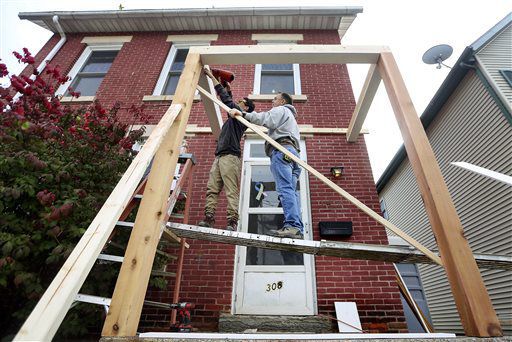
Donath had outside duty at the home at 308 E. 22nd St.
"I like tearing stuff down," she said with a smile, after helping with a chain-link fence post and parts of a wooden fence.
It was one of the first weeks of hands-on "tearing stuff down," and it was occurring inside as well.
"I think if I was in regular school, I'd definitely not be in school right now," Donath said. "So it's helping me stay in school."
Olson agreed that getting off campus is beneficial for the kids.
"They all like working with their hands," Olson said. "They're learning through work instead of sitting in the classroom and reading books all of the time."
They had their work cut out for them in this house.
"The (previous) contractor had done a lot of the work — did the simple stuff — but left all of the complicated stuff," Altman said.
That included much of the crown molding, grid work on the ceiling and the base. The crew installed doors, hung drywall and rebuilt the attic stairway. The dust flew, and the saws buzzed.
One student finished sanding a piece of wood, and as the sander slowed down, he put his hand on the still-spinning sandpaper.
"Hey, you better not do that," Altman said. "The bottom line is, I won't get excited if you break some wood or a tool, as long as you don't injure yourself or your partner."
The students volunteer to be in the program, which is limited to 12 each year, and they must be at least 16 years old to work on site.
Hempstead junior Jake Mitchell, 16, had a head start on his peers when he was younger.
"I worked on some home improvement stuff with my grandpa," he said. "But not a day goes by that I don't learn something here. I really enjoy doing it and want to make it my future."
He also said the classroom environment at Four Oaks is a perfect setting for him.
"If I wasn't in the program, I might have dropped out," he said. "I'm honestly grateful I got into the school, too, because I like the work's pace. There's more one-on-one, and you don't feel rushed to get everything done right away."
Fritz kept busy moving from floor to floor, checking on the six teens during the 2 ½-hour morning shift. An afternoon shift would include the other six students. Some boards were cut the wrong size, some wall trim in the kitchen wouldn't budge and one student forgot how to read a tape measure.
"I've worked on this for so long, I expect those kinds of things," Fritz said. "But they could use some more work on cleaning up. We had a couple of slackers."
As of recently, they were on pace to finish the house by Thanksgiving, heading to a house on either West Locust or Jackson streets next.
Welter was one of those slackers as a sophomore three years ago. Working part time at a fast-food restaurant, he was well behind on the number of credits he would need to graduate from Senior.
Then, he was approached to enroll in HEART.
"They said if I'd come in there now, they could get me graduated," Welter recalled. "They said I could work as a carpenter.
Even after joining the program as a junior, however, he resisted the opportunity — as well as his supervisors.
"I was a butthead," he said bluntly. "I was being stubborn with it."
But he noticed that nobody was giving up on him, most notably his classroom teachers and Fritz at the work sites.
"That man is really good," Welter said. "There were some bad kids. Some kids stole money from his coat once. But he met with all of us one-on-one about it and made everybody feel like they had a chance to tell their stories."
It all led to a revelation.
"I thought to myself, 'If I were to give it my all' ... there were some nights I couldn't sleep, wondering what I was going to do with my life."
Welter went on to change his attitude and become such a valued worker that he was offered an opportunity as a senior to join a new program called HEART Bridge. Its goal is to help link high school graduation to a viable career. Students participate in a variety of financial educational sessions from Dupaco Community Credit Union and designate a portion of their stipend to invest in savings.
It is available to any student at the start of their program. Olson helped Welter over his bridge.
"It was fun going out to get him started," she said. "He built references through our program, and the money he saved through it bought a computer, printer, printer cartridge and paper."
A few months ago, Welter had an interview with River City Paving, located in Kieler, Wisconsin.
"They did a great job with him," owner Mike Hoffmann said of the HEART program. "During the interview, I had him put his notes away and talk about himself. He's a sharp kid. He's come well prepared."
Welter considers himself a jack-of-all-trades with River City Paving. Out in the field, he is a manual laborer, certified flagger and certified weighmaster. Inside, he works in the lab, testing the density of rock to see how much oil goes into it to make asphalt. He also is taking a Northeast Iowa Community College program to become a heavy equipment operator.
"He says, 'When I'm 50, I don't want to be shoveling,'" Hoffmann said, with a laugh.
Welter makes $15 per hour.
"It still feels amazing coming here each day," he said. "I fought for this job. If it wasn't for (HEART), I'd probably still be working at Burger King."
Fritz and Altman express great pride in developing the students.
"I don't care as much about the houses," Fritz said. "It's actually walking through Wal-Mart and one of them saying, 'Hey Ron. How you doing?'"
Hoffmann couldn't say enough about HEART.
"If they have other candidates, send them my way. If they're anything like Garrett, I'd entertain talking to them."
___
Information from: Telegraph Herald, http://www.thonline.com
An AP Member Exchange shared by the Telegraph Herald.
- Updated
CHICAGO (AP) — A published report says one in four Chicago Public Schools teachers missed more than 10 days of school a year.
The Chicago Sun-Times (http://bit.ly/2fmK6Pr ) based its analysis on 2013-2014 data from the Illinois State Board of Education. The state board has started reporting teacher absences on the annual school report cards it puts out in the fall.
The numbers include teachers taking maternity leave and other short-term disability leaves, as well as regular sick days.
Experts say teacher absenteeism can affect student performance.
The Sun-Times report says teacher absenteeism is worse in the district's poorest schools. Jackson Potter of the Chicago Teachers Union says that's not surprising because the school district has created conditions that take a toll on teachers and the poorest schools shoulder the majority of budget cuts.
___
Information from: Chicago Sun-Times, http://chicago.suntimes.com/
- Updated
JEFFERSONVILLE, Ind. (AP) — A southern Indiana jail has made changes including additional officers and more resources for inmates after letting a cable television program film for four months inside its walls, a sheriff said.
The Clark County Jail also has added two body scanners to better detect weapons, drugs and other contraband being smuggled into the jail, Sheriff Jamey Noel said Friday. The jail also now has a drug detection dog for searches throughout the facility.
The A&E's program "60 Days In" followed seven undercover volunteers disguised as inmates, and only a few jail personnel knew about the filming. The second season finale was shown Thursday.
"Overall, I think it was a good learning experience for us," Noel said.
Seven officers resigned during the show and five were fired for unacceptable behavior. Noel said. A corrections officer who pulled out a riot gun and threatened inmates during a sewage backup was disciplined, he said.
A&E let the jail keep surveillance equipment worth more than $200,000, and it was used to file about 35 criminal charges against inmates including intimidation, battery and criminal mischief.
Since the show finished filming in March, the jail has added four new officers, Noel said.
During a 10-day break between the filming of the first and second seasons, the jail changed its mental health care after exit interviews showed inmates needed treatment for anxiety, depression, substance abuse and other mental health issues after being released, Noel said.
A pamphlet detailing resources for release was created between the first and second seasons, Noel said. The jail also has expanded its inmate help services including GED programming, substance abuse counseling and courtroom etiquette classes.
"It's that low point when they're arrested, I think, that it's the best time where we can offer help through our inmate programming," he said. "But it's tough to do that if they feel they can get those street level drugs" in jail.
Noel said the jail will keep improving using information from debriefing interviews of the undercover inmates and working with Jennifer Ortiz, ?an assistant professor of criminology at Indiana University Southeast, to develop ways to reduce recidivism.
First Timers Holdings LLC, the production company that filmed the show, agreed to pay the jail $500 per day, or $51,000 over the two seasons, which was used to pay for jail equipment and officer training, Noel said.
- Updated
BELLEVILLE, Ill. (AP) — Illinois regulators have suspended the breast-imaging operations of a radiology center in Belleville following a review that found major quality problems that constituted a "serious risk" to health.
More than 2,000 patients of Belleville Imaging are receiving letters telling them they need to have their mammograms reviewed, the Belleville News-Democrat reported (http://bit.ly/2fNhgqb ). Some may need repeat mammograms,
Mammograms are tests that screen for breast cancer. They're also used to check patients who were treated for breast cancer in the past.
Belleville Imaging failed to meet quality standards established by the American College of Radiology as required by Illinois. The American College of Radiology's report states the facility's practice posed a "serious risk to human health."
Reviewers disputed the findings of nine out of 30 examinations, including eight breast tissue abnormalities that failed to result in a follow-up recommendation. Problems with images included breast positioning, film exposure and contrast and sharpness.
That worries patient Mary Nettleton of Belleville. She had three exams during the period the facility was reviewed, May 13, 2014 through Aug. 31, 2016.
"How did this get away for three years and nobody catches this?" Nettleton said.
Mammography centers are reviewed once every three years, said Rebecca Clark, a spokeswoman for Illinois Emergency Management Agency, which regulates the facilities.
Belleville Imaging manager David Horace defended the facility's record, telling the newspaper that quality problems with mammography images don't necessarily prevent diagnosis. The facility is transferring patients' images to the Breast Health Center at Memorial Hospital in Belleville where patients can pick them up, Horace said.
Belleville Imaging may apply to conduct mammograms again after it has fixed the problems.
___
Information from: Belleville News-Democrat, http://www.bnd.com
- Updated
SIOUX CITY, Iowa (AP) — A woman on probation for her role in a staged Sioux City bank robbery is now behind bars.
The Sioux City Journal reports (http://bit.ly/2ftPWw2 ) that 19-year-old Heaven Zevenbergen, of Holstein, was ordered to spend 30 days in jail.
Zevenbergen admitted to smoking marijuana in August and quitting her job for two months — both violations of her probation. District Judge John Ackerman told her Thursday that she would likely go to prison if she violates her probation again.
Zevenbergen and her friend, 19-year-old Angelica Perez, were sentenced in February to five years in prison after pleading guilty to second-degree theft, but had their sentences suspended in May. Prosecutors said Perez entered the bank in disguise and passed Zevenbergen, who was a bank teller, a note demanding cash.
___
Information from: Sioux City Journal, http://www.siouxcityjournal.com
- Updated
BISMARCK, N.D. (AP) — A group of former prisoners have helped an Annunciation Monastery nun move her organization from a 1,000-square-foot storefront in downtown Bismarck to a location six times that size on the east side of the city.
Sister Kathleen Atkinson's Ministry on the Margins has spent the last four years helping prisoners re-enter society, according to the Bismarck Tribune (http://bit.ly/2fYhVaJ).
Former prisoner Donald Trowbridge was one of the more than 20 people who gathered to help Atkinson set up her prison re-entry ministry's new, expanded location. He said Atkinson has helped him so many times and that it was his opportunity to help her out.
Former prisoner Robert Rinehart, who was acting as foreman on light construction projects, said many of the participants put in 10-hour days over a full week.
The new location has separate rooms for coffee and dining, prayer, meetings and a food pantry. It's also much closer to the new jail and the probation and parole offices. The old location was too small for Atkinson, since she served more than 400 people weekly.
Atkinson said donations from the local community and the monastery are what made the move possible. Volunteers offered to help the nun with her program by assisting people with resumes, teaching classes and reviewing legal documents. Atkinson would also eventually like networking events for convicted felons and potential employers willing to interview them.
Atkinson's program is also known for a weekday coffeehouse for socializing, Sunday church services for people to share stories, and the "stay out of jail supper club," that gives former inmates a chance to eat and provide encouragement to each other.
___
Information from: Bismarck Tribune, http://www.bismarcktribune.com
- By TAWANA ROBERTS The (Willoughby) News-Herald
- Updated
PAINESVILLE, Ohio (AP) — It took Scott Wallace four days to go through all the contents of a medium-sized file box that was anonymously dropped off at the American Legion Post 336 in Painesville.
Wallace, the historian director, said he was fascinated by the findings.
"I know I have all my military information, but mine is not nearly that thick," Wallace said. "This guy kept everything."
The box originally belonged to Matt Steitz of Mentor, who was born in 1921. Steitz kept detailed records while serving in the U.S. Army.
He was active duty in World War II from 1942 to 1946 and in the Korean War from 1950 to 1952, and in between, from 1946 to 1950, Steitz was in the Enlisted Reserve Corp, his military records confirmed.
Through the large pile of records, Steitz kept record jackets, special orders, temporary passes, receipts, ration cards, war bonds, awards, ranks and other personnel records.
"Some of this stuff, you just can't find anymore and some of these places no longer exist, like Camp Perry, where he was stationed," said Wallace.
Steitz also kept a daily journal of his experiences during World War II. In it, he discussed his day-to-day schedules, meals, and duties.
"What I found interesting was what he did in his pastime, how he kept busy," Wallace said. "He would draw pictures and write songs and poems. Some of it really made me cry, because you could feel his loneliness."
In addition to somber poems, Steitz wrote about many things that sparked feelings of nostalgia.
"We went to Uptown Theatre at E. 106 and St. Clair and saw 'The Pied Piper' with Monty Woolley, Roddy McDowall, Anne Baxter and J. Carrol Naish," Steitz said in a journal entry on Nov. 19, 1942.
He also mentioned going to see "George Washington Slept Here," ''White Cargo" and "In Old Oklahoma" in later entries.
"He saw some great movies," Wallace said.
Steitz received an honorable discharge from the Army in 1952 and later pursued a career in accounting.
He died in 2014, according to his obituary.
"He seemed to be an amazing man," Wallace said. "What I would like to see is this box to get back to his family."
___
Information from: The News-Herald, http://www.news-herald.com/jrc-html/index/index_p33.html
- Updated
CLEVELAND (AP) — Cleveland school officials say a museum curator recently gathered acorns and buds from an oak tree planted at a Cleveland high school in honor of Olympic hero Jesse Owens.
The plan is to grow replica trees at a Southern California botanical garden.
A curator at the Henry E. Huntington Library & Art Galleries in San Marino, California, thinks the oak tree planted at Cleveland's Rhodes High School might be one of only three surviving trees from the 20 given to Owens and other U.S. Olympians after the 1936 Summer Games in Berlin.
Owens won four track gold medals in Berlin.
Curator Tim Thibault calls Owens' oak a "national treasure."
Owens attended East Tech High School in Cleveland but mostly trained at Rhodes High School.
- By Frank Stanko Wahpeton Daily News
- Updated
WAHPETON, N.D. (AP) — Having an active youngster is a game-changer. Amanda Dukart, zookeeper and animal trainer for Chahinkapa Zoo, found that out last spring.
The young joey that initially had a 25 percent chance of surviving is thriving.
Barkly, the kangaroo joey whose nighttime care Dukart was primarily sharing with Zoo Director Kathy Diekman, has matured and developed. She can live outside the pouch zoo staff carried her around in. The pouch replicated what Barkly would have experienced with her mother, who died in February, the Wahpeton Daily News (http://bit.ly/2eBRMJT ) reported.
"Your home life (is different), when you've got a 'roo jumping behind you when you're cooking and cleaning," Diekman said. "You're always cleaning with a 'roo. He'd box my chihuahua in the spirit of play."
Dukart agrees, saying Barkly "likes to nibble on everything."
Over the summer, Dukart, Diekman and the rest of Chahinkapa's staff worked on acclimating her to living as a zoo animal. Initially, Barkly was hesitant, vocalizing her stress.
"This summer, we started putting her out in the habitat gradually. (We'd spend) 15 minutes with her (in a pattern) . with her. A half-hour with her An hour with her and then, 15 minutes without us, a half-hour without us . It was gradual. All summer we did this," Diekman said.
According to Dukart and Diekman, weaning Barkly was a team effort.
"She got so attached, mostly to Amanda and then also to me," Diekman continued. "She sees one of us, she'll jump up. Or she'd follow us . she'd hear us and go look for us."
Barkly's adjustment period overlapped with Chahinkapa Zoo going from summer to fall hours, which concerned Diekman and her staff. In late September, Diekman attended the Association of Zoos and Aquariums' annual conference. When she returned to Chahinkapa, Diekman was prepared to put Barkly in her pouch. Even though Barkly had adjusted to living outside the pouch, for safety reasons, she was still being pouched for car rides.
"She wouldn't go in the pouch," Diekman remembered. "She still knew me very well. She wanted to go with me, but she wouldn't go in the pouch. She started kicking. Instead of being upset, I saw this as a good thing. I said, 'You're staying, Barkly.'"
Already familiar with Chahinkapa's kangaroo habitat, Barkly had also progressed to eating kangaroo feed along with getting her three bottles of milk. From there, it was a matter of observation.
"I didn't feel comfortable going, 'There you go,' so, just about every hour, (I'd) look in the window. And she'd hear us coming and go right for the door. I'd think, 'Oh, she hasn't moved from the door. Poor Barkly.' Well, I watched her from the window and realized she was fine. After four days, we were completely comfortable with her being in there," Diekman said.
Dukart, who said she couldn't imagine the process of Barkly's adjustment having gone better, added that she's proud it was a team effort. Not only that, but the record of Barkly's growth and feeding will be available for any zoo that needs it.
"We learn from them, they learn from us," Diekman said. "Having said that . how do you compensate somebody for taking a kangaroo home every night? It's a different world, but what an opportunity."
Among the fellow kangaroos at Chahinkapa is Barkly's father, Herbert. To prevent inbreeding, she will undergo implanting. Herbert is currently Chahinkapa's only adult male kangaroo. Most of his offspring will eventually be sent to other animal facilities. According to Dukart, a kangaroo can start breeding at approximately two years.
"We'll never trade Barkly. She's here forever," Diekman said.
From 5:30 p.m.-12 a.m. Friday, Nov. 18, Chahinkapa Zoo will hold its annual "Wild Game Shows" fundraiser at the Wahpeton Community Center. Tickets are $35 each and may be purchased by calling 701-642-8709 or visiting www.chahinkapazoo.org. Guests must be 21 years or older to attend.
___
Information from: Wahpeton Daily News, http://www.wahpetondailynews.com
An AP Exchange shared by the Wahpeton Daily News.
- By NICHOLAS BERGIN Lincoln Journal Star
- Updated
LINCOLN, Neb. (AP) — After months of paperwork and navigating bureaucratic red tape, University of Nebraska-Lincoln researchers have planted their first crop of legal hemp.
The Lincoln Journal Star (http://bit.ly/2fV28dP ) reports that about 150 plants with the distinctive frond leaf, previously relegated to roadside ditches, are nestled in warm and slightly humid greenhouses on UNL's East Campus.
Industrial hemp has almost none of the psychoactive component tetrahydrocannabinol (THC), found in its cousin marijuana, but the family relationship has gotten both plants lumped together as Schedule I drugs along with heroin, LSD and ecstasy.
"You can get higher smoking a corn plant than you can on this stuff," said Tom Clemente, a professor of biotechnology and one of two UNL researchers growing the plants.
The Schedule I designation has long put the kibosh on hemp as an industrial crop in the United States. But in 2014, Congress carved out an exemption for research purposes. Since then, at least 30 states have adopted legislation related to industrial hemp, according to the National Conference of State Legislatures.
While states like Colorado and Kentucky led the way in hemp cultivation, Nebraska's path has been slow and halting. A bill that would have let Nebraska farmers apply to grow hemp got dusted by state legislators over fears it could be used as a cover for or gateway to marijuana. Senators eventually passed an amended bill restricting hemp research to colleges.
In February, UNL filed an application with the U.S. Drug Enforcement Agency for permission to import seeds. Researchers had to jump through numerous hoops, including reinforcing the floor below where the seeds would be kept with metal because the DEA feared someone could saw through the wood to get to them.
On June 23, the DEA gave UNL the go-ahead to order seeds from Italy and Canada.
Clemente's focus is on genetically engineering hemp to produce oils in its stalks and leaves for use as industrial lubricants and plastics. Once the oil has been extracted, the remaining pulp and fibers can be used in making materials that include paper and cardboard.
"You want to maximize the number of products you're making per acre," Clemente said. "When you're just selling biomass, it's tough to make a buck off that."
Hemp has plenty of potential. It's resilient and doesn't need much fertilizer. It also doesn't need much water. While other plants were withering during the 2012 drought, hemp was blooming across the state.
The plant, which already is grown and imported to the United States from countries including Canada and China, is used in more than 25,000 products, including seizure medicine, lotions and construction materials. Retail value of hemp products in the United States in 2015 amounted to at least $573 million dollars, according to estimates by the Hemp Industry Association and Hemp Business Journal.
And now, inside an East Campus greenhouse, young plants sporting five-fingered leaves sway in an artificial wind created by fans.
The wind is essential, said Dweikat, who had been pushing to get a hemp breeding program at UNL since 2012. Without it, hemp would slump over under its own weight.
He has varieties from Italy and Canada next to plants grown from seeds he gathered himself from ditches and fields in Lincoln and Seward counties, which he did with the blessing of DEA officials.
UNL Assistant Dean of Agricultural Research Hector Santiago said the university is working on a memorandum of understanding with the DEA to formalize plans to use feral hemp from Nebraska in breeding programs.
DEA spokeswoman Barbara Carreno and Nebraska Department of Agriculture spokeswoman Christin Kamm said the researchers got verbal permission to do research with wild hemp as long as the plants have a low THC content.
Any that contain more than .3 percent will be destroyed. Those that fall below the limit will be used to crossbreed crops that are well adapted to Nebraska's climate and will produce the fibers and oils industry wants.
Because federal approval came too late for an outdoor crop this year, Dweikat is focusing on the best way to grow hemp in greenhouse conditions.
"We're just learning the ropes," he said.
He's already found that plants from the Canadian seed need more than 14 hours of light a day or they get spindly and produce prematurely flowering sprouts while wild plants from Nebraska and Italian seeds grow fine with 14 hours.
Dweikat plans to sow two acres of hemp this spring at a UNL research facility near Mead, then move on to planting in different parts of the state to test growing conditions.
While hemp proponents hope it could someday become a Nebraska cash crop, there is still a great deal of work to be done in terms of research -- and in convincing businesses and farmers to invest.
"You can develop a feed stock, but you need the industry to develop around it," Clemente said. "If there is no industry for transportation or to take the stuff, it's going to sit like a log. So there is a lot of work to do outside the sheer biology. There is a lot on the business side."
UNL hopes to partner with companies and business investors in the blooming hemp industry, like Omaha-startup Bastcore, which turns hemp stalks into fiber products. He also is working on procuring federal funding recently made available for hemp research.
___
Information from: Lincoln Journal Star, http://www.journalstar.com
An AP Member Exchange shared by the Lincoln Journal Star.
- By SARA JORDAN-HEINTZ The Times-Republican
- Updated
WELLSBURB, Iowa (AP) — Burdette Walters is known for his eclectic taste in antiques. He owns and operates the Friesian House Museum in his hometown of Wellsburg, population 700. He is a fan of early recorded music, citing Ada Jones, Billy Murray, Manuel Romain, Will Oakland and the Golden Gate Orchestra among his favorite musicians. Before the advent of digital music, compact discs, cassette tapes and turntable record players, there was the phonograph, a device in which Walters owns over 175, ranging in size, age, material and brand.
"When I was six years old I saw a picture of a phonograph and I liked it. My grandma, who lived with us, had one. When she died, I lobbied for her Edison Amberola 30 phonograph," Walters said. "Growing up, I wasn't interested in sports. I was the nerd."
Walters grew up as an only child in a German-American family, learning to speak both languages. He earned a Bachelor of Arts degree in secondary education with a major in history and minor in German. His father Eilert and mother Mary supported his interest in phonographs and antiques, and his mother especially enjoyed listening to records from the late 1920s.
The phonograph was invited by Thomas Alva Edison in 1877 while he was working on ways to improve the quality of the telegraph and telephone. He discovered a way to record and reproduce sound on tinfoil-coated cylinders. The first words he recorded on his device were "Mary had a little lamb." The following year, he established the Edison Speaking Phonograph Company, marketing the machine for use in making recordings of music, voices and for dictation purposes, with the technology also being used for music boxes and talking dolls. Edison coined the term "phonograph" from the Greek roots "phono," meaning sound, and "graph," meaning instrument for recording.
Soon after, competing companies released their own versions of the phonograph, including the Victor Talking Machine Company's gramophone and Columbia's graphophone. Walters cites the Edison brand as his favorite, based on sound quality and durability, although he is skilled in the care and maintenance of all the brands he owns.
The oldest model in his collection - the Edison Suitcase Home Phonograph - dates to 1896. His models are constructed from brass, wood and tin, and come painted black or in their natural states, with some featuring floral designs. His largest phonograph horn is suspended from his basement ceiling - measuring six feet long, for use in concert halls.
"Housewives complained about phonographs' long external horns protruding out into rooms, and so these companies started to make models with interior horns," Walters said.
The collector owns several models with the internal horn design. Many of these models were consoles, and had cabinet space available for storing records. Columbia records called their version Grafonolas, Edison called them Amberolas, and Victor called theirs Victrolas. These companies competed with each other to be ranked highest in sound quality, design, and celebrity endorsements. In time, the name "Victrola" became the common term for record player.
Walters collects phonograph-related memorabilia, in the form of cylinder records, which were also manufactured by the phonograph companies. In those days, the cylinders could only hold between two and four minutes of sound. Walters makes and sells his own cylinder record holders. He also collects advertisements, photographs of his favorite singers and artist renderings of Nipper the dog. Nipper served as the model for the painting "His Master's Voice" - the basis for the now iconic logo of a dog listening to his master's voice emanate from a gramophone. The image became Victor's trademark, also later used by the Radio Corporation of America (RCA). One of Walters' favorite trinkets is "dancing dolls" that would be placed on top of a spinning record.
"It was a novelty. One I have is of Uncle Sam kicking the German Kaiser in the butt," Walters said.
The upkeep of the machines is fairly straightforward; Walters makes sure to keep the pieces cleaned and oiled, avoiding heat and humidity. Certain models are more susceptible to needing springs replaced.
One of the simple pleasures in Walters' life is taking a cylinder recorder out of its holder and listening to the old-time sounds of singers and musicians of yesteryear.
"All my phonographs are in working condition," the collector said.
Walters actively buys and sells, traveling the area to attend shows and auctions, particularly shopping the shows in Union, Ill. To learn more about Walters and his phonographs, visit his website at: www.misteropera.com
___
Information from: Times-Republican, http://www.timesrepublican.com
An AP Member Exchange shared by the Times-Republican.
- By PAT KINNEY Waterloo-Cedar Falls Courier
- Updated
WATERLOO, Iowa (AP) — The Cedar Valley Makers are setting up shop in a big way on a floor of the Cedar Valley TechWorks near downtown Waterloo.
Armed with a couple of good-sized grants and a boatload of goodwill donations, the nonprofit group has accumulated an eclectic array of production equipment, ranging from a laser cutter to welders to metal lathes.
The Waterloo-Cedar Falls Courier (http://bit.ly/2eMm1RI ) reports that they're fitting out their "maker space" on a floor of a former John Deere production building, the "Tech 1" building at 360 Westfield Ave., for inventors, entrepreneurs, industrialists and crafters. They range in age from people in their early 20s to retirees.
They've signed up 20 paid members so far and they want to get more. The initial goal is about 100. Toward that end, they're planning coffee open houses and other public events to encourage folks to putter, play and produce in the maker space.
They've spent the past few months "fixing a couple of the kinks," said Danny Laudick, one of the original "makers" and talent development coordinator for the Greater Cedar Valley Alliance and Chamber. "We're still getting some of the equipment set up. We just recently got the machine shop to the point where people can use it."
People are hearing of the operation by word of mouth and stopping in.
"We had a guy come in, he's a weld engineer for John Deere. He just wanted to become a member. But then he's been taking names and numbers; he's going to be offering some welding classes. He had kind of an education background as well. So we're just starting to see people coming in, looking to get involved."
Cedar Valley Makers Inc., created about a year ago, is pulling together a metal shop, wood shop, electronics lab and 3D printers on about 5,000 square feet of space on the third floor of the Cedar Valley TechWorks building.
They secured a $20,000 matching grant from the McElroy Trust and an account through the Community Foundation of Northeast Iowa. In August, the organization also received a $50,000 grant from the Black Hawk County Gaming Association to purchase equipment for the maker space.
The equipment is open to use by artisans, crafters, inventors and manufacturers who would pay a monthly fee.
The "maker space" — a concept happening in other locations around the country — would be open to all ages and skill levels, and it's hoped the cooperative atmosphere would generate a synergy of creative minds that could lead, potentially, to new products, new companies and new jobs for the area.
An open house in May resulted in a good-sized crowd, and the shop also was a stop on Main Street Waterloo's "Tour de 'Loo" of downtown projects.
"We had one guy who just moved to town a month and a half ago, who, the week he was here, heard about it and showed up," Laudick said. "He'd been involved in one in Missouri. He was worried there wouldn't be anything to be involved with here. He was involved with the local high school there. He was interested in being involved with the schools here. That's one thing that's been really nice — a lot of the members getting involved and willing to help."
The monthly membership is $25 a month for individuals during a start-up "beta" period. The Makers also have talked with local smaller manufacturers about donating scrap materials and other items to work with. Long term, they would like to have a working relationship with major manufacturers such as Deere.
The Makers also are hoping to get multiple generations
The monthly membership is $25 a month for individuals during a start-up "beta" period. The Makers also have talked with local smaller manufacturers about donating scrap materials and other items to work with. Long term, they would like to have a working relationship with major manufacturers such as Deere.
The Makers also are hoping to get multiple generations involved. "One guy brought his dad in with him, a retiree. He became a member, too," Laudick said. They're also talking with local retirement communities about involving residents with manufacturing or crafting skills in the maker space.
"Now that we finally have a little more time to focus on community stuff, now that we have a lot of the physical set up done, we're looking at doing Saturday morning coffees for members, have a chance for everyone to get together and socialize," Laudick said.
The space is already being used for a range of activities. "We are talking right now with a company who wants to use the laser cutter for product development because we can offer access to them cheaper than it costs them to lease a laser cutter," Laudick said. "And then members are just working on custom craft jewelry. Another is working on a bicycle frame. Everything from craft to product development."
He noted some companies also are interested in involving their employees just for the sake of giving them a place to practice hobbies as a kind of quality-of-life amenity.
Laudick said the Makers also are on consultation with local schools and exploring the possibility of getting some of its skilled-retiree members to work with them and involving local school robotics teams in assembling their projects.
"There's a world of opportunities," Laudick said, including putting on product-development workshops utilizing members with skills in that area, or new-product photography as tool for marketing new products.
Or, maybe a "community-build" day inviting people to come and try out equipment with donated raw materials. Or putting together kid-friendly project kits for parents to bring their children to come in and tinker with.
Laudick also is involved with the Mill Race project of developer Mark Kittrell along State Street in Cedar Falls. Entrepreneurs in that project may be able to help Cedar Valley Makers Space members in marketing new products.
"A lot of the people that 'make stuff' aren't usually thinking about market development, product commercialization," he said. "But you can connect them with the people that are doing a lot of that.
"We hope to bring some that community side to it, build some of those relationships between people to realize there's really no reason you can't develop your product," Laudick said.
Open shop hours are 5 to 9 p.m. Tuesdays and Thursdays and from 11 a.m. to 4 p.m. Saturdays. Individuals can stop any time during open shop hours for a tour. New member orientations are currently held every Saturday at 11 a.m. and 2 p.m.
More information is available online at cedarvalleymakers.org, on the organization's Facebook page, emailing CedarValleyMakers@gmail.com or by calling 427-2030.
___
Information from: Waterloo-Cedar Falls Courier, http://www.wcfcourier.com
An AP Member Exchange shared by the Waterloo-Cedar Falls Courier.
- By JIM SWENSON Telegraph Herald
- Updated
DUBUQUE, Iowa (AP) — The stocky, bearded carpenter casually picked up an oversized block of wood and slowly swung it around toward five high school students.
"If you can't read a tape measure — I hate to say it — but you're worthless to me," said 57-year-old Ron Fritz, pointing at the model of a tape measure.
The Telegraph Herald (http://bit.ly/2eE2saB ) reports that dozens of tools were spread out on tables in a small, cramped work shed at the historic Four Mounds property in Dubuque. It was the second week of a nearly yearlong program called Housing, Education and Rehabilitation Training, or HEART.
The first week was spent reading about tool safety in the classroom. The weeks to come would be focused on rehabbing a dilapidated apartment house on 22nd Street in Dubuque.
Fritz went through everything from hammers and pliers to utility knives and power tools.
He held up a wood chisel.
"This thing, when it's sharp, will shave the hairs on your arm.
"You need to familiarize them with the tools, and then they've got to learn about safety with the tools," he continued. "We stress how dangerous they are."
Tesla Donath, 17, gained some experience in the program last year.
"I learned how to work the tools," she said. "For a girl, I didn't know how to use most of them."
As the class continued, Fritz suggested each student figure out what he or she wanted to do in the future.
"Don't come to the work site because you want to get out of class," he said. "Come to the work site because you want to learn."
David Harris of Community Housing Initiatives has long worked with Fritz.
"He's so perfect for that program," Harris said. "He has the skills to teach the kids and the patience to work with them."
Growing up, Garrett Welter was a self-proclaimed "little misfit child who skipped a lot of school." He didn't believe he would graduate from Dubuque Senior High School and figured his "career" might be in fast food.
Then, he enrolled in the HEART program at Four Oaks of Iowa.
"It helped turn things around and helped me do better in life," said 18-year-old Welter.
The program started in 2003 with Four Oaks partnering with Dubuque Community Schools, City of Dubuque and Four Mounds.
"John Gronen was the board president, and his Gronen Properties Restoration company provided both guidance and some assistance as needed," said Christine Happ Olson, executive director of Four Mounds Foundation. "He also was influential in the envisioning, the formation and support long term. Fritz was our existing employee at Four Mounds."
In the past 13 years, dozens of students have learned how to be carpenters. After a pilot program with two Four Mounds projects, they moved on to Washington Street in 2004. They have since transformed about 30 derelict rental units into polished, owner-occupied homes in the Washington Neighborhood.
"Not only have the houses had an amazing transformation, what they've done with the students is amazing," Gronen said.
Welter acknowledged as much.
"I matured tons through it," he said. "I was the kid who didn't want to work."
Fritz, a veteran carpenter and construction worker, wasn't on board right away.
"I was concerned before I did this," he said. "I was working with Gronen and said, 'You've got to be crazy. This isn't 'Romper Room.' This is construction.' But John was pretty persuasive."
Gronen recalled Fritz saying, "If you have any crazy idea of me working with kids, you can forget about it."
"But he's done a fabulous job," Gronen said.
The students come from Dubuque Senior and Hempstead high schools, but have their classes at Four Oaks, one of 10 HEART partners. They earn a small stipend.
"They have challenges for making graduation and typically have not been performing well in the normal classroom," Olson said. "This is an incentive to do well in the classroom."
There is a 91 percent graduation rate among participants.
"They've created one of the most successful models of this kind in the community," said Ellen Goodman Miller, who works in development and strategic partnerships at Gronen Development. "A lot of times, you look at the amount of people served. But this is a huge impact to each individual. It truly does restore lives."
Lori Anderson, transition facilitator for Dubuque Community School District, said the program was going so well, it might have been put on autopilot the past couple of years.
"We were seeing lower numbers," she said of student participation. "So we all pulled together as a team to better communicate," looking at their marketing and promotional efforts. "That's when we also added the stipend. It really revitalized us."
Tim Altman is the youth counselor at Four Oaks who also instructs students on carpentry.
"A lot of people think they all have trouble," he said. "But realistically, what teenager doesn't have trouble?"
He said the way it was explained to him, they were at risk of not graduating.
Harris and Community Housing Initiatives promote home ownership and residential development in the Washington Neighborhood. It purchases, rehabilitates and resells abandoned and derelict houses from 11th to 22nd streets and Elm Street to Central Avenue. HEART has rehabbed five homes for the group in the past four years.
"It's a wonderful program," Harris said. "They do wonderful work and the kids learn a lot. Everybody benefits — we do, the neighborhood does and the homeowners do."
Added Gronen: "Much of what you see going on in the Washington neighborhood is because of HEART. They're able to see houses transform before their eyes."
Donath had outside duty at the home at 308 E. 22nd St.
"I like tearing stuff down," she said with a smile, after helping with a chain-link fence post and parts of a wooden fence.
It was one of the first weeks of hands-on "tearing stuff down," and it was occurring inside as well.
"I think if I was in regular school, I'd definitely not be in school right now," Donath said. "So it's helping me stay in school."
Olson agreed that getting off campus is beneficial for the kids.
"They all like working with their hands," Olson said. "They're learning through work instead of sitting in the classroom and reading books all of the time."
They had their work cut out for them in this house.
"The (previous) contractor had done a lot of the work — did the simple stuff — but left all of the complicated stuff," Altman said.
That included much of the crown molding, grid work on the ceiling and the base. The crew installed doors, hung drywall and rebuilt the attic stairway. The dust flew, and the saws buzzed.
One student finished sanding a piece of wood, and as the sander slowed down, he put his hand on the still-spinning sandpaper.
"Hey, you better not do that," Altman said. "The bottom line is, I won't get excited if you break some wood or a tool, as long as you don't injure yourself or your partner."
The students volunteer to be in the program, which is limited to 12 each year, and they must be at least 16 years old to work on site.
Hempstead junior Jake Mitchell, 16, had a head start on his peers when he was younger.
"I worked on some home improvement stuff with my grandpa," he said. "But not a day goes by that I don't learn something here. I really enjoy doing it and want to make it my future."
He also said the classroom environment at Four Oaks is a perfect setting for him.
"If I wasn't in the program, I might have dropped out," he said. "I'm honestly grateful I got into the school, too, because I like the work's pace. There's more one-on-one, and you don't feel rushed to get everything done right away."
Fritz kept busy moving from floor to floor, checking on the six teens during the 2 ½-hour morning shift. An afternoon shift would include the other six students. Some boards were cut the wrong size, some wall trim in the kitchen wouldn't budge and one student forgot how to read a tape measure.
"I've worked on this for so long, I expect those kinds of things," Fritz said. "But they could use some more work on cleaning up. We had a couple of slackers."
As of recently, they were on pace to finish the house by Thanksgiving, heading to a house on either West Locust or Jackson streets next.
Welter was one of those slackers as a sophomore three years ago. Working part time at a fast-food restaurant, he was well behind on the number of credits he would need to graduate from Senior.
Then, he was approached to enroll in HEART.
"They said if I'd come in there now, they could get me graduated," Welter recalled. "They said I could work as a carpenter.
Even after joining the program as a junior, however, he resisted the opportunity — as well as his supervisors.
"I was a butthead," he said bluntly. "I was being stubborn with it."
But he noticed that nobody was giving up on him, most notably his classroom teachers and Fritz at the work sites.
"That man is really good," Welter said. "There were some bad kids. Some kids stole money from his coat once. But he met with all of us one-on-one about it and made everybody feel like they had a chance to tell their stories."
It all led to a revelation.
"I thought to myself, 'If I were to give it my all' ... there were some nights I couldn't sleep, wondering what I was going to do with my life."
Welter went on to change his attitude and become such a valued worker that he was offered an opportunity as a senior to join a new program called HEART Bridge. Its goal is to help link high school graduation to a viable career. Students participate in a variety of financial educational sessions from Dupaco Community Credit Union and designate a portion of their stipend to invest in savings.
It is available to any student at the start of their program. Olson helped Welter over his bridge.
"It was fun going out to get him started," she said. "He built references through our program, and the money he saved through it bought a computer, printer, printer cartridge and paper."
A few months ago, Welter had an interview with River City Paving, located in Kieler, Wis.
"They did a great job with him," owner Mike Hoffmann said of the HEART program. "During the interview, I had him put his notes away and talk about himself. He's a sharp kid. He's come well prepared."
Welter considers himself a jack-of-all-trades with River City Paving. Out in the field, he is a manual laborer, certified flagger and certified weighmaster. Inside, he works in the lab, testing the density of rock to see how much oil goes into it to make asphalt. He also is taking a Northeast Iowa Community College program to become a heavy equipment operator.
"He says, 'When I'm 50, I don't want to be shoveling,'" Hoffmann said, with a laugh.
Welter makes $15 per hour.
"It still feels amazing coming here each day," he said. "I fought for this job. If it wasn't for (HEART), I'd probably still be working at Burger King."
Fritz and Altman express great pride in developing the students.
"I don't care as much about the houses," Fritz said. "It's actually walking through Wal-Mart and one of them saying, 'Hey Ron. How you doing?'"
Hoffmann couldn't say enough about HEART.
"If they have other candidates, send them my way. If they're anything like Garrett, I'd entertain talking to them."
___
Information from: Telegraph Herald, http://www.thonline.com
An AP Member Exchange shared by the Telegraph Herald.
- By JIM SWENSON Telegraph Herald
DUBUQUE, Iowa (AP) — The stocky, bearded carpenter casually picked up an oversized block of wood and slowly swung it around toward five high school students.
"If you can't read a tape measure — I hate to say it — but you're worthless to me," said 57-year-old Ron Fritz, pointing at the model of a tape measure.
The Telegraph Herald (http://bit.ly/2eE2saB ) reports that dozens of tools were spread out on tables in a small, cramped work shed at the historic Four Mounds property in Dubuque. It was the second week of a nearly yearlong program called Housing, Education and Rehabilitation Training, or HEART.
The first week was spent reading about tool safety in the classroom. The weeks to come would be focused on rehabbing a dilapidated apartment house on 22nd Street in Dubuque.
Fritz went through everything from hammers and pliers to utility knives and power tools.
He held up a wood chisel.
"This thing, when it's sharp, will shave the hairs on your arm.
"You need to familiarize them with the tools, and then they've got to learn about safety with the tools," he continued. "We stress how dangerous they are."
Tesla Donath, 17, gained some experience in the program last year.
"I learned how to work the tools," she said. "For a girl, I didn't know how to use most of them."
As the class continued, Fritz suggested each student figure out what he or she wanted to do in the future.
"Don't come to the work site because you want to get out of class," he said. "Come to the work site because you want to learn."
David Harris of Community Housing Initiatives has long worked with Fritz.
"He's so perfect for that program," Harris said. "He has the skills to teach the kids and the patience to work with them."
Growing up, Garrett Welter was a self-proclaimed "little misfit child who skipped a lot of school." He didn't believe he would graduate from Dubuque Senior High School and figured his "career" might be in fast food.
Then, he enrolled in the HEART program at Four Oaks of Iowa.
"It helped turn things around and helped me do better in life," said 18-year-old Welter.
The program started in 2003 with Four Oaks partnering with Dubuque Community Schools, City of Dubuque and Four Mounds.
"John Gronen was the board president, and his Gronen Properties Restoration company provided both guidance and some assistance as needed," said Christine Happ Olson, executive director of Four Mounds Foundation. "He also was influential in the envisioning, the formation and support long term. Fritz was our existing employee at Four Mounds."
In the past 13 years, dozens of students have learned how to be carpenters. After a pilot program with two Four Mounds projects, they moved on to Washington Street in 2004. They have since transformed about 30 derelict rental units into polished, owner-occupied homes in the Washington Neighborhood.
"Not only have the houses had an amazing transformation, what they've done with the students is amazing," Gronen said.
Welter acknowledged as much.
"I matured tons through it," he said. "I was the kid who didn't want to work."
Fritz, a veteran carpenter and construction worker, wasn't on board right away.
"I was concerned before I did this," he said. "I was working with Gronen and said, 'You've got to be crazy. This isn't 'Romper Room.' This is construction.' But John was pretty persuasive."
Gronen recalled Fritz saying, "If you have any crazy idea of me working with kids, you can forget about it."
"But he's done a fabulous job," Gronen said.
The students come from Dubuque Senior and Hempstead high schools, but have their classes at Four Oaks, one of 10 HEART partners. They earn a small stipend.
"They have challenges for making graduation and typically have not been performing well in the normal classroom," Olson said. "This is an incentive to do well in the classroom."
There is a 91 percent graduation rate among participants.
"They've created one of the most successful models of this kind in the community," said Ellen Goodman Miller, who works in development and strategic partnerships at Gronen Development. "A lot of times, you look at the amount of people served. But this is a huge impact to each individual. It truly does restore lives."
Lori Anderson, transition facilitator for Dubuque Community School District, said the program was going so well, it might have been put on autopilot the past couple of years.
"We were seeing lower numbers," she said of student participation. "So we all pulled together as a team to better communicate," looking at their marketing and promotional efforts. "That's when we also added the stipend. It really revitalized us."
Tim Altman is the youth counselor at Four Oaks who also instructs students on carpentry.
"A lot of people think they all have trouble," he said. "But realistically, what teenager doesn't have trouble?"
He said the way it was explained to him, they were at risk of not graduating.
Harris and Community Housing Initiatives promote home ownership and residential development in the Washington Neighborhood. It purchases, rehabilitates and resells abandoned and derelict houses from 11th to 22nd streets and Elm Street to Central Avenue. HEART has rehabbed five homes for the group in the past four years.
"It's a wonderful program," Harris said. "They do wonderful work and the kids learn a lot. Everybody benefits — we do, the neighborhood does and the homeowners do."
Added Gronen: "Much of what you see going on in the Washington neighborhood is because of HEART. They're able to see houses transform before their eyes."
Donath had outside duty at the home at 308 E. 22nd St.
"I like tearing stuff down," she said with a smile, after helping with a chain-link fence post and parts of a wooden fence.
It was one of the first weeks of hands-on "tearing stuff down," and it was occurring inside as well.
"I think if I was in regular school, I'd definitely not be in school right now," Donath said. "So it's helping me stay in school."
Olson agreed that getting off campus is beneficial for the kids.
"They all like working with their hands," Olson said. "They're learning through work instead of sitting in the classroom and reading books all of the time."
They had their work cut out for them in this house.
"The (previous) contractor had done a lot of the work — did the simple stuff — but left all of the complicated stuff," Altman said.
That included much of the crown molding, grid work on the ceiling and the base. The crew installed doors, hung drywall and rebuilt the attic stairway. The dust flew, and the saws buzzed.
One student finished sanding a piece of wood, and as the sander slowed down, he put his hand on the still-spinning sandpaper.
"Hey, you better not do that," Altman said. "The bottom line is, I won't get excited if you break some wood or a tool, as long as you don't injure yourself or your partner."
The students volunteer to be in the program, which is limited to 12 each year, and they must be at least 16 years old to work on site.
Hempstead junior Jake Mitchell, 16, had a head start on his peers when he was younger.
"I worked on some home improvement stuff with my grandpa," he said. "But not a day goes by that I don't learn something here. I really enjoy doing it and want to make it my future."
He also said the classroom environment at Four Oaks is a perfect setting for him.
"If I wasn't in the program, I might have dropped out," he said. "I'm honestly grateful I got into the school, too, because I like the work's pace. There's more one-on-one, and you don't feel rushed to get everything done right away."
Fritz kept busy moving from floor to floor, checking on the six teens during the 2 ½-hour morning shift. An afternoon shift would include the other six students. Some boards were cut the wrong size, some wall trim in the kitchen wouldn't budge and one student forgot how to read a tape measure.
"I've worked on this for so long, I expect those kinds of things," Fritz said. "But they could use some more work on cleaning up. We had a couple of slackers."
As of recently, they were on pace to finish the house by Thanksgiving, heading to a house on either West Locust or Jackson streets next.
Welter was one of those slackers as a sophomore three years ago. Working part time at a fast-food restaurant, he was well behind on the number of credits he would need to graduate from Senior.
Then, he was approached to enroll in HEART.
"They said if I'd come in there now, they could get me graduated," Welter recalled. "They said I could work as a carpenter.
Even after joining the program as a junior, however, he resisted the opportunity — as well as his supervisors.
"I was a butthead," he said bluntly. "I was being stubborn with it."
But he noticed that nobody was giving up on him, most notably his classroom teachers and Fritz at the work sites.
"That man is really good," Welter said. "There were some bad kids. Some kids stole money from his coat once. But he met with all of us one-on-one about it and made everybody feel like they had a chance to tell their stories."
It all led to a revelation.
"I thought to myself, 'If I were to give it my all' ... there were some nights I couldn't sleep, wondering what I was going to do with my life."
Welter went on to change his attitude and become such a valued worker that he was offered an opportunity as a senior to join a new program called HEART Bridge. Its goal is to help link high school graduation to a viable career. Students participate in a variety of financial educational sessions from Dupaco Community Credit Union and designate a portion of their stipend to invest in savings.
It is available to any student at the start of their program. Olson helped Welter over his bridge.
"It was fun going out to get him started," she said. "He built references through our program, and the money he saved through it bought a computer, printer, printer cartridge and paper."
A few months ago, Welter had an interview with River City Paving, located in Kieler, Wisconsin.
"They did a great job with him," owner Mike Hoffmann said of the HEART program. "During the interview, I had him put his notes away and talk about himself. He's a sharp kid. He's come well prepared."
Welter considers himself a jack-of-all-trades with River City Paving. Out in the field, he is a manual laborer, certified flagger and certified weighmaster. Inside, he works in the lab, testing the density of rock to see how much oil goes into it to make asphalt. He also is taking a Northeast Iowa Community College program to become a heavy equipment operator.
"He says, 'When I'm 50, I don't want to be shoveling,'" Hoffmann said, with a laugh.
Welter makes $15 per hour.
"It still feels amazing coming here each day," he said. "I fought for this job. If it wasn't for (HEART), I'd probably still be working at Burger King."
Fritz and Altman express great pride in developing the students.
"I don't care as much about the houses," Fritz said. "It's actually walking through Wal-Mart and one of them saying, 'Hey Ron. How you doing?'"
Hoffmann couldn't say enough about HEART.
"If they have other candidates, send them my way. If they're anything like Garrett, I'd entertain talking to them."
___
Information from: Telegraph Herald, http://www.thonline.com
An AP Member Exchange shared by the Telegraph Herald.
CHICAGO (AP) — A published report says one in four Chicago Public Schools teachers missed more than 10 days of school a year.
The Chicago Sun-Times (http://bit.ly/2fmK6Pr ) based its analysis on 2013-2014 data from the Illinois State Board of Education. The state board has started reporting teacher absences on the annual school report cards it puts out in the fall.
The numbers include teachers taking maternity leave and other short-term disability leaves, as well as regular sick days.
Experts say teacher absenteeism can affect student performance.
The Sun-Times report says teacher absenteeism is worse in the district's poorest schools. Jackson Potter of the Chicago Teachers Union says that's not surprising because the school district has created conditions that take a toll on teachers and the poorest schools shoulder the majority of budget cuts.
___
Information from: Chicago Sun-Times, http://chicago.suntimes.com/
JEFFERSONVILLE, Ind. (AP) — A southern Indiana jail has made changes including additional officers and more resources for inmates after letting a cable television program film for four months inside its walls, a sheriff said.
The Clark County Jail also has added two body scanners to better detect weapons, drugs and other contraband being smuggled into the jail, Sheriff Jamey Noel said Friday. The jail also now has a drug detection dog for searches throughout the facility.
The A&E's program "60 Days In" followed seven undercover volunteers disguised as inmates, and only a few jail personnel knew about the filming. The second season finale was shown Thursday.
"Overall, I think it was a good learning experience for us," Noel said.
Seven officers resigned during the show and five were fired for unacceptable behavior. Noel said. A corrections officer who pulled out a riot gun and threatened inmates during a sewage backup was disciplined, he said.
A&E let the jail keep surveillance equipment worth more than $200,000, and it was used to file about 35 criminal charges against inmates including intimidation, battery and criminal mischief.
Since the show finished filming in March, the jail has added four new officers, Noel said.
During a 10-day break between the filming of the first and second seasons, the jail changed its mental health care after exit interviews showed inmates needed treatment for anxiety, depression, substance abuse and other mental health issues after being released, Noel said.
A pamphlet detailing resources for release was created between the first and second seasons, Noel said. The jail also has expanded its inmate help services including GED programming, substance abuse counseling and courtroom etiquette classes.
"It's that low point when they're arrested, I think, that it's the best time where we can offer help through our inmate programming," he said. "But it's tough to do that if they feel they can get those street level drugs" in jail.
Noel said the jail will keep improving using information from debriefing interviews of the undercover inmates and working with Jennifer Ortiz, ?an assistant professor of criminology at Indiana University Southeast, to develop ways to reduce recidivism.
First Timers Holdings LLC, the production company that filmed the show, agreed to pay the jail $500 per day, or $51,000 over the two seasons, which was used to pay for jail equipment and officer training, Noel said.
BELLEVILLE, Ill. (AP) — Illinois regulators have suspended the breast-imaging operations of a radiology center in Belleville following a review that found major quality problems that constituted a "serious risk" to health.
More than 2,000 patients of Belleville Imaging are receiving letters telling them they need to have their mammograms reviewed, the Belleville News-Democrat reported (http://bit.ly/2fNhgqb ). Some may need repeat mammograms,
Mammograms are tests that screen for breast cancer. They're also used to check patients who were treated for breast cancer in the past.
Belleville Imaging failed to meet quality standards established by the American College of Radiology as required by Illinois. The American College of Radiology's report states the facility's practice posed a "serious risk to human health."
Reviewers disputed the findings of nine out of 30 examinations, including eight breast tissue abnormalities that failed to result in a follow-up recommendation. Problems with images included breast positioning, film exposure and contrast and sharpness.
That worries patient Mary Nettleton of Belleville. She had three exams during the period the facility was reviewed, May 13, 2014 through Aug. 31, 2016.
"How did this get away for three years and nobody catches this?" Nettleton said.
Mammography centers are reviewed once every three years, said Rebecca Clark, a spokeswoman for Illinois Emergency Management Agency, which regulates the facilities.
Belleville Imaging manager David Horace defended the facility's record, telling the newspaper that quality problems with mammography images don't necessarily prevent diagnosis. The facility is transferring patients' images to the Breast Health Center at Memorial Hospital in Belleville where patients can pick them up, Horace said.
Belleville Imaging may apply to conduct mammograms again after it has fixed the problems.
___
Information from: Belleville News-Democrat, http://www.bnd.com
SIOUX CITY, Iowa (AP) — A woman on probation for her role in a staged Sioux City bank robbery is now behind bars.
The Sioux City Journal reports (http://bit.ly/2ftPWw2 ) that 19-year-old Heaven Zevenbergen, of Holstein, was ordered to spend 30 days in jail.
Zevenbergen admitted to smoking marijuana in August and quitting her job for two months — both violations of her probation. District Judge John Ackerman told her Thursday that she would likely go to prison if she violates her probation again.
Zevenbergen and her friend, 19-year-old Angelica Perez, were sentenced in February to five years in prison after pleading guilty to second-degree theft, but had their sentences suspended in May. Prosecutors said Perez entered the bank in disguise and passed Zevenbergen, who was a bank teller, a note demanding cash.
___
Information from: Sioux City Journal, http://www.siouxcityjournal.com
BISMARCK, N.D. (AP) — A group of former prisoners have helped an Annunciation Monastery nun move her organization from a 1,000-square-foot storefront in downtown Bismarck to a location six times that size on the east side of the city.
Sister Kathleen Atkinson's Ministry on the Margins has spent the last four years helping prisoners re-enter society, according to the Bismarck Tribune (http://bit.ly/2fYhVaJ).
Former prisoner Donald Trowbridge was one of the more than 20 people who gathered to help Atkinson set up her prison re-entry ministry's new, expanded location. He said Atkinson has helped him so many times and that it was his opportunity to help her out.
Former prisoner Robert Rinehart, who was acting as foreman on light construction projects, said many of the participants put in 10-hour days over a full week.
The new location has separate rooms for coffee and dining, prayer, meetings and a food pantry. It's also much closer to the new jail and the probation and parole offices. The old location was too small for Atkinson, since she served more than 400 people weekly.
Atkinson said donations from the local community and the monastery are what made the move possible. Volunteers offered to help the nun with her program by assisting people with resumes, teaching classes and reviewing legal documents. Atkinson would also eventually like networking events for convicted felons and potential employers willing to interview them.
Atkinson's program is also known for a weekday coffeehouse for socializing, Sunday church services for people to share stories, and the "stay out of jail supper club," that gives former inmates a chance to eat and provide encouragement to each other.
___
Information from: Bismarck Tribune, http://www.bismarcktribune.com
- By TAWANA ROBERTS The (Willoughby) News-Herald
PAINESVILLE, Ohio (AP) — It took Scott Wallace four days to go through all the contents of a medium-sized file box that was anonymously dropped off at the American Legion Post 336 in Painesville.
Wallace, the historian director, said he was fascinated by the findings.
"I know I have all my military information, but mine is not nearly that thick," Wallace said. "This guy kept everything."
The box originally belonged to Matt Steitz of Mentor, who was born in 1921. Steitz kept detailed records while serving in the U.S. Army.
He was active duty in World War II from 1942 to 1946 and in the Korean War from 1950 to 1952, and in between, from 1946 to 1950, Steitz was in the Enlisted Reserve Corp, his military records confirmed.
Through the large pile of records, Steitz kept record jackets, special orders, temporary passes, receipts, ration cards, war bonds, awards, ranks and other personnel records.
"Some of this stuff, you just can't find anymore and some of these places no longer exist, like Camp Perry, where he was stationed," said Wallace.
Steitz also kept a daily journal of his experiences during World War II. In it, he discussed his day-to-day schedules, meals, and duties.
"What I found interesting was what he did in his pastime, how he kept busy," Wallace said. "He would draw pictures and write songs and poems. Some of it really made me cry, because you could feel his loneliness."
In addition to somber poems, Steitz wrote about many things that sparked feelings of nostalgia.
"We went to Uptown Theatre at E. 106 and St. Clair and saw 'The Pied Piper' with Monty Woolley, Roddy McDowall, Anne Baxter and J. Carrol Naish," Steitz said in a journal entry on Nov. 19, 1942.
He also mentioned going to see "George Washington Slept Here," ''White Cargo" and "In Old Oklahoma" in later entries.
"He saw some great movies," Wallace said.
Steitz received an honorable discharge from the Army in 1952 and later pursued a career in accounting.
He died in 2014, according to his obituary.
"He seemed to be an amazing man," Wallace said. "What I would like to see is this box to get back to his family."
___
Information from: The News-Herald, http://www.news-herald.com/jrc-html/index/index_p33.html
CLEVELAND (AP) — Cleveland school officials say a museum curator recently gathered acorns and buds from an oak tree planted at a Cleveland high school in honor of Olympic hero Jesse Owens.
The plan is to grow replica trees at a Southern California botanical garden.
A curator at the Henry E. Huntington Library & Art Galleries in San Marino, California, thinks the oak tree planted at Cleveland's Rhodes High School might be one of only three surviving trees from the 20 given to Owens and other U.S. Olympians after the 1936 Summer Games in Berlin.
Owens won four track gold medals in Berlin.
Curator Tim Thibault calls Owens' oak a "national treasure."
Owens attended East Tech High School in Cleveland but mostly trained at Rhodes High School.
- By Frank Stanko Wahpeton Daily News
WAHPETON, N.D. (AP) — Having an active youngster is a game-changer. Amanda Dukart, zookeeper and animal trainer for Chahinkapa Zoo, found that out last spring.
The young joey that initially had a 25 percent chance of surviving is thriving.
Barkly, the kangaroo joey whose nighttime care Dukart was primarily sharing with Zoo Director Kathy Diekman, has matured and developed. She can live outside the pouch zoo staff carried her around in. The pouch replicated what Barkly would have experienced with her mother, who died in February, the Wahpeton Daily News (http://bit.ly/2eBRMJT ) reported.
"Your home life (is different), when you've got a 'roo jumping behind you when you're cooking and cleaning," Diekman said. "You're always cleaning with a 'roo. He'd box my chihuahua in the spirit of play."
Dukart agrees, saying Barkly "likes to nibble on everything."
Over the summer, Dukart, Diekman and the rest of Chahinkapa's staff worked on acclimating her to living as a zoo animal. Initially, Barkly was hesitant, vocalizing her stress.
"This summer, we started putting her out in the habitat gradually. (We'd spend) 15 minutes with her (in a pattern) . with her. A half-hour with her An hour with her and then, 15 minutes without us, a half-hour without us . It was gradual. All summer we did this," Diekman said.
According to Dukart and Diekman, weaning Barkly was a team effort.
"She got so attached, mostly to Amanda and then also to me," Diekman continued. "She sees one of us, she'll jump up. Or she'd follow us . she'd hear us and go look for us."
Barkly's adjustment period overlapped with Chahinkapa Zoo going from summer to fall hours, which concerned Diekman and her staff. In late September, Diekman attended the Association of Zoos and Aquariums' annual conference. When she returned to Chahinkapa, Diekman was prepared to put Barkly in her pouch. Even though Barkly had adjusted to living outside the pouch, for safety reasons, she was still being pouched for car rides.
"She wouldn't go in the pouch," Diekman remembered. "She still knew me very well. She wanted to go with me, but she wouldn't go in the pouch. She started kicking. Instead of being upset, I saw this as a good thing. I said, 'You're staying, Barkly.'"
Already familiar with Chahinkapa's kangaroo habitat, Barkly had also progressed to eating kangaroo feed along with getting her three bottles of milk. From there, it was a matter of observation.
"I didn't feel comfortable going, 'There you go,' so, just about every hour, (I'd) look in the window. And she'd hear us coming and go right for the door. I'd think, 'Oh, she hasn't moved from the door. Poor Barkly.' Well, I watched her from the window and realized she was fine. After four days, we were completely comfortable with her being in there," Diekman said.
Dukart, who said she couldn't imagine the process of Barkly's adjustment having gone better, added that she's proud it was a team effort. Not only that, but the record of Barkly's growth and feeding will be available for any zoo that needs it.
"We learn from them, they learn from us," Diekman said. "Having said that . how do you compensate somebody for taking a kangaroo home every night? It's a different world, but what an opportunity."
Among the fellow kangaroos at Chahinkapa is Barkly's father, Herbert. To prevent inbreeding, she will undergo implanting. Herbert is currently Chahinkapa's only adult male kangaroo. Most of his offspring will eventually be sent to other animal facilities. According to Dukart, a kangaroo can start breeding at approximately two years.
"We'll never trade Barkly. She's here forever," Diekman said.
From 5:30 p.m.-12 a.m. Friday, Nov. 18, Chahinkapa Zoo will hold its annual "Wild Game Shows" fundraiser at the Wahpeton Community Center. Tickets are $35 each and may be purchased by calling 701-642-8709 or visiting www.chahinkapazoo.org. Guests must be 21 years or older to attend.
___
Information from: Wahpeton Daily News, http://www.wahpetondailynews.com
An AP Exchange shared by the Wahpeton Daily News.
- By NICHOLAS BERGIN Lincoln Journal Star
LINCOLN, Neb. (AP) — After months of paperwork and navigating bureaucratic red tape, University of Nebraska-Lincoln researchers have planted their first crop of legal hemp.
The Lincoln Journal Star (http://bit.ly/2fV28dP ) reports that about 150 plants with the distinctive frond leaf, previously relegated to roadside ditches, are nestled in warm and slightly humid greenhouses on UNL's East Campus.
Industrial hemp has almost none of the psychoactive component tetrahydrocannabinol (THC), found in its cousin marijuana, but the family relationship has gotten both plants lumped together as Schedule I drugs along with heroin, LSD and ecstasy.
"You can get higher smoking a corn plant than you can on this stuff," said Tom Clemente, a professor of biotechnology and one of two UNL researchers growing the plants.
The Schedule I designation has long put the kibosh on hemp as an industrial crop in the United States. But in 2014, Congress carved out an exemption for research purposes. Since then, at least 30 states have adopted legislation related to industrial hemp, according to the National Conference of State Legislatures.
While states like Colorado and Kentucky led the way in hemp cultivation, Nebraska's path has been slow and halting. A bill that would have let Nebraska farmers apply to grow hemp got dusted by state legislators over fears it could be used as a cover for or gateway to marijuana. Senators eventually passed an amended bill restricting hemp research to colleges.
In February, UNL filed an application with the U.S. Drug Enforcement Agency for permission to import seeds. Researchers had to jump through numerous hoops, including reinforcing the floor below where the seeds would be kept with metal because the DEA feared someone could saw through the wood to get to them.
On June 23, the DEA gave UNL the go-ahead to order seeds from Italy and Canada.
Clemente's focus is on genetically engineering hemp to produce oils in its stalks and leaves for use as industrial lubricants and plastics. Once the oil has been extracted, the remaining pulp and fibers can be used in making materials that include paper and cardboard.
"You want to maximize the number of products you're making per acre," Clemente said. "When you're just selling biomass, it's tough to make a buck off that."
Hemp has plenty of potential. It's resilient and doesn't need much fertilizer. It also doesn't need much water. While other plants were withering during the 2012 drought, hemp was blooming across the state.
The plant, which already is grown and imported to the United States from countries including Canada and China, is used in more than 25,000 products, including seizure medicine, lotions and construction materials. Retail value of hemp products in the United States in 2015 amounted to at least $573 million dollars, according to estimates by the Hemp Industry Association and Hemp Business Journal.
And now, inside an East Campus greenhouse, young plants sporting five-fingered leaves sway in an artificial wind created by fans.
The wind is essential, said Dweikat, who had been pushing to get a hemp breeding program at UNL since 2012. Without it, hemp would slump over under its own weight.
He has varieties from Italy and Canada next to plants grown from seeds he gathered himself from ditches and fields in Lincoln and Seward counties, which he did with the blessing of DEA officials.
UNL Assistant Dean of Agricultural Research Hector Santiago said the university is working on a memorandum of understanding with the DEA to formalize plans to use feral hemp from Nebraska in breeding programs.
DEA spokeswoman Barbara Carreno and Nebraska Department of Agriculture spokeswoman Christin Kamm said the researchers got verbal permission to do research with wild hemp as long as the plants have a low THC content.
Any that contain more than .3 percent will be destroyed. Those that fall below the limit will be used to crossbreed crops that are well adapted to Nebraska's climate and will produce the fibers and oils industry wants.
Because federal approval came too late for an outdoor crop this year, Dweikat is focusing on the best way to grow hemp in greenhouse conditions.
"We're just learning the ropes," he said.
He's already found that plants from the Canadian seed need more than 14 hours of light a day or they get spindly and produce prematurely flowering sprouts while wild plants from Nebraska and Italian seeds grow fine with 14 hours.
Dweikat plans to sow two acres of hemp this spring at a UNL research facility near Mead, then move on to planting in different parts of the state to test growing conditions.
While hemp proponents hope it could someday become a Nebraska cash crop, there is still a great deal of work to be done in terms of research -- and in convincing businesses and farmers to invest.
"You can develop a feed stock, but you need the industry to develop around it," Clemente said. "If there is no industry for transportation or to take the stuff, it's going to sit like a log. So there is a lot of work to do outside the sheer biology. There is a lot on the business side."
UNL hopes to partner with companies and business investors in the blooming hemp industry, like Omaha-startup Bastcore, which turns hemp stalks into fiber products. He also is working on procuring federal funding recently made available for hemp research.
___
Information from: Lincoln Journal Star, http://www.journalstar.com
An AP Member Exchange shared by the Lincoln Journal Star.
- By SARA JORDAN-HEINTZ The Times-Republican
WELLSBURB, Iowa (AP) — Burdette Walters is known for his eclectic taste in antiques. He owns and operates the Friesian House Museum in his hometown of Wellsburg, population 700. He is a fan of early recorded music, citing Ada Jones, Billy Murray, Manuel Romain, Will Oakland and the Golden Gate Orchestra among his favorite musicians. Before the advent of digital music, compact discs, cassette tapes and turntable record players, there was the phonograph, a device in which Walters owns over 175, ranging in size, age, material and brand.
"When I was six years old I saw a picture of a phonograph and I liked it. My grandma, who lived with us, had one. When she died, I lobbied for her Edison Amberola 30 phonograph," Walters said. "Growing up, I wasn't interested in sports. I was the nerd."
Walters grew up as an only child in a German-American family, learning to speak both languages. He earned a Bachelor of Arts degree in secondary education with a major in history and minor in German. His father Eilert and mother Mary supported his interest in phonographs and antiques, and his mother especially enjoyed listening to records from the late 1920s.
The phonograph was invited by Thomas Alva Edison in 1877 while he was working on ways to improve the quality of the telegraph and telephone. He discovered a way to record and reproduce sound on tinfoil-coated cylinders. The first words he recorded on his device were "Mary had a little lamb." The following year, he established the Edison Speaking Phonograph Company, marketing the machine for use in making recordings of music, voices and for dictation purposes, with the technology also being used for music boxes and talking dolls. Edison coined the term "phonograph" from the Greek roots "phono," meaning sound, and "graph," meaning instrument for recording.
Soon after, competing companies released their own versions of the phonograph, including the Victor Talking Machine Company's gramophone and Columbia's graphophone. Walters cites the Edison brand as his favorite, based on sound quality and durability, although he is skilled in the care and maintenance of all the brands he owns.
The oldest model in his collection - the Edison Suitcase Home Phonograph - dates to 1896. His models are constructed from brass, wood and tin, and come painted black or in their natural states, with some featuring floral designs. His largest phonograph horn is suspended from his basement ceiling - measuring six feet long, for use in concert halls.
"Housewives complained about phonographs' long external horns protruding out into rooms, and so these companies started to make models with interior horns," Walters said.
The collector owns several models with the internal horn design. Many of these models were consoles, and had cabinet space available for storing records. Columbia records called their version Grafonolas, Edison called them Amberolas, and Victor called theirs Victrolas. These companies competed with each other to be ranked highest in sound quality, design, and celebrity endorsements. In time, the name "Victrola" became the common term for record player.
Walters collects phonograph-related memorabilia, in the form of cylinder records, which were also manufactured by the phonograph companies. In those days, the cylinders could only hold between two and four minutes of sound. Walters makes and sells his own cylinder record holders. He also collects advertisements, photographs of his favorite singers and artist renderings of Nipper the dog. Nipper served as the model for the painting "His Master's Voice" - the basis for the now iconic logo of a dog listening to his master's voice emanate from a gramophone. The image became Victor's trademark, also later used by the Radio Corporation of America (RCA). One of Walters' favorite trinkets is "dancing dolls" that would be placed on top of a spinning record.
"It was a novelty. One I have is of Uncle Sam kicking the German Kaiser in the butt," Walters said.
The upkeep of the machines is fairly straightforward; Walters makes sure to keep the pieces cleaned and oiled, avoiding heat and humidity. Certain models are more susceptible to needing springs replaced.
One of the simple pleasures in Walters' life is taking a cylinder recorder out of its holder and listening to the old-time sounds of singers and musicians of yesteryear.
"All my phonographs are in working condition," the collector said.
Walters actively buys and sells, traveling the area to attend shows and auctions, particularly shopping the shows in Union, Ill. To learn more about Walters and his phonographs, visit his website at: www.misteropera.com
___
Information from: Times-Republican, http://www.timesrepublican.com
An AP Member Exchange shared by the Times-Republican.
- By PAT KINNEY Waterloo-Cedar Falls Courier
WATERLOO, Iowa (AP) — The Cedar Valley Makers are setting up shop in a big way on a floor of the Cedar Valley TechWorks near downtown Waterloo.
Armed with a couple of good-sized grants and a boatload of goodwill donations, the nonprofit group has accumulated an eclectic array of production equipment, ranging from a laser cutter to welders to metal lathes.
The Waterloo-Cedar Falls Courier (http://bit.ly/2eMm1RI ) reports that they're fitting out their "maker space" on a floor of a former John Deere production building, the "Tech 1" building at 360 Westfield Ave., for inventors, entrepreneurs, industrialists and crafters. They range in age from people in their early 20s to retirees.
They've signed up 20 paid members so far and they want to get more. The initial goal is about 100. Toward that end, they're planning coffee open houses and other public events to encourage folks to putter, play and produce in the maker space.
They've spent the past few months "fixing a couple of the kinks," said Danny Laudick, one of the original "makers" and talent development coordinator for the Greater Cedar Valley Alliance and Chamber. "We're still getting some of the equipment set up. We just recently got the machine shop to the point where people can use it."
People are hearing of the operation by word of mouth and stopping in.
"We had a guy come in, he's a weld engineer for John Deere. He just wanted to become a member. But then he's been taking names and numbers; he's going to be offering some welding classes. He had kind of an education background as well. So we're just starting to see people coming in, looking to get involved."
Cedar Valley Makers Inc., created about a year ago, is pulling together a metal shop, wood shop, electronics lab and 3D printers on about 5,000 square feet of space on the third floor of the Cedar Valley TechWorks building.
They secured a $20,000 matching grant from the McElroy Trust and an account through the Community Foundation of Northeast Iowa. In August, the organization also received a $50,000 grant from the Black Hawk County Gaming Association to purchase equipment for the maker space.
The equipment is open to use by artisans, crafters, inventors and manufacturers who would pay a monthly fee.
The "maker space" — a concept happening in other locations around the country — would be open to all ages and skill levels, and it's hoped the cooperative atmosphere would generate a synergy of creative minds that could lead, potentially, to new products, new companies and new jobs for the area.
An open house in May resulted in a good-sized crowd, and the shop also was a stop on Main Street Waterloo's "Tour de 'Loo" of downtown projects.
"We had one guy who just moved to town a month and a half ago, who, the week he was here, heard about it and showed up," Laudick said. "He'd been involved in one in Missouri. He was worried there wouldn't be anything to be involved with here. He was involved with the local high school there. He was interested in being involved with the schools here. That's one thing that's been really nice — a lot of the members getting involved and willing to help."
The monthly membership is $25 a month for individuals during a start-up "beta" period. The Makers also have talked with local smaller manufacturers about donating scrap materials and other items to work with. Long term, they would like to have a working relationship with major manufacturers such as Deere.
The Makers also are hoping to get multiple generations
The monthly membership is $25 a month for individuals during a start-up "beta" period. The Makers also have talked with local smaller manufacturers about donating scrap materials and other items to work with. Long term, they would like to have a working relationship with major manufacturers such as Deere.
The Makers also are hoping to get multiple generations involved. "One guy brought his dad in with him, a retiree. He became a member, too," Laudick said. They're also talking with local retirement communities about involving residents with manufacturing or crafting skills in the maker space.
"Now that we finally have a little more time to focus on community stuff, now that we have a lot of the physical set up done, we're looking at doing Saturday morning coffees for members, have a chance for everyone to get together and socialize," Laudick said.
The space is already being used for a range of activities. "We are talking right now with a company who wants to use the laser cutter for product development because we can offer access to them cheaper than it costs them to lease a laser cutter," Laudick said. "And then members are just working on custom craft jewelry. Another is working on a bicycle frame. Everything from craft to product development."
He noted some companies also are interested in involving their employees just for the sake of giving them a place to practice hobbies as a kind of quality-of-life amenity.
Laudick said the Makers also are on consultation with local schools and exploring the possibility of getting some of its skilled-retiree members to work with them and involving local school robotics teams in assembling their projects.
"There's a world of opportunities," Laudick said, including putting on product-development workshops utilizing members with skills in that area, or new-product photography as tool for marketing new products.
Or, maybe a "community-build" day inviting people to come and try out equipment with donated raw materials. Or putting together kid-friendly project kits for parents to bring their children to come in and tinker with.
Laudick also is involved with the Mill Race project of developer Mark Kittrell along State Street in Cedar Falls. Entrepreneurs in that project may be able to help Cedar Valley Makers Space members in marketing new products.
"A lot of the people that 'make stuff' aren't usually thinking about market development, product commercialization," he said. "But you can connect them with the people that are doing a lot of that.
"We hope to bring some that community side to it, build some of those relationships between people to realize there's really no reason you can't develop your product," Laudick said.
Open shop hours are 5 to 9 p.m. Tuesdays and Thursdays and from 11 a.m. to 4 p.m. Saturdays. Individuals can stop any time during open shop hours for a tour. New member orientations are currently held every Saturday at 11 a.m. and 2 p.m.
More information is available online at cedarvalleymakers.org, on the organization's Facebook page, emailing CedarValleyMakers@gmail.com or by calling 427-2030.
___
Information from: Waterloo-Cedar Falls Courier, http://www.wcfcourier.com
An AP Member Exchange shared by the Waterloo-Cedar Falls Courier.
- By JIM SWENSON Telegraph Herald
DUBUQUE, Iowa (AP) — The stocky, bearded carpenter casually picked up an oversized block of wood and slowly swung it around toward five high school students.
"If you can't read a tape measure — I hate to say it — but you're worthless to me," said 57-year-old Ron Fritz, pointing at the model of a tape measure.
The Telegraph Herald (http://bit.ly/2eE2saB ) reports that dozens of tools were spread out on tables in a small, cramped work shed at the historic Four Mounds property in Dubuque. It was the second week of a nearly yearlong program called Housing, Education and Rehabilitation Training, or HEART.
The first week was spent reading about tool safety in the classroom. The weeks to come would be focused on rehabbing a dilapidated apartment house on 22nd Street in Dubuque.
Fritz went through everything from hammers and pliers to utility knives and power tools.
He held up a wood chisel.
"This thing, when it's sharp, will shave the hairs on your arm.
"You need to familiarize them with the tools, and then they've got to learn about safety with the tools," he continued. "We stress how dangerous they are."
Tesla Donath, 17, gained some experience in the program last year.
"I learned how to work the tools," she said. "For a girl, I didn't know how to use most of them."
As the class continued, Fritz suggested each student figure out what he or she wanted to do in the future.
"Don't come to the work site because you want to get out of class," he said. "Come to the work site because you want to learn."
David Harris of Community Housing Initiatives has long worked with Fritz.
"He's so perfect for that program," Harris said. "He has the skills to teach the kids and the patience to work with them."
Growing up, Garrett Welter was a self-proclaimed "little misfit child who skipped a lot of school." He didn't believe he would graduate from Dubuque Senior High School and figured his "career" might be in fast food.
Then, he enrolled in the HEART program at Four Oaks of Iowa.
"It helped turn things around and helped me do better in life," said 18-year-old Welter.
The program started in 2003 with Four Oaks partnering with Dubuque Community Schools, City of Dubuque and Four Mounds.
"John Gronen was the board president, and his Gronen Properties Restoration company provided both guidance and some assistance as needed," said Christine Happ Olson, executive director of Four Mounds Foundation. "He also was influential in the envisioning, the formation and support long term. Fritz was our existing employee at Four Mounds."
In the past 13 years, dozens of students have learned how to be carpenters. After a pilot program with two Four Mounds projects, they moved on to Washington Street in 2004. They have since transformed about 30 derelict rental units into polished, owner-occupied homes in the Washington Neighborhood.
"Not only have the houses had an amazing transformation, what they've done with the students is amazing," Gronen said.
Welter acknowledged as much.
"I matured tons through it," he said. "I was the kid who didn't want to work."
Fritz, a veteran carpenter and construction worker, wasn't on board right away.
"I was concerned before I did this," he said. "I was working with Gronen and said, 'You've got to be crazy. This isn't 'Romper Room.' This is construction.' But John was pretty persuasive."
Gronen recalled Fritz saying, "If you have any crazy idea of me working with kids, you can forget about it."
"But he's done a fabulous job," Gronen said.
The students come from Dubuque Senior and Hempstead high schools, but have their classes at Four Oaks, one of 10 HEART partners. They earn a small stipend.
"They have challenges for making graduation and typically have not been performing well in the normal classroom," Olson said. "This is an incentive to do well in the classroom."
There is a 91 percent graduation rate among participants.
"They've created one of the most successful models of this kind in the community," said Ellen Goodman Miller, who works in development and strategic partnerships at Gronen Development. "A lot of times, you look at the amount of people served. But this is a huge impact to each individual. It truly does restore lives."
Lori Anderson, transition facilitator for Dubuque Community School District, said the program was going so well, it might have been put on autopilot the past couple of years.
"We were seeing lower numbers," she said of student participation. "So we all pulled together as a team to better communicate," looking at their marketing and promotional efforts. "That's when we also added the stipend. It really revitalized us."
Tim Altman is the youth counselor at Four Oaks who also instructs students on carpentry.
"A lot of people think they all have trouble," he said. "But realistically, what teenager doesn't have trouble?"
He said the way it was explained to him, they were at risk of not graduating.
Harris and Community Housing Initiatives promote home ownership and residential development in the Washington Neighborhood. It purchases, rehabilitates and resells abandoned and derelict houses from 11th to 22nd streets and Elm Street to Central Avenue. HEART has rehabbed five homes for the group in the past four years.
"It's a wonderful program," Harris said. "They do wonderful work and the kids learn a lot. Everybody benefits — we do, the neighborhood does and the homeowners do."
Added Gronen: "Much of what you see going on in the Washington neighborhood is because of HEART. They're able to see houses transform before their eyes."
Donath had outside duty at the home at 308 E. 22nd St.
"I like tearing stuff down," she said with a smile, after helping with a chain-link fence post and parts of a wooden fence.
It was one of the first weeks of hands-on "tearing stuff down," and it was occurring inside as well.
"I think if I was in regular school, I'd definitely not be in school right now," Donath said. "So it's helping me stay in school."
Olson agreed that getting off campus is beneficial for the kids.
"They all like working with their hands," Olson said. "They're learning through work instead of sitting in the classroom and reading books all of the time."
They had their work cut out for them in this house.
"The (previous) contractor had done a lot of the work — did the simple stuff — but left all of the complicated stuff," Altman said.
That included much of the crown molding, grid work on the ceiling and the base. The crew installed doors, hung drywall and rebuilt the attic stairway. The dust flew, and the saws buzzed.
One student finished sanding a piece of wood, and as the sander slowed down, he put his hand on the still-spinning sandpaper.
"Hey, you better not do that," Altman said. "The bottom line is, I won't get excited if you break some wood or a tool, as long as you don't injure yourself or your partner."
The students volunteer to be in the program, which is limited to 12 each year, and they must be at least 16 years old to work on site.
Hempstead junior Jake Mitchell, 16, had a head start on his peers when he was younger.
"I worked on some home improvement stuff with my grandpa," he said. "But not a day goes by that I don't learn something here. I really enjoy doing it and want to make it my future."
He also said the classroom environment at Four Oaks is a perfect setting for him.
"If I wasn't in the program, I might have dropped out," he said. "I'm honestly grateful I got into the school, too, because I like the work's pace. There's more one-on-one, and you don't feel rushed to get everything done right away."
Fritz kept busy moving from floor to floor, checking on the six teens during the 2 ½-hour morning shift. An afternoon shift would include the other six students. Some boards were cut the wrong size, some wall trim in the kitchen wouldn't budge and one student forgot how to read a tape measure.
"I've worked on this for so long, I expect those kinds of things," Fritz said. "But they could use some more work on cleaning up. We had a couple of slackers."
As of recently, they were on pace to finish the house by Thanksgiving, heading to a house on either West Locust or Jackson streets next.
Welter was one of those slackers as a sophomore three years ago. Working part time at a fast-food restaurant, he was well behind on the number of credits he would need to graduate from Senior.
Then, he was approached to enroll in HEART.
"They said if I'd come in there now, they could get me graduated," Welter recalled. "They said I could work as a carpenter.
Even after joining the program as a junior, however, he resisted the opportunity — as well as his supervisors.
"I was a butthead," he said bluntly. "I was being stubborn with it."
But he noticed that nobody was giving up on him, most notably his classroom teachers and Fritz at the work sites.
"That man is really good," Welter said. "There were some bad kids. Some kids stole money from his coat once. But he met with all of us one-on-one about it and made everybody feel like they had a chance to tell their stories."
It all led to a revelation.
"I thought to myself, 'If I were to give it my all' ... there were some nights I couldn't sleep, wondering what I was going to do with my life."
Welter went on to change his attitude and become such a valued worker that he was offered an opportunity as a senior to join a new program called HEART Bridge. Its goal is to help link high school graduation to a viable career. Students participate in a variety of financial educational sessions from Dupaco Community Credit Union and designate a portion of their stipend to invest in savings.
It is available to any student at the start of their program. Olson helped Welter over his bridge.
"It was fun going out to get him started," she said. "He built references through our program, and the money he saved through it bought a computer, printer, printer cartridge and paper."
A few months ago, Welter had an interview with River City Paving, located in Kieler, Wis.
"They did a great job with him," owner Mike Hoffmann said of the HEART program. "During the interview, I had him put his notes away and talk about himself. He's a sharp kid. He's come well prepared."
Welter considers himself a jack-of-all-trades with River City Paving. Out in the field, he is a manual laborer, certified flagger and certified weighmaster. Inside, he works in the lab, testing the density of rock to see how much oil goes into it to make asphalt. He also is taking a Northeast Iowa Community College program to become a heavy equipment operator.
"He says, 'When I'm 50, I don't want to be shoveling,'" Hoffmann said, with a laugh.
Welter makes $15 per hour.
"It still feels amazing coming here each day," he said. "I fought for this job. If it wasn't for (HEART), I'd probably still be working at Burger King."
Fritz and Altman express great pride in developing the students.
"I don't care as much about the houses," Fritz said. "It's actually walking through Wal-Mart and one of them saying, 'Hey Ron. How you doing?'"
Hoffmann couldn't say enough about HEART.
"If they have other candidates, send them my way. If they're anything like Garrett, I'd entertain talking to them."
___
Information from: Telegraph Herald, http://www.thonline.com
An AP Member Exchange shared by the Telegraph Herald.


View this profile on Instagram#ThisIsTucson 🌵 (@this_is_tucson) • Instagram photos and videos
Most viewed stories
-
Cheer on the Wildcats in the Final Four at these local restaurants and bars 🐻⬇️
-
Over 70 fun events happening in Tucson in April 🎡🐰
-
Over 30 fun events happening in Tucson March 27-29!
-
New Eats! 20 new restaurants that opened up in Tucson this winter 🍽️
-
Viral fruit ice cream and strawberry Oreos: the $25 challenge at Sandyi Oriental Market
-
5 basement bars and speakeasies to visit when you want a fun drink and cool AC
-
Bloomfest celebrates palo verde blooms and Tucson culture
-
OaxaRico opened their first brick-and-mortar, serving up delicious mole and gorditas
-
Vintage band tees take center stage at Tucson’s new shop Almandel
-
Over 40 exciting events to check out this weekend! 🌱