


Clown tackles intruder; puppy rescued from pipe; new whooping crane plan
Odd and interesting news from the Midwest.
- Updated
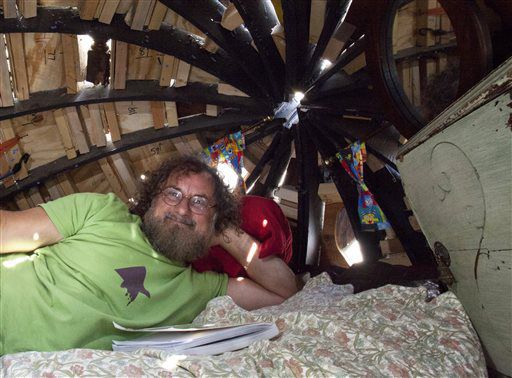
GRAND RAPIDS, Mich. (AP) — An artist plans to bring awareness to homelessness by spending about a month inside his creation during an annual competition in western Michigan.
Loren Naji will call the 8-foot spherical "Emoh" home during ArtPrize in Grand Rapids, The Grand Rapids Press reported (http://bit.ly/2cb0P3h ).
After all, "Emoh" is "home" spelled backward, and pieces of wood and debris from demolished houses were used to create the 192 panels covering the sphere.
Naji, of Cleveland, told the newspaper he wants to confront the issues behind homelessness.
"I think it's wrong that there are human beings living on the streets," said Naji, who is one of more than 1,400 artists competing for cash prizes in ArtPrize.
The event's preview week runs through Tuesday, and the competition takes place Wednesday through Oct. 19.
Art will be displayed throughout downtown Grand Rapids and is voted on by the public and a jury of experts.
If he wins, Naji said he plans to donate $20,000 to a homeless organization.
Naji's entry could get people talking about the issue, but "we have to be careful when we play at a struggle people live daily," said Jesica Vail, program manager for the Grand Rapids Coalition to End Homelessness.
___
Information from: The Grand Rapids Press, http://www.mlive.com/grand-rapids
- Updated
MINNEAPOLIS (AP) — A Minnesota blogger who has written about two Lakeville sisters who went missing has been served with a restraining order.
The girls' mother, Sandra Grazzini-Rucki, got the restraining order against Michael Brodkorb because she claimed he was harassing her.
Brodkorb calls his work journalism and says the restraining order violates his First Amendment rights and ability to cover Grazzini-Rucki's sentencing on Wednesday. He tells the Star Tribune (9http://strib.mn/2cvpvJN) nearly all of Grazzini-Rucki's claims against him are false.
Grazzini-Rucki's attorney told The Associated Press that her client was harassed. Attorney Michelle MacDonald says she was with her client when Brodkorb followed them.
Grazzini-Rucki was convicted in July of felony deprivation of parental rights for hiding her daughters for more than two years from their father.
___
Information from: Star Tribune, http://www.startribune.com
- Updated
CHICAGO (AP) — Illinois' wealthy governor has donated $100,000 to Missouri Republican gubernatorial candidate Eric Greitens.
A state campaign finance report filed Friday shows Republican Gov. Bruce Rauner and his wife Diana made the contribution on Thursday.
Greitens faces Democratic Attorney General Chris Koster in the race to replace Missouri Gov. Jay Nixon, a Democrat.
Earlier this week Rauner also donated $100,000 to the Republican gubernatorial candidate in Indiana, Lt. Gov. Eric Holcomb.
Rauner is a multimillionaire former private equity investor who spent millions of his personal fortune on his own 2014 election bid. He has invested $16 million from his bank account to help GOP candidates for the Illinois Legislature this fall.
Holcomb is working to close a fundraising shortfall with Democrat John Gregg.
- Updated
RAPID CITY, S.D. (AP) — A man who was tackled by a rodeo clown after he ran into the ring during an event in Rapid City has been fined $100.
The Rapid City Journal reports (http://bit.ly/2cslhgL) that 35-year-old Edward Mashburn, of Quinn, pleaded guilty to disorderly conduct. He was also ordered to pay $66 in court costs.
Authorities say Mashburn dashed into the rodeo ring twice during the Aug. 25 performance of the outdoor Range Days Rodeo. The first time he ran around the dirt during a break in the action and hopped over the fence to evade security. Mashburn jumped in the second time at the end of a saddle bronc ride only to be blindsided by a sprinting rodeo clown.
A phone number for Mashburn could not be found.
___
Information from: Rapid City Journal, http://www.rapidcityjournal.com
- Updated
DES MOINES, Iowa (AP) — A former Cedar Rapids Washington High School substitute teacher charged with sexual exploitation of a 17-year-old male student has turned herself in after a judge issued an arrest warrant for violation of a no-contact order.
Mary Elizabeth Haglin, who is 24, agreed to stay away from the student, who has since turned 18.
An assistant Linn County attorney says in court documents Haglin called the student and met with him, violating the order. Judge Angie Wilson authorized Haglin's arrest Thursday afternoon.
KCRG Television (http://bit.ly/2cPCy5y ) says Haglin reported to jail, posted bond and has a Sept. 30 hearing.
Television reality show "Crime Watch Daily" recently broadcast video of Haglin meeting the student at a strip club.
Haglin's attorney, Katie Frank, did not immediately return messages.
Haglin's trial is set for November.
- Updated
WICHITA, Kan. (AP) — A federal judge has approved a diversion agreement for a small town bank teller caught up in the prosecution of an alleged conspiracy to launder drug money for a Mexican cartel in Kansas.
The government and the defense for Kathy Shelman asked the court Friday to defer prosecution for 12 months. The former Plains State Bank teller is charged with failing file a report on suspicious banking activity.
Her attorney, Jim Pratt, says the agreement means that if she stays out of trouble a motion will be filed at the end of that time to dismiss the charge.
Trial begins Oct. 26 against former Plains State Bank President James Kirk Friend and customers, George and Agatha Enns of Meade.
The couple deposited more than $6.8 million between 2011 and 2014.
- Updated
LOUISVILLE, Ky. (AP) — A Libertarian congressional candidate from Indiana has been arrested in Louisville on a preliminary charge of third-degree assault of a police officer after an alleged struggle over his phone during a traffic stop.
Forty-five-year-old Russell Brooksbank is preliminarily charged with traffic violation of failing to signal and a misdemeanor count of obstructions/interference with a police officer. An arrest report alleges Brooksbank was stopped after making a rude gesture to a passing Kentucky State trooper about 10:40 a.m. Friday.
Campaign manager Greg Hertzsch told WAVE-TV Brooksbank denies making an inappropriate gesture. Hertzsch says Brooksbank took out his phone to record the stop.
Brooksbank is scheduled to be arraigned Saturday.
He is running for the 9th congressional district seat against Democrat Shelli Yoder and Republican Trey Hollingsworth.
- Updated
KANSAS CITY, Mo. (AP) — The Internal Revenue Service center in Kansas City will be one of only two national IRS processing centers left after another reduction in centers across the country.
The IRS announced this week that a center in Covington, Kentucky will close in 2019. One in Fresno, California will close in 2021 and one in Austin, Texas, will close in 2024.
The Kansas City center, which employs about 4,600 people, will continue to process Form 1040 paper filings. A center in Ogden, Utah will process business filings.
IRS Commissioner John Koskinen says budget cuts and growth in electronic filings contributed to the closings.
The Kansas City Star reports (http://bit.ly/2cLVZh3 ) the IRS began consolidating its processing centers in 2003, merging 10 locations into the five operating today.
___
Information from: The Kansas City Star, http://www.kcstar.com
- Updated
PIERRE, S.D. (AP) — Attorney General Marty Jackley says a state court has upheld South Dakota's smoking ban.
Jackley's office said Friday that Circuit Court Judge John Pekas granted the state's motion for summary judgment in the case.
The smoking ban challenge was brought in 2011 by video lottery operators, who argued the ban violated the state constitution.
The state Legislature in 2009 passed the law banning smoking in almost all public places, including video lottery establishments. Voters supported the ban in 2010.
The court decision can be appealed to the South Dakota Supreme Court.
- Updated
BARABOO, Wis. (AP) — A plan to save the endangered whooping crane species takes a turn this week when the birds will no longer rely on humans to guide them during fall migration, ending an effort that began 15 years ago with ultralight aircraft.
The slow-moving aircraft will be absent for the first time since 2001, when a public-private partnership launched a new reintroduction plan involving ultralights and humans dressed to look like cranes, the Milwaukee Journal Sentinel (http://bit.ly/2d5uU9c ) reported.
The reintroduction is relying on parent rearing instead of human caretakers starting this year.
Nine young cranes flown to Wisconsin by private plane Wednesday will be paired with adult cranes in the White River Marsh State Wildlife Area in Green Lake County and other areas. In the coming weeks, three other cranes hatched at the International Crane Foundation in Baraboo will be released with the hope they follow adults south for the winter.
Efforts to bring whooping cranes back to the eastern part of the county has cost over $20 million and has resulted in a population of about 100. Most of the 5-foot-tall birds spend all seasons except winter in Wisconsin.
"They know how to survive in the wild," said Davin Lopez, a conservation biologist with the Wisconsin Department of Natural Resources, one of the government agencies involved in crane reintroduction. "But what they are not doing is raising chicks."
The U.S. Fish and Wildlife Service said in January it wouldn't support the use of ultralights in migrations and wanted to de-emphasize the use of humans dressed in crane-like outfits who tended to the young birds until they were able to join the wild.
The idea is to carry out a more natural method of raising birds where the chicks learn skills and behaviors directly from adults instead of human surrogates such as those involved in the project.
Operation Migration, the nonprofit group that pioneered the ultralight use, will stay involved in crane reintroduction.
Joe Duff, the group's co-founder, said Operation Migration is working with other groups to transport the young cranes and closely monitor them with telemetry.
___
Information from: Milwaukee Journal Sentinel, http://www.jsonline.com
- Updated
ST. PAUL, Minn. (AP) — Another new invasive species has arrived in Minnesota.
Two red swamp crawfish, which are native to southeastern states, were recently found in Tilde Lake, northeast of Moorhead in northwestern Minnesota.
The Department of Natural Resources says they might have been castoffs from an aquarium or a crawfish boil. It's illegal to possess them or import them into Minnesota without a permit. And it's illegal to release them into the wild or use them as bait.
DNR fisheries staffers are searching the lake to see if any others are present.
The DNR says swamp crawfish compete with native species for habitat, and they eat tadpoles, snails and other small aquatic animals. It also says their burrowing habits make them extremely difficult to remove and damage levees, dams and other water-control structures.
- Updated
PARK HILLS, Mo. (AP) — A month-old puppy is OK after being rescued from a pipe in eastern Missouri.
The Daily Journal newspaper in Park Hills, Missouri (http://bit.ly/2cucLn1 ) reports that it happened last weekend when the dog became lodged in a sewage pipe in Park Hills. Firefighters were called and could hear the puppy whimpering.
Firefighter Justin Thomas says the dog was about 4 feet down into the drain. Firefighters had to break about 18 inches of the pipe to be able to reach down and save the puppy.
The owner says the puppy is recovering well.
___
Information from: Daily Journal, http://dailyjournalonline.com
- Updated
DEVILS LAKE, N.D. (AP) — A Devils Lake man found beating a sport utility vehicle with a broom during a burglary has been sentenced.
WDAZ-TV (http://bit.ly/2ciUlT4 ) reports 19-year-old Colton Feather will be on supervised probation for 18 months. He received a suspended sentence of 18 months in prison after he entered an Alford plea to a felony count of burglary.
An Alford plea is one in which a defendant acknowledges there was sufficient evidence for conviction but does not admit guilt.
A Devils Lake homeowner in July found Feather in a garage beating the SUV. The station reports Feather swung the broom at the homeowner and asked him, "Do you want to die?"
Officers later located Feather walking nearby. Feather admitted in court that he has no recollection of the incident because he was intoxicated.
___
Information from: WDAZ-TV, http://wdaz.com
- By DEVAN FILCHAK The Herald Bulletin
- Updated
ELWOOD, Ind. (AP) — A sick child used to mean a parent taking off work and a child missing school, but kids can now see the doctor without leaving Elwood Intermediate School.
When a child is sick at school, he or she will go to the school nurse's office. If the nurse deems it necessary, the student can be seen by Dr. Robert Zentz of St. Vincent Medical Group with technology similar to Skype video chatting.
Elwood Community School Corporation is one of the first schools in Indiana to have a telehealth clinic. It teamed with Managed Health Services, Indiana Rural Health Association, Aspire Indiana and St. Vincent Mercy Hospital.
When a child is seen by a health provider at school, parents will be alerted to see if they would like to join.
ECSC Superintendent Chris Daughtry said he is optimistic about how students will open up to video chatting.
"They said it's amazing how kids will open to a computer screen than having an adult sitting in the room that they don't know," he said. "The intimidation factor isn't there."
The school nurse, who is Heather Gordon at Elwood Intermediate, works as the doctor's hands and examines the child. Gordon said the equipment used to look into the child's ears and throat magnifies and provides a better look than the doctor might get otherwise.
"He can actually see it better than if he was just looking in his office," Gordon said.
Cuts and abrasions, rashes, pink eye, coughs, colds, strep throat, earaches or flu-like symptoms can all be examined using the telehealth clinic. Antibiotics the child might need will be available at the school.
Children will also be able to receive counseling service through the telehealth clinic. The child will be to video chat with a counselor at Aspire Indiana without leaving school.
The billing for the appointment will be sent to the parents' insurance, just as if they had taken the child to the doctor's office.
Daughtry said he is looking forward to increasing the health care for students in the rural community.
"There are a lot of rural areas where your closest doctor may not be downtown but 20 miles away," he said. "It kind of brings schools back to being the center of the community again, which I think is important."
The program is also designed to lower the amount of emergency room visits at the hospital that are for simple issues, such as the ones the telehealth clinic will be able to assess and treat.
A ribbon-cutting ceremony was held on Sept. 6. As of Tuesday, the equipment for the clinic was not up and running, Gordon said, but she said once it is, she thinks the clinic will get plenty of use.
"There has been a couple cases when I thought, 'Gosh, I wish it was up and running because I'd use it now,'" she said.
Jenni Hill, Community Health Outreach program manager at the rural health association, said she expects similar clinics in other rural communities throughout Indiana.
The amount of students who receive free and reduced lunches and county health rankings were two criteria when choosing Elwood as the first community to receive one of the telehealth clinics.
Hill said IRHA hopes to open anywhere from three to six clinics a year.
"To me, I think this is going to become a model of what's going to happen all across the state," Daughtry said.
___
Source: The (Anderson) Herald-Bulletin, http://bit.ly/2d1qflJ
___
Information from: The Herald Bulletin, http://www.theheraldbulletin.com
This is an AP-Indiana Exchange story offered by The (Anderson) Herald Bulletin.
- By AUDREY J KIRBY The Star Press
- Updated
MUNCIE, Ind. (AP) — Indiana State Police officer Eric Parker always knew Troy Lawrence was a good friend, but he never would have imagined that Lawrence would be there when his life literally depended on it.
The two had once lived near each other in the same Muncie neighborhood after Lawrence moved in from Australia, and they maintained the friendship as Parker moved to Fort Wayne. Distance separated them, but they always kept in touch.
In 2011, Parker was diagnosed with kidney problems. Last January, he finally hit the point where he met medical qualifications to join the organ donor recipients list. His kidneys were failing, working below a 20 percent glomerular filtration rate (GFR). An average GFR for a man around his age was above 90 percent.
Parker was scared. He was exhausted. He and his wife Catherine had a strong faith that everything would be OK, but they also knew many people in his position had to wait five or more years to receive an organ donation, so they prepared themselves for the worst.
A July afternoon meal at Outback Steakhouse with Lawrence rid him of any fears he had.
"He called me and said, 'Hey, let's get lunch,'" Parker said.
It was a lunch the two most certainly would never forget. Lawrence told Parker he was going to give him his left kidney.
All Parker felt was shock.
"It's hard for the emotions to catch up with the reality of the information," Parker said. "I'm trying to process all of it in my mind with what he said, and then my feelings are trying to catch up with what I'm understanding."
The man who made this moment possible was the mutual friend who introduced Lawrence and Parker to one another. Chris Karson, a Ball State University graduate who, after being paralyzed at the age of 19 while the passenger of a drunk driver, unfortunately died this summer in a vehicle accident in Merrillville.
But before he died, Karson was there to console Parker when he was at his lowest point. In return, he was there to provide advice for Lawrence when he so desperately wanted to help. Thus, the idea for the life-saving surgery was brought forth. Without Karson, Parker and Lawrence agree that their friendship might not have happened, and subsequently, Parker might not be getting a kidney so quickly now.
"(Karson) was pretty excited to know I was willing to do this," Lawrence said. "He'd be jumping for joy if he could."
Surgery is scheduled for Friday, Sept. 16, both of theirs on the same day, at IU Medical Center in Indianapolis.
When Parker found out he was getting a kidney, the day already had had a surreal start, almost as if it was all building up to that emotional moment. Just before heading to Outback, Parker got gas for his car, when a random motorist who saw him in uniform came up to him and handed him $10.
"Lunch is on me," the good Samaritan said, later thanking him for his work as a police officer. Then, when Parker and Lawrence sat down for lunch, restaurant patrons approached their table, one-by-one, also thanking him for his service.
And then, Lawrence shared the news for which he had set up the lunch.
Parker walked out of that restaurant, belly and heart full, only to discover their bill already had been paid by patrons who overheard the emotional conversation. So, the $10 he got from the motorist at the gas station went toward the tip.
The state trooper, fully dressed in his uniform, can't stop the tears from welling in his eyes when talking about it. Lawrence reaches over and pats his friend's shoulder.
"It'll be all right," Lawrence reassures with no tears in his eyes, just a warm smile.
Lawrence is used to surgery. He's had four in the past two years. His friend calls him a "surgery expert."
The Aussie's right foot was amputated after a bad fall when cutting a friend's tree. His ankle got hooked in the rungs of his ladder as he tumbled down, sending him to the hospital and leaving him with the tough decision to remove the limb below his knee.
"In my life, where I'm at, I look at things from a different perspective because I'm an amputee," Lawrence said. "I can understand a bit of what Eric could be going through, that anticipation of what could happen."
Lawrence remembers doctors and counselors asking him if he was up for this challenge, if he knew what he was getting himself into. Lawrence was a bit baffled. All he could think was, Why wouldn't I, seriously? My friend's gonna die. That's kind of a stupid question.
But experience with past surgeries didn't prompt Lawrence to go through with this one, nor did it get him to decide so quickly. It was his strong faith. All he knew was that if he had to go to his friend's funeral, he wanted to be able to go up to his family and tell them that he tried his best to save him. He asked God to help him do that.
"Pretty much every morning, I'd pray," he said. "Every time after coming to the gym, I'd pray and ask God, 'My life is yours. Open and close the right doors. If that's what you want from me, let it happen.'"
Lawrence's prayers were answered. At a similar age and similar body type, he found out he was a match for his friend, which is quite a rare occurrence. In order to be a match, one must pass a variety of compatibility tests, which might include blood, urine and human leukocyte antigen (HLA) testing.
Nonetheless, they all cooperated. Lawrence said he can now fulfill what God has led him to do, to help Parker spend more days alive and well.
"His donation is adding years to my life, but also adding life to my years," Parker said.
Parker remembers when his late friend Karson once reminded him to take advantage of the time he has now. That no one is disabled. In essence, everyone is "temporarily abled." There will always be something that rids you of your mobility in the end, and it was up to Parker to use his "abled" time wisely.
If Lawrence hadn't offered to be a donor, Parker's time would be a lot shorter. He eventually would have been put on dialysis, which he said would've given him only five years to live, at most.
Parker said he is eternally grateful for his friend's sacrifice, and like Lawrence, he believes the situation is in God's hands.
The surgery itself will require Lawrence to change his lifestyle a bit. He's an avid exerciser at the Northwest YMCA in Muncie. Working out there is what got him to the proper size in order to be a donor match. Now, however, he can't exercise as much because his protein levels are way too high. (He said it's killing him to sit still.) As of 5 p.m. on a typical day, Lawrence already has 13,900 steps logged on his pedometer. He needs to cut that in half.
He even quit caffeine cold turkey after being used to drinking several cups of coffee a day.
The lifestyle changes are nothing Lawrence can't handle. He said he's "got great kidneys." These changes are so he doesn't put them to waste.
Lawrence could focus on how he's already missing a leg, and how he's now getting rid of another part of his body. He could fester over the risks, how the transplant process could cause pain, infection and blood loss. He could lament over how he'll have to be extra careful about blows to his stomach during his recovery after the surgery, and how being an amputee makes that more difficult because it's easier for him to slip and fall.
Instead, all he does is grin, thinking about how he now has the chance to save Parker's life.
"Who would've thought God could do that?"?
___
Source: The (Muncie) Star Press, http://tspne.ws/2cAec0M
___
Information from: The Star Press, http://www.thestarpress.com
This is an AP-Indiana Exchange story offered by The (Muncie) Star Press.
- By JIM COLLAR Post-Crescent
- Updated
APPLETON, Wis. (AP) — Fifteen years after a horrific diving incident, John Reese thinks a lot about what life used to be and what "home" really means.
The paralyzed former Appleton firefighter has been in assisted living ever since, and has made peace with the reality that he'll never again enjoy the level of privacy most people have, the Post-Crescent (http://post.cr/2cLBD6c ) reported. Still, at age 42, he'd love a little more time alone. And he misses the quiet times — without the traffic of nurses and neighbors just beyond his door.
"A lot of times I harken back, and I think about what it was like in my own home," Reese said. "It's wistful — it was one of those beautiful, incredibly blessed time periods of my life."
Those blessings could soon return.
Today, Reese is feeling overcome by love as the community rallies to return some of the freedoms he lost to quadriplegia during a 2001 diving accident. A fundraising drive is underway to build him a home.
A benefit on Reese's behalf will be Sept. 18 at the Bridgewood Best Western Resort Hotel in Neenah.
"It's humbling," Reese said. "It's been amazing to see the family response that I've had, the friends that have come out of the woodwork — even strangers."
Reese finished his work shift on Aug. 7, 2001, and went on a pontoon boat with colleagues. Reese dove from the boat into Lake Poygan, broke his neck and suffered spinal cord damage.
He spent the next four months in hospitals and several years re-learning how to function in everyday life. He's paralyzed below the shoulders and has limited shoulder and arm movement. And he can't move his hands or legs.
Heidi Frederickson, executive director of Kaukauna's Community Benefit Tree, said the home is no small project, but there are many people dedicated "to give him a better quality of life, for John to have his life back."
The Kaukauna nonprofit is organizing the event and fundraising efforts.
Donors have already provided a plot of land in the Village of Fox Crossing, near his parents. Architects chipped in, and design work is nearly completed. It will be a duplex — with one side for Reese and the other for a hired caregiver. Reese will have rooms to accommodate his visiting, teenage children.
Supporters are seeking not only for cash donations, but firms that are willing to assist in construction and plumbing or donate materials. Frederickson said the financial side is a big hurdle with costs anticipated to reach $250,000.
"That's a big chunk of change, but it isn't impossible," Frederickson said.
Friends Paul and Jolene Moran, owners of Century Oaks Assisted Living, are working hard for Reese's cause, and Jolene thinks they can reach the goal. It hasn't been difficult to convince people to help after hearing John's story.
"It's really heartwarming," she said. "He's just a very inspirational human being."
His home will require more than construction. Supporters are also planning ways to meet his care needs in a private home setting.
In thinking of a new home, Reese's mind often returns to his earlier life.
He's come to miss the little things, like having a low-key meal in the kitchen rather than heading off to a busy commons area. He's warmed by thoughts of the traditional neighborhood setting with lawns and sidewalks.
"So often, we take things for granted until they're ripped away from you or they disappear, and you think about what a blessing it was," he said.
Reese has endured some new battles in recent years.
He spent the last year in pain after developing a pressure ulcer and had a surgery in July.
He's currently recovering at Manor Care Health Services in Appleton and will soon transfer to Century Oaks — his fifth home in 15 years. From there, he'll continue to plan for a life that's a little closer to what it used to be.
A home would mean greater stability for Reese. He was forced to move twice after getting notices of involuntary discharge — akin to eviction — when new owners changed direction in services. He successfully appealed two other attempts.
"It's hard enough for somebody who's able bodied in a 30-day eviction scenario," Reese said.
Reese spends his mornings receiving care, and when his post-surgery bed rest is over, he'll be back in his wheelchair.
He enjoys taking strolls. He's found deep fulfillment in his Christian faith and in fatherhood.
But it took time to achieve equanimity, he said.
Reese was airlifted after the dive to what was then Neenah's Theda Clark Medical Center and spent a week in a drug-induced coma. He couldn't grasp his situation in those early months.
"Initially after my spinal cord injury, I was dead set on walking out of the hospital," Reese said, "and that was a real learning curve right there."
He wrestled with God and wrestled with himself.
Reese remembered how he weighed whether to head out on the boat on that fateful afternoon. It was a scorcher of a day — with a heat index of 110 — and there was plenty of work to be done on his basement renovation.
He finally figured that with a growing family, there would soon be fewer opportunities — so he went along "and everything hit the fan from there."
He was hospitalized during the birth of his daughter, Nadia. He was soon divorced.
The physical aspects of paralysis required a daunting degree of adjustment.
"It's like being born into an entirely new body," Reese said. "You learn how to suffer and how to deal with pain management, you learn how to deal with seating and posture issues; skin integrity problems and a host of other issues that go with being paralyzed."
The spiritual journey provided just as difficult a climb. He said he repeatedly read the Book of Job, and finally came to recognize he wasn't the only one suffering.
His time in a care facility with a man who suffered a traumatic head injury taught Reese some important lessons.
"It's looking at life from a perspective that so many people live with less than what I had, and in some ways, less than I have now," he said. "My body is broken — I can't operate my body like I used to — but my mind is intact."
Mother Cathy Reese said her son, as a result of his struggles, gained a deep perspective and appreciation for the most important aspects of life. His attitude and strong faith has rubbed off on others. It's been a personal blessing, she said.
"Through all of this, he's become stronger, and we've become stronger, too," she said. "It's brought all us closer to God."
John Reese said acceptance became easier once he began to shift the focus from what he couldn't do to what he could do — and being a father was a big part.
He couldn't toss the ball around in the yard but came to see there's so much more to parenthood.
"I continued, and I will continue, to throw myself into fatherhood, because I think that there's really nothing better in life," he said. "I see being a father as being a leader figure, trying to breathe wind in their sails, to teach them about God and the value of faith and family and friends."
He relishes his phone calls and visits with 16-year-old son Drake and 14-year-old Nadia. He tries to squeeze the most from every minute.
It's the idea of family that's made the fundraising so overwhelming. But while Reese is excited about hitting the goal, he hasn't lost sight that the journey is incredible. He suspects the benefit will carry a feeling of family, and anticipates a joy-filled day of friends — some of whom he'll meet for the first time.
"To see so many people who are in good positions — to just be charitable, to share their time and talent and resources and reach out with love and compassion — is just humbling," Reese said. "It's a joy to see and I'm touched. My heart is really touched."
___
Information from: Post-Crescent Media, http://www.postcrescent.com
An AP Member Exchange shared by the Post-Crescent.
GRAND RAPIDS, Mich. (AP) — An artist plans to bring awareness to homelessness by spending about a month inside his creation during an annual competition in western Michigan.
Loren Naji will call the 8-foot spherical "Emoh" home during ArtPrize in Grand Rapids, The Grand Rapids Press reported (http://bit.ly/2cb0P3h ).
After all, "Emoh" is "home" spelled backward, and pieces of wood and debris from demolished houses were used to create the 192 panels covering the sphere.
Naji, of Cleveland, told the newspaper he wants to confront the issues behind homelessness.
"I think it's wrong that there are human beings living on the streets," said Naji, who is one of more than 1,400 artists competing for cash prizes in ArtPrize.
The event's preview week runs through Tuesday, and the competition takes place Wednesday through Oct. 19.
Art will be displayed throughout downtown Grand Rapids and is voted on by the public and a jury of experts.
If he wins, Naji said he plans to donate $20,000 to a homeless organization.
Naji's entry could get people talking about the issue, but "we have to be careful when we play at a struggle people live daily," said Jesica Vail, program manager for the Grand Rapids Coalition to End Homelessness.
___
Information from: The Grand Rapids Press, http://www.mlive.com/grand-rapids
MINNEAPOLIS (AP) — A Minnesota blogger who has written about two Lakeville sisters who went missing has been served with a restraining order.
The girls' mother, Sandra Grazzini-Rucki, got the restraining order against Michael Brodkorb because she claimed he was harassing her.
Brodkorb calls his work journalism and says the restraining order violates his First Amendment rights and ability to cover Grazzini-Rucki's sentencing on Wednesday. He tells the Star Tribune (9http://strib.mn/2cvpvJN) nearly all of Grazzini-Rucki's claims against him are false.
Grazzini-Rucki's attorney told The Associated Press that her client was harassed. Attorney Michelle MacDonald says she was with her client when Brodkorb followed them.
Grazzini-Rucki was convicted in July of felony deprivation of parental rights for hiding her daughters for more than two years from their father.
___
Information from: Star Tribune, http://www.startribune.com
CHICAGO (AP) — Illinois' wealthy governor has donated $100,000 to Missouri Republican gubernatorial candidate Eric Greitens.
A state campaign finance report filed Friday shows Republican Gov. Bruce Rauner and his wife Diana made the contribution on Thursday.
Greitens faces Democratic Attorney General Chris Koster in the race to replace Missouri Gov. Jay Nixon, a Democrat.
Earlier this week Rauner also donated $100,000 to the Republican gubernatorial candidate in Indiana, Lt. Gov. Eric Holcomb.
Rauner is a multimillionaire former private equity investor who spent millions of his personal fortune on his own 2014 election bid. He has invested $16 million from his bank account to help GOP candidates for the Illinois Legislature this fall.
Holcomb is working to close a fundraising shortfall with Democrat John Gregg.
RAPID CITY, S.D. (AP) — A man who was tackled by a rodeo clown after he ran into the ring during an event in Rapid City has been fined $100.
The Rapid City Journal reports (http://bit.ly/2cslhgL) that 35-year-old Edward Mashburn, of Quinn, pleaded guilty to disorderly conduct. He was also ordered to pay $66 in court costs.
Authorities say Mashburn dashed into the rodeo ring twice during the Aug. 25 performance of the outdoor Range Days Rodeo. The first time he ran around the dirt during a break in the action and hopped over the fence to evade security. Mashburn jumped in the second time at the end of a saddle bronc ride only to be blindsided by a sprinting rodeo clown.
A phone number for Mashburn could not be found.
___
Information from: Rapid City Journal, http://www.rapidcityjournal.com
DES MOINES, Iowa (AP) — A former Cedar Rapids Washington High School substitute teacher charged with sexual exploitation of a 17-year-old male student has turned herself in after a judge issued an arrest warrant for violation of a no-contact order.
Mary Elizabeth Haglin, who is 24, agreed to stay away from the student, who has since turned 18.
An assistant Linn County attorney says in court documents Haglin called the student and met with him, violating the order. Judge Angie Wilson authorized Haglin's arrest Thursday afternoon.
KCRG Television (http://bit.ly/2cPCy5y ) says Haglin reported to jail, posted bond and has a Sept. 30 hearing.
Television reality show "Crime Watch Daily" recently broadcast video of Haglin meeting the student at a strip club.
Haglin's attorney, Katie Frank, did not immediately return messages.
Haglin's trial is set for November.
WICHITA, Kan. (AP) — A federal judge has approved a diversion agreement for a small town bank teller caught up in the prosecution of an alleged conspiracy to launder drug money for a Mexican cartel in Kansas.
The government and the defense for Kathy Shelman asked the court Friday to defer prosecution for 12 months. The former Plains State Bank teller is charged with failing file a report on suspicious banking activity.
Her attorney, Jim Pratt, says the agreement means that if she stays out of trouble a motion will be filed at the end of that time to dismiss the charge.
Trial begins Oct. 26 against former Plains State Bank President James Kirk Friend and customers, George and Agatha Enns of Meade.
The couple deposited more than $6.8 million between 2011 and 2014.
LOUISVILLE, Ky. (AP) — A Libertarian congressional candidate from Indiana has been arrested in Louisville on a preliminary charge of third-degree assault of a police officer after an alleged struggle over his phone during a traffic stop.
Forty-five-year-old Russell Brooksbank is preliminarily charged with traffic violation of failing to signal and a misdemeanor count of obstructions/interference with a police officer. An arrest report alleges Brooksbank was stopped after making a rude gesture to a passing Kentucky State trooper about 10:40 a.m. Friday.
Campaign manager Greg Hertzsch told WAVE-TV Brooksbank denies making an inappropriate gesture. Hertzsch says Brooksbank took out his phone to record the stop.
Brooksbank is scheduled to be arraigned Saturday.
He is running for the 9th congressional district seat against Democrat Shelli Yoder and Republican Trey Hollingsworth.
KANSAS CITY, Mo. (AP) — The Internal Revenue Service center in Kansas City will be one of only two national IRS processing centers left after another reduction in centers across the country.
The IRS announced this week that a center in Covington, Kentucky will close in 2019. One in Fresno, California will close in 2021 and one in Austin, Texas, will close in 2024.
The Kansas City center, which employs about 4,600 people, will continue to process Form 1040 paper filings. A center in Ogden, Utah will process business filings.
IRS Commissioner John Koskinen says budget cuts and growth in electronic filings contributed to the closings.
The Kansas City Star reports (http://bit.ly/2cLVZh3 ) the IRS began consolidating its processing centers in 2003, merging 10 locations into the five operating today.
___
Information from: The Kansas City Star, http://www.kcstar.com
PIERRE, S.D. (AP) — Attorney General Marty Jackley says a state court has upheld South Dakota's smoking ban.
Jackley's office said Friday that Circuit Court Judge John Pekas granted the state's motion for summary judgment in the case.
The smoking ban challenge was brought in 2011 by video lottery operators, who argued the ban violated the state constitution.
The state Legislature in 2009 passed the law banning smoking in almost all public places, including video lottery establishments. Voters supported the ban in 2010.
The court decision can be appealed to the South Dakota Supreme Court.
BARABOO, Wis. (AP) — A plan to save the endangered whooping crane species takes a turn this week when the birds will no longer rely on humans to guide them during fall migration, ending an effort that began 15 years ago with ultralight aircraft.
The slow-moving aircraft will be absent for the first time since 2001, when a public-private partnership launched a new reintroduction plan involving ultralights and humans dressed to look like cranes, the Milwaukee Journal Sentinel (http://bit.ly/2d5uU9c ) reported.
The reintroduction is relying on parent rearing instead of human caretakers starting this year.
Nine young cranes flown to Wisconsin by private plane Wednesday will be paired with adult cranes in the White River Marsh State Wildlife Area in Green Lake County and other areas. In the coming weeks, three other cranes hatched at the International Crane Foundation in Baraboo will be released with the hope they follow adults south for the winter.
Efforts to bring whooping cranes back to the eastern part of the county has cost over $20 million and has resulted in a population of about 100. Most of the 5-foot-tall birds spend all seasons except winter in Wisconsin.
"They know how to survive in the wild," said Davin Lopez, a conservation biologist with the Wisconsin Department of Natural Resources, one of the government agencies involved in crane reintroduction. "But what they are not doing is raising chicks."
The U.S. Fish and Wildlife Service said in January it wouldn't support the use of ultralights in migrations and wanted to de-emphasize the use of humans dressed in crane-like outfits who tended to the young birds until they were able to join the wild.
The idea is to carry out a more natural method of raising birds where the chicks learn skills and behaviors directly from adults instead of human surrogates such as those involved in the project.
Operation Migration, the nonprofit group that pioneered the ultralight use, will stay involved in crane reintroduction.
Joe Duff, the group's co-founder, said Operation Migration is working with other groups to transport the young cranes and closely monitor them with telemetry.
___
Information from: Milwaukee Journal Sentinel, http://www.jsonline.com
ST. PAUL, Minn. (AP) — Another new invasive species has arrived in Minnesota.
Two red swamp crawfish, which are native to southeastern states, were recently found in Tilde Lake, northeast of Moorhead in northwestern Minnesota.
The Department of Natural Resources says they might have been castoffs from an aquarium or a crawfish boil. It's illegal to possess them or import them into Minnesota without a permit. And it's illegal to release them into the wild or use them as bait.
DNR fisheries staffers are searching the lake to see if any others are present.
The DNR says swamp crawfish compete with native species for habitat, and they eat tadpoles, snails and other small aquatic animals. It also says their burrowing habits make them extremely difficult to remove and damage levees, dams and other water-control structures.
PARK HILLS, Mo. (AP) — A month-old puppy is OK after being rescued from a pipe in eastern Missouri.
The Daily Journal newspaper in Park Hills, Missouri (http://bit.ly/2cucLn1 ) reports that it happened last weekend when the dog became lodged in a sewage pipe in Park Hills. Firefighters were called and could hear the puppy whimpering.
Firefighter Justin Thomas says the dog was about 4 feet down into the drain. Firefighters had to break about 18 inches of the pipe to be able to reach down and save the puppy.
The owner says the puppy is recovering well.
___
Information from: Daily Journal, http://dailyjournalonline.com
DEVILS LAKE, N.D. (AP) — A Devils Lake man found beating a sport utility vehicle with a broom during a burglary has been sentenced.
WDAZ-TV (http://bit.ly/2ciUlT4 ) reports 19-year-old Colton Feather will be on supervised probation for 18 months. He received a suspended sentence of 18 months in prison after he entered an Alford plea to a felony count of burglary.
An Alford plea is one in which a defendant acknowledges there was sufficient evidence for conviction but does not admit guilt.
A Devils Lake homeowner in July found Feather in a garage beating the SUV. The station reports Feather swung the broom at the homeowner and asked him, "Do you want to die?"
Officers later located Feather walking nearby. Feather admitted in court that he has no recollection of the incident because he was intoxicated.
___
Information from: WDAZ-TV, http://wdaz.com
- By DEVAN FILCHAK The Herald Bulletin
ELWOOD, Ind. (AP) — A sick child used to mean a parent taking off work and a child missing school, but kids can now see the doctor without leaving Elwood Intermediate School.
When a child is sick at school, he or she will go to the school nurse's office. If the nurse deems it necessary, the student can be seen by Dr. Robert Zentz of St. Vincent Medical Group with technology similar to Skype video chatting.
Elwood Community School Corporation is one of the first schools in Indiana to have a telehealth clinic. It teamed with Managed Health Services, Indiana Rural Health Association, Aspire Indiana and St. Vincent Mercy Hospital.
When a child is seen by a health provider at school, parents will be alerted to see if they would like to join.
ECSC Superintendent Chris Daughtry said he is optimistic about how students will open up to video chatting.
"They said it's amazing how kids will open to a computer screen than having an adult sitting in the room that they don't know," he said. "The intimidation factor isn't there."
The school nurse, who is Heather Gordon at Elwood Intermediate, works as the doctor's hands and examines the child. Gordon said the equipment used to look into the child's ears and throat magnifies and provides a better look than the doctor might get otherwise.
"He can actually see it better than if he was just looking in his office," Gordon said.
Cuts and abrasions, rashes, pink eye, coughs, colds, strep throat, earaches or flu-like symptoms can all be examined using the telehealth clinic. Antibiotics the child might need will be available at the school.
Children will also be able to receive counseling service through the telehealth clinic. The child will be to video chat with a counselor at Aspire Indiana without leaving school.
The billing for the appointment will be sent to the parents' insurance, just as if they had taken the child to the doctor's office.
Daughtry said he is looking forward to increasing the health care for students in the rural community.
"There are a lot of rural areas where your closest doctor may not be downtown but 20 miles away," he said. "It kind of brings schools back to being the center of the community again, which I think is important."
The program is also designed to lower the amount of emergency room visits at the hospital that are for simple issues, such as the ones the telehealth clinic will be able to assess and treat.
A ribbon-cutting ceremony was held on Sept. 6. As of Tuesday, the equipment for the clinic was not up and running, Gordon said, but she said once it is, she thinks the clinic will get plenty of use.
"There has been a couple cases when I thought, 'Gosh, I wish it was up and running because I'd use it now,'" she said.
Jenni Hill, Community Health Outreach program manager at the rural health association, said she expects similar clinics in other rural communities throughout Indiana.
The amount of students who receive free and reduced lunches and county health rankings were two criteria when choosing Elwood as the first community to receive one of the telehealth clinics.
Hill said IRHA hopes to open anywhere from three to six clinics a year.
"To me, I think this is going to become a model of what's going to happen all across the state," Daughtry said.
___
Source: The (Anderson) Herald-Bulletin, http://bit.ly/2d1qflJ
___
Information from: The Herald Bulletin, http://www.theheraldbulletin.com
This is an AP-Indiana Exchange story offered by The (Anderson) Herald Bulletin.
- By AUDREY J KIRBY The Star Press
MUNCIE, Ind. (AP) — Indiana State Police officer Eric Parker always knew Troy Lawrence was a good friend, but he never would have imagined that Lawrence would be there when his life literally depended on it.
The two had once lived near each other in the same Muncie neighborhood after Lawrence moved in from Australia, and they maintained the friendship as Parker moved to Fort Wayne. Distance separated them, but they always kept in touch.
In 2011, Parker was diagnosed with kidney problems. Last January, he finally hit the point where he met medical qualifications to join the organ donor recipients list. His kidneys were failing, working below a 20 percent glomerular filtration rate (GFR). An average GFR for a man around his age was above 90 percent.
Parker was scared. He was exhausted. He and his wife Catherine had a strong faith that everything would be OK, but they also knew many people in his position had to wait five or more years to receive an organ donation, so they prepared themselves for the worst.
A July afternoon meal at Outback Steakhouse with Lawrence rid him of any fears he had.
"He called me and said, 'Hey, let's get lunch,'" Parker said.
It was a lunch the two most certainly would never forget. Lawrence told Parker he was going to give him his left kidney.
All Parker felt was shock.
"It's hard for the emotions to catch up with the reality of the information," Parker said. "I'm trying to process all of it in my mind with what he said, and then my feelings are trying to catch up with what I'm understanding."
The man who made this moment possible was the mutual friend who introduced Lawrence and Parker to one another. Chris Karson, a Ball State University graduate who, after being paralyzed at the age of 19 while the passenger of a drunk driver, unfortunately died this summer in a vehicle accident in Merrillville.
But before he died, Karson was there to console Parker when he was at his lowest point. In return, he was there to provide advice for Lawrence when he so desperately wanted to help. Thus, the idea for the life-saving surgery was brought forth. Without Karson, Parker and Lawrence agree that their friendship might not have happened, and subsequently, Parker might not be getting a kidney so quickly now.
"(Karson) was pretty excited to know I was willing to do this," Lawrence said. "He'd be jumping for joy if he could."
Surgery is scheduled for Friday, Sept. 16, both of theirs on the same day, at IU Medical Center in Indianapolis.
When Parker found out he was getting a kidney, the day already had had a surreal start, almost as if it was all building up to that emotional moment. Just before heading to Outback, Parker got gas for his car, when a random motorist who saw him in uniform came up to him and handed him $10.
"Lunch is on me," the good Samaritan said, later thanking him for his work as a police officer. Then, when Parker and Lawrence sat down for lunch, restaurant patrons approached their table, one-by-one, also thanking him for his service.
And then, Lawrence shared the news for which he had set up the lunch.
Parker walked out of that restaurant, belly and heart full, only to discover their bill already had been paid by patrons who overheard the emotional conversation. So, the $10 he got from the motorist at the gas station went toward the tip.
The state trooper, fully dressed in his uniform, can't stop the tears from welling in his eyes when talking about it. Lawrence reaches over and pats his friend's shoulder.
"It'll be all right," Lawrence reassures with no tears in his eyes, just a warm smile.
Lawrence is used to surgery. He's had four in the past two years. His friend calls him a "surgery expert."
The Aussie's right foot was amputated after a bad fall when cutting a friend's tree. His ankle got hooked in the rungs of his ladder as he tumbled down, sending him to the hospital and leaving him with the tough decision to remove the limb below his knee.
"In my life, where I'm at, I look at things from a different perspective because I'm an amputee," Lawrence said. "I can understand a bit of what Eric could be going through, that anticipation of what could happen."
Lawrence remembers doctors and counselors asking him if he was up for this challenge, if he knew what he was getting himself into. Lawrence was a bit baffled. All he could think was, Why wouldn't I, seriously? My friend's gonna die. That's kind of a stupid question.
But experience with past surgeries didn't prompt Lawrence to go through with this one, nor did it get him to decide so quickly. It was his strong faith. All he knew was that if he had to go to his friend's funeral, he wanted to be able to go up to his family and tell them that he tried his best to save him. He asked God to help him do that.
"Pretty much every morning, I'd pray," he said. "Every time after coming to the gym, I'd pray and ask God, 'My life is yours. Open and close the right doors. If that's what you want from me, let it happen.'"
Lawrence's prayers were answered. At a similar age and similar body type, he found out he was a match for his friend, which is quite a rare occurrence. In order to be a match, one must pass a variety of compatibility tests, which might include blood, urine and human leukocyte antigen (HLA) testing.
Nonetheless, they all cooperated. Lawrence said he can now fulfill what God has led him to do, to help Parker spend more days alive and well.
"His donation is adding years to my life, but also adding life to my years," Parker said.
Parker remembers when his late friend Karson once reminded him to take advantage of the time he has now. That no one is disabled. In essence, everyone is "temporarily abled." There will always be something that rids you of your mobility in the end, and it was up to Parker to use his "abled" time wisely.
If Lawrence hadn't offered to be a donor, Parker's time would be a lot shorter. He eventually would have been put on dialysis, which he said would've given him only five years to live, at most.
Parker said he is eternally grateful for his friend's sacrifice, and like Lawrence, he believes the situation is in God's hands.
The surgery itself will require Lawrence to change his lifestyle a bit. He's an avid exerciser at the Northwest YMCA in Muncie. Working out there is what got him to the proper size in order to be a donor match. Now, however, he can't exercise as much because his protein levels are way too high. (He said it's killing him to sit still.) As of 5 p.m. on a typical day, Lawrence already has 13,900 steps logged on his pedometer. He needs to cut that in half.
He even quit caffeine cold turkey after being used to drinking several cups of coffee a day.
The lifestyle changes are nothing Lawrence can't handle. He said he's "got great kidneys." These changes are so he doesn't put them to waste.
Lawrence could focus on how he's already missing a leg, and how he's now getting rid of another part of his body. He could fester over the risks, how the transplant process could cause pain, infection and blood loss. He could lament over how he'll have to be extra careful about blows to his stomach during his recovery after the surgery, and how being an amputee makes that more difficult because it's easier for him to slip and fall.
Instead, all he does is grin, thinking about how he now has the chance to save Parker's life.
"Who would've thought God could do that?"?
___
Source: The (Muncie) Star Press, http://tspne.ws/2cAec0M
___
Information from: The Star Press, http://www.thestarpress.com
This is an AP-Indiana Exchange story offered by The (Muncie) Star Press.
- By JIM COLLAR Post-Crescent
APPLETON, Wis. (AP) — Fifteen years after a horrific diving incident, John Reese thinks a lot about what life used to be and what "home" really means.
The paralyzed former Appleton firefighter has been in assisted living ever since, and has made peace with the reality that he'll never again enjoy the level of privacy most people have, the Post-Crescent (http://post.cr/2cLBD6c ) reported. Still, at age 42, he'd love a little more time alone. And he misses the quiet times — without the traffic of nurses and neighbors just beyond his door.
"A lot of times I harken back, and I think about what it was like in my own home," Reese said. "It's wistful — it was one of those beautiful, incredibly blessed time periods of my life."
Those blessings could soon return.
Today, Reese is feeling overcome by love as the community rallies to return some of the freedoms he lost to quadriplegia during a 2001 diving accident. A fundraising drive is underway to build him a home.
A benefit on Reese's behalf will be Sept. 18 at the Bridgewood Best Western Resort Hotel in Neenah.
"It's humbling," Reese said. "It's been amazing to see the family response that I've had, the friends that have come out of the woodwork — even strangers."
Reese finished his work shift on Aug. 7, 2001, and went on a pontoon boat with colleagues. Reese dove from the boat into Lake Poygan, broke his neck and suffered spinal cord damage.
He spent the next four months in hospitals and several years re-learning how to function in everyday life. He's paralyzed below the shoulders and has limited shoulder and arm movement. And he can't move his hands or legs.
Heidi Frederickson, executive director of Kaukauna's Community Benefit Tree, said the home is no small project, but there are many people dedicated "to give him a better quality of life, for John to have his life back."
The Kaukauna nonprofit is organizing the event and fundraising efforts.
Donors have already provided a plot of land in the Village of Fox Crossing, near his parents. Architects chipped in, and design work is nearly completed. It will be a duplex — with one side for Reese and the other for a hired caregiver. Reese will have rooms to accommodate his visiting, teenage children.
Supporters are seeking not only for cash donations, but firms that are willing to assist in construction and plumbing or donate materials. Frederickson said the financial side is a big hurdle with costs anticipated to reach $250,000.
"That's a big chunk of change, but it isn't impossible," Frederickson said.
Friends Paul and Jolene Moran, owners of Century Oaks Assisted Living, are working hard for Reese's cause, and Jolene thinks they can reach the goal. It hasn't been difficult to convince people to help after hearing John's story.
"It's really heartwarming," she said. "He's just a very inspirational human being."
His home will require more than construction. Supporters are also planning ways to meet his care needs in a private home setting.
In thinking of a new home, Reese's mind often returns to his earlier life.
He's come to miss the little things, like having a low-key meal in the kitchen rather than heading off to a busy commons area. He's warmed by thoughts of the traditional neighborhood setting with lawns and sidewalks.
"So often, we take things for granted until they're ripped away from you or they disappear, and you think about what a blessing it was," he said.
Reese has endured some new battles in recent years.
He spent the last year in pain after developing a pressure ulcer and had a surgery in July.
He's currently recovering at Manor Care Health Services in Appleton and will soon transfer to Century Oaks — his fifth home in 15 years. From there, he'll continue to plan for a life that's a little closer to what it used to be.
A home would mean greater stability for Reese. He was forced to move twice after getting notices of involuntary discharge — akin to eviction — when new owners changed direction in services. He successfully appealed two other attempts.
"It's hard enough for somebody who's able bodied in a 30-day eviction scenario," Reese said.
Reese spends his mornings receiving care, and when his post-surgery bed rest is over, he'll be back in his wheelchair.
He enjoys taking strolls. He's found deep fulfillment in his Christian faith and in fatherhood.
But it took time to achieve equanimity, he said.
Reese was airlifted after the dive to what was then Neenah's Theda Clark Medical Center and spent a week in a drug-induced coma. He couldn't grasp his situation in those early months.
"Initially after my spinal cord injury, I was dead set on walking out of the hospital," Reese said, "and that was a real learning curve right there."
He wrestled with God and wrestled with himself.
Reese remembered how he weighed whether to head out on the boat on that fateful afternoon. It was a scorcher of a day — with a heat index of 110 — and there was plenty of work to be done on his basement renovation.
He finally figured that with a growing family, there would soon be fewer opportunities — so he went along "and everything hit the fan from there."
He was hospitalized during the birth of his daughter, Nadia. He was soon divorced.
The physical aspects of paralysis required a daunting degree of adjustment.
"It's like being born into an entirely new body," Reese said. "You learn how to suffer and how to deal with pain management, you learn how to deal with seating and posture issues; skin integrity problems and a host of other issues that go with being paralyzed."
The spiritual journey provided just as difficult a climb. He said he repeatedly read the Book of Job, and finally came to recognize he wasn't the only one suffering.
His time in a care facility with a man who suffered a traumatic head injury taught Reese some important lessons.
"It's looking at life from a perspective that so many people live with less than what I had, and in some ways, less than I have now," he said. "My body is broken — I can't operate my body like I used to — but my mind is intact."
Mother Cathy Reese said her son, as a result of his struggles, gained a deep perspective and appreciation for the most important aspects of life. His attitude and strong faith has rubbed off on others. It's been a personal blessing, she said.
"Through all of this, he's become stronger, and we've become stronger, too," she said. "It's brought all us closer to God."
John Reese said acceptance became easier once he began to shift the focus from what he couldn't do to what he could do — and being a father was a big part.
He couldn't toss the ball around in the yard but came to see there's so much more to parenthood.
"I continued, and I will continue, to throw myself into fatherhood, because I think that there's really nothing better in life," he said. "I see being a father as being a leader figure, trying to breathe wind in their sails, to teach them about God and the value of faith and family and friends."
He relishes his phone calls and visits with 16-year-old son Drake and 14-year-old Nadia. He tries to squeeze the most from every minute.
It's the idea of family that's made the fundraising so overwhelming. But while Reese is excited about hitting the goal, he hasn't lost sight that the journey is incredible. He suspects the benefit will carry a feeling of family, and anticipates a joy-filled day of friends — some of whom he'll meet for the first time.
"To see so many people who are in good positions — to just be charitable, to share their time and talent and resources and reach out with love and compassion — is just humbling," Reese said. "It's a joy to see and I'm touched. My heart is really touched."
___
Information from: Post-Crescent Media, http://www.postcrescent.com
An AP Member Exchange shared by the Post-Crescent.


View this profile on Instagram#ThisIsTucson 🌵 (@this_is_tucson) • Instagram photos and videos
Most viewed stories
-
Cheer on the Wildcats in the Final Four at these local restaurants and bars 🐻⬇️
-
Over 30 fun events happening in Tucson March 27-29!
-
Over 70 fun events happening in Tucson in April 🎡🐰
-
New Eats! 20 new restaurants that opened up in Tucson this winter 🍽️
-
Bloomfest celebrates palo verde blooms and Tucson culture
-
5 basement bars and speakeasies to visit when you want a fun drink and cool AC
-
Vintage band tees take center stage at Tucson’s new shop Almandel
-
OaxaRico opened their first brick-and-mortar, serving up delicious mole and gorditas
-
Over 40 exciting events to check out this weekend! 🌱