



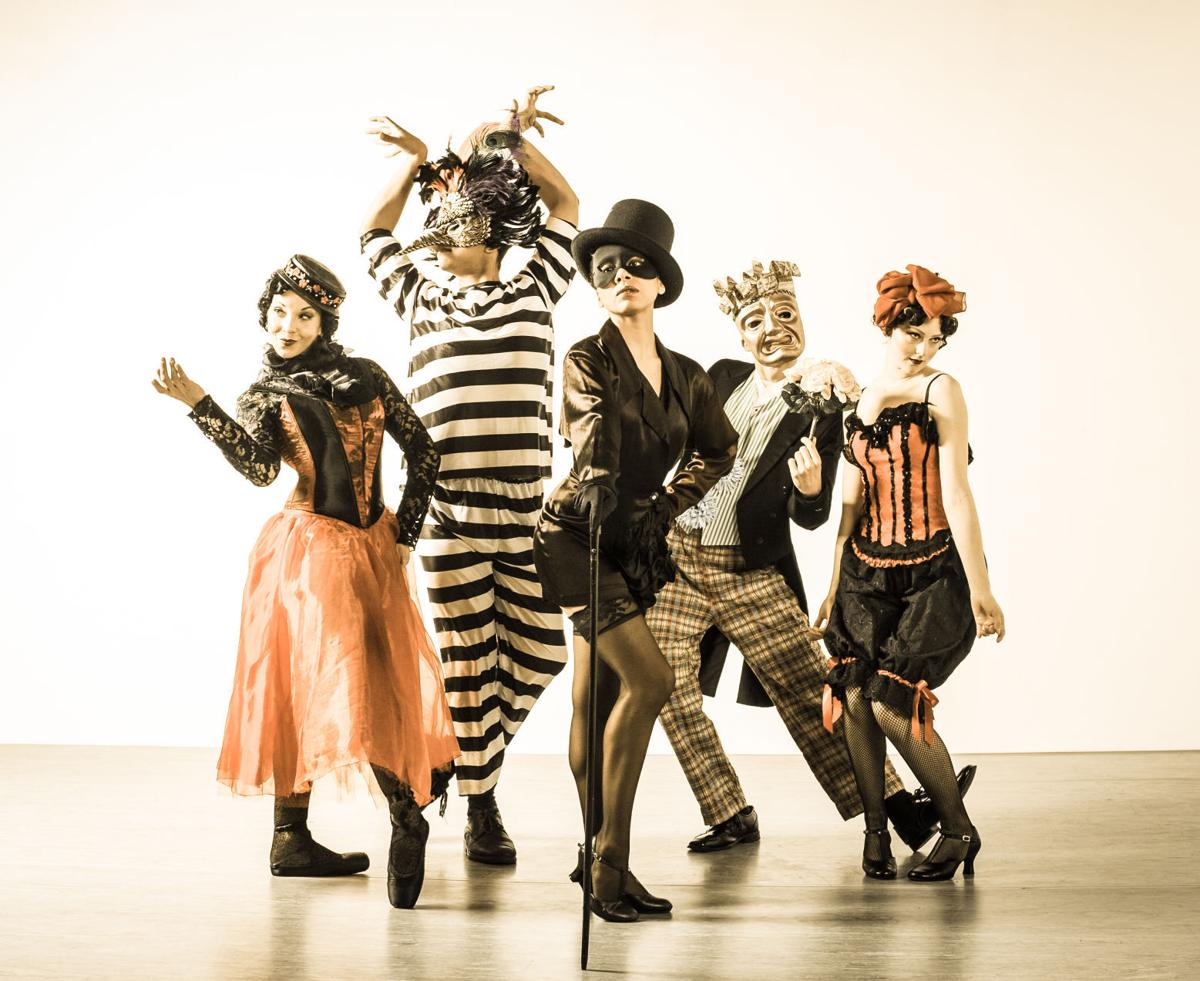
Diving headfirst into America’s vaudeville past, Artifact Dance Project couldn’t resist fitting this weekend’s “The Grand Parlor” into the performance space of the downtown Scottish Rite Cathedral.
“This is the cathedral’s 100th year, so we wanted to observe it by presenting styles of vaudeville popular in 1915,” said Claire Hancock, Artifact’s co-founder with Ashley Bowman.
Bowman and Hancock have always had a soft spot for early 20th century entertainment. As a brand new company they twice toured China with their “Great American Dance Tour,” a kind of short history of vaudeville hoofers. That went so well they created “Speakeasy,” a feature-length dance with spoken word segments set in New York during the Prohibition Era.
“It was after the Civil War that American vaudeville began to explode,” said Bowman. “There was lots we could draw from for ‘The Grand Parlor.’ ”
“American vaudeville, as opposed to British vaudeville, had a lot of singing, acting and dancing,” said Bowman. “We won’t have any singing, but we will have lots and lots of dancing.”
“And comedy, and parody,” added Hancock.
“And music,” Bowman replied.
Music director Ben Nisbet has selected pieces from the standard classical repertoire. The musicians are Derek Granger, reeds; Ken Marrs, bass; Paul Gibson, percussion; Mary Turcotte, piano, and Samantha Bounkeua, violin.
ADP never performs without live music. Among the composers represented are Sergei Rachmaninov, Claude Debussy, Franz Schubert and Gioachino Rossini.
“There is also one song from Gershwin, ‘Fascinatin’ Rhythm’,” said Hancock.
“All of the vaudeville acts — strong men, magicians, jugglers, clowns, a contortionist and others — are represented by dancers,” Bowman explained. “Everything is communicated through dance, and each of the pieces is relatively short. The whole show runs about 90 minutes.”
“There is a main character, too, our Mistress of Ceremonies, who is Cindy Cantos. She’s a senior member of the company,” said Bowman. “She has a solo to open the show, and then she introduces each of the pieces, always through dance.”
In preparing this program, the fascination that Bowman, Hancock and Nisbet have for early pop culture in the 20th century took top priority once they picked the downtown Scottish Rite Cathedral as their performance venue.
“Now that we have our downtown studio (17 E. Toole Ave.), we want to be identified with downtown,” said Hancock. “We want to be performing downtown.”
“So for us, it was this space that dictated the Grand Parlor program,” Hancock continued. “Our show is straight out of 1915. So is the style and architecture of this building.”
With those parameters in mind, the three sat around a table together to let their dance ideas percolate. First came the music for some of the larger pieces.
“Claire will dance ‘The Dying Swan’ in a recreation of the performance by Anna Pavlova,” Hancock said. The music is from Saint-Saëns’ “Carnival of the Animals: The Swan.”
Another tribute to dancers of the period is “The Isadorables,” a set about six women, in the style of Isadora Duncan, to music by Franz Schubert.
It features contortionist Hannah Farrell.
“She does a lot of gymnastics,” said Hancock.
“She is very flexible,” said Bowman.

