


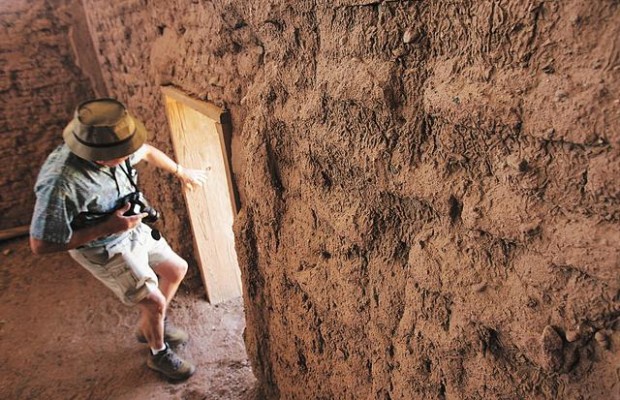
RIO RICO — Carmen Friedman stepped two-and-a-half centuries into the past, peered at a crumbling adobe wall and found a faint sign of faith.
"I wonder if this might have been a niche for saints — a little prayer corner," said Friedman as she pointed out a hollow in the wall. "Very interesting!"
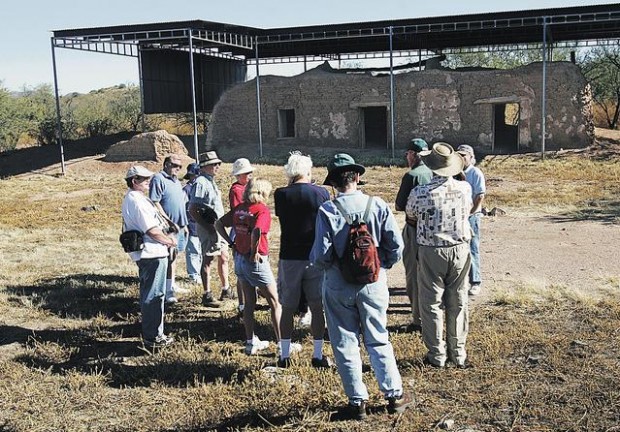
The site was historic Mission San Cayetano de Calabazas, perched on a low hill near Rio Rico about 55 miles south of Tucson. Friedman, of Green Valley, and a dozen other visitors recently took part in a rare tour of the church ruins, which are normally closed to the public.
The National Park Service, which manages the site as part of Tumacácori National Historical Park, will conduct once-a-month public tours of the mission site through March. The next tour will be Dec. 13. (See the accompanying box for details.)
"Just because this is a sleepy old place baking away in the sun doesn't mean important things didn't happen here," said Grant Hilden, a volunteer guide for the Park Service.
Hilden led the visitors on a short hike to the site and sketched its history, which dates to about 1760.
"The structure was put up in the 1760s and is typical of the structures built by Jesuit missionaries," Hilden said. "It's made of adobe, and it was long, narrow, high and flat."
The mission — located in an area occupied by Pima, or O'odham, Indians — apparently was a functioning church by 1773. It was abandoned in the 1780s when Pimas left the area after repeated raids and conflicts with Apaches.
The site later served as a ranch house, Customs house and squatters' dwelling.
Calabazas, which means "squash" or "gourds" in Spanish, became a part of the Tumacácori National Historical Park in 1990. The centerpiece of the park is the well-preserved Tumacácori Mission near Tubac.
Today, Calabazas is protected by a metal ramada and a locked razor-wire fence — and it's accessible to the public only on infrequent tours conducted by the Park Service.
"I'm just fascinated with the history of the Spanish missions. It's amazing to see these old ruins out here in the desert," said Brian Hembacher, a visitor from California who participated in the recent tour.
On a short walk to the mission site, members of the tour group had a surprise encounter with a "visitor" from long ago.
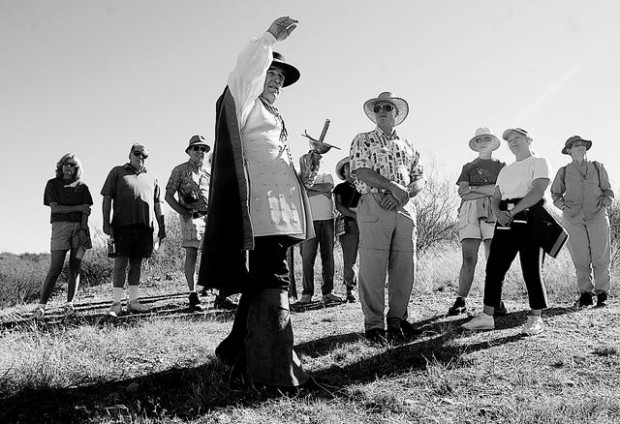
"My name is Juan Bautista de Anza!" bellowed a man in full period costume who strode up to the group during a rest stop.
De Anza — a soldier and trailblazer of the mission era, portrayed by Park Service historian Don Garate — proceeded to warn the group that they were vulnerable without horses and could be attacked by raiding Indians.
"What are you doing here?" he demanded of the group — playing his tough-guy role to the hilt as part of a "living history" element of the tour.
"We're going to buy this land and put up Rio Rico!" came a humorous reply from tour participant Sig Friedman.
After bidding farewell to time-traveler de Anza, Hilden led the group through the mission site and shared some details of life there long ago. Among them:
● Missionaries and Indians probably relied on the nearby Santa Cruz River for water — and grew corn, squash and beans for food.
● The adobe walls of the mission were finished with lime plaster. Much of it has weathered away over the years, but some patches of original plaster remain.
● The church probably served as a center of community life, with some people coming to the site almost daily for religious instruction and prayers.
Tour participants had varying reasons for seeking the experience.
"I see it as a good orientation to the Southwest in general," said Alice Prall, who had lived in Hawaii for 10 years before moving to Green Valley.
Said participant Jerrie Ford: "I'm interested in the Spanish influence on the Indians. So, historically, this is a very interesting place for me."
Visit the mission
What: Public tours of Mission San Cayetano de Calabazas in the Rio Rico area south of Tucson.
When: 9 a.m.-noon Dec. 13, Jan. 17, Feb. 14 and March 14.
Meeting place: Tours begin at the visitor center of Tumacácori National Historical Park. From Tucson, drive south on Interstate 19 about 45 miles and take Exit 29 to reach the park.
Cost: $10 per person.
Reservations and information: 1-520-398-2341.

