


A vampire, a beatnik and some gospel dancers walk into a bar, sit down with some friends remembering the liberation of the Jews at Auschwitz and decide to stage a dance concert. Other dancers join them to complete the program for this season’s showcase “Spring Collection” by the University of Arizona School of Dance, opening Friday in the Stevie Eller Dance Theatre on campus.
The students will perform choreography from dance faculty members James Clouser, Sam Watson, Michael Williams, Amy Ernst, Elizabeth George-Fesch and Tamara Dyke-Compton.
“We don’t really say he’s a vampire, but there is a mystery that’s never explained,” said Clouser, smiling. “There’s also a zombie.”
Clouser’s piece is a new one titled “The Visit,” set to the music of Dmitri Shostakovich. It tells the story of a mysterious ballet master who visits this particular studio late one evening to audition ballerinas for his company Ballets of the Night.
“Actually, the story plays off the fact that dancers will do anything to get a job,” Clouser adds wryly.
Watson found the music for his dance, “Badum Boom,” in an old box of records at a yard sale in the 1980s.
“It’s a seven-minute percussion piece taken from the longer ‘Savage Drum Fantasy,’ recorded in 1958 by Richard Campbell and Harry Coon,” said Watson. “The dance has become one of my signature works.”
“Badum Boom” doesn’t have a story exactly, but is more of an implied journey that evolves continuously from primitive rhythms at the beginning to a final frenzy at the end for four men and six women.
“I wanted to include all the trademarks of jazz dance from the 1950s,” said Watson. “As the piece gets faster and faster, it becomes very athletic.”
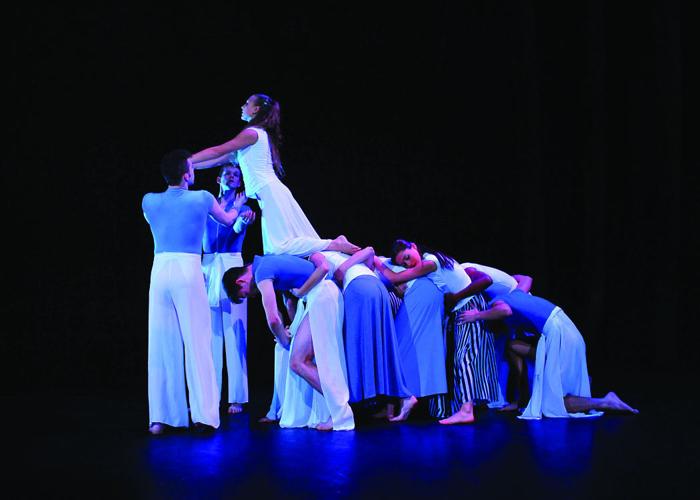
The gospel dancers are in Williams’ celebratory “Rising,” also new, which combines the music of Andra Day’s recording of“Rise Up” with “Fly Again” by the group Sounds of Blackness featuring Jamecia Bennett.
“To my mind, there’s a strong gospel feeling to it, but there’s no mention of God or Jesus in it,” said Williams. “The spirit of the piece is to overcome obstacles, to be rising up and moving forward. I just feel such a sincere, deep connection with that music.
“And the dancers, 26 of them, are all in white, which I’ve never done before, either.”
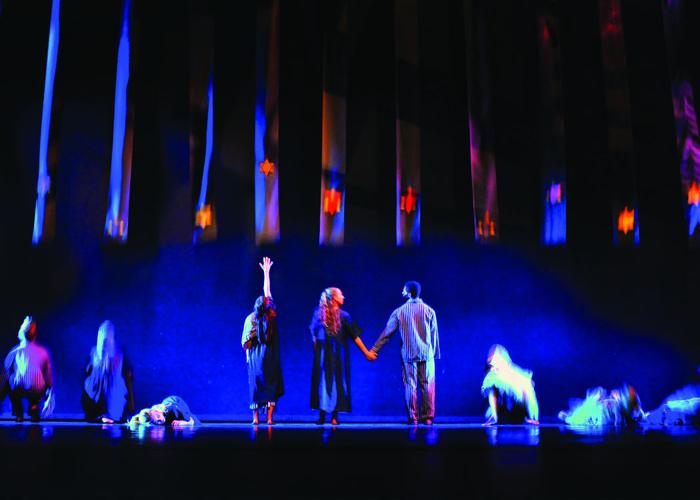
Ernst is back to reprise her well-received piece from last spring’s concert, “In the Shadow of the Dreamers,” commemorating the 70th year of remembrance marking the liberation of Auschwitz.
“This dance isn’t about the liberation specifically, but touches on the emotional aspects of it,” Ernst explained, choosing for her music the haunting “Five Hebrew Love Songs” by Eric Whitacre, composed for five poems a wife wrote to her husband.
“We were hearing about a lot of community interest in the piece,” said Ernst. “Many wished they had seen it last spring.”
Program notes describe this 12-minute piece for 12 dancers as “capturing moments separating dream from reality, despair from hope.”
“I have changed it some, refined it,” said Ernst. “And a lot of the dancers are new from last year.”
Completing the program are “Woven,” a dance en pointe by George-Fesch, and “Pathways,” a jazz dance by Dyke-Compton.

