


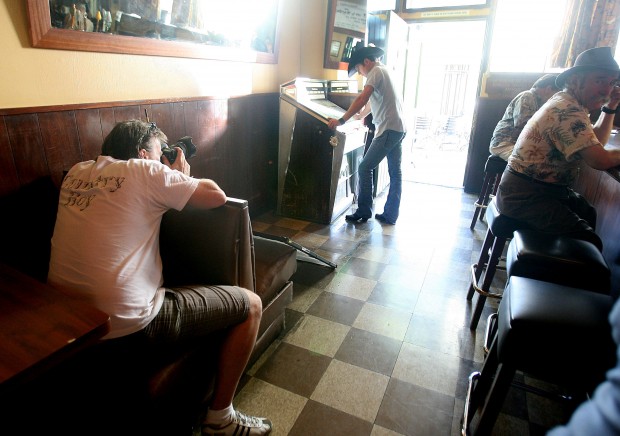
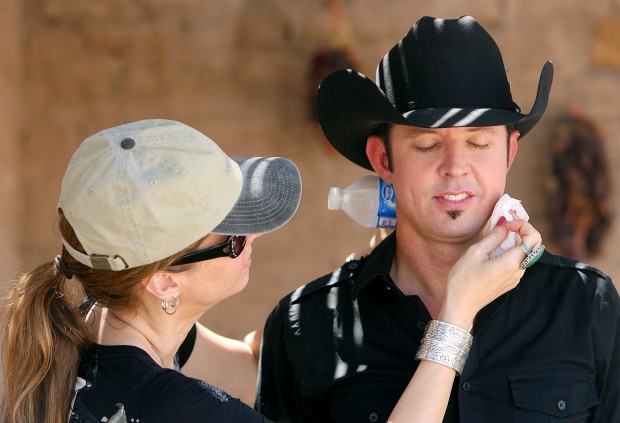
Troy Olsen sits on a stool in Tucson Electric Park's makeshift green room, fielding a reporter's questions as a photographer clicks away. His manager huddles across the room with a rep from his record label.
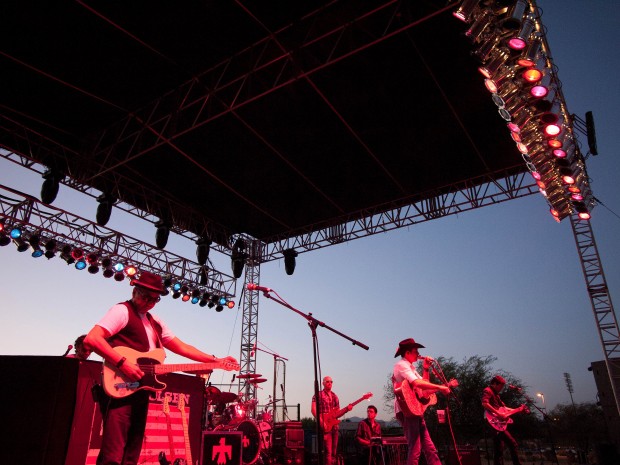
Outside on the sprawling practice fields, 8,000 fans restlessly wait for him to take the stage.
"I wouldn't even know how to dream this," the country singer-songwriter says with a smile that's equal parts joy, relief and disbelief.
He finds himself saying that over and over that day, to friends, fans and strangers who congratulate him on the sudden turn his hard-fought country music career has taken in the last nine months.
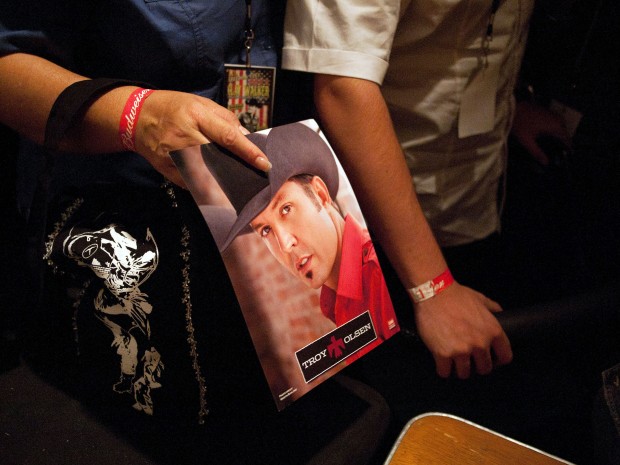
Last November, Olsen became the first Southern Arizona country singer in a quarter-century to land a major-label recording deal when he signed with EMI Nashville, a Capitol Records imprint.
By summer, his first single was spinning on country radio coast to coast. His debut album is set for release on Oct. 5, and Olsen, 37, is crisscrossing the nation playing small clubs, festivals and honky-tonks to introduce himself.
On this early July day, no introductions are necessary. He will stand before a hometown crowd at the KIIM-FM Freedom Fest. The headliner is Clay Walker, but this is all about Olsen. It is his first Tucson concert in five years. For the audience and Olsen, this is a homecoming celebration.
But it's also one more city, one more day, one more scene unfurling in Olsen's dream.
"This is it. This is what I've been waiting for," he says.
The journey begins
Olsen's parents gave him his first guitar when he was 12. He learned to play by mimicking country artists he heard on the radio - Steve Earle, Dwight Yoakam, Buck Owens - during branding roundups on his dad's and granddad's cattle ranches in Duncan, a small town near the New Mexico border.
"I can remember when he came out to the ranch, and about the only song he knew was '(Ghost) Riders in the Sky,' " cousin Cole Young recalls. "He was good. He was kind of a natural at it."
"I told him learning guitar, that's something you can do for the rest of your life," says his dad, Ted. "I didn't know he was going to stay up all night long with the neighbor boys. I'd run them out of the bedroom at midnight."
After graduating from Marana High School, he and some buddies from those jam sessions formed a band and hired themselves out for weekend gigs at $50 or $100 a pop. He played golf for Pima Community College and took classes, but college wasn't his thing. So he focused instead on writing songs. He knew that the key to making it was to perform his own songs, not to cover others.
In 1995, when he was 22 years old, he decided to make music his full-time job. Within two years, he had landed the coveted house-band gig at the Maverick, a honky-tonk that had broken in dozens of country singers before him. He stayed on through 1998, building a local reputation for high-energy shows five nights a week.
"In the intermission, he would go down and talk with everybody," recalls Valarie Maldonado, who first caught Olsen at a Maverick show in 1998. "He was so personable and down to earth."
"You don't get too many people (who have) a good voice and have personality," adds former Maverick owner Mo Farhang, who hired Olsen. "He can talk on the stage. The guy's good."
On his nights off, Olsen played gigs in the Phoenix area and in towns across Arizona and New Mexico. He opened for national artists in Tucson and built a respectable career playing at conventions and other corporate gigs.
While his friends were starting families, Olsen was singing and writing.
"I really don't have a choice. This is what I do," says Olsen, whose four-year marriage recently ended in divorce.
"It was tough," he says of the relationship, which started and ended in Nashville. "We didn't have any money. It seemed like everything was on the line at all times, and it was stressful. I wasn't exactly emotionally there for her, because I was too wrapped up in trying to get this career off the ground, really."
Nashville calling
Olsen landed a songwriting deal with Windswept Publishing after fellow Tucsonan Linda Ronstadt heard him in a Tucson studio. He traveled to Nashville for writing sessions and had a few nibbles from artists interested in recording his music, but nothing panned out. So he decided to try his hand at recording an album.
He turned to Jeb Schoonover, a longtime roots music promoter, who released Olsen's debut indie album, "Living in Your World," on his Honky-Tonk Hacienda label. The album's 10 original songs hinted at Olsen's potential as a writer.
"One of the things that impressed me was he knew exactly what he wanted to sound like and exactly how he wanted his music to reflect him," says fellow Tucson singer-songwriter John Coinman, who wrote with Olsen on that album. "We would sit down and he would have an idea, or I would have an idea, and we would make it fit to his musical identity. He wouldn't compromise, which I really liked very much."
"He was really formulating his sound, which he said was a mixture of Dwight Yoakam and BR549," recalls Schoonover, who also managed Olsen at the time. "He was really emulating the kind of modern guys who like the traditional sounds.
"That first record really got a lot of acclaim," Schoonover adds. "We got written up in Country Weekly magazine. No Depression "magazine" also wrote about him. He really had the potential to cross over into the commercial world, and that first album really shows that," Schoonover said.
Buoyed by the excitement, Olsen took the plunge and moved to Nashville in 2002. He figured he would play a few "showcases" - concerts for record-label executives that are more like auditions - and wait for an offer.
None came.
"I was rejected by almost every label in Nashville, some of them three or four times," he says.
Every time, Olsen would retrench and write a few more songs.
Each pitch ended with "I'm sorry."
"There were times it was a drag," Olsen says. "I would take stock: 'What am I doing here?' "
In 2004, he recorded his second CD, titled "Troy Olsen," at Nashville's Blackbird Studios. He knocked on the same doors and got the same heartbreaking responses.
"There's been so many close calls of Troy almost getting signed," says longtime friend and songwriting buddy Teddy Morgan, who met Olsen through Schoonover in Tucson in 2000. He remembers thinking, "Eventually he's going to be signed. It might take awhile, but someone would be a fool not to take a chance on him."
Olsen was not so sure.
"I was so unsatisfied with what I was doing for so long. I focused on what was wrong with it, not what was right with it," he says. "That's not a fun way to live your life, when you're always focused on the negative aspects of what you're doing."
So five years ago, he put his singing career on hold and focused solely on his songwriting. He teamed up with other writers from Nashville's thriving songwriting community and drew deeply from his Western heritage for songs about finding and losing love, and wandering the West of his youth.
His writing got stronger, says his manager and longtime publisher, Rusty Gaston.
"It's just great stuff. It's got a commercial pitch to it, but at the same time it's got a lot of feeling of the Southwest, Tucson and New Mexico," Coinman says. "I think that's really important for him to not lose that identity."
"I finally got good at what I was doing," Olsen said. "And once I started getting command of what I was doing and could steer the songs where I wanted them to go, that's when it started getting dangerous."
The big break
Olsen caught his big-time break in 2008 when Blake Shelton cut his ballad "I'll Just Hold On." The song slowly climbed the chart, reaching No. 6 after nearly 40 weeks.
The royalties - paid whenever a radio station plays the song - let Olsen pay off his credit card debts and his Toyota 4Runner loan, he says.
Then Tim McGraw picked up Olsen's "Ghost Town Train" for his 2009 album, "Southern Voice."
Gaston, his manager, believed the time had come for Olsen to put himself in front of the labels again.
"He shopped record deals before, but the music wasn't right," Gaston says. "The music now is great."
Because of Olsen's songwriting success with the song Shelton recorded, as well as the McGraw coup, it wasn't hard filling the room with record execs last November.
"I had been here long enough - for seven years - and had enough stature that we had every label head in the room, which is nearly impossible to do," he says.
By several accounts, the showcase was awe-inspiring.
"People were like: 'Oh, my gosh! That's the best showcase I've seen - ever.' And we go to those things pretty much two, three times a week," says Trisha McClanahan, who signed on to co-manage Olsen with Gaston.
"He really had a fully entertaining, awesome showcase," says McClanahan, whose previous clients include Reba McEntire and Kelly Clarkson.
The phone started ringing the next day. The only call Olsen rushed to answer was from Capitol Nashville CEO Mike Dungan, whose successes include breaking out Lady Antebellum, Keith Urban and Luke Bryan. Dungan didn't want any bidding wars with other labels, so he offered Olsen a unique opportunity: be the flagship artist on Capitol's upstart sister label, EMI Nashville, complete with his own marketing team.
There was more: Olsen would have creative control in the studio.
"They're just committed to breaking acts. They know what they're doing," Olsen says. "I could not be luckier, and to put me on my own label and to have my own promo staff and to move this quickly and let me produce the record - all of this stuff has been amazing. I wouldn't have even known to dream it."
Back to that wildest dream
Olsen looks out into the KIIM-FM Freedom Fest audience on that July 3 afternoon.
"It feels so good to be home - I can't tell you," he says above the roar of applause. "I've been on the road 10 weeks straight, all over this damn country, and I can tell you, there's no place like Tucson."
EMI regional rep Ron Bradley stands next to the stage and looks out into the crowd.
"Amazing," he mouths to Gaston. "Next year we're going to headline this thing."
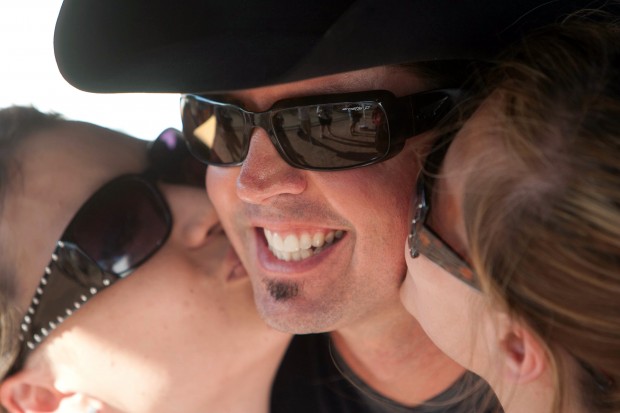
Olsen recognizes dozens of faces in the audience, old friends from school such as Corina Pargas, who had never seen Olsen perform before that night. There's also Jesus Lopez, a 19-year-old from Sahuarita who has been attending Olsen's concerts and following his career since he was 9.
Jeff Schulz, who played golf with Olsen at Pima College, drove down from Scottsdale.
"We kind of had a little bet, he and I, to see if he would make it first in the music business or if I would make it first in golf," says Schulz, who now works construction. "I think he won."
Young, Olsen's cousin, drove in from New Mexico.
"He is kind of big time now, I guess," Young says. "I always thought it would happen - but to see it happen! A lot of people would've given up, I think. But he stuck to it. There were a few times when he thought about coming back to Tucson, where he had a name. But he stuck it out."
Back in the green room, Olsen sits up straight and smiles.
"Just the fact that I got a record deal at this age in a Taylor Swift world just is amazing," he confides with a laugh. "And it makes me proud. It's the music that did it, my songs. I consider myself a songwriter first, and my songs got me this deal.
"You know, this is a game changer. This is the dream of all dreams."
On StarNet: To see more Troy Olsen photos by Star photographers, go to azstarnet.com/gallery

