


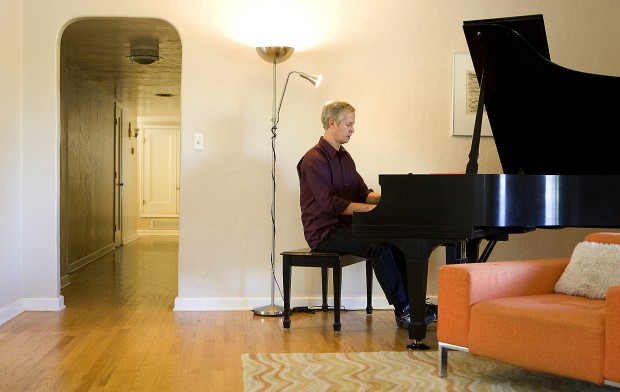
There's little wiggle room for mistakes with Mozart's 21st Piano Concerto. Which could explain why George Hanson has been working on the piece since last February - a good eight months before he will perform it to open the Tucson Symphony Orchestra's 82nd season tonight.
"Mozart's kind of strange because it's not as many notes as Rachmaninoff's Second Piano Concerto, but in some ways it's harder," Hanson said one recent morning, sitting at the 7-foot Steinway baby grand piano that takes up half his living room. "It requires more clarity. If there's even the slightest bobble, you can't fake it."
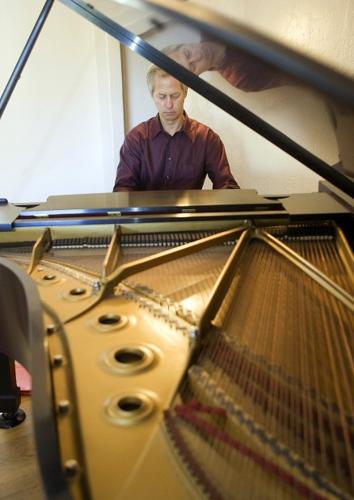
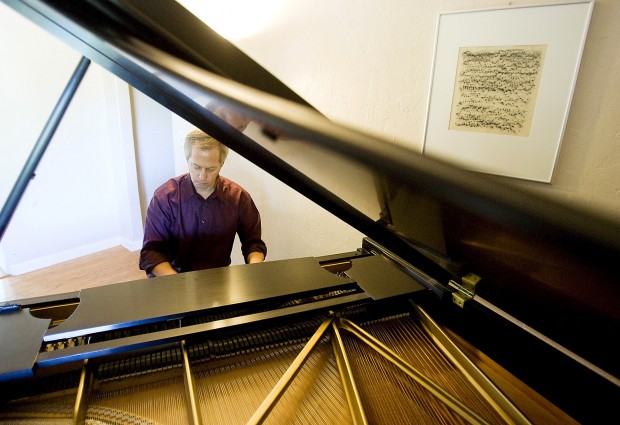
Hanson danced his fingers over the keys and gently played the quiet march of the opening movement while the metronome on his iPhone pong-ponged the timing. Gradually, Hanson's strokes grew more forceful to match the growing tempo, and the sound of the piano filled the room and spilled out into the University of Arizona-area neighborhood through the open front door.
Hanson's eyes were trained mostly on his hands as he played the piece from memory.
He will perform the concerto in concerts tonight and Sunday as he opens his 15th season as the TSO's music director and conductor. This is his third TSO concerto performance; the two earlier ones - in 2006 and 2008 - also were Mozart works.
"He is well-suited for conducting from the piano," Hanson explained during a break in rehearsing. "That's the way Mozart always envisioned it would be done. He never imagined an orchestra with 16 violinists."
Hanson confessed that while he's a classically trained pianist, he has to work at the physical act of making music. "Conductors don't make music," he said, "They guide it."
Doing the concerto allows him to retrain those muscles, but, more than anything, it puts him on an equal plane with the musicians he leads.
"The real purpose is to bring the audiences, the orchestra and me together," he said. "I'm reminded of how much I admire the work these musicians do daily."
In this weekend's performances, Hanson has the advantage of having performed the concerto before an audience. Early this month, he returned to his alma mater, Concordia College in Minnesota, for a performance with the college orchestra. His father conducted.
"I can play this thing 10 times without missing a single note, but that changes when you have 2,000 people looking at you and the orchestra," he said. "Regardless of what level you're at, you have to get used to playing under pressure."
Hanson has paired the Mozart with Beethoven's "Eroica" Symphony, which bridged Mozart's Classical era with Beethoven's Romantic. The symphony was unprecedented when Beethoven composed it in 1804-05, largely because of its defining nods to the Romantic style that came to dominate music in the 19th century.
This weekend's concerts also mark the TSO debuts of three new principal players - Lillian Copeland on oboe, David Morgan on tuba and Laura Stoutenborough on clarinet - and violinist Diane Zelickman.
If you go
Tucson Symphony Orchestra: Beethoven's "Eroica" & Mozart
• Featuring: Music director George Hanson on piano.
• When: 8 p.m. today and 2 p.m. Sunday.
• Where: Tucson Music Hall, 260 S. Church Ave.
• Tickets: $23 to $78 by calling 882-8585; online at www.tucsonsymphony.org.
• Program:
Mozart's Concerto for Piano No. 21 in C major
Beethoven's Symphony No. 3 in E-flat major, "Eroica"
• Et cetera: See review in Sunday's Vamos section.
Did you know
Early in his career George Hanson was an assistant to Leonard Bernstein, and like Bernstein, he turned to Mozart when it came time to perform a concerto with his orchestra. Hanson will tackle Mozart's 21 this weekend. He did the 23rd in 2006 and the 17th in 2008.
Contact reporter Cathalena E. Burch at cburch@azstarnet.com or 573-4642.

