


On a stage painted in blue light, with plumes of smoke drifting above, Trans-Siberian Orchestra pianist Vitalij Kuprij softly played the opening strains of the Overture to “Beethoven’s Last Night.”
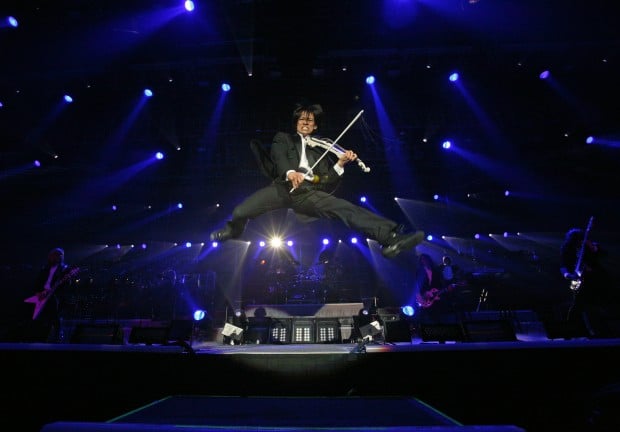
Just as he pulled his fingers off the keyboard, a trio of Trans-Sib guitarists interrupted the quiet with thrashing rock strains augmented by furious percussive blasts, a blistering electric violin and fantastic laser lights spitting out into the audience that loosely filled the dramatically-reconfigured Tucson Arena Thursday night.
It was a rock show with fireballs shooting in the air and laser lights piercing the darkness; a symphony concert on steroids; and muscular musical theater for the adrenaline junkie. Or, as Trans-Sib founder and composer Paul O’Neill likes to call it, theater rock.
In its first Tucson appearance in eight years, Trans-Siberian Orchestra performed its 2000 concept album “Beethoven’s Last Night” cover to cover. The 2 1/2-hour show follows the famous composer on his final night as he bargains with the devil to save his soul from going to hell and his music from disappearing from mankind altogether.
Bryan Hicks, a superb actor and enthralling orator, narrated the story in dramatic rhyming pentameter. After each segment, he would slip to the back of the giant stage, which had three towering arched windows with videos screens projecting scenes of a stormy night and videos depicting flashes of Beethoven’s life.
Each time Hicks left the stage, the band would lite into thundering prog-rock inspired by the works of Beethoven and Mozart — composers who in their day were regarded in the same manner that we regard today’s rock stars. Suggestions of Beethoven’s Moonlight Sonata, and Fifth and Ninth symphonies were evident in the Overture, which also had passing gestures to Mozart’s solemn Requiem. The Requiem and the Fifth Symphony returned in rocked-out incarnations midway into the night. There also was 21st century reimaginations of “Für Elise” and Rimsky-Korsakov’s “Flight of the Bumblebee,” featuring a pulse-pounding performance by pre-eminent rock violinist Roddy Chong. (Fans of country music might have seen him on the road with Shania Twain or Kevin Costner and Modern West in recent years.)
Chong led a chamber-sized group of Tucson string players who may not have been able to match Chong’s energy but surely matched his enthusiasm. One young violinist bopped her head like a rocker throughout the night.
She wasn’t alone. Head banging and hair flipping ala 1980s arena rockers were signature moves for the long-haired guitarists and the five female singers, dressed in tight-fitting, low-slinging thigh-high black dresses.
Other notable performances included Broadway veteran Rob Evan in the role of Beethoven; powerfully voiced metal rocker Ronny Munroe as Mephistopheles; and Chloe Lowery as Beethoven’s longtime love Theresa.
At the end of the concert, Trans-Siberian Orchestra vocalist Kayla Reeves delivered an unforgettable performance of the band’s heartbreaking ballad “Someday” from their forthcoming rock musical “Gutter Ballet And The New York City Blues Express” followed by the blistering rocker “Child Unseen.”
The full ensemble closed the night with a rocked-out rendition of “O Fortuna” from Carl Orff’s “Carmina Burana,” complete with flames shooting hot from the stage.
Just shy of 2,500 people attended Thursday’s concert, leaving about 1,000 seats of the arena empty. Two-thirds of the arena was shut off because of Trans-Sib’s stage, which took up a good third of the floor. The arena can seat as many as 9,275.

