


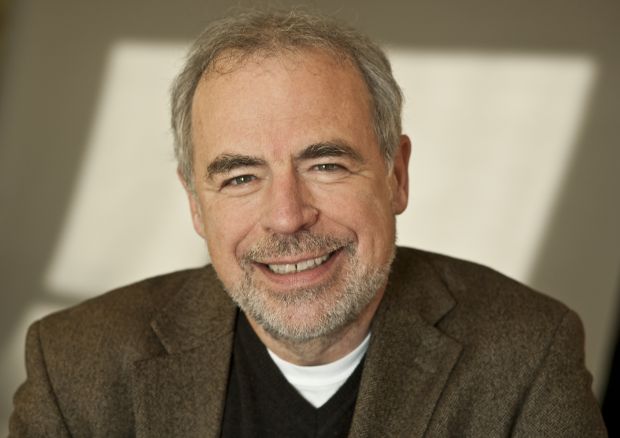
Richard Russo writes everyman stories.
Gloversville in upstate New York, where he grew up, is the inspiration for his working-class communities left blighted after the major industry or economic driver has fled or dried up. Russo weaves with humor and heart the stories of the hardscrabble lives of the interesting, albeit flawed, characters that populate his small towns.
The multilayered, richly detailed tale of one such town, “Empire Falls,” won the 2002 Pulitzer Prize for Fiction.
Russo will add another award to his trophy case when he receives the Tucson Festival of Books Founders Award, which recognizes the lifetime achievement of an outstanding festival participant, at the March 14 Author’s Table dinner. He will also participate in three presentations during the March 15-16 event that is expected to attract an estimated 120,000 participants to the University of Arizona campus.
He probably won’t need directions to the UA Modern Languages Building for his session on the impact of Charles Dickens. Russo spent almost 15 years at UA, earning a bachelor’s in English and then a Ph.D. in American literature in 1980 and a master’s of fine arts in creative writing in 1981. He splits his time now between homes in coastal Maine and Boston.
After leaving the UA, he taught fiction at the Southern Illinois University at Carbondale and creative writing at Colby College in Waterville, Md. Russo wrote his first book, “Mohawk,” while teaching, and gave up the classroom for full-time writing after “Straight Man,” a novel about academic politics in the English department of a small college in rural Pennsylvania. (Bet you can figure out his inspiration.)
“Nobody’s Fool” was made into a film starring Paul Newman, who received an Oscar nomination for his role as ne’er-do-well “Sully” Sullivan.
Russo deviated from his novelist path a few years ago and ventured into nonfiction, writing a memoir, “Elsewhere,” about life with his parents in upstate New York and the relationship with his mother.
Several critics said Russo paid tribute to the ink-and-paper book in the digital age with “Interventions: A Novella & Three Stories,” illustrated by his daughter, Kate. The four individually bound volumes are in a slipcase and not available in electronic format.
Then he turned around and gave techies a tidbit. You won’t find his latest, “Nate in Venice,” in bookstores. You can read it only on an e-reader.
Russo is now traveling another literary road he hasn’t taken before, writing a new book called “Everybody’s Fool,” that is a sequel to “Nobody’s Fool.”
“First time I’ve done that,” he says. “Too soon to tell if it’s a good idea or, well, foolish.”
Russo broke away from writing “Everybody’s Fool,” to respond to our questions by email.
What are your feelings about receiving the Founders Award?
“Well, of course, (former Founders Award recipients) Elmore Leonard and Larry McMurtry are particular heroes of mine. I had the chance to meet both in Tucson a couple of years ago at my first festival.
“Sometimes people tell me they’re nervous meeting me, a famous author, and I always try to reassure them by saying there’s no need to be. But meeting the author of ‘Lonesome Dove’ and ‘Horseman, Pass By,’ I was barely able to speak, to tell him who I was and how many hours (weeks? months?) of pleasure his books have given me, after which I bolted before I suffered a nervous breakdown.
“So the Founders Award puts me in excellent company, for which I’m very grateful. And to receive a literary award in Tucson is especially gratifying. I learned to be a writer there, and it remains a special place for that reason.”
How (or has) winning the Pulitzer Prize changed things for you? Do you feel “Empire Falls” was/is your greatest literary achievement?
“More than anything, winning the Pulitzer has made me want to be worthy of it. The year ‘Empire Falls’ won the prize it could have gone to a couple dozen other novels that were every bit as worthy, which means you have to be lucky.
“Is it my ‘finest literary achievement?’ I don’t know. Writers are notoriously bad at judging their own work. My affection for the book has more to do with the people in it. I wrote it when my daughters were young and I was coming to understand that there were things going on in their lives that they’d never tell me about, just as I never let on to my parents when I was troubled. The world can be cruel, and it might be cruel to them, and there’d be no way for me to protect them, as Miles learned when he tries to protect his beloved daughter Tick.
“I like all those people a lot, and it was a fine four years I spent listening to them tell me all about themselves. They broke my heart and made me laugh. That’s the achievement, I think.”
Is there a panel in which you are most interested in participating?
“The panels all look interesting, but I’m very excited to be in conversation with Luis Alberto Urrea, who’s become a good friend and who I admire both as a writer and as a human being. Actually, as a favor to the audience, I think I’ll just let him do the talking.”
Tell us about your views on hard copy vs. electronic books. How you made the decision to make a book print-only or only electronic. Also, your views on bookstores and their future.
“Actually, ‘Interventions’ was sold online. There was just no electronic version. The reason was that my daughter and I thought of it as an art book, a beautiful object that simply didn’t translate into ones and zeroes.
“I don’t have anything against e-books. I have a reader and use it a lot, especially when I travel. And I had a very good experience publishing ‘Nate in Venice’ at Byliner, a digital magazine. Its novella length would’ve made it a tough sell at the magazines. I’ll probably use it to anchor a collection of short fiction, sometime, so it will probably have a second life on the printed page.
“I’m cautiously optimistic about independent bookstores. Those that have survived everything thrown at them over the last few decades (chain stores in malls, big-box stores, and now Amazon) have come out of the experience leaner and stronger, and they’re teaching another generation of booksellers how it’s done.
“The threat posed by Amazon is real, but it’s part of something much larger than just books. We all buy things online from time to time, and we congratulate ourselves that we saved a couple bucks. But as physical stores disappear — stores that employed our friends and neighbors and paid taxes that funded our schools and repaired our roads — the true costs of shopping online are beginning to reveal themselves.
“I just hope Joni Mitchell’s wrong when she says, ‘You don’t know what you’ve got ’til it’s gone.’”

