

As a Chicana girl growing up in East Los Angeles, it was hard for young Estella González to envision herself becoming an author. She grew up devouring books from the public library, and always did well in writing, but a lack for representation made her dream just that, a dream.
She never thought of it as a realistic way to make a living, but it was always something that was in the back of her head.
“I think I was kind of lucky to grow up in East LA because in the public library there was a Chicano resource center, and they actually had books by Chicano writers there,” González says. “It was mainly male, that’s true, but at least I could say to myself, ‘maybe one of my books will be on the shelves one day.”
She took this sliver of representation, along with the one she found in school when she was assigned to read a book by Jane Austen — the only woman author explored in her English class in a sea of “dead white men,” as she calls them.
Putting the two together, it didn’t seem like such a farfetched dream for a Chicana girl to succeed as a writer, she thought.
But there was one more obstacle, this one greater than the lack of representation, and that was having immigrant parents. Her mother was from Chihuahua and her father from Jalisco, Mexico.
It’s hard to justify becoming an author to parents who up gave a lot for their children to give them a better opportunity in life than the one they got.
“They would ask me, ‘how are you gonna make money with that?’” González says. “And I said, ‘I don’t know. I’ll figure it out.’”
And so, she did.

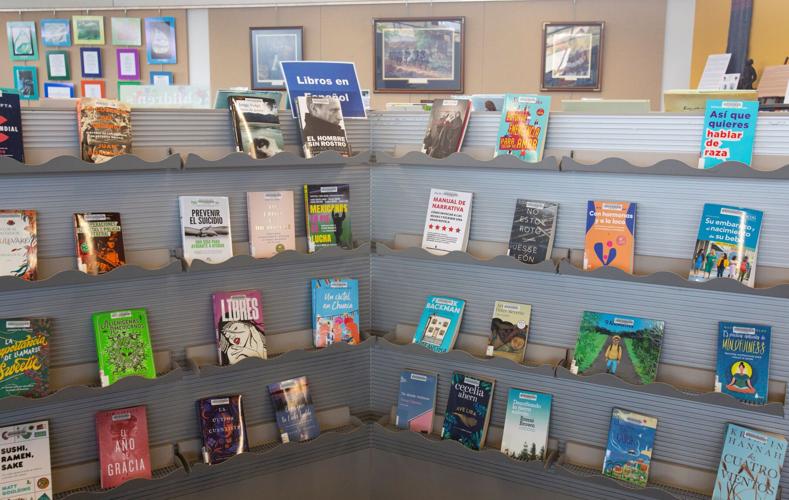
Quincie Douglas Library has an offering of Spanish-language books. It was at a public library in East LA where González first saw books by Chicano writers.
Breaking in to the industry
She received her bachelor’s degree in English from Northwestern University and after that took some jobs that were “writing adjacent.” She worked in marketing and later as a reporter, but it wasn’t until sometime in the 1990s when she was living in Tucson, that she decided to give creative writing a shot.
González started by taking some fiction writing classes at Pima Community College and submitting work to literary journals before going out of state to obtain her master’s in fine arts in fiction from Cornell University.
It was a different time then than it is now. There are, of course, still many hurdles as a woman of color becoming a writer, but in the ‘90s it was much worse.
During workshops, students in her class would tell her they couldn’t understand or relate to her work because it was mainly focused on her Chicana existence and sometimes used words in Spanish.
“I think as a reader and writer, you must be open to all different cultures, but there’s resistance,” González says. “There’s always been that resistance from some English readers that say, ‘well, I can’t relate.’ Well, I still related to Shakespeare. I love his poetry and his plays are amazing. I especially love Jane Austen, too. What do I have to do with the women living in the Regency period in Great Britain? Nothing, but she’s a woman and she was going through all this crap with her family, and I can relate to that. We all have families. We’re all humans.”
There’s always been a twinge of defiance in González. From breaking the mold and pursuing writing, to then pursuing it in the “wrong way.” But sticking to her guns has paid off.
Her stories have received multiple distinctions and awards. Most recently, at the annual International Latino Book Awards, she received a Rising Star award for “Chola Salvation,” which won gold medals for Best First Book and Best Short Story Collection.
The book is comprised of inter-related stories, mostly set in East LA, to show the complicated lives of a conflicted Chicano community, just like the one she grew up in.
Two years later and González is now the writer in residence for Pima County Public Library, where she will be conducting one-on-one consultations for writers and workshops for the community through April.
“I think she she’s gonna be really great,” says Margie Farmer, literary arts librarian. “She has a background in teaching at Pima College and quite an extensive background in education and her new book is one that we’re familiar with.”
Farmer met González at the last Tucson Festival of Books and when it came time to choose a new writer in residence, she invited González to submit an interest form.
“We’re going to Quincie Douglas (Library), which I don’t believe has ever had a writer in residence and there will be workshop at Valencia (Library), which is also something new for that community,” Farmer says. “So, I’m looking forward to reaching out to those neighborhoods and introducing her and her book to the community.”
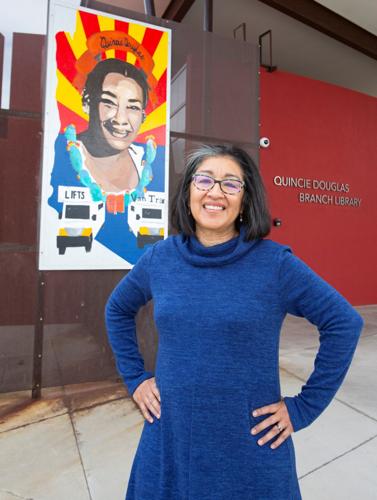
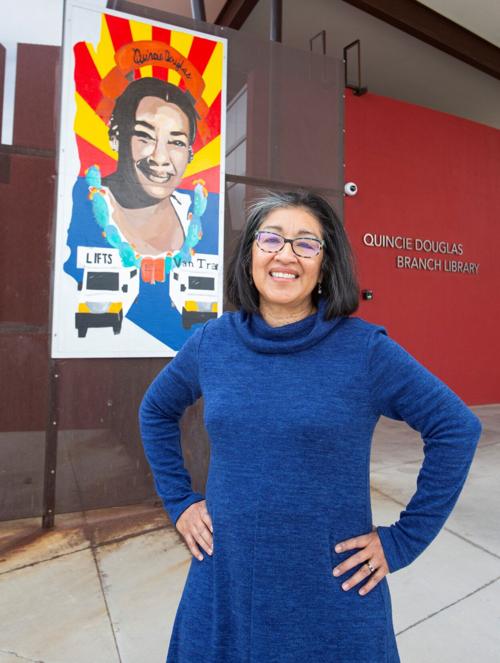
The consultations and workshops are for writers of all ages, all genres, and all levels of experience. González will have eight 30-minute sessions per week. On Tuesdays they will be at Quincie Douglas Library, 1585 E. 36th St., and on Wednesdays at Flowing Wells Library, 1730 W. Wetmore Road. The sessions begin at 1 p.m. and run every half hour with the last session beginning at 2:30 p.m.
Although she says her Spanish, “isn’t perfect” she is willing and eager to help Spanish writers polish their skills, even if she has to pull out Google Translate.
“I’m hoping the writers will find support for their dreams, especially aspiring writers searching for the courage to do this for a living,” González says. “I also want writers to realize that the library, especially public libraries, and the librarians are a resource to help push you or nurture those writing aspirations, because I look back and think, ‘wow, if we didn’t have that library, I don’t know what would have been.’”
Call 520-594-5335 or stop by the Quincie Douglas Library to register for consultations. Call 520-594-5228 or stop by the Flowing Wells Library to register for those sessions. There is a limit of one session per week per person.
The three workshops during her residency will be:
Mapping Memory: Using the Five Senses to Create Character, Conflict, and Setting — Sunday, March 5, from 1 to 2 p.m. at the Tucson Festival of Books in the University of Arizona Main Library, 254/main floor
Mapping Memory: Using the Five Senses to Create Character, Conflict, and Setting — Saturday, March 25, from 1 to 2:30 p.m. at Valencia Library, 202 W. Valencia Road
Writing in Community — Saturday, April 22, from 1 to 2:30 p.m. at Nanini Library, 7300 N. Shannon Road
Get more information about the Writer in Residence program at tucne.ws/wirpcpl.
Watch now: Hola Chingona, 412 E. Seventh St., is home to slippers shaped like conchas, horchata-flavored lip balm and funky earrings.

