


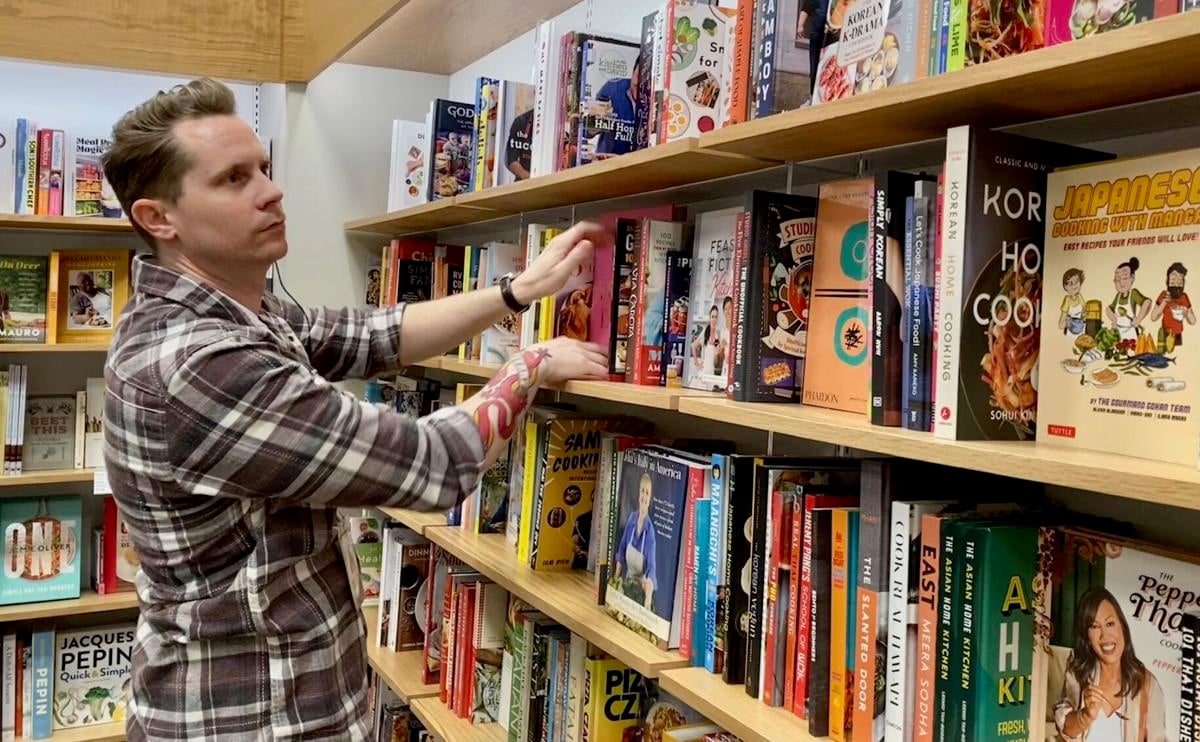
The newest bookstore in Tucson can be found on East Broadway, just west of the Williams Center, and is called … Barnes & Noble?
Forget that the store first opened in 1997, and from the parking lot still looks the same as it did then.
Once inside, readers can’t miss the newness of the place. There’s a new floor plan, a new brightness and a renewed emphasis on books.
So many books!
Until recently, Barnes & Noble stores often felt like large gift shops that happened to sell literature. They offered items ranging from CDs and DVDs to puzzles, games and toys. Most of those areas now display books, some 60,000 in the Broadway location alone.
All these things are examples of changes Barnes & Noble began making systemwide in 2020 and 2021.
Among them: Empowering each store manager to think small; to feature books that will appeal to readers in their communities.
Exhibit A in Tucson was “Feels Like Home,” the recent memoir by Linda Ronstadt and Lawrence Downes. It was not a big seller, nationally. It did well in Tucson, in part because our two Barnes & Nobles were able to order it specially and display it prominently.
“We are now doing some of the things vocational booksellers have always done,” midtown store manager Bret Christopherson said. “The principles used by independent bookstore ended up being very beneficial. We’ve gotten back to basics. We’re focused on the books.”
Make no mistake: Barnes & Noble is still big. America’s largest chain of physical bookstores, it operates 592 locations nationwide. But by thinking small, it has bounced back from the brink of bankruptcy. Two months ago, in fact, the company announced plans to open 30 new stores this year.
The revival was inspired by James Daunt, who became CEO in 2019. He had done similar work at Waterstones, which operates 311 bookstores in the United Kingdom. Daunt restructured the entire company, rebuilding from the bottom up.
One of the cornerstones of the new Barnes & Noble is localization, a commitment to serve local communities, and there can be no better example than Christopherson. Born in Tucson, he attended Amphitheater High School and the University of Arizona.
“I majored in creative writing,” he said, “but until I find the discipline to write a book, the next-best thing is to sell them.”
Christopherson started at Barnes & Noble as a receiver in the back dock of the store in northwest Tucson, 7325 N. La Cholla Blvd.
He later became a shelver and, eventually, the assistant store manager.
He was named manager at the midtown location, at 5130 E. Broadway, in 2018, so he has had a front-row seat for the company’s surprising comeback.
Much of it was the product of design, Christopherson said. The new sales strategies have proven to be popular and successful. In other ways, Barnes & Nobel happened to be in the right place at the right time.
“The pandemic helped millions of people rediscover their passion for reading,” Christopherson said. “I think that was the biggest thing. People started reading again. Fortunately, when the lockdowns came, we had systems in place to sell online. And each of our stores became small warehouses.”
The store also benefited from the emergence of BookTok, the TikTok community that blossomed during the pandemic and has since turbo-charged the book industry.
“BookTok has been huge for us,” Christopherson noted. “We’ve been promoting BookTok favorites for a long time. BookTok has sold a lot of books.”
Finally, COVID-19 also gave Barnes & Noble the opportunity to sharpen its new sales strategies behind closed doors.
The concept of localization was augmented with other cornerstone strategies addressing presentation, commerciality and section detail. In other words, store managers were provided with tools to enhance the sales of their featured book. Each store decides how best to deploy the tools at their disposal.
“Before,” Christopherson explained, “the layouts at all our stores were essentially the same. Management sold priority book placement to the publishers, so uniformity was important. The new company ended all that. The focus now is discoverability. Most people come into a bookstore wanting to browse. Everything we do now is designed to help people explore. We want them to find the treasure they didn’t know they were searching for.”

At Barnes & Noble, the concept of localization was augmented with other cornerstone strategies addressing presentation, commerciality and section detail.
This is evidenced most vividly by the layout of bookcases, kiosks and tables. Instead of seeing row after row of identical bookshelves, Barnes & Noble stores are now segmented into two- or three-sided “rooms” walled by books. A given room might group biographies, memoirs and histories, for example. Another might display fiction, historic fiction and romance.
Books in these displays are not selected randomly. There are specific reasons why specific books are placed on specific tables. Again, each store decides what its community will want to read.
“All of us interpret the company’s principles in our ways,” Christopherson said, “so all of our stores are a little different. The presentations are different, the featured books are different. In the end, though, the focus is always on the book … and the reader.”
Barnes and Noble now operates 16 stores in Arizona, two of them in Tucson. To find locations and store hours, visit stores.barnesandnoble.com.
FOOTNOTES
The Barnes & Noble bloodline can be traced to 1873, when Charles M. Barnes started a book business from his home in Wheaton, Illinois. In 1917, Barnes’ son, William, moved to New York City and merged forces with G. Clifford Noble to form Barnes & Noble.
Still headquartered in New York, the company became a discounter in 1975. The store soon became a powerhouse, and – in 1986 – it acquired B. Dalton, a national book chain with 797 stores located in shopping malls.
Until the mid-1990s, Barnes & Noble’s chief rival was Borders. Under pressure from the newly emergent Amazon, Borders declared bankruptcy in 2011. This left Barnes & Noble as America’s largest chain of bookstores … an in-person alternative to Amazon.
An increasing number of books were banned during this school year.

