

This is the first in a monthly series that explores cultural cuisine leading up to Tucson Meet Yourself, Oct. 8-10, celebrating 37 years of community folk art, traditions and cultural identity.
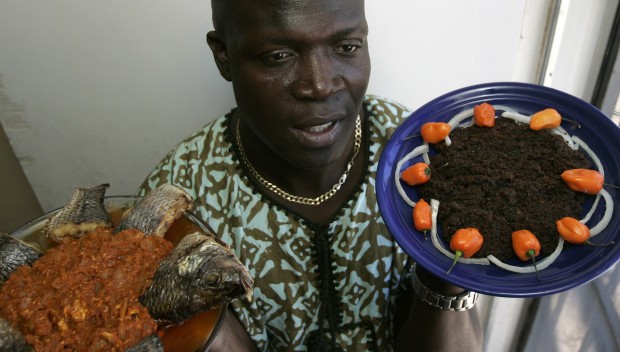
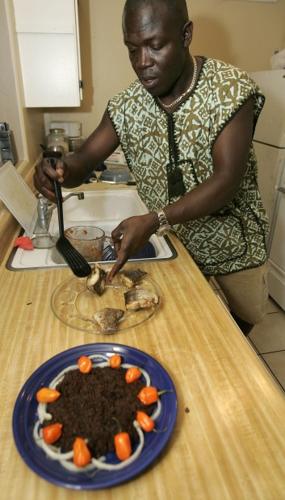
The first aromas were gentle as Peter Hiadzi prepared kpakpo shitoh at home last weekend.
Then the sweet smell of onions caramelizing gave way to a spicy smokiness after he added a touch of shitoh, a potent fish-scented sauce that is ubiquitous in Ghanaian cuisine.
A few moments later it felt like a can of pepper spray had gone off somewhere in his house. And Hiadzi was keeping it mild.
"Back home in Africa everything we eat is very spicy and very hot," explained Hiadzi, 35, who is the organizing secretary for the Ghanaian Association of Tucson. The nonprofit offers a variety of activities for its 80 members in Tucson and Phoenix, and also works to spread the word about the diversity of Tucson's African populations.
The group joined Tucson Meet Yourself last year and prepared a meat pie, chicken wings and a traditional dish called kilile wala, which is ripe plantain that's soaked in ginger then deep fried.
This year they will also be serving shitoh. In fact, the thick dark condiment will be entered into the festival's new competition to find the world's hottest sauces and dishes.
Hiadzi learned to make shitoh (SHEE-toe) with kpakpo, which is a small, round pepper that is little known outside of Africa. It sometimes can be found in Phoenix-area markets.
How hot is the kpakpo?
"A habanero is not hot," Nana Otibiri III, the Ghanaian association's chairman, said with a smile.
On the Scoville scale, which measures the heat level in chilepeppers, a habanero is eight times hotter than a jalapeno.
Shitoh can be made in varying degrees of hotness, and commonly involves grinding dried shrimp, fresh or dried hot peppers, onions, ginger, a bouillon cube or two, salt and a little tomato paste. He added beef to his most recent batch. Then it's fried in vegetable oil and can be kept unrefrigerated for weeks or months.
The thick dark paste, which can be a bit grainy from the dried shrimp, can be used as a base to other dishes or on its own.
"You can use it on sandwiches. You can also use it on rice and potatoes. You can eat it on a whole lot of things," said Hiadz, who will also be making some for the Refugee Fest on June 19 at El Presidio Park. While they are not refugees, he said many African nations are represented at the event.
The pepper's heat is healthy, says Hiadzi, who came to Tucson nearly six years ago to study nursing and currently works as a corrections officer at the Pima County jail.
It's a cure for stomach troubles and clears the sinuses, he said. Sweating also cleanses your system.
Much of Ghanaian culture revolves around food. People love to gather at house parties and share meals. Men and women grow up knowing how to cook, said Otibiri, a nurse.
Otibiri expects lots of festivities when the World Cup soccer tournament gets underway next month. "Soccer is a religion," said Otibiri, noting that Ghana's team knocked the U.S. out of the World Cup first round in 2006. The 2010 World Cup marks the Black Stars second consecutive appearance.
Otibiri said the Ghanaian Association became involved in Tucson Meet Yourself last year as a way to feel more part of the larger community. "We need to give to the community where we live," he said. "And we want people to know who we are also."
Despite describing Tucson as the hottest place he has ever been, Otibiri said he feels at home here.
"Southern Arizona is so diverse," he said. "I think we fit in perfectly."
The Ghana Project
The non-profit Ghana Project is a local effort to help build and supply schools in Ghana's rural communities. Go to ghanaproject.org for more information.
Did you know?
• 1n 1957, Ghana became the first sub-Saharan country in colonial Africa to gain its independence.
• Ghana was the first country in the world to welcome the Peace Corps. The first group of 52 volunteers arrived in Ghana in 1961.
• Kofi Atta Annan, the first black African to serve as Secretary-General of the United Nations (and a co-recipient of the 2001 Nobel Peace Prize), is from Ghana.
• President Obama spent two days in Ghana as part of his first official trip to sub-Saharan Africa last summer.
• A major oil discovery off the coast of Ghana in 2007 has led to significant international commercial interest in Ghana. Ghana is likely to be the third-largest producer of oil in West Africa, according to the U.S. State Department.
Shitoh
• 12 ounces vegetables of your choice
• 8 cloves garlic, finely chopped
• 4 medium onions, finely chopped
• 3-1/2 ounces root ginger, coarsely grated (with or without skin)
• 2 tablespoons tomato paste
• 2 chicken stock cubes
• 5 ounces dried prawns (shrimp)/fish/ground beef
• 3-1/2 ounces dried, tiny prawns (shrimp)
• 3-1/2 ounces chile (hot pepper) powder or 12 chiles (kpakpo shitoh or another can be substituted)
• Heat the oil in a heavy-based saucepan and fry the garlic, onions and ginger for 10 to 15 minutes until the onions are golden. Stir in the tomato paste and mix thoroughly.
• Crush the chicken stock cubes and add that to the pan, without water. Add lots of dried prawns (shrimp) and stir for 1 minute. Add the chile(hot pepper) powder and thoroughly mix in.
• Remove from the heat and stand for about 1 hour or until the sambal has cooled down. Transfer to a storage jar and keep in a cool place until required.
Note: This shitoh can be stored for up to one year in the refrigerator, so you can make a large quantity and freeze in several small containers.
Recipe courtesy of Nana Otibiri III

