

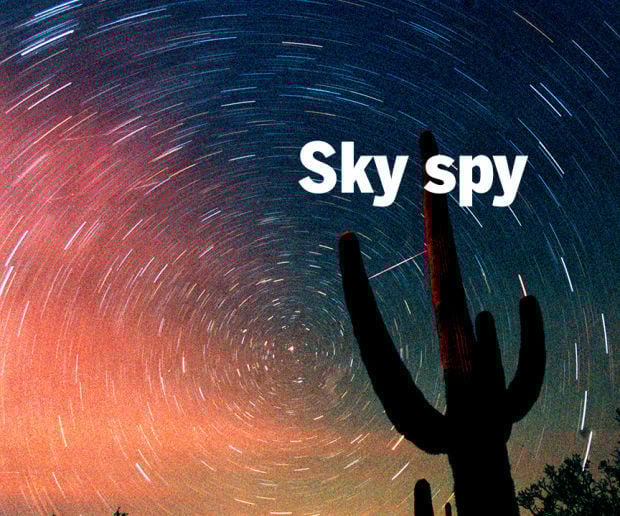
Monsoon permitting, now is a great time to enjoy the summer Milky Way in the evening sky. To find the darkest sky possible, it is best to get away from the city lights. The summer Milky Way stretches completely across the sky from the northeast to the southwest by 10 p.m.
The Milky Way is the name for our parent galaxy, which is sometimes called the Galaxy with a capital G. We are located in one of its spiral arms about 25,000 light years from the center of the galaxy in the constellation Sagittarius. From our point of view, the Milky Way wraps completely around the sky, and there is a “summer Milky Way” and a “winter Milky Way.” For Northern Hemisphere observers, the summer Milky Way is more spectacular than the winter Milky Way.
When we look in the sky toward the plane of the Milky Way’s disk, we see thousands of stars seemingly piled on top of one another, thus giving the illusion of milk spilled across the sky. When we look away from the plane of the Milky Way’s disk, we see many fewer stars, and there is no “milky” band.
The Milky Way contains more than 100 billion stars as well as giant clouds of gas and dust. There are few astronomical sights that can compete with the summer Milky Way overhead on a clear dark night.

