





As spring returns to Tucson next week, the start of a new season brings three things: warm weather, sunny skies and colorful wildflowers.
Although March 19 is the first official day of spring, vibrant wildflowers have already started blooming around Tucson and Southern Arizona.
“It’s a very good year,” says Jim Malusa, a former research scientist at the University of Arizona School of Natural Resources and the Environment who specializes in plant geography. “For fans of flowers that can't get out this weekend or the next, it's not too late because the perennials are just getting going. … The perennials are really just revving up and that's the brittlebush and the globe mallows and the marigolds. So, they'll be fantastic in just a week or two and they're all over the place.”

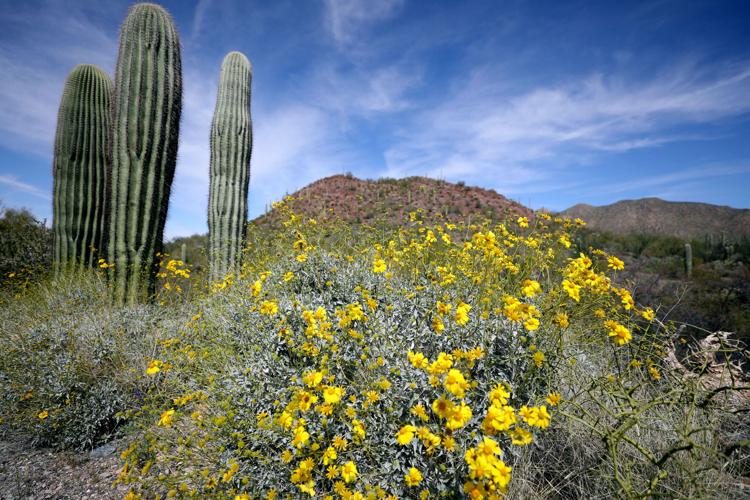
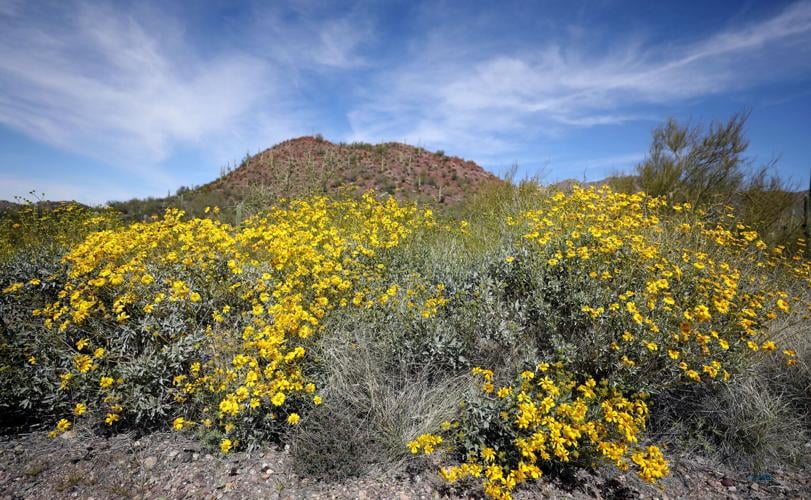
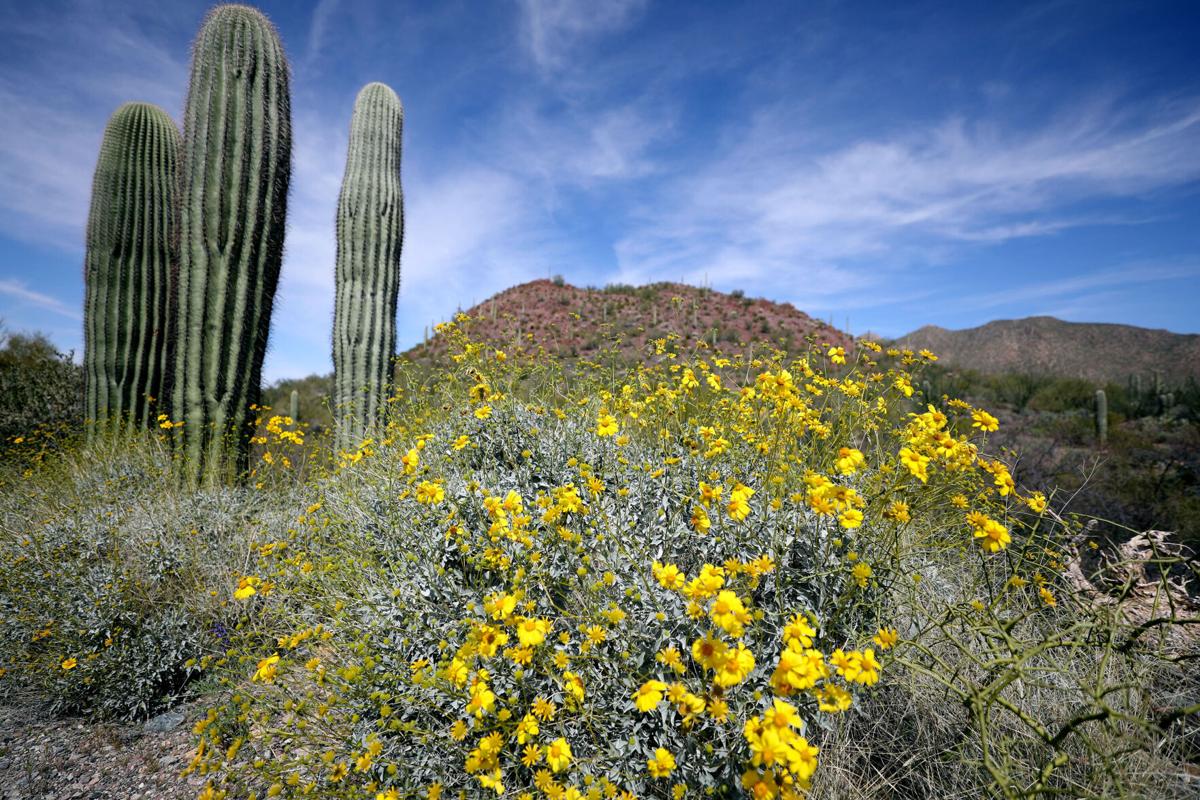
Wildflowers are in bloom all over Saguaro National Park West, March 12, 2024.
Some of the winter annuals that Tucsonans can expect to see this spring include the Mexican gold poppy, Arizona jewelflower, owl’s clover and more.
“The Tucson Mountains have a very good bloom of jewelflower, also called silver bells,” Malusa says. “You can see them all over the Tucson Mountains from the (Arizona-Sonora) Desert Museum over to ‘A’ Mountain. I’ve been working out in southwestern Arizona, so I drove just last week on Highway 86 all the way to Ajo and there was a very good poppy bloom near the Kitt Peak turn-off. And much of that highway is trimmed with purple lupines a foot tall.”
Sonya Norman, the public programs coordinator at the Arizona-Sonora Desert Museum and wife of Malusa, says she spotted blankets of bladderpods in the central Tucson Mountains recently. Malusa says you can also find bladderpods out west in the creosote flats.

Wildflowers are in bloom all over Saguaro National Park West, March 12, 2024.
Aside from the Tucson Mountain District, other places to find spring wildflowers, like the Mexican gold poppy, include Saguaro National Park (West) along the Ringtail Trail near West Picture Rocks and North Kinney roads. Saguaro National Park predicts that wildflowers will begin to bloom in the Rincon Mountain District “any day now,” according to a recent Instagram post.
The Arizona-Sonora Desert Museum also recently posted about pink penstemons blooming around the museum.

Wildflowers are in bloom all over Saguaro National Park West on March 12, 2024.
If you’re up for a day trip, Picacho Peak, which is about 45 miles north of downtown Tucson, is another popular place to see wildflowers — especially poppies — during springtime. However, this year’s poppy bloom at Picacho Peak may look a little different from previous years.
“Picacho Peak, where my wife just visited, does not have the poppy bloom that it had last year,” Malusa says. “Now there still are lots of poppies, many, many poppies, along with fiddlenecks, lupines, desert chicory and variants of the globe mallow that have lilac blooms so it's quite pretty and is dazzling. Only it's not like last year where folks can spot it from five miles away. The poppies were tremendous. So, that's one place that's certainly worth a look.”
You can also check out the Tucson Botanical Gardens and Tohono Chul to scratch that flower itch if you're unable to visit any of the other wildflower spots this season. The Arizona Native Plant Society also hosts wildflower walks in spots like Catalina State Park's Canyon Loop Trail.

Wildflowers are in bloom all over Saguaro National Park West, March 12, 2024.
Malusa says this year’s wildflower season will be “average in Tucson” and “super above average” as you head west in Arizona.
While you can still find some wildflowers on the east side, near Sabino Canyon for example, wildflower blooms greatly depend on winter rains — meaning the more rainfall we see during the winter months, the better wildflower season we’ll have when spring rolls around.
Wildflowers are in bloom all over Saguaro National Park West, March 12, 2024.
Overall, the winter months have been wetter than normal, according to the National Weather Service. The Tucson International Airport received 1.47 inches of rain in December 2023, 1.77 inches of rain in January and 1.39 inches of rain last month, the NWS reported.
“The summer rains come from the south and the east and winter rains come from the west,” Malusa says. “The pattern is flipped. So, we should expect more blooms on the west side.”

Bees pollinate wildflowers around Saguaro National Park West on March 12, 2024.
A new threat to Tucson’s wildflowers
Even though Southern Arizona wildflowers bring a colorful touch to the Sonoran Desert, the blooms also act as an essential food source for native pollinators. However, a “new kid on the block” now puts Tucson’s beloved wildflowers at risk, according to the Arizona-Sonora Desert Museum.
The oncosiphon piluliferum, also known as stinknet, may look beautiful with its vibrant yellow orbs, but the invasive species is stinky and can potentially “wreak havoc” on the Sonoran Desert ecosystem, according to a post by the Arizona-Sonora Desert Museum.
This invasive species that’s native to Southern Africa not only overtakes native wildflowers but can also cause a plethora of health issues including skin irritation, headaches and respiratory issues, the Arizona-Sonora Desert Museum wrote on Instagram. It’s also highly flammable, which isn’t ideal in a desert environment.
The team at Saguaro National Park describes the invasive species as “probably the most troubling local arrival since buffelgrass,” according to a post on Instagram.
While stinknet greatly spread in the Phoenix area and throughout Maricopa County last spring, the plant is just starting to gain traction in Tucson, according to Saguaro National Park.
Currently, flower enthusiasts and research scientists like Malusa are working to help control the spread of stinknet.
“That's a tremendous problem in the Phoenix area and it's becoming a problem in the Tucson area,” he says. “And I'm trying to keep it out of west Arizona altogether.”
Multiple local environmental organizations, including Saguaro National Park, Arizona-Sonora Desert Museum and the Tucson Audubon Society are encouraging the community to report sightings of stinknet on stinknet.org. All reports help track and potentially curb the spread of the invasive species in Tucson.
“To manage invasive species, the absolute best-case scenario is ‘early detection, rapid response’ (EDRR). Luckily, around Tucson, we are still in that phase! But it will take a community effort to keep it that way,” Saguaro National Park posted on Instagram.
Despite this possible threat toward Southern Arizona wildflowers, the blooms continue to be known in the community for their essential role in the desert’s ecosystem and their undeniable beauty.
Simply put, “they make people happy,” Malusa says.

