




Officials at Kitt Peak National Observatory have unveiled what they’re calling the first public science center ever built inside a working telescope, but that’s not its only claim to fame. It also features one of the world’s brightest skylights.
The new Windows on the Universe Center for Astronomy Outreach opens Wednesday inside Kitt Peak’s iconic McMath-Pierce Solar Telescope, that distinctive, acute-angle-shaped structure at the mountaintop observatory 55 miles southwest of Tucson.
“There’s really no other astronomical instrument on Earth that looks like this. It looks like something aliens left here on the mountain,” said Peter McMahon, the observatory’s visitor center operations manager. “You can see it from Tucson. It’s synonymous with Kitt Peak.”

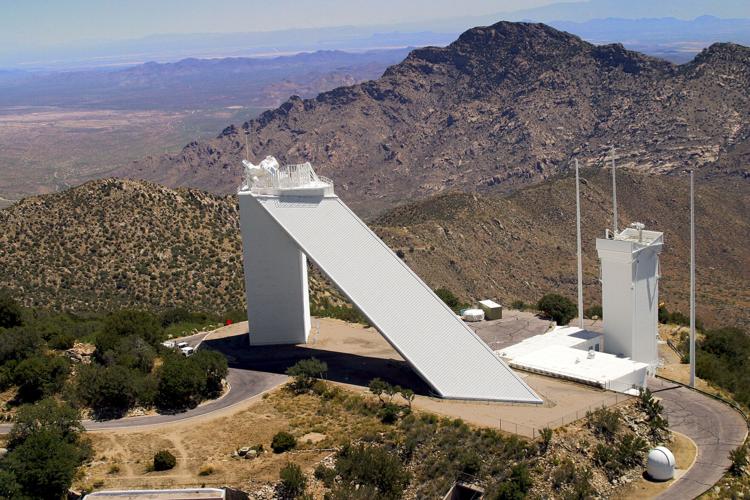
The McMath-Pierce solar telescope on Kitt Peak as it looked in an aerial photo taken in June 2003.
McMath-Pierce opened in 1962 and was the largest solar telescope in the world for much of its 55-year operational life. It uses a mirror atop a 10-story platform to reflect light down a 200-foot-long tunnel that angles diagonally into the mountain and is cooled in part by liquid circulating through pipes in the concrete walls.
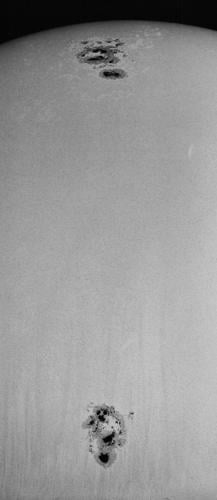
Primarily designed to observe the sun, the telescope has been used to map the solar magnetic field, study sunspots and even detect water vapor in the roiling atmosphere of our closest star. It can also be trained on bright celestial objects at night, which is why NASA astronauts visited the facility in the early 1960s to study features on the moon.
McMahon said the Windows Center was conceived shortly after the solar telescope was retired from service in 2017. A $4.5 million grant from the National Science Foundation covered most of the center’s development costs, with private donations making up the rest.
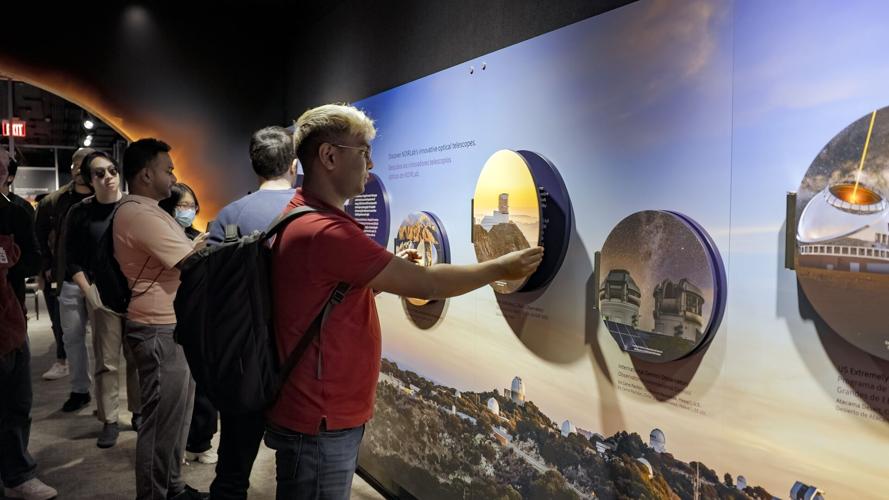
The telescope’s old offices, research space and storage areas have been converted into an exhibit hall filled with interactive displays.
McMahon said the exhibits run through the facility in a line that eventually leads to McMath-Pierce’s old control room, where visitors can see images of the solar disk, the moon and other solar system objects projected by the telescope onto a viewing table.

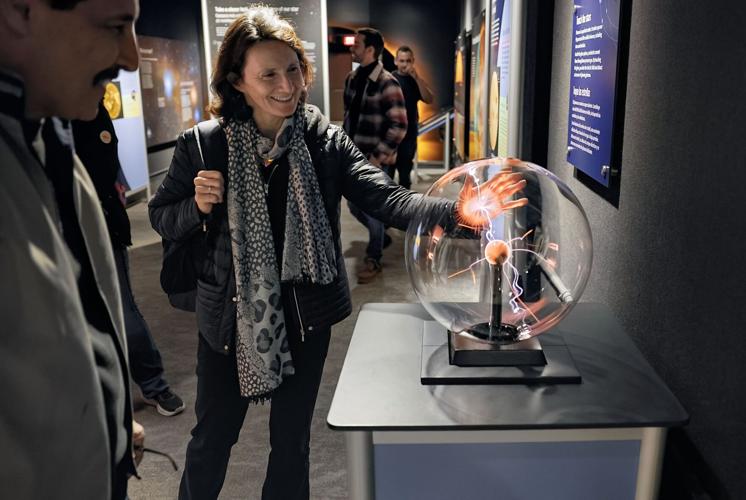
Visitors check out an exhibit at the new Windows on the Universe Center for Astronomy Outreach, which opens to the public Wednesday inside the retired McMath-Pierce Solar Telescope at Kitt Peak National Observatory.
The Windows Center also features a theater playing a 15-minute, ultrahigh definition movie called “Dark Universe” that was made especially for the new facility and highlights some of the cutting-edge research currently underway at the observatory.
“This is a golden age of discovery at Kitt Peak,” McMahon said.

Visitors view the Science on a Sphere exhibit at the new Windows on the Universe Center for Astronomy Outreach, which opens to the public Wednesday inside the retired McMath-Pierce Solar Telescope at Kitt Peak National Observatory.
The final stop at the end of the exhibit hall is a show called Science on a Sphere, which uses a projector to transform a 5-foot diameter globe into a realistic replica of the planets and stars. McMahon considers it the perfect way for visitors to wrap up their trip through the science center, because it feels a bit like being in orbit around the celestial objects they just learned about.
But his favorite part of the Windows Center is the historic control room, where you can view actual imagery from the telescope while “standing in the place where the Apollo astronauts stood and looked at the moon,” he said.
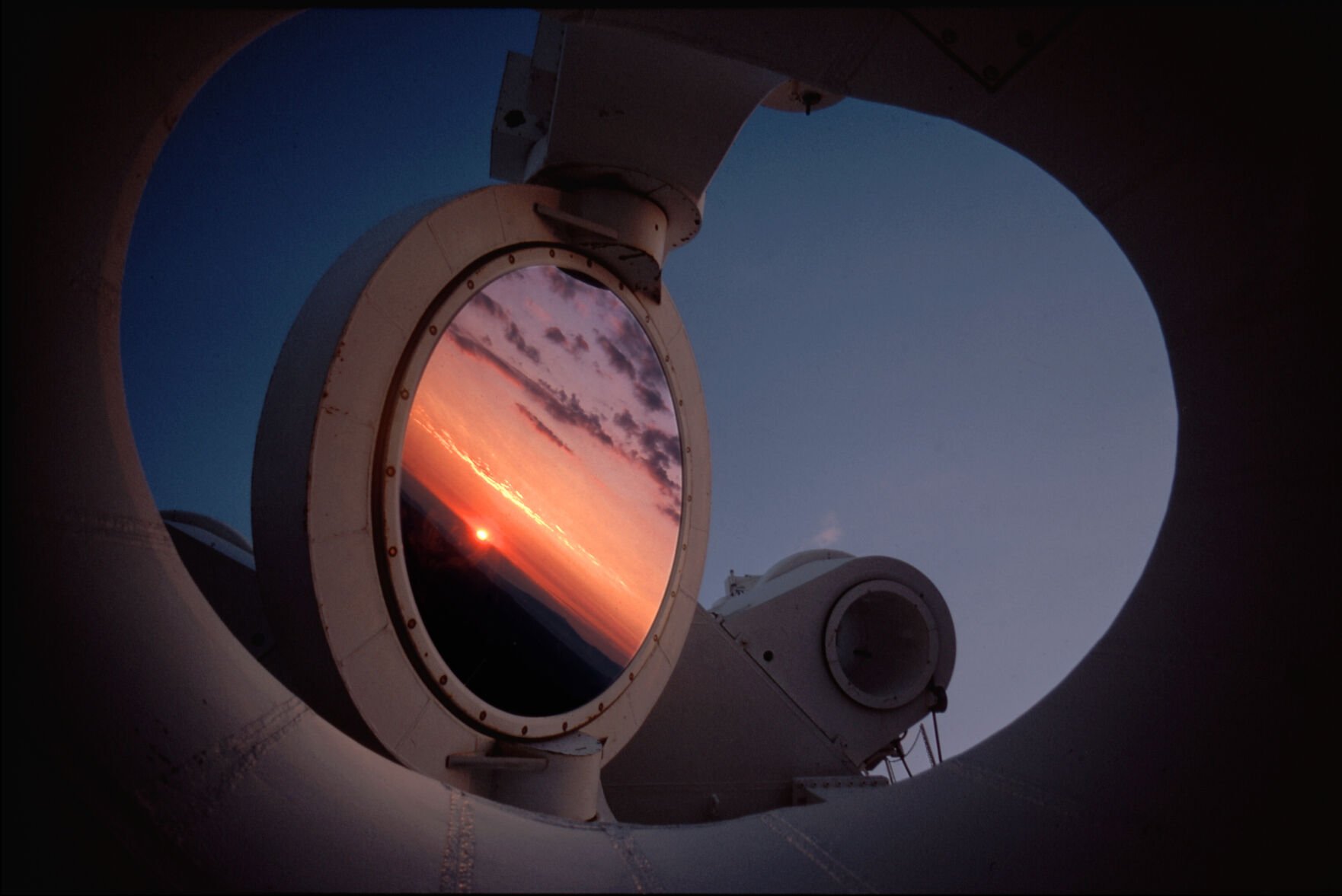
Heliostat of McMath-Pierce Solar Telescope on Kitt Peak at Sunset.
Kitt Peak is overseen by the National Optical-Infrared Astronomy Research Laboratory, better known as NOIRLab, which is sponsored by the National Science Foundation and headquartered on the University of Arizona campus.
The observatory on the Tohono O’odham Nation began operations in 1958 and officially opened its grounds to the public in 1964. Since then, more than 2 million people have toured the collection of about two dozen telescopes, though the COVID-19 pandemic and a wildfire in 2022 all but closed the mountain to visitors for about three years.
These days, Kitt Peak draws about 20,000 visitors a year, but McMahon expects that number to rise thanks to the Windows Center and future attractions.
The new science center inside the triangular McMath-Pierce telescope is merely the first phase of planned improvements on the mountain, he said. The observatory’s main visitor center is also due for an extensive overhaul and expansion, including the addition of a planetarium where the story of Kitt Peak will one day play out on a dome overhead.
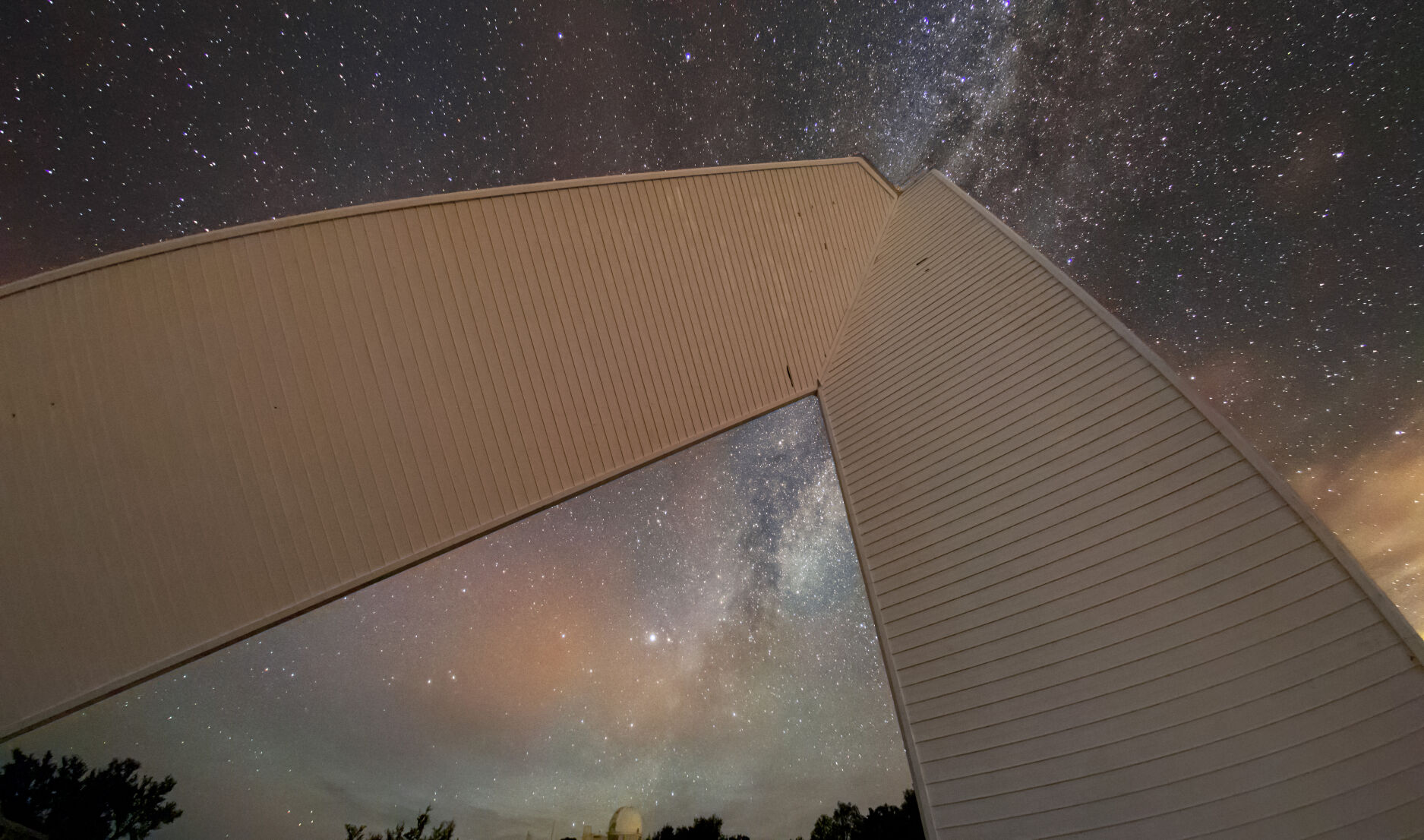
The Milky Way rises above Kitt Peak's iconic McMath-Pierce Solar Telescope, which was retired in 2017 and has been repurposed as a science center for visitors.

Visitors check out the exhibits at the new Windows on the Universe Center for Astronomy Outreach, which opens to the public Wednesday inside the retired McMath-Pierce Solar Telescope at Kitt Peak National Observatory.

