




BASTOGNE, Belgium — Eighty years later, World War II veteran David Marshall has a picture in his wallet of him fighting in the snow and bitter cold in one of the defining moments of the war: the Battle of the Bulge.
The 100-year-old vet was part of commemorations Friday as the United States, its European allies and a dwindling number of veterans remembered the month of dramatic fighting that stopped Adolf Hitler's last-ditch offensive and opened the way for the full Nazi defeat.

World War II veterans David Marshall, left, U.S. Army 84th Infantry Division, from New York, and Gilbert Charleston, Choctaw Nation Elder, 739th Tank Battalion, from Oklahoma, pose for a photo Friday during the 80th commemoration of the Battle of the Bulge in Bastogne, Belgium.
Still, beyond the ceremonies and this weekend's events in Belgium and Luxembourg to commemorate one of the most important and deadly battles that helped decide the war, Marshall wants people to go one step beyond just remembering it.
The young should "study about the war," he said in an interview with The Associated Press. "Learn all you can about it in order to prevent any future war."
"If you forget the past, you are not going to have a future," said Marshall, who worked a mortar in the battle.

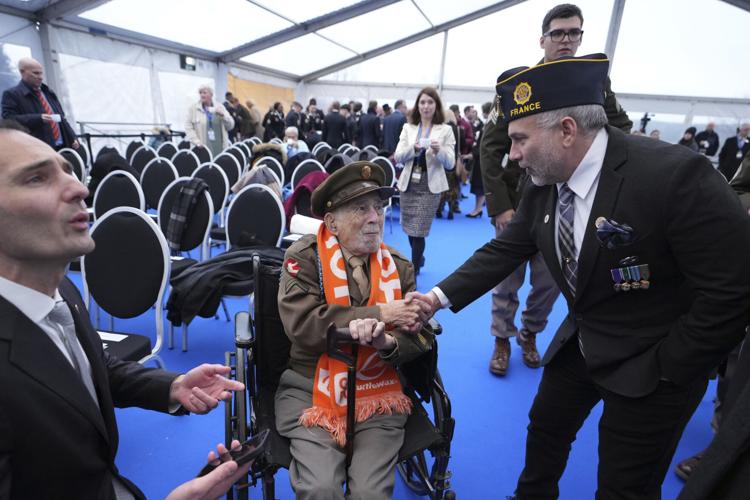
World War II veteran David Marshall, U.S. Army 84th Infantry Division, from New York, center, shakes hands with attendees Friday during the 80th commemoration of the Battle of the Bulge at the Mardasson Memorial in Bastogne, Belgium.
At dawn Dec. 16, 1944, more than 200,000 German soldiers threw Hitler's last hopes into an unexpected attack through the dense woods of Belgium and Luxembourg's hilly Ardennes.
Making the most of the surprise move, the cold, freezing weather and wearied U.S. troops, the Germans pierced the front line so deeply, it came to be known as the Battle of the Bulge.

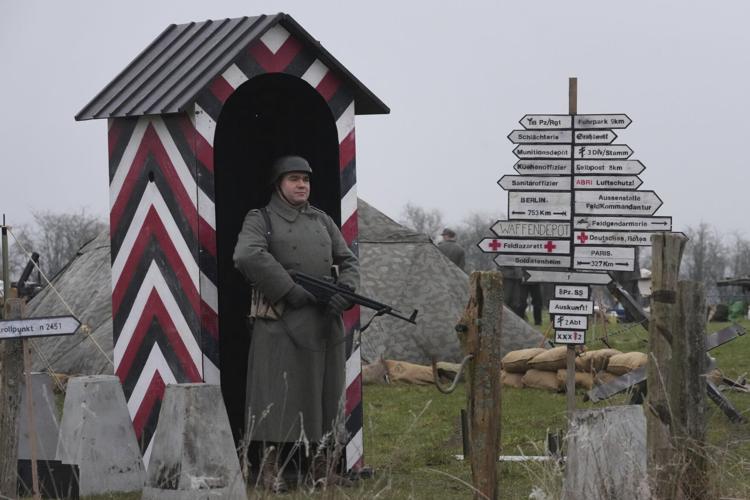
A man dressed in period uniform stands in a living history encampment Friday during the 80th commemoration of the Battle of the Bulge in Bastogne, Belgium.
It ultimately made sure the Allied advance, started on the D-Day beaches of Normandy in June 1944, could continue right to Berlin. Initially outnumbered, U.S. troops delayed the attack enough in fierce fighting to allow reinforcements to stream in and turn the tide of the battle by Christmas.
Beyond the overwhelming German forces, the conditions were just as tough, Marshall said.

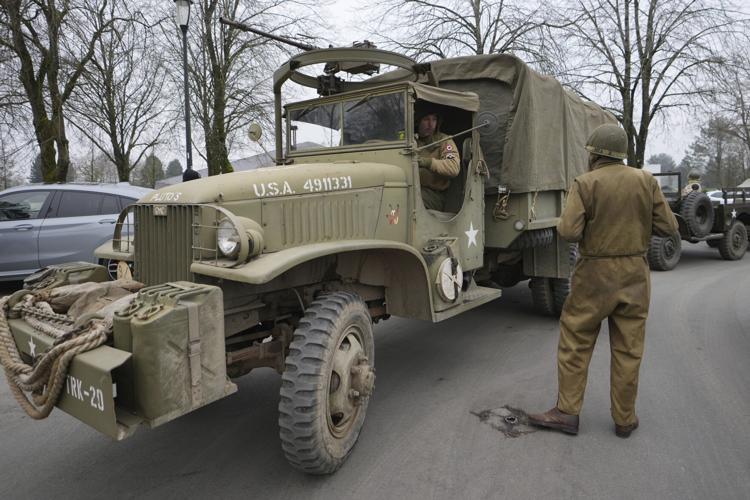
Living history enthusiasts drive vintage vehicles Friday during the 80th commemoration of the Battle of the Bulge in Bastogne, Belgium.
"It was cold, wind with snow — and there were a few Germans around, you know. And it was a matter of subsisting, you know, the weather rather than the Germans. Fighting them was not the problem. Fighting the weather was the problem," Marshall said.
Hitler hoped the advance would change the course of the war by forcing U.S. and British troops to sue for peace, thus freeing Germany to focus on the rapidly advancing Soviet armies in the east.

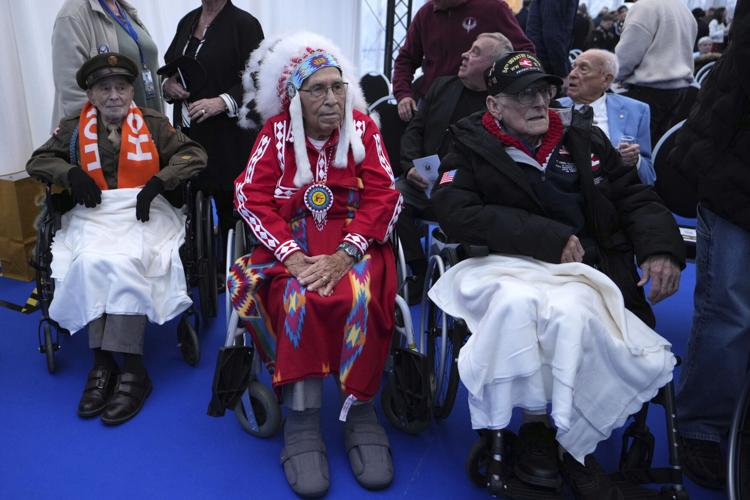
From left, World War II and Battle of the Bulge veterans David Marshall, U.S. Army 84th Infantry Division, from New York; Gilbert Charleston, 101, Choctaw Nation Elder, 739th Tank Battalion, from Oklahoma, and Fred J. Nungesser Jr., 334th Infantry Regiment, 84th Infantry Division, from New Jersey, attend the 80th commemoration of the Battle of the Bulge on Friday at the Mardasson Memorial in Bastogne, Belgium.
After the Battle of the Bulge ended Jan. 28, 1945, Allied forces invaded Germany, eventually leading to the Nazi surrender and the end of the war in Europe.
Germany is now an ally of the United States and its wartime partners in NATO, and the symbolism was not wasted on such a day.

World War II veteran David Marshall, U.S. Army 84th Infantry Division, from New York, holds out his wallet containing a photo of himself during the Battle of the Bulge on Friday during the 80th commemoration of the battle in Bastogne, Belgium.
"There's no reason we cannot get along," said veteran Gilbert Charleston, 101, a Choctow Nation Elder of the 739th Tank Battalion, after he shared memories over the picture with Marshall.
"If they would just take the time to be kind to each other and not try to be so possessive — help when help is needed," he said. "I think the world would be a lot better place."
World War II's Operation Market Garden commemorated

King Willem Alexander of the Netherlands, center, meets some surviving veterans Saturday in Ginkel Heath, Netherlands, to mark the 80th anniversary of the audacious but unsuccessful World War II mission codenamed Operation Market Garden.

Parachutists jump Saturday over Ginkel Heath, Netherlands, to mark the 80th anniversary of World War II's audacious but unsuccessful Operation Market Garden.

Parachutists jump Saturday over Ginkel Heath, Netherlands, to mark the 80th anniversary of World War II's Operation Market Garden.

Parachutists jump Saturday over Ginkel Heath, Netherlands, to mark the 80th anniversary of World War II's Operation Market Garden.

Parachutists jump Saturday over Ginkel Heath, Netherlands, to mark the 80th anniversary of World War II's Operation Market Garden.

Parachutists jump Saturday over Ginkel Heath, Netherlands, to mark the 80th anniversary of World War II's Operation Market Garden.

Parachutists jump Saturday over Ginkel Heath, Netherlands, to mark the 80th anniversary of the World War II's Operation Market Garden.

Parachutists jump Saturday over Ginkel Heath, Netherlands, to mark the 80th anniversary of World War II's Operation Market Garden.

Parachutists jump Saturday over Ginkel Heath, Netherlands, to mark the 80th anniversary of World War II's Operation Market Garden.

