




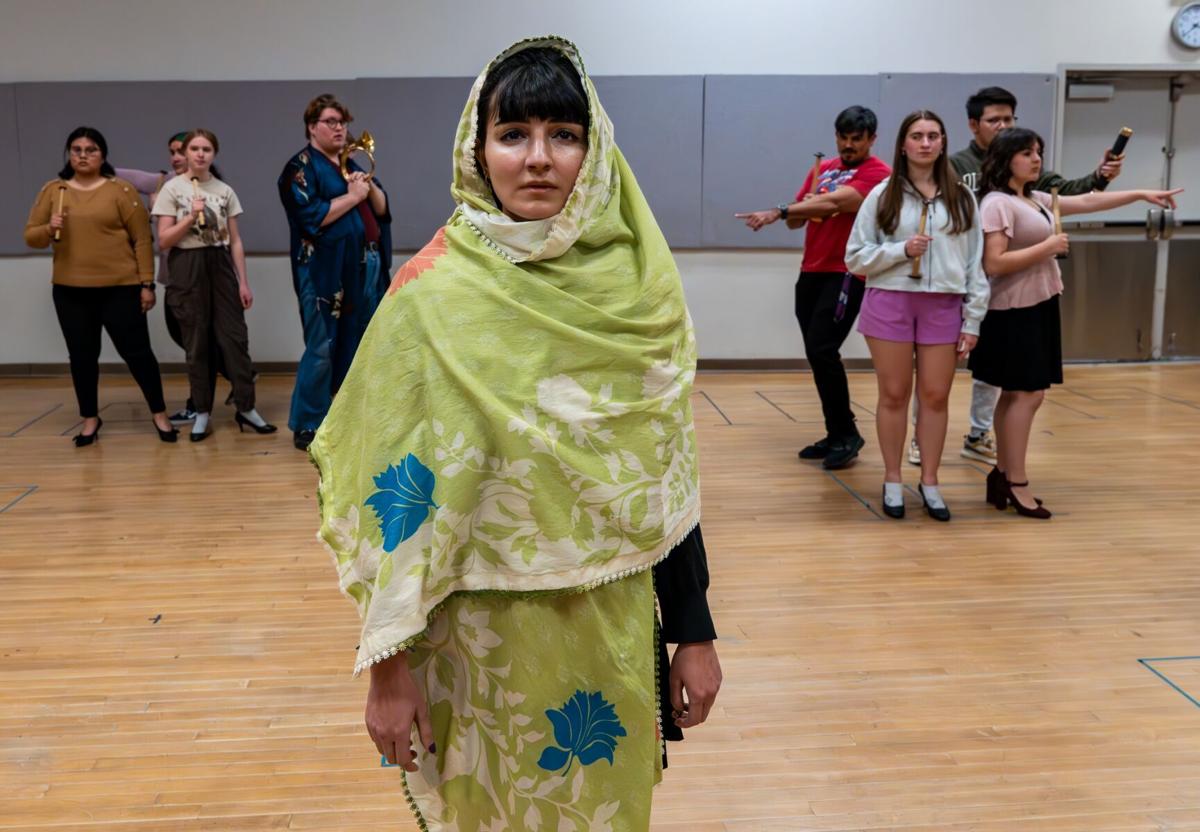
In perhaps one of the most devastating scenes of the University of Arizona Opera Theatre‘s performance Wednesday of “Thumbprint,” it is what we didn’t see on stage that struck the deepest emotional blow.
But we knew what was happening.
We could sense it as the mood shifted in Kamala Sankaram’s wonderful tapestry of Indian raga and Western music performed by a six-member ensemble under the baton of guest conductor Kristin Roach. The rich Indian accents went from playful when Mukhtar Mai (soprano Aysen Milliogullari) and her mom (soprano Beth Jargstorf) teased little sister Annu (alto Betsey Carter) to ominous when the group of tribesmen came seeking retribution. The striking bell-like tones from the tabla stabbed the air like a knife and repeated ragas set to Western harmonies drove the drama until it became near quiet and all we heard was what sounded like a woman gasping for air.
We also heard it in Mukhtar’s cries that she wouldn’t follow tradition and lock herself up in her room or, worse, kill herself to redeem the shame the attack left on her family. And we heard it in the denials of her chief attacker Faiz (tenor Jess Barrera), who hid behind the cloak of “honor” and “tradition,” words that flashed on the screens in Sally Day’s dramatic set design.
The UA Opera Theatre, under director Cynthia Stokes, could have closed the 2023-24 season with a warhorse from the Western operatic cannon, maybe a frolic with Mozart and or the bold romance of Bernstein’s “West Side Story.”
But there’s one thing we’ve learned since Stokes took over the opera program in 2016: She hasn’t met an artistic challenge she’s not willing to tackle.
Stokes introduced herself to Tucson in 2017 with Benjamin Britten’s “The Rape of Lucretia” at a time when the headlines were filled with tales of powerful celebrities being accused of sexually-related crimes at the height of the #MeToo movement.
But “Thumbprint” resonates even deeper. Stokes showed us a culture that we have only witnessed from afar, glances on the evening news when tensions in the Middle East rise. But at its core, the message of “Thumbprint” is universal; it’s about empowering women and the disenfranchised. It’s a message that we sorely need today with women’s reproductive rights and health care under attack nationwide and economic and social justice disparities growing.
If you go to see “Thumbprint” and you walk away feeling energized to make a change in your world, consider the message delivered.
But the other reason you’ll want to see this is to hear the amazing coloratura soprano range from Milliogullari and Jargstorf, who were the dominant voices throughout the 90-minute performance, and to see the brilliant tenor Barrera play such a wretchedly awful character so believably that you had to remind yourself he was just acting.
Other standout performances included bass Zhixiang “Luke” Xie as Mukhtar’s father and the orchestra under Roach, who brought out the rich cultural intersection of Sankaram’s Hindustani and Western European score.
UA Opera Theatre will perform “Thumbprint” at 7:30 p.m. Thursday, April 18, and Friday, April 19, and 3 p.m. Saturday, April 20, at Crowder Hall, 1017 N. Olive Road, in the UA School of Music. Get tickets ($10-$20) at am.ticketmaster.com/uacfa/buy/music.

