


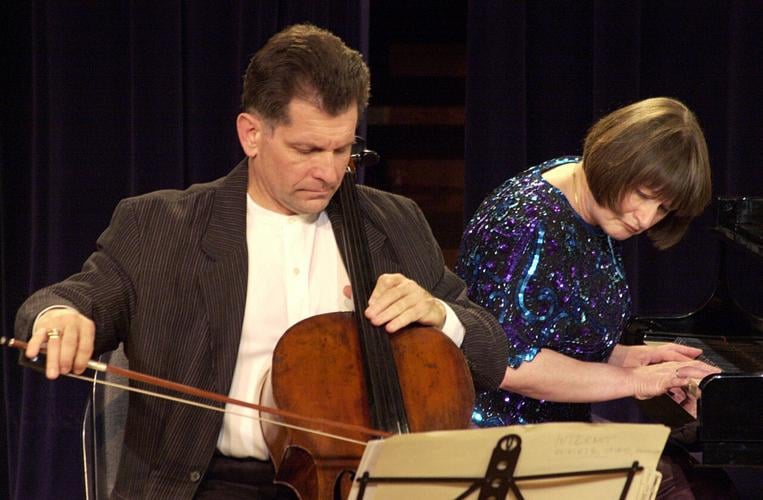


Beethoven’s music, from the stunning victorious exclamations of the Symphony No. 3 “Eroica” to the bombastic famous four notes opening his landmark Symphony No. 5, speaks for itself.
But who speaks for Beethoven?
That was the thought running through the mind of Tucson native and writer/cellist Harry Clark last year as the classical music world was winding down its celebration of Beethoven’s 250th birthday.
Aside from historic references by musicologists and Beethoven’s contemporaries, who could talk about Beethoven the man?
In the latest of his “Rhythms of Life” musical/theater portrait series, Clark hopes to shed light on Beethoven outside the brilliant music that defined his life. The portraits, centerpieces of Clark’s long-running Chamber Music Plus series with wife/pianist Sanda Schuldmann, combine music and spoken word theater to tell stories about great classical music figures.
“Beethoven Remembered” tells that story through eight vignettes from people who knew the 19th century composer beyond his music. There’s his nephew Karl, who Beethoven helped raise after his brother died. His surviving brother, Johann, a successful druggist in Vienna. A lifelong friend and doctor, who recalled Beethoven in his youth. And a local barkeep at the tavern Beethoven frequented who had no idea about the composer’s music.

Cellist Harry Clark and his pianist wife Sanda Schuldmann are performing Clark’s newest work “Beethoven Remembered” in two performances in Green Valley.
Each adds to the narrative of Beethoven the man and, aside from the bartender who Clark made up based on the idea that Beethoven regularly frequented a local tavern, all are based on historical accounts from Beethoven’s life.
“I just thought it was an interesting way of different people getting to know him in very different settings,” said Clark, who with Schuldmann and actor Robert Clendenin (“Scrubs,” “Cougar Town”) will premiere the piece on Wednesday, March 2, in Green Valley.
“It gives a very insightful look at Beethoven’s life by people who really knew him well, not just his publisher or colleagues,” Schuldmann added.

Robert Clendenin
Clark, who penned dozens of “Rhythms of Life” over the nearly 45 years that he and Schuldmann ran the series in Tucson and Connecticut, finished “Beethoven Remembered” in January. The work draws on biographical material and two famous letters written by Beethoven that were discovered after his death.
“The Immortal Love” letter, discovered in a locked drawer by Beethoven’s secretary, professes love to some unidentified woman, who has been the subject of much speculation and debate since the letter’s discovery.
“To this day we don’t know who this is,” said Clark. “There are eight or nine possibilities.”
In the second letter, “The Heiligenstadt Testament,” meant for his brothers, Beethoven was becoming increasingly more deaf and frustrated with his fate. The letter, which the composer never sent, also hinted at thoughts of suicide.
“There are all these reveals about him, some funny, some somewhat poignant, some tragic,” Clark said. “That’s sort of what I wanted to get at with this. Not so much as a musician, because the music speaks for itself, but what made him an interesting person.”
“Beethoven Remembered,” which the 75-year-old Schuldmann said will be her final public performance, intersperses movements from several of Beethoven’s sonatas — he composed 32 piano sonatas in his career — including the slow movement from No. 14 in C-sharp minor “Moonlight” and a movement from No. 8 in C minor “Pathétique.”
Clark said the performance also will include short works from Beethoven’s contemporaries Haydn and Schubert.
Clark and Schuldmann will perform the piece twice in Green Valley, where they have lived for several years. It will be only the second public performance for the pair since 2013, when they ended their nine-year run with Chamber Music Plus in Tucson.
“Beethoven Remembered” is one of several “Rhythms of Life” works Clark has written over the past several years. He’s also been working on a collection of short stories that he is calling “Tales from Green Valley” that are based on composites of people he has met since moving to Green Valley, and a memoir of growing up in Tucson before leaving his senior year in high school in the 1960s.
“It’s been a lot of fun to write and sort of interesting for me to recollect Tucson. It was a small town,” said the 73-year-old Clark, who said Tucson’s population when he was a high school freshman was less than 60,000. When he left his senior year, the population had nearly doubled.

